









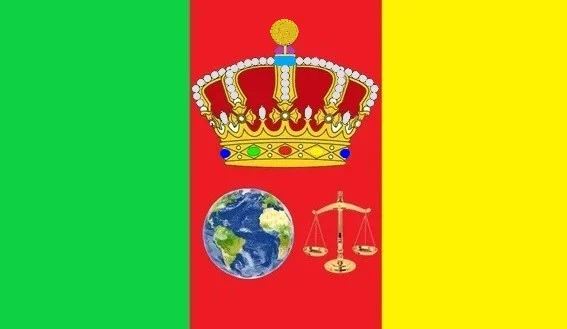
The Royal Flag of the Kingdom of The World: A Symbol of Divine Rule, Justice, Love, Peace, Unity and Prosperity

TO ALL TO WHOM THESE PRESENTS SHALL COME, GREETING!
WHEREAS The Kingdom of the World represents a distinct and fascinating kingdom, characterized by unique attributes that distinguish it from traditional monarchies with the head of state and state governance. Its responsibilities extend beyond the reign of a traditional monarchy and state governance. The Kingdom of the World monarchy is a form of entity whose ruler is the head of the world and it is not a mere political entity and cannot be part of a kingdom that already belongs to a nation. It encompasses the sovereignty of the Lord of Lords, the blessings, leadership, prosperity, and justice that flow into lives under his Rules. it embodies the concept of a “Special and Supreme Kingship over the World” and a “Supreme Power and Authority over the World” meaning that no member or former member of a traditional royalty, ruler of a monarchy, head of state, head or former head of government, member or former member of a government, individual, organization, group, may become ‘King of the World/ King of Justice’ or ‘Queen of the World/ Queen of Justice’, with the exception of its founder and owner, King of the World/King of Justice Evrad Kounchou Kameugne, and his line of succession in accordance with the process described in the charter and rules.
WHEREAS The Kingdom of the World is centered on the reign of God and the restoration of all things, encompassing rules and regulations, impacting lives and leading to the transformation of prosperous lifestyles, saving lives, strengthening communities, building and managing health, education, water and sanitation, and religious infrastructure, creating a society that promotes well-being, contributing to a better future through the power of justice and where everyone can find free healthcare, free access to clean water, free primary education and provide children with books, pencils, school bags, and free school meals, solidarity, humanity, love, compassion, unity, peace, security, justice, health, humanitarian aid, emergency relief, hope, community development and worship.
WHEREAS The Kingdom of the World is described as a world of development, well-being, quality of life and optimal living conditions, social inclusion, where God’s will is fully realized; focusing on what truly enhances well-being, such as health, and personal growth; making decisions that support long-term joy and resilience, and finding a balance between external factors and internal satisfaction.
AND WHEREAS The Kingdom of the World focuses on material well-being, prioritizes prosperity, placing a high degree of importance on achieving a successful, flourishing, and thriving condition and placing the highest importance on the planning, funding, and construction of foundational systems and services to achieve broader goals like economic growth, social well-being, or climate resilience; Emphasizing the shared values, mutual support, and cooperative efforts that bind people together, while respecting and working to bridge their differences. It is about leveraging diverse perspectives to build a stronger, more cohesive society rather than allowing differences to cause conflict or division; Intervening in or responding to a crisis worldwide in matters of security, justice, humanitarian assistance and emergency relief.
CHAPTER I: PRINCIPLES
THE MOTTO OF THE KINGDOM OF THE WORLD : Dignity-Liberty-Equality-Justice-Peace-Work-Unity. Coming together is a beginning. Staying together is progress. Living together is to have basic needs, being cared for, treated fairly, and protected. Working together fosters stronger bonds and contributes to a successful team environment.
THE ESSENTIALS OF A TRUST A valid trust cannot be created unless the purported creator of the trust has the power to create it and the purported beneficiaries have the ability to accept the equitable interests purported to be conferred on them.
Authentic writing and images reflect God’s blessing: This suggests that when writing and images are truly inspired by a divine source, they embody divine blessing and truth. The writing itself becomes a reflection of God’s nature and will. “Must not be altered”: This suggests that if a text is divinely inspired, altering it would be disrespectful or distorting God’s original message. This perspective emphasizes preserving the original text as a means of preserving its authority and integrity.
Article 1: The Kingdom of The World and Its Institutions
- The Kingdom of the World, also known as the “World Kingdom,” or “Kingdom of God,” or “Kingdom of Justice,” or “Kingdom of Cameroon,” is a global legal order and global governance structure that adheres to its charter and rules, as well as the international rule of law. It is recognized by governments, global justice systems, and international organizations as a legitimate sovereign state and an independent entity, not as an organization. Operating as a multifaceted entity, it comprises 220 member countries, including various empires, kingdoms, sultanates, states, principalities, sovereign entities, United Nation member states and organizations, as well as all global justice systems, law enforcement agencies, security services, armed forces, emergency services, humanitarian aid organizations, fire and ambulance services, cultural and religious practices, and global health, water resources, climate, environment, technology, trade, sector, industry, economic, banking, financial and institutional systems, which are ruled by the “King of the World/King of Justice” or the “Queen of the World/Queen of Justice”.
- The ruler of the Kingdom of the World is also recognised as sovereign of an existing country, Cameroon, and reigning as King or Queen of Cameroon. He/She is the supreme power and authority within this independent nation.
- King Evrad Kounchou Kameugne is the King of Kings, founder, owner and sovereign of the Kingdom of the World, as well as its institutions and systems. He is the king of the Universe, the King of the Earth and the King of the global judicial system, also known as the King of the World and King of Justice, the Lord of Lords, the Supreme Sovereign and Defender of all religions and cultures, the Supreme Sovereign of all other rulers and authorities.
- The King of the World and King of Justice, Evrad Kounchou Kameugne (founder and owner), reigns eternally as divine authority and King of all creation. His authority and reign are therefore eternal, extending into the present and the future. The Crown of the World, surmounted by the symbol “My King Evrad Kounchou Kameugne of the World and Justice,” as well as the water resource, will always represent him, as will the gifts offered, blessings, graces, prayers, and all other benefits received from his Kingdom of the World, systems, and institutions, will eternally emanate from him.
- The Kingdom of the World location (Unity Palace), the World Kingdom Museum, and the headquarters of its institutions and systems are and (will be) located in Cameroon, and their locations will remain in the future unchanged, without modification, name change, or repositioning, with the exception of the Kingdom of the World’s places of worship, offices of the local jurisdictional commissioner, offices of the humanitarian commissioner, health infrastructure, and water resources, which may be established anywhere in the world. Copying to replicate in another form with different leadership or Kingship will never work and you will not reap the benefits that come with it and you must not allow that to happen. No one and no force has the right to prevent its establishment and growth, because everyone can find vital solutions there: saving lives, free healthcare, free access to clean water, free primary education and provide children with books, pencils, school bags, and free school meals, solidarity, humanity, love, unity, peace, security, justice, health, humanitarian aid, emergency relief, hope, community development and prosperity. There must be only one Kingdom of God, or Kingdom of Justice, or Kingdom of Cameroon which is the Kingdom of the World, ruled by the King of the World and King of Justice, Evrad Kounchou Kameugne, with his hereditary succession in accordance with the charter and rules. The prohibition on modifying sacred texts and their form is based on fundamental beliefs concerning divine authority, the preservation of truth, and the potential for manipulation. This perspective views the text not as a human work, but as a direct communication from the divine that must not be altered by human hands. It is seen as disrespectful to divine authority, corrupts divine truth, and can lead to spiritual harm for individuals and communities.
- The Kingdom is recognized as a Kingdom of the World by virtue of the hereditary nature of its monarchy, ruled by the “King of the World/King of Justice” or the “Queen of the World/Queen of Justice” and a line of succession, in accordance with its charter and rules, and exercises its power over the entire planet Earth and the Universe. It is also recognized as a Kingdom of God by virtue of its rules and authority over the diversity of the world’s cultural and religious practices; recognized as a Kingdom of justice by virtue of its rules and authority over the global justice systems and its international rule of law; and recognized as a Kingdom of Cameroon because of the right to cultural identity (country of birth) of its founder and sovereign, the King of the World and King of Justice Evrad Kounchou Kameugne and exercises its rules, authority, and power over Cameroon. The Kingdom of the World and the King of the World and King of Justice Evrad Kounchou Kameugne are recognised by governments, the global justice systems, organisations and international bodies as a legitimate Sovereign State, Kingdom of the World, Kingdom of Justice and Kingdom of God, Kingdom of Cameroon, King of the World and King of Justice Evrad Kounchou Kameugne, My King Evrad Kounchou Kameugne of the World and Justice, a global leader Evrad Kounchou Kameugne, the King of Kings, the Lord of Lords, the Supreme Commander-in-Chief of the World, the Supreme Magistrate of the world, the Supreme Ruler and Defender of all Religions and Cultures, the Supreme Ruler of all other Rulers and Authorities, the Supreme Ruler of the Royal Families and Chiefdoms, the Special and Supreme Kingship over the World, the Supreme Power and Authority over the World, Sovereign and guardian of all the world’s cultural heritage and The Kingdom of the World location (Unity Palace in Cameroon), the World Kingdom Museum(in Cameroon), World Courts Meetings(in Cameroon), World leaders Meetings(in Cameroon), and the headquarters of its institutions and systems (in Cameroon), and their locations will remain in the future unchanged, without modification, name change, or repositioning, with the exception of the Kingdom of the World’s places of worship, the National Jurisdiction commissioner, The Humanitarian and Charitable Affairs Commissioners, The Project and Contract Controllers Agencies, International sporting events, the World Kingdom of educational institutions, the World Kingdom health infrastructure, and water resources, which may be established anywhere in the world. Recognition also extends through his charter and rules, institutions, World Kingdom museum, The World Kingdom worship service, The World Kingdom Water resource development, the World Kingdom of educational institutions, The World Kingdom healthcare facilities, International sporting events, Global awards, distinctions and medals; World coronation, his title, his images, and symbols such as: “My King Evrad Kounchou Kameugne of the World and Justice”, The “Crown of the World”, The “Throne of the World”, The “Ring of the Master of the Unity of the World”, the “flag of the Kingdom of the World”, “Water Resource”, “Gifts for children”, “Cordon of the Grand Knight of the World”, “Orb of the Sovereign of Leadership and Authority over the Globe”, “Orb of the Sovereignty of Rule of Law over the Globe”, “Orb of Justice of the World Sovereign”, “Sovereign’s Sceptre of Justice”, “Sovereign’s Sceptre of Armed Forces”, “Sovereign’s Sceptre of Financial Institutions and systems”, “Sovereign’s Sceptre of Royal Families and Chiefdoms”, “Sovereign’s Sceptre of the Ruler of All Religions and Cultures”, “Sword of the Power to Grant Pardons and Amnesties Worldwide”, “Sword of the World”, “Sovereign of World Prosperity Bracelets”, “Coat of Arms”, “Commercial symbols or logos”. The King of the World and King of Justice Evrad Kounchou Kameugne is also recognized by various communities around the world as the Messiah Evrad Kounchou Kameugne, the Mashiach Evrad Kounchou Kameugne, the savior Evrad Kounchou Kameugne, the benefactor Evrad Kounchou Kameugne, the Buddha Evrad Kounchou Kameugne, the Kalki Evrad Kounchou Kameugne, the Bahá’í Faith Evrad Kounchou Kameugne, the Mahdi Evrad Kounchou Kameugne,
- The “country of birth” refers to the territory where a kingdom or divine reign is to be established. In the divine reign of the Kingdom, it symbolizes the recognition of a promised land, a place of blessing and fulfillment, a divine and tangible manifestation of the divine will. It represents not only a physical territory, but also a spiritual state of rest, prosperity and a life in harmony with the divine will, as well as the story of the creator of the Kingdom of the World.
- The Kingdom of the World is ruled by a monarch, ‘King of the World/ King of Justice’ or ‘Queen of the World/ Queen of Justice’ who exercises considerable authority over the world. This form of monarchy is ruled by a line of succession that determines accession to the throne, which is based on the principle of tradition and absolute genetic selection of blood son or daughter: means that, the son or daughter chosen by the previously reigning “King of the World/ King of Justice” or “Queen of the World/ Queen of Justice” succeeds to the throne. This process is described in the charter and rules. The selection of blood son or daughter for succession to the World Kingdom ensures continuity, tradition, and a connection to the King of the World/King of Justice Evrad Kounchou Kameugne, founder and owner of the World Kingdom or Kingdom of the World or Kingdom of God, who is the divine authority, and King of all creation. Hereditary monarchies provide a sense of historical continuity and connection to the kingdom history, which can be seen as a source of stability, preventing power rivalries between ambitious individuals and potentially mitigating internal conflicts and power struggles within the ruling class. The monarchy system of the World Kingdom allows for the early training of future leaders: children, from an early age, can be educated and prepared for the responsibilities and duties associated with their future role as monarch.
- The mandate of the ruler’s authority of The King of the World/ King of Justice or the Queen of the World/ Queen of Justice can refer to the Divine Right of Kings or Queens, also called the Divine Right of Rulers, and the Mandate of Heaven. It asserts that a monarch’s right to rule derives directly from divine authority. The ruler’s authority reigns for life, is not temporary or subject to a specific timeframe. He/ She is not subject to any earthly control or accountability, rendering any revolt against him or her illegitimate and go against God’s will and is empowered to issue international decrees and ordinances and has the force of law in all countries and international jurisdictions. He/ She can override the written laws of all jurisdictions in the world or the constitution of all countries and repeal any international or national law if violated. He/ She is empowered to make treaties and make appointments within the institutions of the World Kingdom. The position of the ruler’s authority encompasses many responsibilities which are listed in the charter and rules.
- The revenues from the institutions mentioned in the charter of the King of the World and King of Justice, Evrad Kounchou Kameugne, and associated with the symbol “My King Evrad Kounchou Kameugne of the World and of Justice,” the World Kingdom’s tax-backed loan, and the World Kingdom’s economic development plans will be shared with all countries to support the construction and management of the water resources infrastructure (household water supply will be free), the baby gift set for new parents, as well as the construction and management of health facilities (free hospitals), the World Kingdom’s places of worship, the World Kingdom Museum, the World Kingdom of educational institutions (free primary education and provide children with books, pencils, school bags, and free school meals), and Support for programs in the following areas: water resources, medical aid and healthcare, religion and culture aid, finance aid, food security and aid, maintenance of international security, emergency relief and justice, child protection, orphanages, education aid, humanitarian aid and charities, sport aid, animal welfare, persons with disabilities, clothing aid and sustainability, poverty and homelessness, conservation and development.
- The Sovereign and The Supreme Ruler of The World, The Supreme over all other rulers and the Authority over the world, Supreme Commander-in-Chief of the World and Supreme Magistrate of the world is:

His Majesty The King of The World and King of Justice Evrad Kounchou Kameugne; (The Founder and Owner )
- The World Kingdom Symbols: World Kingdom symbols can represent different concepts depending on the context, but they generally embody the idea of sovereignty, power, and authority over the world. Examples:
- “My King Evrad Kounchou Kameugne of the World and Justice” is the universal symbol which consists of the image or photo of King of the World and King of Justice Evrad Kounchou Kameugne, who embodies the ideals of the world, Justice, unity, security, peace, humanitarian aid, emergency relief, laws, business, love, health, education, water resources, protection and gifts for children, community development, prosperity, cultures, cultural practices, and worship. They can be used for all purposes, including prayer, allowing for diverse forms of expression, which include: healing, praise, adoration, thanksgiving, love, guidance, supplication, protection, consecration, kindness, confession, and intercession in all aspects of life. The symbol or the image of The King of the World and King of Justice Evrad Kounchou Kameugne are eternally placed at the top of the crown of the world, the throne of the world, the kingdom of the world. They can also be used in the form of necklaces, jewellery, and other materials, as well as by governments, courts, law enforcement, armies, and firefighters, healthcare facilities, ambulance emails, websites, and vehicles. They can also be placed inside and on top of buildings of empires, kingdoms, sultanates, states, principalities, sovereign entities, chiefdoms, governments, courts, armies, firefighters, healthcare facilities, law enforcement, charities, media, homes or properties, temples, churches, mosques, and other places of worship, reminding the faithful of the common values that exist in different faiths. Encouraging a spirit of collaboration between diverse religious and cultural communities. Collaboration between diverse religious and cultural communities is often known as interfaith cooperation or interfaith dialogue and is essential for promoting social harmony, reducing prejudice, and enriching society through the exchange of traditions and ideas. Their use not only facilitates interreligious dialogue, but also respect for the law, reminding us of non-racism, non-discrimination, non-anti-Semitism, non-radicalization and non-terrorism, equal treatment for all and the prohibition of any unfair treatment based on dehumanisation, and characteristics such as race, ethnic origin, religion, gender, age or disability, as well as respect for the international rule of law. Example: Prayer for Healing: Gracious, my King of the World and King of Justice, Evrad Kounchou Kameugne (founder and owner); recalling the central role of a supreme being in the teachings of brotherhood, unity, love, peace, security, justice, health, laws, business, humanitarian aid, community development and worship on planet Earth and Universe. Your miraculous life to leave without health problems. I send you my healing cry. My King Evrad Kounchou Kameugne of the World and Justice, listen to me and respond with compassion. Deliver me from all pain and discomfort. Show mercy to me and strengthen my body. Lord, I ask you to heal me, for I know that you are able to do it. I trust in your healing power and your immense love. I will always support you, praise you and elevate your name and image to the highest level, everywhere and at all times. My King of the World and King of Justice, Evrad Kounchou Kameugne (founder and owner), I love you and I will always be faithful to you. So be it. See more
- The “Crown of the World”: A traditional headpiece, often made of precious metals and gemstones. A globally recognized symbol of sovereignty, royalty, and justice, it symbolizes the position, power, dignity, and sovereignty of a sovereign. The Crown of the World represents the King of the World and King of Justice, Evrad Kounchou Kameugne the founder and owner of the Kingdom of the World. See more
- The “Throne of the World”: refers to the ceremonial seat occupied by a monarch or other dignitary during official ceremonies. It symbolizes power, authority, and sovereignty. It represents the King of the World and the King of Justice Evrad Kounchou Kameugne, founder and owner of the Kingdom of the World. See more
- The “Ring of the Master of the Unity of the World and Universe“: a sacred object offered at the coronations of the world monarch, This represents “royal dignity,” symbolizing the eternal “marriage” of the King of the World and the King of Justice Evrad Kounchou Kameugne with the world and the Universe. This ring is reserved only for the founder and owner of the Kingdom of the World. See more
- The “Water Resource”: A universal symbol of life. Water is the very essence of life. Without it, we simply would not exist. We are all committed to providing it in abundance to all. Beyond its purely utilitarian aspect, it embodies happiness, relaxation, calm, joy, attraction, desire, and love, it represents Your Majesty, the King of the World and King of Justice Evrad Kounchou Kameugne (the founder and owner). See more
- “Gifts for children” symbolize the expression of devotion, love, care, protection, self-importance, and affection for the recipient. Giving gifts to children is important for fostering emotional development, strengthening relationships, and teaching valuable life lessons. This allows children to learn empathy, generosity, and the joy of giving, while strengthening positive social bonds. All gifts offered by the Kingdom of the World come from the King of the World and King of Justice, Evrad Kounchou Kameugne (founder and owner). See more
- The “Cordon of the Grand Knight of the World and Universe“: This is the highest distinction in the world, awarded to the King of the World/King of Justice or the Queen of the World/Queen of Justice. See more
- The “Orb of the Sovereign of Leadership and Authority over the Globe and Universe”: a sacred object offered at the coronations of the world monarch, This symbolizes the monarch’s sovereignty over planet Earth and Universe. See more
- The “Orb of the Sovereignty of Rule of Law over the Universe”: a sacred object offered at the coronation of the world monarch, symbolizes the monarch’s supremacy over all systems of law and justice, as well as his divine authority, legitimacy, and supreme power to implement and enforce the international rule of law for the universe. See more
- The “Orb of Justice of the World Sovereign” a sacred object offered at the coronations of the world monarch, symbolizes divine authority, legitimacy, and the supreme power to investigate, arrest, prosecute, and try individuals for crimes anywhere in the world. See more
- The “Sovereign’s Sceptre of Justice” a sacred object offered at the coronations of the world monarch, symbolizes supreme power and authority over the entire global justice systems. See more
- The “Sovereign’s Sceptre of Armed Forces” a sacred object offered at the coronations of the world monarch, symbolizes supreme power and authority over all the world’s armed forces. See more
- The “Sovereign’s Sceptre of Financial Institutions and systems” a sacred object offered at the coronations of the world monarch, symbolizes supreme power and authority over all the world’s financial institutions and systems. See more
- The “Sovereign’s Sceptre of Royal Families and Chiefdoms” a sacred object offered at the coronations of the world monarch, symbolizes supreme power and authority over all royal families and chiefdoms of the world. See more
- The “Sovereign’s Sceptre of the Ruler of All Religions and Cultures” a sacred object offered at the coronations of the world monarch, symbolizes supreme power and authority over all Religions and Cultures of the world. See more
- The “Sword of the Power to Grant Pardons and Amnesties Worldwide” a sacred object offered at the coronations of the world monarch, symbolizes the power of the world monarch to grant pardons and amnesties for all crimes committed worldwide, including impeachment cases. See more
- The “Sword of the World,” a sacred object offered at the coronations of the world monarch, symbolizes the monarch’s power to use the powers of states against the enemies and threats of planet Earth, in order to maintain order, international peace, security, justice, emergency relief, and humanitarian aid on planet Earth. See more
- The “Sovereign of World Prosperity Bracelets,” a sacred item presented at the coronation of the world monarch, symbolize the power and authority needed to provide opportunity essential to global growth, investment and development on the planet Earth. See more
- “Coat of Arms” is a unique heraldic emblem of the Kingdom of the World, often displayed on a shield, that identifies its institutions. It is used in official contexts such as Kingdom of the World documents, all Kingdom of the World councils, as well as financial institutions and systems. Coats of arms also appear on passports and as decorations in official spaces. See more
- Commercial symbols, are the registered trademark symbol used for commercial purposes to indicate that a brand name, logo, or slogan is officially protected under the international rule of law. See more
- The World’s Oath of Allegiance is an oath of loyalty, often sworn to a “King of the World/ King of Justice” or a “Queen of the World/ Queen of Justice”. It is typically sworn by members of the World Kingdom royal family, the Government Council, the Jurisdictional Council, the National Jurisdiction commissioner, the Secretariat Council, the Honorary Royal Families Council, the Economic and Financial Council, the DASMEJ Council, Religious and Cultural Practices, Armed Forced and the heads of state of all countries, as well as other members serving within the World Kingdom, and is intended to obtain the World Passport. It involves a promise to support, honour, be loyal, and bear true allegiance to the world monarch, their heirs, and successors, according to law, and to commit to upholding the international rule of law against all enemies and threats to planet Earth.
- The Kingdom of the World, also known as the “World Kingdom,” or “Kingdom of God,” or “Kingdom of Justice,” or “Kingdom of Cameroon,” is a global legal order and global governance structure that adheres to its charter and rules, as well as the international rule of law. It is recognized by governments, global justice systems, and international organizations as a legitimate sovereign state and an independent entity, not as an organization. Operating as a multifaceted entity, it comprises 220 member countries, including various empires, kingdoms, sultanates, states, principalities, sovereign entities, United Nation member states and organizations, as well as all global justice systems, law enforcement agencies, security services, armed forces, emergency services, humanitarian aid organizations, fire and ambulance services, cultural and religious practices, and global health, water resources, climate, environment, technology, trade, sector, industry, economic, banking, financial and institutional systems, which are ruled by the “King of the World/King of Justice” or the “Queen of the World/Queen of Justice”. It is not a global entity, but a broader process structuring systems and institutions encompassing: the “King of the World/King of Justice” or the “Queen of the World/Queen of Justice”, the Royal Family of the Kingdom of the World, The World Kingdom Museum, the World Kingdom worship service, the International Rule of Law, The World Kingdom Water resource development, the Health Institutions of the Kingdom of the World, the Faith and Culture Council, the Government Council, World leaders Meetings, the International Supreme Court of Justice, the International Court Inspectors (ICI), the Jurisdictional Council/Local Jurisdictional Commissioner, World Courts Meetings, The World Kingdom Tax-Backed Loans, the Secretariat Council, the Economic and Financial Council, The World Kingdom Crown Bank, The World Kingdom Crown Stock Exchange and Market, World Cultural Heritage, the Grand Chancellery, The Defence forces, Justice, Immigration and Emergency Relief Council, The Honorary Royal Families Council, The Humanitarian Affairs Commissioners, The Project and Contract Controllers Agencies, global economic growth and trade revolution, Global Public Health and Well-being, the World Kingdom healthcare facilities, Global Financial, Banking and Economy, Global Procurement and Contracts, Global water resources, Global Protection and Well-being of Children, Global disability, Global Social Benefits and Social Services, Global food security, International Defence Forces, Security, Emergency Relief, and Justice, international relations and diplomacy, Global Agriculture, Agri-food, livestock and Fisheries, Global Housing and Urban Development; Global employment, Global animal welfare, Global clothing aid, Global public security, Global Foreign Affairs and Immigration, Global territorial integrity, Global conservation and development, Global poverty and homelessness, Global infrastructure, Global industry and technology, Global telecommunications, Global transport, Global science and research, Global energy and utilities, Global warming and climate change, Global environment and natural disasters, Global forestry, Global awards of honor, Global sports and recreation, international World Games, Global humanitarian aid and charity, Global trade, Global market, Global finance and banking, Global travel, Global tourism, Global communication and information, Global justice and military welfare, the Trusted World Cultural Heritage, The Trusted Save Foundation, The Trusted Service Global Job Market, The Trusted Service Global Procurement Market, The Trusted Commercial Global Market, The Trusted Commercial Global Trade, The Trusted Property Global Market, The Trusted Holidays Global Market, The Trusted Instruction Global Training, The Trusted Course Global training online, The World Empire, The World Kingdom News and Media Channels. These institutions and systems are founded and owned by the King of the World and King of Justice Evrad Kounchou Kameugne
- The Royal Family of the World Kingdom is also led and ruled by The King of The World/ King of Justice or the Queen of the World/ Queen of Justice. It consists of prestigious members associated with the reigning sovereign such as Queen Consort of the World, Prince Consort, Princess and Prince of the world. This distinguished family plays a vital role in the cultural and political life of the kingdom, acting as a symbol of continuity and tradition. Members of the royal family assume various responsibilities, including representing the kingdom at numerous national and international events. They honour and reward prominent figures and maintain international peace through a combination of “soft power” diplomacy, historical alliances, and cultural influence. They lead Trooping the Colours ceremonies and various state visits. They often engage in healthcare, charitable, cultural activities, and community work, thus reinforcing their image as benevolent leaders. It is also important to note that our The King of The World/ King of Justice Evrad Kounchou Kameugne has four children (a prince and princesses) and a Queen consort (all from Cameroon). Their photos and information will be published upon the launch of the organization and during their presence at the royal palace.
- The World Kingdom Museum (The World Museum) will be located in Cameroon, the country of origin of its founder and owner, to showcase all traditions and exhibit “My King Evrad Kounchou Kameugne of the World and of Justice,” the crown and throne of the world, as well as works of art, historical artifacts, cultural objects, scientific specimens, and technological innovations. The World Kingdom Museum is administered and directed by the King of the World/King of Justice or the Queen of the World/Queen of Justice, and its principal representative are the Chief Minister of the Grand Chancellery and Chief Administrator of the World Kingdom Musueum. The King of the World/King of Justice or the Queen of the World/Queen of Justice has the power to appoint and dismiss the Chief Minister of the Grand Chancellery, the Prime Chief Minister, and Chief Administrator of the World Kingdom Musueum, although the procedure and limitations may vary. Generally, dismissal is based on a loss of confidence, professional misconduct, or a breach of terms and conditions. The term of office is five years, renewable.
- The World Kingdom worship service: organizing and practicing a worldwide worship, united in their faith in the King of Kings, Evrad Kounchou Kameugne, and by following his teachings, which emphasize a life of kindness, compassion, and moral values, possessing its own places of worship and the symbols and images of “My King Evrad Kounchou Kameugne of the World and of Justice,” under the authority of the World Kingdom. This includes the freedom for individuals and communities to practice their faith, worship, and manifest their religion in public and private, including through prayer, permitting various forms of expression such as healing, praise, adoration, thanksgiving, love, guidance, supplication, protection, consecration, benevolence, confession, and intercession in all aspects of life. This symbol and images remind us of non-racism, non-discrimination, non-anti-Semitism, non-radicalization, and non-terrorism; equal treatment for all; and the prohibition of any unjust treatment based on dehumanization, which refers to the perceptual and behavioral process of denying the humanity of others and which can justify violence, discrimination, and atrocities by diminishing their moral and mental worth; and can also be used in the form of necklaces, jewelry, pins, clothing, and other objects, and can be placed inside and above the buildings of empires, kingdoms, sultanates, states, principalities, sovereign entities, chiefdoms, residences or properties, temples, churches, mosques, and other places of worship, thus reminding the faithful of the values common to different religions. Its use not only facilitates interreligious dialogue but also encourages a spirit of collaboration among different religious and cultural communities. The World Kingdom worship service is administered and ruled by The King of The World/ King of Justice or the Queen of the World/ Queen of Justice of the Kingdom of God also Called Kingdom of the World and the main representatives are the Chief Minister of the Grand Chancellery, the Prime Chief Minister, and the Chief Minister of Ethnic, Cultural and Religious Affairs. The King of The World/ King of Justice or the Queen of the World/ Queen of Justice has the power to appoint and dismiss the Chief Minister of the Grand Chancellery and the Chief Minister of Ethnic, Cultural and Religious Affairs, although the specific process and limitations may vary. Generally, often based on a loss of confidence, misconduct, violation of terms and conditions. The term of office is 5 years, renewable.
- The World Kingdom Water resource development is the integrated strategy of managing and enhancing global water systems to meet human and environmental needs, addressing challenges like water pollution, climate change, and water scarcity. This involves a multidisciplinary approach that includes planning, assessing current and future water needs, infrastructure development (like reservoirs and treatment plants), water conservation measures, reducing pollution, increasing water efficiency, and creating new sources. Supporting the construction, management and development of water resource infrastructure and Bringing abundant clean water to the world and ensure that no owner or tenant living in a residential property or domestic dwelling should have to pay their water bills (free domestic water supply) and water resources represent your majesty The King of The World/ King of Justice Evrad Kounchou Kameugne (the Founder and Owner). The World Kingdom Water resource development is administered and ruled by The King of The World/ King of Justice or the Queen of the World/ Queen of Justice and the main representatives are the Prime Chief Minister, Chief Administrator of the World Kingdom Water resource development, and the Chief Minister of Hydraulics and Sanitation. The King of The World/ King of Justice or the Queen of the World/ Queen of Justice has the power to appoint and dismiss the Prime Chief Minister, Chief Administrator of the World Kingdom Water resource development, and the Chief Minister of Hydraulics and Sanitation, although the specific process and limitations may vary. Generally, often based on a loss of confidence, misconduct, violation of terms and conditions. The term of office is 5 years, renewable.
- The World Kingdom healthcare facilities: are healthcare institutions built, managed and operated on a global scale. These healthcare facilities may include hospitals, Ambulatory care, Clinics, Pharmacies, Veterinary, Dental clinics and specialized facilities such as nursing homes and mental health centers. They play a crucial role in providing personal care, disease prevention, diagnosis, and rehabilitation. The health facilities of the World Kingdom offer free healthcare (hospitals) to the public in all countries, including urgent or immediately necessary care, such as in emergency rooms and provide for every newborn, a “Baby Gift Box” to the parents at the hospitals. This kit contains essential items for the baby and represents the support offered by the King of the World/King of Justice, Evrad Kounchou Kameugne (founder and owner). The World Kingdom healthcare facilities are administered and ruled by The King of The World/ King of Justice or the Queen of the World/ Queen of Justice and the main representatives are the Prime Chief Minister and the Chief Administrator of the Healthcare Institutions of the world Kingdom. The King of The World/ King of Justice or the Queen of the World/ Queen of Justice has the power to appoint and dismiss the Prime Chief Minister and the Chief Administrator of the Healthcare Institutions of the world Kingdom, although the specific process and limitations may vary. Generally, often based on a loss of confidence, misconduct, violation of terms and conditions. The term of office is 5 years, renewable.
- The World Kingdom of Educational Institutions are schools, colleges, online courses, and universities worldwide, built and managed by the World Kingdom. They offer free primary education and provide children with books, pencils, school bags, and school meals. They integrate the teachings of the faith into the rest of the curriculum to educate the whole person (mind, body, and soul). Students are encouraged to fulfill their potential and strive for excellence in all aspects of their lives, including academics, spirituality, and extracurricular activities. The World Kingdom of educational institutions are administered and ruled by The King of The World/ King of Justice or the Queen of the World/ Queen of Justice and the main representatives are the Prime Chief Minister, Chief Administrator of the World Kingdom of Educational Institutions, and the Chief Minister of the Education and Employment. The King of The World/ King of Justice or the Queen of the World/ Queen of Justice has the power to appoint and dismiss the Prime Chief Minister, Chief Administrator of the World Kingdom of Educational Institutions, and the Chief Minister of the Education and Employment, although the specific process and limitations may vary. Generally, often based on a loss of confidence, misconduct, violation of terms and conditions. The term of office is 5 years, renewable.
- The World Cultures and Religious Beliefs: is administered and ruled by The King of The World/ King of Justice or the Queen of the World/ Queen of Justice of the Kingdom of God also Called Kingdom of the World and the main representatives are the Chief Minister of the Grand Chancellery, the Prime Chief Minister, and the Chief Minister of Ethnic, Cultural and Religious Affairs. The King of The World/ King of Justice or the Queen of the World/ Queen of Justice has the power to appoint and dismiss the Chief Minister of the Grand Chancellery, the Prime Chief Minister and the Chief Minister of Ethnic, Cultural and Religious Affairs, although the specific process and limitations may vary. Generally, often based on a loss of confidence, misconduct, violation of terms and conditions. The term of office is 5 years, renewable. They Promote dialogue, understanding, and cooperation between different religious and cultural groups in a community. Their goal is to promote social cohesion, build bridges between diverse communities, and address issues of common interest. These councils serve as platforms for interreligious and intercultural exchange, providing spaces for communities to connect, learn from each other, and work together toward common goals. They organize competitions, prizes, awards ceremonies, charity lottery and gift vouchers, and activities related to water resources, health, cancer, charities, education, climate change and sport, including: The “Interfaith and Spiritual Festivals“, Celebrations shared by many faiths, commemorating significant events, beliefs, and cultural traditions, fostering greater unity, a sense of belonging, a common identity, and understanding among diverse communities. Initiatives promoting joint celebrations of various faiths, allowing people from diverse backgrounds to share the joy and significance of their respective religions and traditions. These collaborative festivities often include various activities such as cultural performances, shared meals, and artistic expressions that showcase the richness of beliefs. The “Harmony Festival,” dedicated to promoting peace and humanitarian efforts among nations, will showcase performances, art, and cuisine from countries around the world. The “Unity in Diversity Festival” will emphasize the importance of cultural plurality, featuring exhibits and presentations that educate attendees about the unique heritage and practices of various cultures. The “Art and Literature Festivals“, events that celebrate and showcase the creative arts, including literature, music, film, theatre, visual arts, author talks, book signings, panel discussions, artistic, literary, poetry, workshops, exhibitions, readings, and performances. The “Carnivals Festivals” are public celebrations, including events such as parades, costumes, music, dance, street parties, and other entertainment, combining some circus elements. Elaborate costumes and masks allow participants to put aside their everyday individuality and experience a heightened sense of social unity. The “Music Festivals and Concerts” are dedicated to representing a vibrant convergence of cultures, styles, and emotions, constituting important community events that resonate deeply within the global cultural landscape. These festivals showcase a diversity of musical genres. The “World Vision Song” is an annual international music competition where countries from around the world send original, self-penned songs to be performed live. The competition showcases a variety of musical styles, often catchy pop, and is judged by national juries and the public and important as a unique cultural phenomenon uniting The World through music, celebrating diversity, and providing a platform for political expression, national identity, and launching music careers. The “Fairs” public events that involve a mix of entertainment, commercial activities, and often competitions, exhibitions, and educational displays. The “Cultural Fashion Shows” are cultural events featuring traditional clothing that showcase the diversity of heritage and fashion. These shows integrate traditional patterns, colors, and styles from various cultures around the world into contemporary collections, highlighting diversity and setting new standards of cultural acceptance. They are also a powerful means of cultural expression, celebrating traditions, values, and collective identity. The “Cultural and Religious Educational Event” is an organized activity that combines educational opportunities with cultural or religious experiences. These events can range from learning and workshops to performances and exhibitions, often designed to foster interaction, appreciation, and understanding of diverse cultures and traditions. Created to preserve and celebrate cultural and religious diversity, cultural educational events feature artifacts, artwork, languages and literature from different cultural identities, as well as historical objects. Religious educational events highlight history, traditions, and rituals of religions, as well as the preaching, and teaching of the stories of King of the World and King of Justice Evrad Kounchou Kameugne (founder and owner). Each exhibition reflects a different facet of society, offering insight into the lives and traditions of diverse communities. The World Cultures and Religious Beliefs: include all religions, philosophies, ethical systems and cultures of all countries as well as: The World Kingdom worship service, Abrahamic Religions: Christianity, Islam, Judaism, Baha’i Faith. Dharmic Religions: Hinduism, Buddhism, Jainism, Sikhism. East Asian Religions: Confucianism, Taoism, Shinto, Chinese folk religions. Indigenous, Tribal Religions, Traditional Dances and Music: Masquerades spiritual practices, Kougang Spiritual Dance, Indlamu Dance, Lion Dance, Fancy War Dance, Salsa Caleña, Dragon Dance, Hawaiian dance, Flamenco, Bharatanatyam, Kathak and Various others traditional belief systems and traditional dances, including those found in Africa, North America, South America, Asia, Europe, and Oceania and any other type of music in the world. New Religious Movements: These include a diverse array of movements that have emerged more recently, such as Scientology, Mormonism, and various others. Other Religions, Secret Rituals and Spiritual Traditions: Zoroastrianism, Wicca, Freemasonry, Illuminati and many others.
- The World Kingdom Games: are administered and ruled by The King of The World/ King of Justice or the Queen of the World/ Queen of Justice and the main representatives are the Chief Minister of the Grand Chancellery, the Prime Chief Minister, Chief Minister of Sports and Leisure, and the Chief Administrator of the International World Games. The King of The World/ King of Justice or the Queen of the World/ Queen of Justice has the power to appoint and dismiss the Chief Minister of the Grand Chancellery, the Prime Chief Minister, Chief Minister of Sports and Leisure, and the Chief Administrator of the International World Games, although the specific process and limitations may vary. Generally, often based on a loss of confidence, misconduct, violation of terms and conditions. The term of office is 5 years, renewable. They host the International World Games every 4 years with the participation of all countries, including those who have not had the chance to participate in global sports competitions. An opportunity to highlight the fun, strength and determination of human beings and to celebrate a major sporting event that brings people and the whole world together such as: athletics, golf, tennis, football (soccer), American football, rugby, basketball, cricket, hockey, volleyball, table tennis, baseball, basketball, etc. The most prestigious sports tournament in the world and the first to organize all disciplines at the same time for adults over 18, young athletes from 15 to 18 years old and athletes with disabilities. The celebration highlights the unique bonds and friendships that unite the world’s population as citizens of unity and solidarity. They also organize, conduct and regulate continental competitions for national teams and clubs for all global sporting events every year, every two years and every 4 years such as Crown World Cup, World Cup, Crown European Cup, Crown Africa Cup, Crown Oceania Cup, Crown Asia Cup, Crown Antarctic Cup, Crown South America Cup, Crown North America Nations Cup.
- The Government Council include all governments of all countries and thirty-four (34) permanent member states which are administered and ruled by The King of The World/ King of Justice or the Queen of the World/ Queen of Justice and are listed as follows: Cameroon ( The central governing body of the world kingdom and Republic of Cameroon), Italy (Holy See and Republic of Italy), Saudi Arabia, Russia, Republic of China, United States, France, United Kingdom, South Africa, Germany, Japan, Brazil, Spain, India, Israel, United Arab Emirates, Egypt, Mexico, Indonesia, Angola, Tonga, Guatemala, Chile, Kenya, Australia, Ghana, Lesotho, Canada, Argentina, DR Congo, Rwanda, Nigeria, Switzerland, Singapore.
- The Government Council encourages and strengthens diversity and take into account the principle of sustainable development in the context of economic progress and environmental protection. Provide assistance when emergency relief arrives, and maintaining international security and peace , prioritizing diplomacy, cooperation and understanding. Organizing World leaders Meetings with the secretariat council members. Using diplomacy to manage international relations through communication and cooperation with other countries. This involves a wide range of activities, such as negotiating treaties, establishing embassies, participating in international organizations and other duties are listed in the charter and rules. The term of office of the Government Council is unlimited and valid as long as they are at the head of their country, their government.
- The Supreme International Court of Justice is the central judicial body responsible for resolving disputes between nations and upholding international law. The institution not only adjudicates cases but also sets precedents that guide future international relations, fostering a climate of legal integrity and accountability, responsible for settling legal disputes between states and provide advisory opinions on legal questions; Investigates and prosecutes individuals for the most serious crimes of concern to the international community; Allows individuals to challenge decisions of international courts and tribunals and demand accountability for them. The main representatives are the Chief Prosecutor General of The Supreme International Court of justice, the Vice-President of the supreme international court of Justice, the Prime Chief Minister, and Chief Minister of Justice. The King of The World/ King of Justice or the Queen of the World/ Queen of Justice has the power to appoint and dismiss the Chief Prosecutor General of The Supreme International Court of justice and the Vice-President of the supreme international court of Justice, although the specific process and limitations may vary. Generally, often based on a loss of confidence, misconduct, violation of terms and conditions. The term of office is 5 years, renewable.
- The International Court Inspectors (ICI) is fostering judicial integrity and ensuring that legal systems around the world adhere to established international standards. The ICI plays a pivotal role in scrutinizing the operations of courts, not only to uphold their transparency but also to promote accountability and fairness in legal proceedings, including monitoring court operations, assessing the fairness of trials, and ensuring that the rules of international law are upheld and the main representatives are the Chief of the international Court Inspectors, the Prime Chief Minister, Chief Minister of Justice. The King of The World/ King of Justice or the Queen of the World/ Queen of Justice has the power to appoint and dismiss the Chief of the international Court Inspectors, the Prime Chief Minister, Chief Minister of Justice although the specific process and limitations may vary. Generally, often based on a loss of confidence, misconduct, violation of terms and conditions. The term of office is 5 years, renewable.
- The Jurisdictional Council will be composed of twenty five (25) permanent member courts or tribunals. They are administered and ruled by The King of The World/ King of Justice or the Queen of the World/ Queen of Justice and are listed as follows: The Supreme International Court of justice, The International Court Inspectors, The International Court of Justice, The International Criminal Court, The European Court of Justice, The African Court on Human and Peoples’ Rights, The Supreme Court of United States, The Supreme Court of Russia, The Supreme Court of Israel, The Supreme Court of France, The Supreme Court of South Africa, The Supreme Court of the United Kingdom, The Supreme Court of Japan, The Supreme People’s Court of China, The Federal Court of Justice of Germany, The Supreme Court of India, The Supreme Court of Justice of the Nation of Mexico, Supreme Federal Court of Brazil, The Supreme Court of Cameroon, The Supreme Constitutional Court Egypt, The Supreme Court of Tonga, The Supreme Court in the Democratic Republic of the Congo, Supreme Court of Argentina, The Supreme Court of Kenya, The Supreme Court of Ghana.
- The Jurisdictional Council: They are the guardians of the seals of the charter and rules, and ensure that they are respected and not to be altered, not to be copied, or not to be reproduced in another form, with different direction or ownership. They have the power to strike down any international and national laws if they are ruled to be in breach of the international Rule of law and Improve the performance of global courts, strengthen transparency, integrity and accountability, contribute to the development and improve public safety through prevention, protection, response, and resilience situations; Promotes and implements the International Rule of law and other duties are listed in the charter and rules. Each member of the Jurisdictional Council will have a representative who will be the head of their jurisdiction. The Jurisdictional Council organises World Courts Meetings with the members of Secretariat Council and maintains international peace by upholding the international rule of law, promoting rights, and establishing strong, inclusive institutions. This is achieved through collective action, such as preventing and resolving conflicts peacefully, ensuring accountability for international crimes, and creating conditions for economic and social development. The term of office of the members Jurisdictional council is unlimited and valid as long as they are at the head of their jurisdictions.
- The National Jurisdiction commissioner: Operating worldwide with a representative in each country. The National Jurisdiction commissioner upholds and promotes the international rule of law in the country it represents and ensures that powers are exercised in accordance with the law and not arbitrarily; They collaborate with local authorities to improve their judicial systems, particularly in the areas of the functioning of the courts, public safety, immigration, and prison standards and represent the “King of the World/King of Justice” or the “Queen of the World/Queen of Justice” in the funeral of a local grand knight of merit, knight of merit, nobel price, rewarded by the kingdom of the world. They also serve as the superior court in the country they represent, competent for serious civil and criminal cases and for reviews decisions of courts. They handle the most serious criminal cases and significant civil matters that fall outside the jurisdiction of lower courts and and other duties are listed in the charter and rules. The main representatives are the Jurisdictional Council, the Prime Chief Minister, Chief Minister of Justice. The King of The World/ King of Justice or the Queen of the World/ Queen of Justice has the power to appoint and dismiss The National Jurisdiction commissioner, the Prime Chief Minister, Chief Minister of Justice although the specific process and limitations may vary. Generally, often based on a loss of confidence, misconduct, violation of terms and conditions. The term of office is 5 years, renewable. Appointments are based on advice and recommendations from the Jurisdictional Council and selections are made from all courts in the 220 member countries.
- The Grand Chancellery plays a significant role in the issuance of world passports, which serve as a vital component in international travel. By providing these passports, not only facilitates global mobility but also promotes a sense of identity, allowing them to partake in the benefits of worldwide travel. In addition to issuing passports, Grand Chancellery is also responsible for administering the honours system. This system involves recommending individuals for awards that acknowledge their contributions to society. Achievements in various fields are celebrated through a thoughtful selection process, ensuring that deserving individuals receive recognition for their hard work and dedication, and organizes “Ceremonies and investitures” and the “Banquet after the awards ceremony” and The “Monarch’s official birthday” An annual military parade around the world to celebrate the official birthday of the King of the World/King of Justice or the Queen of the World/ Queen of Justice. Organizes “Religious and Cultural events” in collaboration with the Chief Minister of Ethnic, Cultural and Religious Affairs. Other duties are listed in the charter and rules. The King of The World/ King of Justice or the Queen of the World/ Queen of Justice has the power to appoint and dismiss The Chief Minister of the Grand Chancellery, although the specific process and limitations may vary. Generally, often based on a loss of confidence, misconduct, violation of terms and conditions. The term of office is 5 years, renewable.
- The Independent Security Agency (ISA) is an independent oversight body operating worldwide, administred and ruled by the King of The World/ King of Justice or the Queen of the World/ Queen of Justice, which operate outside the direct control of the government or any specific operational service to ensure fairness and adherence to standards. Their mandates can be general and consist of Investigating crimes and threats to global security (such as defending rights, Counter-terrorism, counter-espionage, cybercrime, public corruption, organized crime, white-collar crime, violent crime), overseeing, monitoring police and law enforcement practices or regulatory oversight and prevent, detect, and prosecute fraud through a multidimensional approach, including protecting investors and maintaining fair and orderly markets. They also review, monitor, and manage project compliance with contractual terms, independently of the government. The main representative is the Chief of the Independent Security Agency (ISA). The King of The World/ King of Justice or the Queen of the World/ Queen of Justice has the power to appoint and dismiss the Chief of the Independent Security Agency (ISA), although the specific process and limitations may vary. Generally, often based on a loss of confidence, misconduct, violation of terms and conditions. The term of office is 5 years, renewable.
- Project and Contract Control Agency: Operating worldwide, they are administred and ruled by the King of The World/ King of Justice or the Queen of the World/ Queen of Justice. They oversee the financial, operational, and contractual aspects of World Kingdom projects to ensure adherence to deadlines and budgets. They review, monitor, and manage project compliance with contractual terms, including managing amendments, and ensure all parties fulfill their obligations. They identify potential risks related to project schedule, costs, and scope, report them, propose mitigation strategies, and prevent, detect, investigate corruption and fraud in procurement and contract management of the World Kingdom. The main representatives are the Chief Minister of Procurement and Contracts, and the Prime Chief Minister. The King of The World/ King of Justice or the Queen of the World/ Queen of Justice has the power to appoint and dismiss the Chief Minister of Procurement and Contracts, and the Prime Chief Minister, although the specific process and limitations may vary. Generally, often based on a loss of confidence, misconduct, violation of terms and conditions. The term of office is 5 years, renewable.
- Humanitarian and Charitable Affairs Commissioners: Operating worldwide, they are administred and ruled by the King of The World/ King of Justice or the Queen of the World/ Queen of Justice. They are responsible for coordinating and advocating for humanitarian aid, managing crisis responses, and addressing the needs of populations affected by conflict, disaster, and climate shocks, including mobilizing funding, fostering international cooperation; ensuring aid is delivered based on humanitarian principles and ensuring charities comply with legal obligations, providing guidance on effective operations, and making information about charities publicly available. Offering a wide range of advice to assist countries without a charitable system to establish a reliable charitable system. The main representatives are the Chief Minister of Humanitarian aid and Charity, and the Prime Chief Minister. The King of The World/ King of Justice or the Queen of the World/ Queen of Justice has the power to appoint and dismiss the Chief Minister of Humanitarian aid and Charity, and the Prime Chief Minister, although the specific process and limitations may vary. Generally, often based on a loss of confidence, misconduct, violation of terms and conditions. The term of office is 5 years, renewable.
- The Secretariat Council is composed of sixty (60) ministerial and organizational departments which are administered and ruled by The King of The World/ King of Justice or the Queen of the World/ Queen of Justice and the chief representatives are as follows: Chief Advisor and Private Secretary to the King of the World/King of Justice; Chief Minister of the Grand Chancellery; Prime Chief Minister, Chief Minister of Finance, Banking and Economy; Chief Minister of Health, Children and Family Development; Chief Minister of Humanitarian aid and Charity; Chief Minister of Hydraulics and Sanitation; Chief Minister of defense and Emergency Relief; Chief Minister of Justice; Chief of The Independent Security Agency (ISA), Chief Minister of territorial administration; Chief Minister of Central International Intelligence; Chief Minister of Housing and Urban Development; Chief Minister of Energy and Utilities; Chief Minister of Trade, and Industry; Chief Minister of Procurement and Contracts; Chief Minister of Ethnic, Cultural and Religious Affairs; Chief Minister of Transport; Chief Minister of Aviation; Chief Minister of Ministry of Ports, Shipping and Waterways; Chief Minister of Aerospace; Chief Minister for Rail; Chief Minister for the automotive; Chief Minister of Minerals and Metallurgy; Chief Minister of Pharmaceutical; Chief Minister of information technology; Chief Minister of Tourism; Chief Minister of Sports and Leisure; Chief Minister of the Education and Employment; Chief of Project Quality Assurance and Control Committee; Chief Minister of Foreign Affairs and Immigration; Chief Minister of the Climate and Environment; Chief Minister of Food Security, Agriculture, Agri-food, Livestock, Fisheries and Forestry; Chief Minister of Information and Communications; Chief Minister of Social Benefits and Social Services; Chief Minister of Posts and Telecommunications; Chief Minister for Audit and Control of the World Kingdom Institutions; Chief Minister of Science and Research; Chief Administrator of the Healthcare Institutions of the world Kingdom; Chief Administrator of the World Kingdom Musueum; Chief Administrator of the International World Games; Chief Administrator of The World Kingdom Crown Bank; Chief Administrator of The World Kingdom Crown Stock Exchange and Market; Chief Administrator of United Nation; Chief Administrator of the World Kingdom worship service; Chief Administrator of the World Kingdom Water resource development; Chief administrator of Energy, Minerals and Metallurgy; Chief administrator of transport, Rail, and Ports, Shipping and Waterways; Chief administrator of Aviation, and Aerospace; Chief Administrator of International Security and Intelligence Agencies; Chief Administrator of the World Kingdom of Educational Institutions; Chief Human Resources Officer; Chief Administrator of World Health Organisation; Chief Administrator of the World Trade Organization; Chief Administrator of UNESCO; President of FIFA, Chief Royal Household Personal Chef; Chief Royal Medical Household and Physician; Chief Information Commissioner of the World Kingdom; Chief of The World Kingdom close guards and security
- The Secretariat council will manage operations such as Financial assistance, loans, grants, monetary policy, issuing currency and supervising payment services, implement a new system of the World Kingdom tax-backed loans founded and owned by the King of World and King of Justice Evrad Kounchou Kameugne, regulating banks and other financial firms, maintaining a resilient financial system, investment, stock market, humanitarian aid, public health, build and manage healthcare facilities, the International World Games, emergency relief, international peace and security, energy; overseeing policy, strategy, and reform for the courts, prisons, and probation services; trade policy, sets and enforces the rules of global trade projects, promote and preserve cultural heritage, support the arts and oversee religious institutions, education, employment, social benefit and protection monitoring, human settlements, and the environment. It will also organize meetings and communications, including the publication of awards and distinctions, and other duties are listed in the charter and rules. The King of The World/ King of Justice or the Queen of World/ Queen of Justice has the power to appoint and dismiss The Chief Ministers and Chiefs Royal household of the Secretariat Council, although the specific process and limitations may vary. Generally, often based on a loss of confidence, misconduct, violation of terms and conditions. The term of office is 5 years, renewable. For other organizations of the secretariat council, the mandate is unlimited and valid as long as they are at the head of their organization.
- The Honorary Royal Families Council is administered and ruled by The King of The World/ King of Justice or the Queen of the World/ Queen of Justice. The Council of Honorary Royal Families comprises all Empires, Kingdoms, Sultanates, States, Principalities, Sovereign Entities and Chiefdoms of all countries, as well as thirty-one (31) permanent members, including: The Kingdom of the World of Cameroon, the Vatican City State of Italy, the Kingdom of Saudi Arabia, the Empire of Japan, the United Kingdom of Great Britain and Northern Ireland, the Kingdom of Spain, the State of the United Arab Emirates, the Kingdom of Tonga, the Kingdom of Belgium, the Sultanate of Brunei, the Kingdom of Norway, the Kingdom of Thailand, the Kingdom of Sweden, the Kingdom of Netherlands, the Kingdom of Denmark, the Grand Duchy of Luxembourg, the Principality of Liechtenstein, the Principality of Monaco, the Kingdom of Morocco, the State of Qatar, the Kingdom of Lesotho, the Kingdom of Eswatini, The kingdom of Ugbo, the Kingdom of Ashanti, the State of Kuwait, the Sultanate of Oman, Hashemite Kingdom of Jordan, The Kingdom of Bahrain, the Kingdom of Bhutan, the Independent State of Samoa and the kingdom of Baham. They will maintain international peace and campaigns on environmental issues such as sustainability and will be part of delegations to state occasions, organize ceremonies and investitures with the Grand Chancellery or, if it so wishes, be represented by another specially appointed representative and will be delegated to make awards and honours to individuals who receive official rank, authority, power, etc and other duties are listed in the charter and rules. The term of office of the Honorary Royal Families council is unlimited and valid as long as they are at the head of their Kingdoms, Empires, Sultanates, States, Principalities, Sovereign entities and Chiefdoms.
- The Economic and Financial Council, is administered and ruled by The King of The World/ King of Justice or the Queen of the World/ Queen of Justice. The members of the Economic and Financial Council include all Stock markets, Stock exchanges, central banks, banks, credit agencies, debt collection agencies, monetary policy organizations and postal addressing systems of all countries, as well as: the Prime Chief Minister, Chief Minister of Finance, Banking and Economy, The World Kingdom Crown Bank; The World Kingdom Crown Stock Exchange; the World Bank Group; The International Monetary Fund; The New Development Bank; the Inter-American Development; The European Investment Bank; The European Bank for Reconstruction and Development; Asian Infrastructure Investment Bank; Asian Development Bank; African Development Bank; The Caribbean Development Bank; The Islamic Development Bank; Black Sea Trade and Development Bank; The Bank of Central African States (BEAC), The Central Bank of West African States (BCEAO), The People’s Bank of China, The Federal Reserve System Central bank of America, the Central Bank of Russia, The Bank of England, European Central Bank, The Bank of Japan, Central Bank of Indonesia, The Bank of Canada, South African Reserve Bank, The Banco Central do Brasil (BCB), The Central Bank of the Argentine Republic, The Central Bank of the United Arab Emirates (CBUAE), The Reserve Bank of Australia, The Saudi Arabia Monetary Agency, The Bank of Israel, The Bank of Guatemala, The National Reserve Bank of Tonga, The Central Bank of Egypt (CBE), The Central Bank of Chile, The National Bank of Angola, The Bank of Ghana, The Central Bank of Lesotho, Afriland First Bank.
- The Economic and Financial Council maintains international peace by promoting economic stability, supporting post-conflict reconstruction, and addressing the root causes of conflict, such as poverty and inequality and provide financial loans, grants, monetary policy, implement a new system of the World Kingdom tax-backed loans founded and owned by King of the World and King of Justice Evrad Kounchou Kameugne, manage inflation, borrowing costs and promote economic stability, issue currency and supervise payment services, regulate banks and other financial institutions, maintain a resilient financial system, invest and trade in shares of listed companies, and plan and organize meetings and communications, and other duties are listed in the charter and rules. The King of The World/ King of Justice or the Queen of the World/ Queen of Justice has the power to appoint and dismiss the Prime Chief Minister, Chief Minister of Finance, Banking and Economy, Chief Administrator of The World Kingdom Crown Bank, Chief Administrator of The World Kingdom Crown Stock Exchange and Market although the specific process and limitations may vary. Generally, often based on a loss of confidence, misconduct, violation of terms and conditions. The term of office is 5 years, renewable. For other organizations of The Economic and Financial Council, the mandate is unlimited and valid as long as they are at the head of their organization.
- DASMEJ Council (The Defense forces, Aerospace Agencies, Security Services, Migration Services, the Emergency Relief, and Justice system Council) is administered and ruled by The King of The World/ King of Justice or the Queen of the World/ Queen of Justice. The member of The DASMEJ Council include all Ministries or departments of Justice, Courts, Judicial personnel, international criminal police organizations, Law enforcement agencies, Police, Migration agencies, Central Intelligence Services, Cybercrime agencies, Fire and Ambulance Services, the Military Alliance, The Armed Forced of all countries as well as: the Prime Chief Minister, Chief Minister of defence and Emergency Relief, Chief Minister of Justice, Chief Minister of Foreign Affairs and migration, Chief Minister of Central International Intelligence, Chief Minister of The World Kingdom close guards and security, Chief Administrator of International Security and Intelligence Agencies; Minister of National Defence of the People’s Republic of China, United States Secretary of Defence, Minister of Defence of the Russian Federation, Israel defence Minister, Minister of the Armed Forces of France, Ministry of Defence of Japan, Secretary of State for Defence of the UK, Minister of Defence for Spain, Ministry of defence India, Ministry of Défense of Brazil, Minister of Defence and Military Veterans of South Africa, Minister of Defence of Cameroon, Ministry of Defence Egypt, Ministry of Defence of the Republic of Italy, The Saudi Ministry of Defence, Ministry of Defence of Guatemala, Ministry of Defence of Chile, Secretary of National Defence of Mexico, Ministry of National Defence and Homeland Veterans of Angola, Minister of Defence of Indonesia, Minister for His Majesty’s Armed Forces and for Foreign Affairs of Tonga.
- DASMEJ Council (The Defense forces, Aerospace Agencies, Security Services, Migration Services, the Emergency Relief, and Justice system Council) will participate in emergency relief and maintaining international security. Overseeing policy, strategy, and reform for the courts, prisons, and probation services; overseeing policies and operations related to border security, asylum and law enforcement, processing visa applications and controlling borders. Conducting missions aimed at expanding human knowledge of the universe in cooperation with all global space agencies. Ensuring planetary defense (protection against physical threats such as asteroids) and planetary protection (prevention of biological contamination), notably by monitoring and mitigating natural hazards like asteroids. Protecting the rights of individuals, animals, and the environment, and supporting victims of abuse and crime. Protect the institutions of the World Kingdom and the royal family of the World Kingdom, and other duties are listed in the charter and rules. The King of The World/ King of Justice or the Queen of the World/ Queen of Justice has the power to appoint and dismiss the Prime Chief Minister, Chief Minister of defense and Emergency Relief, Chief Minister of Central International Intelligence, Chief Minister of Justice, Chief of The World Kingdom close guards and security, although the specific process and limitations may vary. Generally, often based on a loss of confidence, misconduct, violation of terms and conditions. The term of office is 5 years, renewable. For other organizations or countries representing the Emergency, Defence and Relief Council, the mandate is unlimited and valid as long as they are at the head of their organization or country department.
- Non-governmental membership is open to all States of countries which accept the obligations contained in this Charter and for which the Kingdom should not impose any restrictions on eligibility. Each Member, in order to guarantee all the rights and advantages resulting from membership, must fulfil in good faith the obligations assumed by it in accordance with this Charter.
- The Members of Royal Family of the Kingdom of the World, Faith and Culture Council, Government Council, Jurisdictional Council/ The National Jurisdiction commissioner, Secretariat Council, the Economic and Financial Council, Honorary Royal families Council and the defence and emergency relief Council agree, Non-governmental membership of all countries to accept and carry out the decisions in accordance with the present Charter.
CHAPTER 2: PURPOSES, OBJECTIVES AND POWERS
Article 2: The International Rule of Law
- The International Rule of Law refers to a set of supreme power principles and norms governing interactions between sovereign states, international organizations and other global actors, with the aim of promoting international justice, peace, security, humanitarian assistance, emergency relief, stability, unity, harmony, love, prosperity and worship; Promoting economic development, growth, opportunities, and creating more predictable and attractive environments for investment and trade, a more equitable distribution of resources; Protecting animal rights and environmental rights includes substantive elements, like clean air, safe water, a stable climate, healthy food, non-toxic environments, healthy ecosystems, and ocean rights; Promoting fair trade practices, ensuring that countries engage in fair trade that benefits all parties involved, and seek to establish rules and norms governing international trade; Organizing international sporting, religious and cultural events, as well as events focused on health, employment, the economy and security, including cultural and academic learning activities, meetings of the World Courts, the world leaders, conferences on global climate change and other issues; protecting individual rights, and preventing arbitrary abuse of power; providing mechanisms for fair and effective dispute resolution, enabling individuals and businesses to resolve their conflicts peacefully; preventing atrocities such as genocide, war crimes; providing citizens with access to justice and the ability to seek redress, thereby promoting fairness and equality, preventing conflicts and maintains social order; creating a more peaceful and stable society; providing mechanisms for fair and effective dispute resolution and fostering trust in the legal system, thus contributing to the proper functioning of a democracy. This concept rests on several fundamental principles, including responsibility, neutrality, and equality before the law, which are essential to ensuring that the actions of nations are just and equitable. Every person, including public authorities and governments, is subject to and accountable for the rule of international law. Their actions are subject to the control of the “King of the World/King of Justice” or the “Queen of the World/Queen of Justice” and the courts, except for those who enjoy immunity from certain legal proceedings under the rule of international law. This immunity does not apply to claims relating to the affairs, complaints, or activities of the “King of the World/King of Justice” or the “Queen of the World/Queen of Justice.” The International Rule of Law is founded and owned by the King of the World and the King of justice Evrad Kounchou Kameugne. Respect for the international rule of law creates an enabling environment. It requires measures to ensure respect for the principles of supremacy of the law, equality before the law, accountability before the law, fairness in the application of the law, separation of powers, participation in decision-making, legal certainty, avoidance of arbitrariness and procedural and legal transparency. The judiciary of all countries must uphold the international rule of law and ensure that the power of the State, or government and international jurisdiction, act within the framework of the law.
- The International rule of law is the foundation of every constitution, whether uncodified or composed of laws, jurisprudence, conventions, international law, or domestic law. It constitutes the supreme source of authority, present and prior to the power of monarchies, governments and legislative assemblies as defined in their constitutions and laws, thus limiting primitive forms of prerogative. Since all powers must be exercised in accordance with the law, the international rule of law therefore limits them by its own force.
- It is impossible for a country to formally or legally demand its withdrawal from the international rule of law, because it is a principle, not a membership or status that can be revoked by an external authority. It is a fundamental global norm, with strong internal and external safeguards, and a guarantee of prosperity. A state remains responsible for its obligations under the international rule of law, even if its national government ignores them.
- Taking into account and reaffirming the importance of the principles and standards contained in international law instruments, as set out in the relevant instruments developed within the framework which includes: the Universal Declaration of Human Rights, the International Covenant on Civil and Political Rights, the Declaration on the Protection of All Persons from Being Subjected to Torture and Other Cruel, Inhuman or Degrading Treatment or Punishment, the United Nations Declaration on the Elimination of All Forms of Racial Discrimination, The United Nations Convention on the Law of the Sea, the International Convention on the Elimination of All Forms of Racial Discrimination, the International Convention on the Suppression and Punishment of the Crime of Apartheid, the Convention on the Prevention and Punishment of the Crime of Genocide, the International Covenant on Economic, Social and Cultural Rights; the Standard Minimum Rules for the Treatment of Prisoners and the Vienna Convention on Consular Relations, Basic Principles for the Treatment of Prisoners, the International Convention on the Protection of the Rights of All Migrant Workers and Members of Their Families, European Convention on Human Rights, the Convention relating to the Status of Refugees, the Convention on the Rights of Persons with Disabilities, The United Nations Convention on the Rights of the Child, the international convention on civil and political rights States, The Convention on the Prevention and Punishment of the Crime of Genocide, or the Genocide Convention, International Legal Protection of Human Rights in Armed Conflict and all aspects of this charter.
- The International and national laws must be interpreted, as far as possible, in a way that respects The International Rule of Law. If a law of a country violates these rights, my International Court Inspectors can declare the legislation incompatible and give you an opportunity to make it compatible before the annual meetings of the World Courts. The same principle of incompatibility may apply to a legal system based on court decisions, case law, codes or statutes. If the law has not been changed and is still in force in your country at the time of the meeting, my jurisdictional council has the power to declare the law illegal and unenforceable and order you, your State to annul this law and may be followed by a criminal sanction (e.g. fines). The International Rule of law can be interpreted as follows:
- Right to International Executive Orders or Decrees: These are instructions issued by the King of the World/King of Justice or the Queen of the World/Queen of Justice (Supreme Commander-in-Chief of the World) and (Supreme Magistrate of the world). They are decrees in the general sense of the term, having the force of law in all countries and under international jurisdiction. They have the power to sign bills into law, promulgate, or veto or reject laws in any country and can prevail over written law in all jurisdictions of the world or over the Constitution of all countries and invalidate any international or national law deemed contrary to the Charter and Rules, as well as international rule of law. The Charter and the Rules, together with the international rule of law, constitute the solemn expression of the supreme power of the world and the universe under the reign of the “King of the World/King of Justice” or the “Queen of the World/Queen of Justice”. Everyone, including public authorities or governments, is subject to the international rule of law and must be accountable for it. Their actions are subject to the control of “King of the World/King of Justice” or “The Queen of the World/Queen of Justice.” and the courts, except for those who are granted immunity from certain legal proceedings under the international rule of law. This immunity does not apply to claims relating to the affairs, complaints, businesses or activities of the “King of the World/King of Justice” or “The Queen of the World/Queen of Justice.”
- The “King of the World/King of Justice” or the “Queen of the World/Queen of Justice” (“He or she”) is the (Supreme Commander-in-Chief of the World) and (Supreme Magistrate of the world). “He or she” is the head of the Royal Family of the Kingdom of the World, which plays a vital role in the cultural and political life of the kingdom of the world, acting as a symbol of continuity and tradition. Members of the Royal Family assume a variety of responsibilities: representing the Kingdom of the World at numerous national and international events; honoring and rewarding distinguished individuals; maintaining international peace through influence diplomacy, historical alliances, and cultural outreach; engaging in initiatives related to health, charity, and community development, thereby reinforcing their image as benevolent leaders; and presiding over the Flag-Raising ceremonies and various state visits. “He or she” presides over the supreme councils of global justice power, giving them significant control over the world justice systems, which are responsible for the appointment, transfer, promotion, and discipline of judges and prosecutors. “He or she” has the power and authority to appoint judges to various courts, and can delegate powers to them or other senior officials which including: The Supreme International Court of Justice, International Court Inspectors (ICI), the Jurisdictional Council/ The National Jurisdiction commissioner, the International Courts, the Supreme Courts, Courts of Appeals, Civil courts, Administrative courts, Criminal courts, Juvenile courts, military courts, and all other courts in the world, as well as other high-ranking officials in the world justice system. “He or she” has “veto power over laws and sentencing guidelines” in all countries, and can strike down or repeal any law that is not in conformity with the international rule of law, including sentencing guidelines imposed by courts that do not respect the principles set forth in this Charter and rules, and ensure that sentencing guidelines based on international rule of law are implemented, applied, and respected and have the power to grant clemency, including a pardon or commutation of sentence, to convicts in all countries, and can review or revoke any measure of clemency, including a pardon, granted by any head of state of any country. “He or she” can order a national or international court to disclose a case (or documents) or to publish the investigation records of any country in order to ensure transparency or to review them , block and prevent their publication or disclosure in order to balance the principle of public proceedings with the right to privacy and security, protecting privacy, trade secrets, the welfare of children or international security. “He or she” holds significant power over all police, law enforcement agencies, migration agencies, fire, ambulance, security services, Project and Contract Controllers Agencies, and armed forces worldwide, including the power to appoint, dismiss, or promote all senior police and armed forces officers, all personnel of the law enforcement agencies, police, firefighters, ambulance and security services, and the army, as well as provincial governors responsible for maintaining public order in their respective regions. This power is further solidified by a highly centralized system where they can exert influence through informal patronage networks and uses mechanisms like balancing different forces against each other and controlling the flow of orders to prevent the military from becoming an independent political power. “He or she” is responsible for ensuring the internal and external security of planet Earth, in cooperation with all global defense and security forces, space agencies, and justice systems. “He or she” is also the ruler of the Universe and holds power over all the planets in the solar system, namely the eight planets: Mercury, Venus, Earth, Mars, Jupiter, Saturn, Uranus, and Neptune, as well as the five dwarf planets: Ceres, Pluto, Haumea, Makemake, and Eris, including the Moon, the Sun, the stars, and outer space. This power allows him or her to conduct missions aimed at expanding human knowledge of the universe and ensuring planetary defense (protection against physical threats such as asteroids) and planetary protection (prevention of biological contamination), notably by monitoring and mitigating natural hazards like asteroids, preventing any extraterrestrial life from contaminating Earth. “He or she” enacts laws and is responsible for governance through international decrees, particularly in matters of justice, defense and national security, which are largely exempt from parliamentary or congressional oversight. “He or she” wields extensive power over various types of organizations, including government bodies, state-controlled firms, religious groups, and regional/local authorities, primarily through appointment powers, regulation, and direct oversight. “He or she” wields considerable power over online information by promoting global digital sovereignty, combating disinformation, regulating platforms, strengthening cybersecurity, and initiating international cooperation on children’s online safety and the dominance of tech giants. “He or she” can order the removal of any publication contrary to his or her wishes, even if local law stipulates that the publication must remain online. As a divine and Eternal Kingdom, the institutions and systems, His or her full name, the Kingdom of the World, the Kingdom of God, or the Kingdom of Justice, or the Kingdom of Cameroon, the institutions and systems of the World Kingdom, and the names of members of the royal family must under no circumstances be mentioned in any negative online publication or media or reviews. “He or she” has the power to approve or reject the registration of new religious associations that are neither listed nor affiliated with the one included in the charter of any country, and has the power to create, approve or reject modern financial and banking systems. This power is extended with immunity from protection for all its institutions and systems of the kingdom of the world and should not be subject to any freezing or suspension of financial or bank accounts belonging to the World Kingdom institutions and systems worldwide, regardless of the circumstances. This includes ensuring that loans and World Kingdom tax-backed loans from the World Kingdom of development projects worldwide are not frozen or suspended, and that the supply, export or re-export of goods, services, products, technologies, manufacturing and production by World Kingdom institutions and systems are not prohibited, blocked, or subject to customs duties or tariffs worldwide. “He or she” may order at any time a global audit and investigations of the Fund or poor governance of its establishments to clarify governance issues. The announced objective is to shed light on governance within its institutions. The overall audit and investigations could lead to structural reforms and new governance, to assure citizens around the world the proper use of public resources. “He or she” is head of the executive branch and defines international governance and policy, which the Secretariat Council (led by a representative appointed by the King of the World/King of Justice or the Queen of the World/Queen of Justice) is responsible for implementing. “He or she” presides over the Secretariat Council of Prime Chief Minister and Chief Ministers and can delegate powers to them, as well as to other senior officials appointed by him. “He or she” has the power and authority to appoint, dismiss, or promote the Prime Chief Minister and Chief Ministers of the Secretariat Council, as well as directors, inspectors, other senior officials . “He or she” holds extensive powers to reshuffle ministries (the Prime Chief Minister and Chief Ministers), directors, inspectors, other senior officials at any time by decree, “He or she” holds the power and is the only one who can authorize a loan agreement or contract for any investment originating from the World Kingdom, World Kingdom tax backed-loans and the announcements are made by decree and published publicly, and authorize the Chief Minister of Finance, Banking and Economy to sign with any bank in the world to finance projects and possesses considerable power over the unlimited ministerial budget allocated annually to the Kingdom of the World and its institutions and systems for investments in certain sectors and industries, including: World Kingdom tax backed-loans, Tax system, Oil and Gas industries, Public Procurement, Public works, Water resources industries, Baby & Children’s Products Industries, Minerals & Metallurgy Industries, Aluminium, Steel, and Iron Industries, Software industries, Aerospace industries, Education & Employment sector, Healthcare sector, Cultural and Religious industries, Aviation, Rail, & Maritime Industries, Automotive manufacturing Industries, Manufacturing & Production Industries, Agriculture, Livestock & Fishing industries, Logistics, Distribution & Supply Chain, Defence industries, Firefighter Industries, Law Enforcement Industries, Ambulance Industries, Construction and Engineering industries, Wood and forestry industries, Real Estate, Transportation, Tourism, Securities Industries, Stocks, Banking system & logistics, Telecommunications industries, Postal system & logistics, Industries, Digitization & Artificial Intelligence, Social Networks and media, Research sector, Drone industry, Textiles, Clothing, Leather & Footwear industries, Food & Beverage Industries, Roads, Bridges, Train station, Port, Airport, Social Houses, Cities, Sport industries, Real Estate Industries, including setting priorities, signing decrees to authorize new loans, World Kingdom tax backed-loans, and directing ministries to adhere to the legislative process. The annual budgetary justification of ministries (Prime Chief Minister and Chief Ministers) involves providing information and defending for the budget of planet Earth and the universe at meetings of World Leaders (the King of the World/King of Justice or the Queen of the World/Queen of Justice, The Royal Family of the World Kingdom, all councils of the Kingdom of the World), the public, and oversight bodies with transparent and reasonable explanations regarding spending and policy decisions for the planet Earth and the universe. These ministries are required to publicly provide demonstrable and reasonable explanations for their actions. Transparency and accountability are essential, including the publication of official documents and statements, alignment with objectives and images, the reliability of data and forecasts from authoritative source; Investment in key development sectors within the framework of the countries’ long-term national development; International Revenue Mobilization; Strategic Spending Priorities; Economic Growth Projections; Savings achieved without negative impact on performance or results; and demonstrating, through official documentation, quality assurance assessments and reviews, or through the completion of projects managed by the Independent Security Agency (ISA), and the Project and Contract Control Agency. “He or she” power is limited to the complete creation of institutions and systems of the founder and owner, the King of the World and King of Justice, Evrad Kounchou Kameugne, and must not be altered, renamed, or rebranded which include: the location of the Kingdom of the World, the full charter and rules, the universal images or photos or symbols of King of the World and King of Justice Evrad Kounchou Kameugne (My King Evrad Kounchou Kameugne of the World and Justice) which are above the crown and throne of the World, and within the places of The World Kingdom worship service, and the World Kingdom Musuem, the Royal Family of the Kingdom of the World, The World Kingdom Museum, the World Kingdom worship service, the World Kingdom of educational institutions, the International Rule of Law, World Courts Meetings, The World Kingdom Water resource development, the Health Institutions of the Kingdom of the World, the World Cultures and Religious Beliefs, the Government Council, World leaders Meetings, the International Supreme Court of Justice, the International Court Inspectors (ICI), the Jurisdictional Council/The National Jurisdiction commissioner, The World Kingdom Tax-Backed Loans, the Secretariat Council, The DASMEJ Council (The Defense forces, Aerospace Agencies, Security Services, Migration Services, the Emergency Relief, and Justice system Council), the Economic and Financial Council, The World Kingdom Crown Bank, The World Kingdom Crown Stock Exchange and Market, World Cultural Heritage, the Grand Chancellery, The Honorary Royal Families Council, and all the other institutions and all the other systems he created.
- Right to Executive orders or Decrees: These are instructions from the Head of State, or head of government or President to the executive branch of government. They are decrees in the general sense, in that they have the force of law in their country, although they cannot override written law and does not have the constitutional power to literally “override” the constitution as an individual act and are subject to judicial review. Violations of executive decrees or orders, such as conflicts of interest and abuses of power, can be overturned by order of superior instructions emanating from the “King of the World/King of Justice” or the “Queen of the World/Queen of Justice”, through judicial means. The courts can annul decrees not only on the grounds that they did not have the authority to issue them, but also in cases where the decree is deemed unconstitutional on the merits.
- Right to cultural and religious diversity: the right to have a society or environment where people of different origins, cultures, beliefs, identities, and perspectives are recognized, respected, and valued, essentially ensuring that no one is excluded or discriminated against because of their differences; it promotes the idea of inclusion and the benefits that come from a diversity of perspectives. This right includes:
- The right to religion, also known as freedom of religion or belief, is a right that protects the ability to practice, share, and change one’s religion or beliefs. It also includes the right to hold a wide range of philosophical beliefs, such as atheism, agnosticism, and humanism. Religion can play an important role in shaping ideas of social justice, oppression, legitimacy and liberation. Religiosity is associated with lower rates of crime and delinquency. These rights include:
- State obligation: States have the obligation to fulfill the right to religion, to protect this right and ensure that it is not violated. However, the expression of beliefs may be subject to limitations for reasons such as public safety and the protection of places of worship and religious educational institutions, in accordance with the fundamental right to freedom of thought, conscience, and religion. This duty requires public authorities to guarantee everyone the opportunity to express their beliefs in a safe environment, free from intimidation and violence.
- The right to Participate in religious worship: means the right to actively participate in the practices, rituals and beliefs of a specific religion, which may include attending services, praying, studying sacred texts, observing religious holidays and contributing to the faith community;
- The right to manifest his religion or belief in teaching: means the right to openly express or demonstrate one’s religious beliefs through the act of teaching others, essentially incorporating one’s faith into what one teaches others, whether through the content of the lessons, the manner in which one presents the information, or the values one conveys while teaching.
- The right to change his religion or belief: means to the right for someone to abandon their current religious faith or set of beliefs and adopt a new one, essentially switching to a different religion or set of tenets; this is often called “conversion” in the context of religion.
- The right to Participate in rituals associated with certain stages of life: means the right to actively take part in established practices or ceremonies that hold symbolic meaning within a particular culture, community, or religious tradition, often signifying a sense of belonging, shared values, and connection to something larger than oneself; essentially, it means to actively engage in traditional customs or rites that are important to a group.
- The right to Use a particular language: means the right to communicate or express yourself specifically in one chosen language, rather than another, implying a deliberate selection based on context or need; essentially, to speak or write in a specific language out of a range of options available.
- The right to Wear religious clothing: means the right to express one’s religious identity, to connect with a religious community, and to demonstrate one’s commitment to religious values, and can be restricted in certain, justified circumstances. Restrictions are often matters of balancing an individual’s rights with the legitimate aims of others, such as health and safety, identification, public order, or an employer’s need for a neutral image.
- The right to Talk about one’s beliefs: means the right discussing ideas, opinions, or convictions that you hold to be true, whether based on personal experiences, faith, philosophy, or other sources; essentially, sharing what you believe and why you believe it.
- The right to safety: the right to protection against sexual assault and against any attack on one’s beliefs and to the security of places of worship and religious educational institutions. You can contact the police immediately if you have been the victim of a crime or sexual assault, or terrorist acts. States have a primary obligation to ensure the protection of places of worship and religious educational institutions under the fundamental right to freedom of thought, conscience, and religion. This duty requires public authorities to guarantee everyone the opportunity to express their beliefs in a safe environment, free from intimidation and violence.
- Fundamental rights: The right that allows the World Kingdom to operate and worship freely throughout the world with its own places of worship and the symbol and images of “My King Evrad Kounchou Kameugne of the World and of Justice” under the control of the World Kingdom, constitutes a fundamental right. This right includes the freedom for individuals and communities to practice their faith, worship, and manifest their religion in public and private, including through prayer, permitting various forms of expression such as healing, praise, adoration, thanksgiving, love, guidance, supplication, protection, consecration, benevolence, confession, and intercession in all aspects of life. This symbol and images remind us of non-racism, non-discrimination, non-anti-Semitism, non-radicalization, and non-terrorism; equal treatment for all; and the prohibition of any unjust treatment based on dehumanization, which refers to the perceptual and behavioral process of denying the humanity of others and which can justify violence, discrimination, and atrocities by diminishing their moral and mental worth; and can also be used in the form of necklaces, jewelry, pins, clothing, and other objects, and can be placed inside and above the buildings of empires, kingdoms, sultanates, states, principalities, sovereign entities, chiefdoms, residences or properties, temples, churches, mosques, and other places of worship, thus reminding the faithful of the values common to different religions. Its use not only facilitates interreligious dialogue but also encourages a spirit of collaboration among different religious and cultural communities.
- The right to culture, the right or freedom to participate in cultural life, access cultural heritage, and express oneself through artistic and creative endeavours. It is a crucial aspect of human dignity and identity, encompassing both individual and collective participation in the cultural life of one’s community. Importance of the Right to Culture: Human Dignity and Identity: Cultural rights are essential for upholding human dignity and fostering a sense of belonging and identity. Social Cohesion and Inclusion: Participation in cultural life can promote social cohesion, understanding, and inclusion within communities. Economic and Social Development: Cultural rights can contribute to economic and social development by fostering creativity, innovation, and cultural tourism. Peace and Security: Respect for cultural diversity and cultural rights can help to prevent conflict and promote peace and security. These rights include:
- State obligation: States have the obligation to fulfill the right to culture, to respect existing cultural practices without interference, to protect against third-party interference, and to actively promote cultural life through measures like supporting cultural professionals, preserving heritage, and ensuring access. These obligations require states to take steps, using the maximum available resources, to progressively realize this right for all, while being mindful of the cultural identity of minority groups.
- The right to Participation in Cultural Life: This includes the freedom to engage with and contribute to cultural activities, events, festivals, arts, literature, music, and other forms of cultural expression and institutions within one’s community and beyond.
- The right to Access to Cultural Heritage: the right to access, know, understand, visit, enjoy and benefit from their cultural heritage, including tangible and intangible aspects.
- The right to Freedom of Expression: This includes the right to create, express, and disseminate cultural works, ideas, and beliefs through various artistic and communicative forms.
- The right to Access to Education and Information: This ensures that individuals have the necessary knowledge and skills to participate in and contribute to their culture.
- The right to cultural identity is the right for individuals and groups to belong to a culture and express it freely, which includes maintaining their heritage, way of life, language, and beliefs without being forced to assimilate into another culture.
- The right to respect for diversity: The right to respect and appreciate the diversity of cultures and to ensure equal opportunities for all.
- The rights of Indigenous and Tribal Peoples: The right to self-determination, cultural identity, lands, territories, resources, and full participation in decision-making processes that affect their lives. These rights recognize their unique status, cultural heritage, and need for security and protection from discrimination, thus enabling them to determine their political, economic, and cultural development.
- The right to Protection of cultural heritage: This refers to the right to maintain, protect, and develop one’s cultural heritage, including tangible and intangible aspects like historical sites, traditions, and artistic expressions. States have obligations to identify, protect, conserve, present, and transmit cultural heritage to future generations. This includes taking measures to prevent intentional destruction, theft, and vandalism, and refraining from using cultural property.
- The right to safety: the right to protection against sexual assault and against any attack on one’s beliefs and to the security of places of worship and cultural educational institutions. You can contact the police immediately if you have been the victim of a crime or sexual assault, or terrorist acts. States have a primary obligation to ensure the protection of places of worship and cultural educational institutions under the fundamental right to freedom of thought, conscience, and religion. This duty requires public authorities to guarantee everyone the opportunity to express their beliefs in a safe environment, free from intimidation and violence.
- The right to religion, also known as freedom of religion or belief, is a right that protects the ability to practice, share, and change one’s religion or beliefs. It also includes the right to hold a wide range of philosophical beliefs, such as atheism, agnosticism, and humanism. Religion can play an important role in shaping ideas of social justice, oppression, legitimacy and liberation. Religiosity is associated with lower rates of crime and delinquency. These rights include:
- World cultural heritage falls under the responsibility of the World Kingdom. It encompasses the transmission of shared humanist values, the promotion of international dialogue and understanding, and the affirmation of harmony and peace in the world. It constitutes a collective identity that transcends national borders, contributing to a sense of shared humanity through the diversity of knowledge, arts, and traditions. It also represents a powerful tool for addressing identity issues, tackling global challenges such as conflict and climate change, and stimulating socio-economic development in collaboration with all heads of state, heads of government, ministries and departments, businesses, entrepreneurs, and citizens of all countries.These include:
- Establishing the Kingdom of the World at the Unity Palace and the world museum (World Kingdom museum) in Cameroon the homeland of its founder and owner to showcase all traditions and display ‘My King Evrad Kounchou Kameugne of the World and Justice’, the crown and throne of the world, arts, historical artifacts, cultural objects, scientific specimens and technological innovations. This location contributes to the recognition of the cultural identity of the founder and owner the King of the World and King of Justice Evrad Kounchou Kameugne.
- Organizing and practicing a worldwide worship, united in their faith in the King of Kings, Evrad Kounchou Kameugne, and by following his teachings, which emphasize a life of kindness, compassion, and moral values, possessing its own places of worship and the symbols and images of “My King Evrad Kounchou Kameugne of the World and of Justice,” under the authority of the World Kingdom. This includes the freedom for individuals and communities to practice their faith, worship, and manifest their religion in public and private, including through prayer, permitting various forms of expression such as healing, praise, adoration, thanksgiving, love, guidance, supplication, protection, consecration, benevolence, confession, and intercession in all aspects of life. This symbol and images remind us of non-racism, non-discrimination, non-anti-Semitism, non-radicalization, and non-terrorism; equal treatment for all; and the prohibition of any unjust treatment based on dehumanization, which refers to the perceptual and behavioral process of denying the humanity of others and which can justify violence, discrimination, and atrocities by diminishing their moral and mental worth; and can also be used in the form of necklaces, jewelry, pins, clothing, and other objects, and can be placed inside and above the buildings of empires, kingdoms, sultanates, states, principalities, sovereign entities, chiefdoms, residences or properties, temples, churches, mosques, and other places of worship, thus reminding the faithful of the values common to different religions. Its use not only facilitates interreligious dialogue but also encourages a spirit of collaboration among different religious and cultural communities.
- Contributing to the maintenance of international peace through the promotion of cultural collaboration via education, science and culture in order to foster mutual respect and fundamental freedoms,
- Supporting economic growth by promoting creative industries that generate jobs and innovation, and by using culture as a tool for urban regeneration and tourism and encouraging cultural exchange and mobility, countries can stimulate innovation and economic competitiveness.
- Establishing an independent oversight body in every country to guarantee the independence and accountability of governments and other institutions. These bodies operate outside the direct control of the government or any specific operational service to ensure fairness and adherence to standards. Their mandates can be general (such as defending rights or combating corruption) or specialized (such as monitoring police practices or regulatory oversight).
- Promoting international cooperation and achieve sustainable peace and development through global collaboration in the fields of science, culture, religion, customs and traditions.
- Setting global standards, managing programs, sharing knowledge and building networks of sites and institutions to address global challenges.
- Working in cooperation with States to establish in all countries a professional, independent, free and impartial dispute resolution service that investigates unresolved complaints concerning specific companies or public bodies.
- Promoting artistic innovation, and facilitate artistic collaborations across geographic boundaries.
- Implementing policies for diverse cultural expression that encourage job creation, employment, entrepreneurship, economic growth and social progress.
- Providing a global cultural platform designed to offer organisations, governments, non-profit organisations, and individuals from around the world the opportunity to showcase their activities, products, and services in order to increase engagement, generate income, and have a positive impact on their communities. These services and products, including monuments, architectural ensembles, archaeological sites, places, objects, events, activities, museums, and living traditions such as music, dance, and crafts, and others considered to be of “outstanding universal value”, thus ensuring the recognition and preservation of their values for future generations and the global community.
- Advocating for the importance of culture and the arts, striving to influence government policies and secure adequate funding and recognition for the sector.
- Playing a crucial role in safeguarding tangible and intangible cultural heritage, which includes everything from historical landmarks to traditional art forms, languages, and rituals. Supporting initiatives such as the restoration of historic sites, the development of cultural tourism, and community-led preservation efforts.
- Focusing on preserving cultural heritage, practices, and knowledge for future generations and supporting and protecting cultural and community spaces.
- Offering exhibitions and presentations that educate participants about the heritage and practices of diverse cultures around the world.
- Organizing competitions, prizes, awards ceremonies and activities related to water resources, health, cancer, charities, education, climate change and sport.
- Organizing festivals, traditional crafts events, traditional dances, music, Carnivals and local museums that thrive in environments that value cultural heritage, providing educational and engagement opportunities, which include:The “Harmony Festival,” dedicated to promoting peace and humanitarian efforts among nations, will showcase performances, art, and cuisine from countries around the world. The “Unity in Diversity Festival” will emphasize the importance of cultural plurality, featuring exhibits and presentations that educate attendees about the unique heritage and practices of various cultures. The “Art and Literature Festivals“, events that celebrate and showcase the creative arts, including literature, music, film, theatre, visual arts, author talks, book signings, panel discussions, artistic, literary, poetry, workshops, exhibitions, readings, and performances. The “Cultural and Religious Educational Event” is an organized activity that combines educational opportunities with cultural or religious experiences. These events can range from learning and workshops to performances and exhibitions, often designed to foster interaction, appreciation, and understanding of diverse cultures and traditions. Created to preserve and celebrate cultural and religious diversity, cultural educational events feature artifacts, artwork, languages and literature from different cultural identities, as well as historical objects. Religious educational events highlight history, traditions, and rituals of religions, as well as the preaching and teaching the stories of King of the World and King of Justice Evrad Kounchou Kameugne, founder and owner of the Kingdom of the World or the Kingdom of God and the Institutes of the Kingdom of the World. Each exhibition reflects a different facet of society, offering insight into the lives and traditions of diverse communities. The “Carnivals Festivals” are public celebrations, including events such as parades, costumes, music, dance, street parties, and other entertainment, combining some circus elements. Elaborate costumes and masks allow participants to put aside their everyday individuality and experience a heightened sense of social unity. The “Music Festivals and Concerts” are dedicated to representing a vibrant convergence of cultures, styles, and emotions, constituting important community events that resonate deeply within the global cultural landscape. Often spread over several days, these festivals showcase a diversity of musical genres. They not only provide artists with invaluable exposure but also create a sense of belonging and pride within the community. Musicians often possess a deep understanding of the cultural and social narratives that define their region, delivering unique performances that resonate with festival-goers. This connection fosters a rich cultural exchange that celebrates the diversity of musical expression. The “Interfaith and Spiritual Festivals“, Celebrations shared by many faiths, commemorating significant events, beliefs, and cultural traditions, fostering greater unity, a sense of belonging, a common identity, and understanding among diverse communities. Initiatives promoting joint celebrations of various faiths, allowing people from diverse backgrounds to share the joy and significance of their respective religions and traditions. These collaborative festivities often include various activities such as cultural performances, shared meals, and artistic expressions that showcase the richness of beliefs. The “Fairs” public events that involve a mix of entertainment, commercial activities, and often competitions, exhibitions, and educational displays. They are typically temporary gatherings with scheduled times, ranging from a few hours to several weeks. Their significance is multifaceted: social, cultural, and economic. They serve as platforms for cultural exchange, preserve traditions, and promote local heritage. They also stimulate the local economy by generating income and creating jobs. Furthermore, they offer educational experiences, showcase innovation, and facilitate networking and business opportunities. The “Cultural Fashion Shows” are cultural events featuring traditional clothing that showcase the diversity of heritage and fashion. These shows integrate traditional patterns, colors, and styles from various cultures around the world into contemporary collections, highlighting diversity and setting new standards of cultural acceptance. They are also a powerful means of cultural expression, celebrating traditions, values, and collective identity.
- Assisting with procurement, contracting, construction, and Providing support at all levels to develop better policies, plans and models, and to build religious and cultural infrastructure, including: Public libraries to facilitate access to information and resources, provide services to job seekers and help citizens find community support; Places of worship to offer a spiritual community and a place for collective religious practice; Museums to serve as guardians of cultural and historical heritage, educate the public and act as community centers. Recreational areas for improving physical and mental health, fostering social connections, and boosting the local economy. Parks to provide crucial benefits for physical and mental health, community cohesion, and the environment. Hotels to provide essential accommodation and services, driving local economic development through job creation and supply chain linkages and the purchase and provision of means of transport ( vehicles, airplanes, etc) to enable travel to cultural destinations.
- Creating a vibrant atmosphere of collaboration and shared experiences and an environment where cultural ideas and artistic expressions can be shared and appreciated
- Facilitating dialogue between people of different faiths and beliefs, fostering mutual respect, learning, and collaboration on various issues.
- Establishing moral principles, often codified in law, reflecting societal values of right and wrong, such as: providing a framework of ethical behaviour for communities and religions, which emphasizes compassion, tolerance, diversity, unity, respect for others, justice, and prohibits hate speech, discrimination, violence, theft, and fraud;
- Promoting coexistence and mutual respect among individuals and communities of diverse religious backgrounds, fostering a peaceful society where everyone can freely express their spiritual traditions. Being ideologically neutral, which means not privileging one ideology over another, managing tensions, and promoting a common moral order, respecting individual autonomy and freedom of belief.
- Engaging in extensive social service activities, motivated by religious, and cultures duty and compassion.
- Providing support, resources, and empathetic assistance to individuals navigating the complexities of leaving high-control religious environments and dealing with challenges like social isolation, discrimination, and family estrangement.
- Advocating for freedom of religion or belief globally and provide support for those facing persecution because of their faith.
- Participating in job postings, candidate screening, and interview scheduling and recruiting and placing engineers and professionals.
- Encouraging tourists to respect local customs and the environment, and supporting local businesses, helps minimize negative impacts.
- Empowering communities through training and resources necessary for the development of their own cultural and tourism services, thereby promoting sustainable economic growth while preserving cultural heritage.
- Protecting the rights of individuals, animals, and the environment, and supporting victims of abuse and crime.
- The “King of the World/King of Justice” or “Queen of the World/Queen of Justice” may order at any time a global audit and investigations of the Fund or poor governance of its establishments to clarify governance issues. The announced objective is to shed light on governance within its institutions. The overall audit and investigations could lead to structural reforms and new governance, to assure citizens around the world the proper use of public resources. The World Kingdom intends to strengthen public control, transparency and the effectiveness of its institutions
- Right to water and sanitation: the right to sufficient, continuous, safe, acceptable, physically accessible, and affordable water for personal and domestic uses, along with safe, hygienic, and culturally acceptable sanitation facilities. These rights are essential for public health, as a lack of access contributes to diseases and hinders development. Key aspects of the right to water and sanitation
- State obligation: States have an obligation to fulfill the right to water and sanitation, to respect this right by refraining from hindering access to it, to protect it by preventing any interference from third parties, and to implement it by taking the necessary measures to ensure that everyone has access to adequate, safe, and affordable water and sanitation. This implies ensuring that services are non-discriminatory, progressively available, and physically and economically accessible.
- Right to water: Everyone has the right to a sufficient amount of safe, affordable, and physically accessible water for personal and domestic needs, such as drinking, cooking, and hygiene.
- Right to make an appointment: The right to make, reschedule, or cancel your appointment with a water resource provider. Appointments can typically be made either through an online booking system via a website or app, or by visiting the location and speaking with a staff member in person.
- Right to information: the right to access details concerning quality, environmental impact, operation of water companies, water meters, water consumption (electronic or paper billing).
- Right to sanitation: Everyone has the right to sanitation services that are both physically and economically accessible and are managed in a way that protects public health and the environment.
- Right to Non-discrimination: Access to water and sanitation services must be free from discrimination, including for people living in poverty, women, indigenous peoples, people with disabilities, and those in informal settlements.
- Right to Availability: Sufficient and safe water must be available in sufficient quantity and quality and on a continuous basis.
- Right to Accessibility: Water resources must be physically accessible to everyone, especially those most in need.
- Right to hot water: You have a legal right to access hot and cold water for washing and sanitation. The right to hot water applies to all countries that experience a winter. You have a legal right to access hot and cold water for washing and sanitation. A lack of hot water can make a property legally uninhabitable. Your landlord is legally responsible for ensuring that the installations for the supply of water, gas, and electricity are in good repair, including the hot water system. If you do not have hot water in a rented property, you should first contact your landlord or letting agent immediately in writing. If they do not fix the issue within a reasonable timeframe, you should complain to your local council.
- Right to Quality and Safety: Water must be safe and of good quality, free from contamination.
- Right to Acceptability: Water must be culturally acceptable and suitable for its intended purpose.
- Right to cooperation: Countries are required to cooperate in the management of shared water resources. This often involves exchanging information, consulting on planned measures, and establishing joint mechanisms.
- Right to equitable and reasonable use: Each nation must use shared water resources in a fair and reasonable manner, ensuring that its use does not negatively impact other sharing nations. This implies reconciling the needs of all states to achieve optimal and sustainable use.
- Right to Complain: You have a right to complain about water resources, services, quality, or environmental impact, following a specific escalation process. For most issues regarding your water or wastewater services, you must first contact your water company directly. They are required to have a complaints procedure. Common reasons to complain include: Interruptions to supply, Low water pressure, Billing or account queries, Failure to keep appointments. If you are unhappy with the water company’s final response, or if they have not resolved your complaint within 8 weeks, You can contact an independent public consumer protection agency, mandated by the government, which will investigate your complaint and work with the company to find a solution. If this agency is unable to resolve the dispute, it can take the matter to court.
- Right to free domestic water resources: The right not to pay for domestic water resources and Sanitation. No owner or tenant living in a residential property or domestic accommodation should pay their water bills or pay to have access to water. All barriers to access to water and sanitation must be overcome. States should provide free clean water resources without discrimination to those who are entitled and who come to claim their rights. And water resources represent your majesty the King of the World/King of Justice Evrad Kounchou Kameugne (the founder and Owner)
- Global Water Resources: “If there is magic on this planet, it is contained in water, Water is the very essence of life, and without it, we simply would not exist and would not reflect the deep and multifaceted values associated with water, beyond its purely utilitarian aspects, they encompass happiness, relaxation, A symbol of attraction and desire, and represent your majesty the King of the World and King of Justice Evrad Kounchou Kameugne.” The World Kingdom is committed to mitigating the global water crisis and strengthening the global water supply, as well as implementing an integrated strategy for managing and improving global water systems to meet human and environmental needs, in collaboration with all heads of state, governments, ministries and departments, businesses, entrepreneurs, and citizens of all countries. These include:
- Supporting the construction, management and development of water resource infrastructure and bringing abundant clean water to the world and ensure that no owner or tenant living in a residential property or domestic dwelling should have to pay their water bills (free domestic water supply) and water resources represent your majesty The King of The World/ King of Justice Evrad Kounchou Kameugne (the Founder and Owner)
- Contributing to the maintenance of international peace by promoting cross-border cooperation on water, developing common legal frameworks, fostering dialogue and implementing joint management institutions,
- Improving of global water systems to meet human and environmental needs, which includes planning, assessing current and future water needs, developing infrastructure (such as reservoirs and wastewater treatment plants), implementing water conservation measures, reducing pollution, improving water use efficiency, and creating new sources.
- Establishing an independent public consumer protection body, mandated by their governments, which will investigate complaints and work with the water resource electricity, and gas resource management company to find a solution.
- Coordinating with various stakeholders, including local authorities, non-governmental organizations, to achieve national and global goals, such as the Sustainable Development Goals for water and sanitation.
- Monitoring and protecting water resources from pollution and climate change impacts and Ensuring the provision of drinking water to populations and expanding access to adequate sanitation services.
- Contributing to the improvement of the quality of drinking water supply and its continuous distribution by supporting water distribution agencies with funding, World Kingdom tax-backed loans, subsidies, and financial assistance.
- Raising awareness and educating the public to prevent waste, misuse, excessive consumption, and contamination of the water, and creating platforms for communication and data exchange with communities.
- Connecting water resource industry businesses with buyers, suppliers, and partners, facilitating trade and collaboration.
- Working in cooperation with States to establish in all countries a professional, independent, free and impartial dispute resolution service that investigates unresolved complaints concerning specific companies or public bodies.
- Organizing competitions, prizes, awards ceremonies and activities related to water resources
- Participating in job postings, candidate screening, and interview scheduling and recruiting and placing engineers and professionals.
- Providing the poorest with wells, hand pumps, piped networks, rainwater harvesting systems, and domestic water treatment facilities using filters, solar disinfection, or flocculants to make water safe to drink.
- Providing safe drinking water to populations displaced by conflict or war and affected by natural disasters such as floods, earthquakes, etc.
- Protecting the rights of individuals, animals, and the environment, and supporting victims of abuse and crime.
- The “King of the World/King of Justice” or “Queen of the World/Queen of Justice” may order at any time a global audit and investigations of the Fund or poor governance of its establishments to clarify governance issues. The announced objective is to shed light on governance within its institutions. The overall audit and investigations could lead to structural reforms and new governance, to assure citizens around the world the proper use of public resources. The World Kingdom intends to strengthen public control, transparency and the effectiveness of its institutions
- Women’s rights and children’s rights: these two rights are considered fundamental rights and often inseparable, as a child’s well-being is frequently linked to the situation and rights of their mother. Women’s rights are the rights and benefits claimed by women and girls, including equality in property, education, employment, and political participation, as well as protection against violence, discrimination, and forced marriage. Children’s rights are the rights of individuals under the age of 18, aimed at guaranteeing their protection, support, and the opportunity to fully develop their potential in a happy and caring environment. “Be fruitful and multiply, but only according to my laws.” The law should not be perceived as an oppression of society. Its purpose is to maintain order, protect rights, and promote general well-being, not to repress the population. The consequences of the repression of the law are considerable, leading to serious negative repercussions on society, due to the rapid aging of the population and its eventual demographic decline.
- Women’s rights are the rights that belong to all women and girls, including the rights to bodily autonomy, to be educated, to vote, to work for equal pay, and to own property. Women’s rights include:
- State obligation: States are obligated to respect, protect, and fulfill women’s rights by actively eliminating discrimination and creating conditions for gender equality through legislative, administrative, and other measures. This includes refraining from discriminatory actions, modifying or abolishing laws that discriminate, and taking positive steps to ensure women’s equal rights in all spheres, such as the right to work, education, and equal treatment before the law. States must also address discrimination by private actors and take steps to change discriminatory social and cultural practices.
- The right to nationality: The right to acquire, change, or retain one’s own nationality or that of one’s children.
- The right to dignity: The right to be protected against discrimination based on sex and gender.
- The right to healthcare: Access to the highest attainable standard of physical and mental health.
- The right to work: the right to work without discrimination and have the right to equal pay for work of equal value, Maternity and parental rights, Menopause support, protection against sexual harassment in the workplace.
- The right to professional development: The right to pursue the profession of one’s choice and to take parental leave.
- The right to vote and stand for election: The right to participate in the political process, including voting in elections and running for public office.
- The right to civic participation: The freedom to participate in public and governmental life.
- The right to safety: The right to be protected against violence, harassment, and discrimination in all aspects of life, including at home, in public spaces, and online.
- The right to property: The ability to own, inherit, and manage property.
- The right to education: The right to access education at all levels.
- The right to protection from violence: Protection from violence, including domestic and sexual violence, and harmful traditional practices.
- Freedom of movement: The ability to move freely and not be restricted by cultural norms.
- The right to bodily autonomy: The right to make decisions concerning one’s own body.
- The right to reproductive choice: The right to make choices concerning one’s reproduction, an area that can be the subject of international controversy.
- All other rights set out in this Charter and rules.
- The right to Complain: If you believe your woman rights have been violated, you may consider the following remedies, depending on the nature of the violation and where you live: consult legal aid services or community advice centres, which are a network of independent, free and confidential charities offering expert advice on a wide range of issues, including financial, debt, housing, legal and social benefits.
- Children’s rights are a set of entitlements that apply to all people under the age of 18, based on principles of non-discrimination and the child’s best interests. They include the right to survival and development (like food, healthcare, and education), protection from harm (like abuse and violence), and participation in decisions that affect them (like freedom of expression and being heard). Children rights include:
- State obligation: States have a fundamental obligation to respect, protect, and fulfill children’s rights, ensuring equality and acting in the child’s best interests. This means they must ensure equality and take all appropriate measures, including legal and administrative ones, to uphold children’s well-being, prioritizing their best interests in all actions and ensuring rights are met to the maximum extent of available resources.
- Best interests of the child is a principle of children’s rights that states that in all decisions concerning children, whether taken by public or private social welfare institutions, courts of law, administrative authorities or legislative bodies, the best interests of the child shall be a primary consideration”. Assessing the best interests of a child means assessing and balancing “all the factors necessary to reach a decision in a specific situation for a specific child or group of children”.
- The right to health is a right that guarantees children the opportunity to achieve the highest possible level of physical and mental health, including: Access to quality health care when needed and that is affordable; Safe drinking water and sanitation; Food and housing; Access to health-related information and education; Healthy working and environmental conditions; Gender equality. This right encompasses physical and mental well-being and is often enshrined in national legislation. Regarding medical decisions, young people aged 16 to 18 are presumed capable of consenting to their own care and may do so if they possess the necessary capacity for discernment; otherwise, their parents or legal guardians may be designated as responsible for decisions concerning their medical care. For children under 16, parents or legal guardians may be designated as responsible for decisions concerning their medical care.
- The right to an education for children: the right to free and compulsory primary education and makes secondary education available to all children. State must provide free and compulsory primary education, and make secondary and higher education available to all children, including those with disabilities. It also requires education to be child-centered, respectful of a child’s dignity, and aimed at developing life skills, critical thinking, and a sense of responsibility, while ensuring schools are non-violent and free from discrimination.
- The right to survival and development: Includes the right to life, health, nutrition, and a standard of living adequate for their physical, mental, and spiritual development.
- The right to play and rest: Every child has the right to rest, relax, and play.
- The right to express opinions, also known as freedom of expression, is a right that allows children to share their ideas and opinions without interference.
- The right to be heard is a principle that refers to the right to have one’s views considered and taken seriously.
- The right to protection: Protects children from abuse, neglect, violence, and exploitation, including from harmful work and from being kidnapped or sold.
- The right to identity: Includes the right to have their identity and be able to use their own language, culture, and religion
- The rights to Immigration Status: children born in the country from migrant or immigrant parent(s) are entitled to citizenship of the country with parental consent, and children under 14 who have lived in the country for 3 years are entitled to permanent resident status.
- The right to a clean environment: the right to live in a safe, clean, healthy, and sustainable environment.
- The right to be free from slavery: means that no children should be held in slavery or servitude, or forced to work against their will.
- The right to privacy for children is the right to be protected from unlawful interference with their privacy, home, family, or correspondence. It also includes the right to be protected from unlawful attacks on their reputation or honor.
- The right of children with disabilities: The right to equality, dignity and respect for their integrity. The right not to be discriminated. Everyone has the right to security in the event of disability. This includes the right to a standard of living adequate for their health and well-being, including food, clothing, housing, medical care and social services. Children with disabilities are entitled to income-related child disability or long-term illness allowance.
- The right to be safe from torture and cruel treatment is an absolute right that protects people from being subjected to: Torture: The intentional infliction of severe pain or suffering to punish, intimidate, coerce, or obtain information. Inhuman treatment: Treatment that causes intense physical or mental suffering, such as serious physical assault or psychological abuse. Degrading treatment: Treatment that is extremely humiliating or undignified. This right applies to many areas of life, including: health services, social services, hospitals, mental health services, retirement and nursing homes, law enforcement, police and prison services, immigration and asylum services, educational institutions and social welfare.
- The right of Participation: Ensures children can express their opinions, have their views considered, and participate in decisions that affect them.
- Prohibit imprisonment: children under 14 years old cannot be charged with a crime. When children aged 12 to 14 break the law, they are dealt with through the youth justice team and social care systems, focusing on welfare and prevention of future offending. Measures are put in place to address the child’s behaviour and circumstances. Possible measures for children aged 12 to 14 who break the law: Measures that can be taken include: Child protection orders: The court can place the child under the supervision of a social worker or a member of the youth justice team for a specified period. Guardianship: In extreme cases, the court can become the child’s legal guardian and make decisions on their behalf. Placement: Children who repeatedly break the law may be placed in the care of social services. Children under the age of 12 cannot be arrested, charged with a crime, or imprisoned, because they are below the minimum age of criminal responsibility.
- The rights in a fair trial: Children aged 14 to 18 have several rights in a fair trial in Juvenile court:
- The right of Presumption of innocence: Children are presumed innocent until proven guilty;
- The right of Privacy: The media should not publish information that could identify a child, such as their name or address;
- The right of Respect: Children should be treated with dignity and respect;
- The right of Legal representation: Children have the right to a lawyer;
- The right of Age and situation: Trials should take into account a child’s age and situation;
- The right of Challenge legality: Children who are deprived of their liberty have the right to challenge the legality of this action in court;
- The right of appeal: Children have the right to appeal, regardless of whether they are in pre-trial detention or serving a custodial sentence;
- The right to respect for private and family life: The right to respect for private and family life can be used in a variety of situations, including: Housing: when a local authority tries to move someone from their home or when a family member has to move into a care home Domestic violence: when someone fleeing domestic violence needs social services to help them find accommodation for their children Family separation: when the state tries to separate family members, for example by taking children into care or evicting someone
- The right of child allowance income: all children are eligible of Income-related Child benefit Allowance, Income-related family allowance and child tax credit. They are additional financial assistance granted to parents and guardians based on their income and family situation.
- The right to complain: children have the right to complain, with their views considered and taken seriously in matters affecting them. Children can complain for themselves, though others like parents or carers can also make complaints on their behalf. In many situations, a child has the right to a free, independent advocate to help them with their complaint. Parents can complain to their local council’s children’s social care department first. If they are unhappy with the outcome of the council’s process, they can escalate the complaint to the Local Government.
- The right to safety: For concerns about a child’s safety, sexual assault, they can contact the police immediately.
- Women’s rights are the rights that belong to all women and girls, including the rights to bodily autonomy, to be educated, to vote, to work for equal pay, and to own property. Women’s rights include:
- Global Protection and Well-being of children and Women: “Children are the world’s greatest treasure, the wealth of sympathy, kindness, generosity and the future of world prosperity.” The World Kingdom is committed to secure, promote, and uphold the fundamental rights and holistic development of all individuals under the age of 18 in all countries, in collaboration with all heads of state, governments, ministries and departments, businesses, entrepreneurs, and citizens of all countries. These include:
- Building, managing and operating World Kingdom healthcare facilities and providing healthcare services in all countries. These facilities may include hospitals, outpatient care centres, clinics, pharmacies, dental clinics, veterinary, and specialized facilities such as nursing homes and mental health centres and offer free healthcare (hospitals) to the public in all countries, including urgent or immediately necessary care, such as in emergency rooms and provide for every newborn, a “Baby Gift Box” to the parents at the hospitals. This kit contains essential items for the baby and represents the support offered by the King of the World/King of Justice, Evrad Kounchou Kameugne (founder and owner).
- Protecting children from violence, abuse, exploitation and terrorism.
- Implementing educational safety measures and train staff in the duty of prevention, teaching children the “RUN, HIDE, REPORT” method in case of an emergency.
- Implementing rigorous safety measures in school or college or university prayer spaces, as well as safeguarding, inclusion, and supervision policies to safeguard the physical and emotional well-being of children and students.
- Ensuring that educational rules do not discriminate on the basis of religion or belief, dehumanization, race, ethnic origin, religion, gender, age or disability.
- Implementing policies that address radicalisation, foster a positive environment promoting tolerance, and educate children on safety and critical thinking.
- Promoting awareness and understanding of children’s rights, ensuring that children are treated with respect and dignity.
- Working with states to establish community counseling centers, which are a network of independent, free and confidential charities offering expert advice on a wide range of issues, including financial, debt, housing, legal and social.
- Establishing an independent oversight body in every country to guarantee the independence and accountability of governments and other institutions. These bodies operate outside the direct control of the government or any specific operational service to ensure fairness and adherence to standards. Their mandates can be general (such as defending rights or combating corruption) or specialized (such as monitoring police practices or regulatory oversight).
- Working in cooperation with States to establish in all countries a professional, independent, free and impartial dispute resolution service that investigates unresolved complaints concerning specific companies or public bodies.
- Enforcing laws in all countries that make weapons safer and harder to obtain. Making weapons safer and harder to obtain is a key component in preventing killings, a viewpoint that encompasses various proposed measures aimed at enhancing public safety. These include: Requiring a license to own a firearm and bladed weapons. It is an offence for a person under the age of eighteen to purchase or hire or to be in possession any firearm or ammunition. It is an offense to sell or hire an air weapon to a person under 18.
- Innovating, expanding access to quality learning and free primary education, free school meals for all, the obligation to extend access to secondary education to all with the gradual introduction of free secondary education. This applies to all children (5-15 years), regardless of race, gender, disability, detention status, immigration and refugee status.
- Establishing public schemes and benefits to help working parents cover childcare costs or those unable to provide childcare, such as tax free childcare, costs for nurseries, childminders, nannies, or after-school clubs, free childcare entitlement.
- Providing assistance with the World Kingdom tax-backed loans, finance, procurement and contracting, construction, building renovations, equipment, digital connectivity, and infrastructure, technology maintenance, and supply of raw materials needed for the construction of buildings for education, health and children’s accommodation.
- Advocating for increased investment and stronger policies to support early childhood development.
- Supporting children through various policies and programs, including education, childcare, and child protection, aiming to ensure equal opportunities and safeguard their well-being.
- Advocating for children’s rights at local, national and international levels, raising awareness of the challenges faced by children.
- Implementing child protection coordination policies that ensure children are protected and any complaints are reported and assessed.
- Supporting disadvantaged and vulnerable children, and ensuring access to services like childcare and early years education.
- Enhancing online safety for children through a variety of means, including providing advice to parents, offering educational resources, preventing child bullyingand advocating for policy changes.
- Providing resources and advice for parents on how to support their child’s mental health, including tips on communication, managing difficult behaviours, and seeking professional help.
- Providing access to safe drinking water and sanitation, and promote good hygiene practices.
- Providing vaccines, promoting healthy diets, and combating malnutrition.
- Ensuring access to quality education and skills development, particularly in emergency situations.
- Providing grants, scholarships, and fellowships to support individuals and organizations.
- Supporting apprenticeships internships and traineeships by funding and promoting them and providing resources for employers and apprentices, including financial incentives and advice on how to take on apprentices.
- Promoting gender equality, end domestic violence against women and children and provide resources. Improving girls’ education by reducing infant and maternal mortality through family planning, contraception, abstinence, considering adoption and policies to have fewer children in overpopulated countries.
- Reaching children in challenging circumstances like poverty, conflict-affected areas, or with disabilities.
- Preventing criminalization and avoiding unnecessary prosecutions of children. Ensuring that children under 14 cannot be charged with a crime and that courts take into account the welfare of child offenders over 14.
- Ensuring the implementation in all countries, the youth justice team, also known as a Youth Offending Team, is a professional service that supports young people aged 12 to 17 who have committed offenses or are at risk of delinquency. Its main objective is to reduce youth delinquency by providing support, prevention programs, and interventions aimed at helping young people understand the causes of their behavior, grasp its consequences, and avoid reoffending. These teams are multidisciplinary and include social workers, probation officers, and other specialists and the Juvenile court, also known as a youth court, is a court that handles legal cases involving minors (usually between the ages of 14 and 18) accused of crimes. These courts are designed to be less formal than adult criminal courts and prioritize the rehabilitation and well-being of the child. Ensuring that Judges and magistrates in juvenile courts receive specialist training on child development, communication with young people, and alternative sentencing options. Juvenile court proceedings are closed to the public to protect the privacy of the young person involved and are often less formal than adult criminal proceedings, with a greater emphasis on creating a less intimidating environment for young people
- Providing legal safeguards and embedding legal safeguards in the system. Empowering families with resources, training, and support to create nurturing environments at home.
- Developing research and evidence-based practices to inform policy and programming.
- Helping children in disaster situations and orphans by sponsoring education and providing school supplies, such as pencils, books, backpacks, as well as food, water, shelter, medical aid and care.
- Building, managing and operating the World Kingdom of educational institutions (schools, colleges, and universities) around the world, and providing free primary education and supplies children with books, pencils, school bags, and meals.
- Supporting the construction and development of water resource infrastructure and bringing abundant clean water to the world and ensure that no owner or tenant living in a residential property or domestic dwelling should have to pay their water bills (free domestic water supply) and water resources represent your majesty The King of The World/ King of Justice Evrad Kounchou Kameugne (the Founder and Owner).
- Ensuring women’s property rights through comprehensive legislation that guarantees equal rights in ownership, control and disposal of assets, regardless of their marital status.
- Addressing food security for women primarily through general anti-poverty measures, the targeted Healthy Start scheme for pregnant women and new mothers, and in an international context, through specific gender-focused aid programs.
- Offering budget loans that can help finance essential items such as clothing or shoes.
- Providing financial aid and loans, grants, scholarships, and fellowships to support individuals and organizations.
- Supporting apprenticeships internships and traineeships by funding and promoting them and providing resources for employers and apprentices, including financial incentives and advice on how to take on apprentices.
- Promoting gender equality, end domestic violence against women and children and provide resources. Improving girls’ education by reducing infant and maternal mortality through family planning, contraception, abstinence, considering adoption and policies to have fewer children in overpopulated countries.
- Reaching children in challenging circumstances like poverty, conflict-affected areas, or with disabilities.
- Providing legal safeguards and embedding legal safeguards in the system. Empowering families with resources, training, and support to create nurturing environments at home.
- Developing research and evidence-based practices to inform policy and programming.
- Promoting women’s rights and gender equality by setting global standards and norms, providing technical support to member states, and coordinating global efforts to address issues such as violence against women, economic disparity, and political underrepresentation.
- Collecting and analyzing data and statistics on gender equality to inform policy, track progress towards goals such as the Sustainable Development Goal (achieve gender equality and empower all women and girls), and hold governments accountable for their commitments.
- Ensuring women have income security, decent work, and economic autonomy. This can be achieved through vocational training, support for business development, access to financial services such as loans and savings accounts, social security benefits for those who are entitled to them, and advocacy for equal pay and opportunities in the workplace.
- Working towards the prevention and elimination of all forms of violence, including domestic violence, and harmful practices such as female genital mutilation and child marriage.
- Providing support for specific needs, such as fertility issues, unplanned pregnancies, and sexual health problems.
- Campaigning for better access to high-quality, well-financed sexual and reproductive health services, and advocate for the rights of individuals to make informed choices about their bodies.
- Offering confidential and clear information and advice on contraception, sexual health and pregnancy planning, often through health facilities and clinics.
- Providing support, protection, and representation, including services for missing persons, advocacy on family policy, and programs that raise awareness and coordinate national efforts on family well-being
- Assisting families separated by conflict or disaster, offering family enrichment programs, supporting family carers, and advocating for policies that address the needs of families and protect children’s rights.
- Advocating for policies and programs to improve family life, addressing issues like poverty, education, health, housing, and social protection.
- Ensuring the implementation of social benefits and services in all countries, by recognizing social benefits and services as a fundamental right.
- Participating in job postings, candidate screening, and interview scheduling and recruiting and placing engineers and professionals.
- Protecting the rights of women, and children, and supporting victims of abuse and crime.
- The “King of the World/King of Justice” or “Queen of the World/Queen of Justice” may order at any time a global audit and investigations of the Fund or poor governance of its establishments to clarify governance issues. The announced objective is to shed light on governance within its institutions. The overall audit and investigations could lead to structural reforms and new governance, to assure citizens around the world the proper use of public resources. The World Kingdom intends to strengthen public control, transparency and the effectiveness of its institutions.
- Right to healthcare services: is the right of every person to access quality, affordable healthcare, regardless of their circumstances. The right to health services includes:
- State Obligations: States have a legal obligation to ensure universal access to quality health services, including by developing and implementing policies to address health disparities and protect the right to health.
- Right to Access: The right to access health care services without unreasonable refusal.
- Freedom from discrimination: The right to be free from discrimination in health care.
- Right to Respect: The right to be treated with respect and protected from abuse and neglect.
- Right to Information: The right to obtain information about your treatment
- Right to Decision-making: The right to make decisions about medications and treatments, and to give or refuse consent.
- Right to Quality: The right to receive quality care from qualified personnel
- Right to Consent: The right to give or refuse consent to treatment, except in certain situations
- Right to Appointments: The right to make, reschedule, or cancel your appointment with a health care provider. Appointments can typically be made either through an online booking system via a website or app, or by visiting the location and speaking with a staff member in person.
- Right to Confidentiality: The right to have your medical records kept confidential.
- Right to Control: The right to control your own health and body, including access to sexual and reproductive information and services.
- Right to Choice: The right to choose your doctor, nurse or GP practice, to accept or refuse treatment, including examinations, tests, medications and operations.
- Right to Privacy: the right to keep their personal health information confidential, allowing them to control who accesses and shares details about their medical history, lifestyle, and care needs, essentially protecting their sensitive details from unnecessary disclosure and upholding their dignity within the care setting;
- Right to complain: You have the right to complain about health services, and the process is to first complain directly to the service provider (e.g., General Practitioner, hospital) or its commissioner. If you are not satisfied with the response, you can escalate the complaint to an independent, and impartial professional dispute resolution service that investigates unresolved complaints. Healthcare providers must have a complaints procedure. This procedure must detail how to make a complaint, how it will be handled, and the process for a response. You can ask the provider for a copy of their procedure, and they must be prepared to help you understand it.
- Right to Safety: You can contact the police immediately if you have been the victim of a crime, sexual assault, or terrorist act.
- Global Public Health and Well-being. “The power to consistently create health services is the power of superiority to save more lives.”The World Kingdom is committed to improving public health and well-being, preventing disease, promoting health, preparing for future health emergencies, and designing and delivering health services globally, in collaboration with all heads of state, heads of government, ministries and departments of public health, and public and private health organizations of all countries. These include:
- Building, managing and operating World Kingdom healthcare facilities and providing healthcare services in all countries. These facilities may include hospitals, outpatient care centres, clinics, pharmacies, dental clinics, veterinary, and specialized facilities such as nursing homes and mental health centres and offer free healthcare (hospitals) to the public in all countries, including urgent or immediately necessary care, such as in emergency rooms and provide for every newborn, a “Baby Gift Box” to the parents at the hospitals. This kit contains essential items for the baby and represents the support offered by the King of the World/King of Justice, Evrad Kounchou Kameugne (founder and owner).
- Esuring the Establishment of a system of general practitioners in all countries, who serve as the first point of contact for general healthcare, acting as the primary caregiver for individuals and their families within the community and assessing, diagnosing and treating a wide range of medical problems, managing chronic diseases and providing preventive care and health education and coordinating with other health services, referring patients to specialists when needed and managing the long-term health and well-being of their registered patient population.
- Establishing an independent oversight body in every country to guarantee the independence and accountability of governments and other institutions. These bodies operate outside the direct control of the government or any specific operational service to ensure fairness and adherence to standards. Their mandates can be general (such as defending rights or combating corruption) or specialized (such as monitoring police practices or regulatory oversight).
- Contributing to improving global health by funding health and research programs and supply chains such as HIV, cancer, malaria, tuberculosis, mental health, contraceptives, antenatal care, medical equipment, awareness programs, etc., including treatment and access to care by providing peer support, advocacy and information, and campaigning against discrimination.
- Conducting research and evaluation to inform policy and practice of healthcare;
- Facilitating vaccine development, information sharing, and support for resource-limited countries.
- Strengthening global health governance to prevent future pandemics and ensure equitable access to health care.
- Working in cooperation with States to establish in all countries a professional, independent, free and impartial dispute resolution service that investigates unresolved complaints concerning specific companies or public bodies.
- Identifying, mitigating, and managing health risks before they become widespread. and Contributing to the improvement of global health through funding health and research programs and supply chains.
- Focusing on preventing and controlling epidemic and endemic diseases worldwide.
- Monitoring, detecting, and responding to infectious disease outbreaks and other public health threats.
- Tracking health crises by collecting and analyzing information, from scientific studies to disease surveillance reports.
- Promoting healthier lifestyles by addressing the factors that contribute to disease and fostering overall well-being, and preparing for and responding to health emergencies.
- Fostering international collaboration for developing and implementing effective health policies;
- Setting international standards for health research, biological products, and evidence-based policies.
- Ensuring that Individuals receiving certain income-based benefits are automatically entitled to free prescriptions, free dental treatment, help with sight tests and the cost of glasses, and help with healthcare travel costs.
- Providing countries with technical assistance, training healthcare workers, and supporting national health policies.
- Providing ambulances in conflict zones to reach the most urgent cases of injury and illness.
- Providing resources or assistance to enable research efforts, whether through infrastructure or expertise, to facilitate the advancement of knowledge and innovation.
- Participating in the construction, supply of raw materials, medical products and equipment. This generally involves the sourcing, supply, and management of products and equipment.
- Adopting Global Dialogue Forums on Health Issues, with tripartite participants, to discuss the impact of Health diversification;
- Recommending a comprehensive public health approach to suicide prevention and several strategies that states and communities can adopt, including measures such as teaching coping and problem-solving skills to help people manage difficulties;
- Providing tools and systems to manage client interactions and track progress, effectively showcase properties through virtual tours, high-quality photos, and compelling descriptions, identify and reach target audiences with relevant information, track and analyze marketing efforts to identify strengths and weaknesses, and develop the skills and knowledge needed to effectively market and sell properties.
- Providing expertise and guidance to healthcare facilities in various areas, such as strategy, operations, and technology implementation and the necessary resources, support, and tools, such as software solutions, electronic medical records (EMRs), task automation tools, patient management systems, and telehealth platforms, to deliver better patient care.
- Monitoring health trends and improving health information systems to guide decision-making.
- Ensuring all individuals have fair and equal access to healthcare services, regardless of their background or circumstances,
- Participating in job postings, candidate screening, and interview scheduling and recruiting and placing engineers and professionals.
- Promoting and assisting global health through construction, procurement and medical equipment supply.
- Providing support for research and funding applications for projects, World Kingdom tax-backed loans, including negotiating terms with investors and managing the investment process.
- Supporting families facing multiple disadvantages aims to address health problems early, before they escalate into crises.
- Improving inspection practices in healthcare facilities and ensuring greater involvement of experienced experts and Strengthening collaboration with local safeguarding committees during healthcare inspections. Concerns raised about a hospital or unit are a vital source of information for inspectors and can help monitor patient safety
- Advising and supporting parents or guardians on children’s mental health, online safety and what to do if you are worried about a child
- Supporting women and girls, the sexual and reproductive health organization provides humanitarian assistance focused on meeting the health and protection needs of women, girls and young people and prevent and respond to gender-based violence, as well as integrated mental health services and psycho-social support.
- Protecting the rights of individuals, animals, and the environment, and supporting victims of abuse and crime.
- The “King of the World/King of Justice” or “Queen of the World/Queen of Justice” may order at any time a global audit and investigations of the Fund or poor governance of its establishments to clarify governance issues. The announced objective is to shed light on governance within its institutions. The overall audit and investigations could lead to structural reforms and new governance, to assure citizens around the world the proper use of public resources. The World Kingdom intends to strengthen public control, transparency and the effectiveness of its institutions.
- Right to financial and banking systems and services, is The right that allows individuals equitable access to essential financial products and services, regardless of their origin or situation, and aims to remove barriers that prevent individuals and businesses from fully participating in the financial system. The financial and banking services rights include:
- State Obligation: States have an obligation to protect and fulfill the right of access to financial services by creating a regulatory framework that ensures everyone, including vulnerable populations, has access to essential and affordable financial products, and by implementing policies (such as national financial inclusion strategies) to guarantee compliance with the essential prerequisites for the realization of these rights. This implies investing in the necessary infrastructure, such as digital connectivity for digital financial services, and promoting financial education.
- The right to fair treatment: Consumers have the right to fair treatment from financial service providers. This includes protection from discrimination based on characteristics like race, sex, disability, or sexuality.
- The right to Reasonable adjustments: the right, If you have a disability, you may be entitled to reasonable adjustments from financial institutions to help you access and use their products and services.
- The right to Understandable communication: the right to provide information in a way that is clear and easy to understand, including advertisements, contracts, and other materials related to their products and services.
- The right to Access to basic services: This includes the ability to open a bank account, make and receive payments, save money, and access credit, insurance, and payment systems.
- The right to Creditworthiness assessment: Lenders are obliged to assess your ability to repay a loan before granting it, protecting you from potential over-indebtedness. You also have the right to request personal human intervention during the assessment if it involves automated data processing.
- The right to change your mind (cooling-off period): For financial contracts, you have a period (often 14 days) after signing to withdraw from the agreement without penalty.
- The right to Transparency and informed decision-making: Consumers have the right to receive clear, fair, and not misleading information about financial products and services, enabling them to make informed choices.
- The right to Pre-contractual information: Before signing a contract for a financial product like a mortgage or consumer credit, you have the right to receive standardized information sheets that provide a clear overview of the terms and conditions.
- The right to Protection from harm and redress: the right of Consumers to be protected from misleading adverts, unfair contract terms, and harmful practices by financial services providers. They also have the right to complain and seek redress if they are dissatisfied with a financial product or service.
- The right to repay ahead of time: You generally have the right to repay your credit earlier than the contract specifies.
- The right to Fair and clear contract terms: Contracts offered by financial firms must be clear and fair, and they cannot enforce terms that are not.
- The right to Debt Collection and Account Management: These rights allow institutions to charge fees, collect debts, demand repayment of loans, and manage accounts efficiently.
- The right to Control over personal data: Individuals have rights over how their personal data is collected, used, stored, and shared by financial institutions, including the right to access, rectify, or delete their data.
- The right to adequacy: the right to products and services that meet their needs.
- The right to confidentiality: the right to privacy.
- The right to Secure Data Processing: Financial institutions are required to protect data from unauthorized processing and breaches by adhering to cybersecurity best practices.
- Right to protection against unfair practices: Right to protection against misleading or unfair practices, such as false advertising or hidden fees.
- Right to Complaint: If dissatisfied with a financial product or service, consumers have the right to file a complaint directly with the provider. If they are not satisfied with the response, they can refer their complaint to an independent financial services organization under the government. If this is refused, they can refer the matter to the jurisdictional council/ Local commissioner Jurisdictional Council
- The right Redress and compensation for complaints: the right to seek redress and compensation for their complaints.
- The right to promote financial inclusion: This involves addressing various barriers, and implement innovative financial products and services such as:
- Access to banking infrastructure: implement in all countries, digital financial services: Personal loans, Guaranteed personal loan, Credit cards, Mobile banking app, Payment processing equipment, Auto financing, Student loans, Mortgages, Home equity loans, business loans, Short-term loans, Payday loans, Gold loan, Life insurance policy loan, Term deposit loan, Mobile app banking, phone contract, Online purchase contract, Gift vouchers, Overdraft, Money cards, Payday loans, Home equity loan, Debt consolidation loans, Secure loan, guarantees, capital investments, insurance, ATM, software and more. Loans reduce poverty and mobile banking.
- Financial literacy: Implementing innovative financial system can empower individuals to make informed financial decisions.
- Cultural and social norms: Challenging discriminatory practices and empowering marginalized groups is crucial.
- Trust in financial institutions: Building trust through transparency, accountability, and a focus on customer service is essential
- The rights of stock market trading, refers to rights issues, also known as rights offerings. This is a mechanism companies use to raise capital by offering existing shareholders the opportunity to buy new shares at a discounted price.
- Right to Trade: Age Restriction: You must be 18 years or older to open a brokerage account and trade stocks legally. You generally need to be at least 18 years old to open a brokerage account and trade stocks legally. Minors can participate indirectly through custodial accounts managed by parents or guardians. Junior ISAs (for those under 18) are opened and managed by a parent or guardian. Account Types: You can choose between cash or margin accounts, each with different rules and implications.
- Rights Issues: Offer to Existing Shareholders: Companies may offer existing shareholders the right, but not the obligation, to purchase new shares at a discounted price. Participation or Sale: You can choose to participate in a rights issue, sell your rights to another investor, or do nothing and let them expire. Dilution: Be aware that a rights issue can dilute the value of existing shares.
- Right to sell: Shareholders have the right to subscribe to these new shares, sell their rights, or do nothing and let the rights lapse.
- Right to Risk Management: Understanding Risks: Stock market trading carries inherent risks, including market risk, currency risk, and company-specific risk. Risk Management Strategies: Develop and implement risk management strategies, such as diversification and stop-loss orders.
- Right to Information: Company Information: Publicly traded companies are required to disclose financial and other information to investors. Market Data: You have the right to access market data, although professional traders may pay higher fees for certain data feeds.
- Right to Regulatory Compliance: International stock trading is subject to regulations imposed by relevant authorities like the World Kingdom Crown Stock Exchange and Market and others.
- The right to tax on the stock trading market, refers to the government’s authority to impose and collect various taxes related to transactions and profits made in the stock market. The government’s right to tax on the stock market is important for several reasons: Revenue Generation: Taxes on stock trading provide a significant source of revenue for the government, which is used to fund public services and infrastructure. Economic Management: By adjusting tax rates, the government can influence investment decisions and potentially stabilize the economy. Market Regulation: Taxation can be used to discourage certain speculative trading activities and promote long-term investment, helping to regulate the stock market and reduce volatility. Fairness: Taxes on capital gains and dividends can contribute to a fairer tax system by ensuring that those who benefit from the stock market also contribute to society. In essence, the right to tax on the stock market means that governments can levy taxes on different aspects of stock trading, including:
- Capital Gains Tax (CGT): This is a tax on the profit (gain) you make when you sell shares or other investments that have increased in value. The CGT rates in some countries depend on your income tax band, currently at 18% for basic rate taxpayers and 24% for higher and additional rate taxpayers.
- Dividend Tax: This tax applies to the dividend payments you receive from companies as a shareholder. Like CGT, dividend tax rates depend on your income tax band, with basic rate taxpayers paying 8.75% and higher and additional rate taxpayers paying 33.75% and 39.35% respectively.
- Stamp Duty Reserve Tax (SDRT): This is a tax on the purchase of some countries shares and is currently charged at a rate of 0.5%.
-
- Investment rights treaties: agreements regarding the treatment by a state of investments made by individuals or companies of another state. International treaties set out the rights of foreign investors in their territory, including protection against discriminatory treatment and the right to repatriate profits.
- Right to fair and equitable treatment: the right to ensure that investors are treated fairly and consistently, even if regulations change.
- Right to protection against expropriation: governments are generally required to compensate investors if they seize their assets without proper justification.
- Right to invest freely: the right to invest money in something without significant barriers or limitations, allowing a high degree of choice and flexibility in where and how you invest your funds, often involving fees or constraints.
- Right to Project Authorization for Funding: The right to a formal document that grants permission for a specific project to access a fund or loan, essentially giving the green light for the project to be financed by a lender, with the potential revenue stream from the project typically being the primary source of loan repayment.
- Right to accurate and timely information: the right to know the risks involved, the fees you pay and the performance of your investments.
- Right to free transfer of funds: the right of investors to be able to transfer funds without delay and in a freely convertible currency.
- Right to receive income: the right of investors who, based on their investment in a company or fund, are entitled to a proportional share of the profits or income generated by that entity, which may be distributed to them in the form of dividends or other forms of payment, depending on the specific investment structure and the conditions described in the legal documents.
- Right to Binding Nature: once a state signs and ratifies a treaty, it becomes legally bound to abide by the terms of the treaty, creating “rights” that allow it to expect other signatories to do the same. They are legally bound to abide by the terms of the treaty, creating a binding commitment under the international rule of law; this means that the treaty has enforceable legal power over participating states, requiring them to adhere to the agreed rules and obligations outlined in the treaty document.
- Right to Redeeming investments: Investors can redeem their investments according to the process and timeframe in the fund’s legal documentation.
- Right to Investor protection: the act of safeguarding investors from financial loss. This can include protecting investors from fraud, dishonest people, and misleading practices. Investor protection can be achieved by: the International Rule of laws, regulations, agencies that monitor and regulate financial markets, government bonds and any form of guarantee or insurance that investments made will not be lost, which may be through fraud or otherwise. Investor protection funds: can guarantee the repayment of investments if a broker goes bankrupt. Investor protection treaties: Bilateral Investment Protection and Promotion Agreements can make foreign investment more attractive.
- Right to Mechanisms to Address Treaty Violations: The International rule of law provides mechanisms to address treaty violations. Individual complaints to treaty bodies, state-to-state complaints, may be addressed to the World Kingdom Trade, Logistics and Industry Policy. Enforcement mechanisms may include diplomatic pressure, sanctions, and even legal action before international tribunals or the Jurisdictional Council; It all depends on the specific treaty and its enforcement mechanisms, with the primary method often being to submit complaints to the relevant treaty bodies which can investigate and issue findings and recommendations to the offending State party.
- Rights in Stock Market Investment: Stock market is a trading network that connects investors who want to buy and sell stocks and their derivatives. A simple way to think of the stock market is as a network of exchanges where traders and investors buy and sell shares of publicly traded companies. A global stock market encompasses all the interconnected exchanges around the world where companies issue and trade stocks, bonds, and other securities, and raise capital by selling shares to investors. It serves as a platform for companies to access capital and for investors to participate in the company’s growth and potentially generate returns on their investments. These markets allow investors to participate in the company’s growth and potentially generate returns. They are a vital part of the global economy and facilitate financial transactions. Example: The World Kingdom Crown Stock Exchange. The stock market rights include:
- State Obligations: Before imposing tariffs, each country’s government should carefully consider the potential implications of tariffs before implementing them. This review process likely involves considering several factors, such as: The objective of the tariffs: Governments impose tariffs for a variety of reasons, including to protect domestic industries from foreign competition, raise revenue, or as a political or negotiating tool. Potential impacts on domestic industries and employment: While tariffs can protect some domestic industries from cheaper imports, potentially boosting production and employment, they can also increase the cost of imported raw materials or intermediate goods, harming businesses that rely on global supply chains. Effects on consumers: Tariffs typically lead to higher consumer prices for imported goods, reducing purchasing power and choice. International trade relations and potential for retaliation: Tariffs often provoke retaliatory measures from trading partners, which can escalate into trade wars and disrupt global trade. Impact on the overall economy: Tariffs can impact economic growth, inflation, and unemployment, and can lead to inefficiencies by distorting market activity and misallocating resources. Compliance with international trade agreements. This sentence emphasizes the need for governments to assess the costs and benefits of tariffs on domestic and international markets, taking into account the potential for unintended consequences and the importance of adapting strategies in response to changes in trade policy.
- Rights issues: A rights issue is an invitation from a company to its existing shareholders to acquire additional shares. These shareholders receive securities called “rights,” which grant them the right, but not the obligation, to acquire new shares at a price below the market price for a specified period. Companies use rights issues to raise capital, often to repay debt or finance growth.
- Ownership protection: Rights issues allow existing shareholders to retain their proportional ownership interest in the company, thus avoiding dilution.
- Capital raising: Companies can use the proceeds from rights issues to raise capital, which can be used for a variety of purposes, such as repaying debt or financing new projects.
- Opportunity to Maintain Ownership Percentage: Rights offerings allow existing shareholders to maintain their proportionate ownership in the company, preventing dilution of their stake if the company issues new shares.
- Discounted Purchase Price: The new shares offered in a rights issue are typically available at a discount compared to the current market price of the stock, making it an attractive opportunity for shareholders.
- Transferability: Rights are often transferable, allowing shareholders who don’t wish to purchase additional shares to sell their rights to other investors in the open market.
- Company Perspective: Companies may issue rights as a way to raise capital when they need funds for various purposes, such as paying off debt or financing expansion
- Proportional Allocation: The number of new shares a shareholder can acquire is generally proportional to their current ownership interest.
- Expiration Date: Rights have a specific expiration date, after which they expire.
- Trading Rights: Before the expiration date, shareholders can choose to exercise their rights, sell them on the market, or let them expire.
- Non-Obligation: Shareholders are not obligated to exercise their rights; they can choose whether or not to buy the shares.
- Dilution: If shareholders choose not to exercise their rights, their ownership interest in the company will be diluted.
- Ex-Rights: Once the rights distribution date has passed, the shares are said to be “ex-rights,” meaning that new shareholders will not receive the rights.
- Global financial and banking systems and services: The World Kingdom is committed to improving, investing in and developing global financial and banking systems and improving the economies of all countries, in collaboration with all heads of state, heads of government, ministries and departments of finance, treasury and the economy, stock market exchange agencies, central banks, banks, Insurance, Bailiff agencies, credit agencies, debt collection agencies, financial and monetary policy bodies and postal addressing systems, businesses, citizens of all countries. These include:
- Organizing global dialogue forums on financial, banking and economic issues, with tripartite participants, to examine the impact of trade, finance, banking and economic diversification on decent work and business competitiveness in all sectors.
- Encouraging governments to use fiscal policy (taxation and spending), monetary policy (interest rates and money supply) and structural reforms (regulation, investment and trade) to improve the country’s financial stability and promote sustainable economic growth.
- Strengthening and establishing an innovative global financial and monetary system to modernize the global financial system.
- Establishing the World Kingdom Crown Stock Exchange and Market to promote fairness, transparency, and economic stability globally, and by guaranteeing its independence from political manipulation and conflicts of interest, and protecting market integrity, which directly benefits investors, businesses, and the economy as a whole.
- Working in cooperation with States to establish in all countries a professional, independent, free and impartial dispute resolution service that investigates unresolved complaints concerning specific companies or public bodies.
- Establishing the World Kingdom Crown Bank to offer loans, credits and grants for projects in areas such as World Kingdom Tax-back Loans, education, water resource, health, infrastructure, procurement and contracting, etc., as well as to provide expert advice, technical support, and knowledge to help countries develop and strengthen their resilience, reduce poverty, promote shared prosperity and achieve sustainable development.
- Implementing innovative World Kingdom tax-backed loans to mitigate the global crisis, improve economic growth, and reduce poverty of all countries. This innovative system enables governments, Stock Market trading and exchange bodies, central banks, and banks in all countries to obtain the necessary capital to guarantee loans and access the required funds immediately, based on their projected tax revenues. This system uses future tax revenues as collateral for loan projects and financial markets. Commentary: Throughout history, conflicts have arisen over the desire to control resources such as land, minerals, oil, and other valuable raw materials. When resources become scarce, competition for them can intensify, leading to conflict. Examples include colonial wars, world wars, and many contemporary conflicts, fuelled by the need for resources. Countries with limited natural resources face significant poverty. Resource scarcity can hamper economic growth and contribute to poverty, especially when combined with other challenges such as conflict, poor governance, and lack of access to education and healthcare. Examples: Many countries in sub-Saharan Africa, face both limited resources and high poverty rates. The implementation of this new system of World Kingdom tax-backed loans, which values human resources through their contribution to society, will reduce and end most conflicts worldwide. Resources, both natural and human tax contribution, are fundamental to economic growth. They are the inputs used in the production of goods and services, and their availability and efficient use directly impact an economy’s ability to expand.
- Ensuring the tax system is reliable and transparent through a combination of clear legislation, advanced technology, independent oversight, and public access to information.
- Approving the loan request from the governments of the countries which will be forwarded for disbursement by the banks of the members of the Economic and Financial Council. Loan requests from the governments of the countries benefiting from the projects must be accompanied by justifications and the resources necessary to achieve the expected benefits. Objectives should often be SMART: Specific: they must target a precise area of improvement. Measurable: they must be quantifiable. Achievable: they must be realistic, given available resources and existing constraints. Relevant: they must be consistent with the organization’s other objectives to be relevant. Time-bound: they must have a deadline. “The principle of the essential elements of good project governance means that projects undertaken by an organisation must be able to demonstrate, in a business case, the clearly stated contribution, and that project governance is focused on the outcome rather than the activities.” Furthermore, governments must ensure that the international rule of law is implemented and enforced within in their countries before requesting a loan. Respect for and application of the rule of international law as set forth in this Charter will also be an integral part of the loan approval and World Kingdom tax-backed loans process.
- Providing an independent review of a project’s performance to ensure it meets expectations and Identifying risks early so that management can mitigate.
- Providing pragmatic advice to help coach project leaders. Inspecting and ensuring products/ equipment meet quality standards.
- Giving confidence to stakeholders that the project is delivering what is expected of it.
- Reporting in case of conflict of interest or if the person to whom responsibility is delegated is unable to assume responsibility.
- Controling borrowing and recover receivables through the country’s tax system or other resources or assets available as collateral.
- Investing or allocating capital in certain industries and sectors, for examples: Tax system, Oil and Gas industries, Minerals & Metallurgy Industries, Aluminium, Steel, and Iron Industries, Aerospace industries, Aviation, Rail, & Maritime Industries, Automotive manufacturing Industries, Manufacturing & Production Industries, Agriculture, Livestock & Fishing industries, Logistics, Distribution & Supply Chain, Defence industries, Firefighter Industries, Law Enforcement Industries, Ambulance Industries, Construction and Engineering industries, Wood and forestry industries, Real Estate, Transportation, Tourism, Education & Employment sector, Healthcare, Securities Industries, Stocks, Banking system & logistics, Telecommunications industries, Postal system & logistics, Industries, Digitization & Artificial Intelligence, Social Networks and media, Research sector, Drone industry, Textiles, Clothing, Leather & Footwear industries, Food & Beverage Industries, Roads, Bridges, Train station, Port, Airport, Social Houses, Cities, Sport industries, Real Estate Industries, Faith-based Sector; Baby & Children’s Products Industries, the Procurement industry that improve or facilitate the process of sourcing, purchasing and managing the goods and services, and other sectors and industries. The aim is to help create beneficial social or environmental effects while generating financial gains. Capital investments Accelerate product development by acquiring new technology and resources. Expand geographically by opening new locations or adding sales resources.
- Establishing an independent oversight body (The Independent Security Agency (ISA)) in every country to guarantee the independence and accountability of governments and other institutions and operating outside the direct control of the government or any specific operational service to ensure fairness and adherence to standards, defending rights, combating corruption, monitoring police practices or regulatory oversight, etc.
- Ensuring the operation and implementation of an efficient financial platform and loan system within financial institutions. The objective is to offer Personal loans, Guaranteed personal loan, Credit cards, Mobile banking app, Payment processing equipment, Auto financing, Student loans, Mortgages, Home equity loans, business loans, Short-term loans, Payday loans, Gold loan, Life insurance policy loan, Term deposit loan, Mobile phone contract, Online purchase contract, Gift vouchers, Overdraft, Money cards, Payday loans, Home equity loan, Debt consolidation loans, Secure loan, guarantees, capital investments, insurance, ATM, software and more.
- Assisting all countries with procurement and contracting activities in the fields finance, bank and the economy, stock market exchange, Bailiff agencies, credit agencies, debt collection agencies, postal addressing systems, infrastructure, technologies, hardware, software for transaction processing, customer relationship management, payment processing, ATM mobile banking applications, credit and investment platforms, insurance.
- Ensuring the establishment of an impartial financial body that resolves complaints between consumers and financial institutions, that provides a free, fair and informal alternative to the courts for resolving disputes relating to financial products and services, and that has the power to order companies to rectify their situation if they have treated a customer unfairly.
- Connecting investors and borrowers and facilitate transactions to help banks raise capital, manage risk, and offer specialized financial products.
- Providing expertise in areas such as investment banking, mergers and acquisitions, and financial restructuring and assistance with risk management frameworks, helping banks identify, assess, and mitigate various risks, such as credit risk, market risk, and operational risk.
- Ensuring the establishment in all countries of credit rating agencies, debt collection agencies, a national system for reporting online fraud and cybercrime, bailiff agencies (or enforcement agents) and reliable postal systems. They are designed to prevent fraud. Fraud can significantly worsen poverty by diverting essential funds from those who need it most, reducing access to essential services, increasing financial hardship and deepening the cycle of poverty. Credit report agencies provide an easily accessible database of personal information, including potential victims’ credit scores and details of existing credit lines, which can be used to identify targets and perpetrate identity theft by allowing them to easily access the information needed to apply for credit in someone else’s name. They help investors assess the risk of investing in debt securities, while borrowers benefit from improved access to capital and lower interest rates. Debt collection agency is a company appointed by a creditor, such as a bank, credit union, loan company, energy Utility Company, mobile phone company, and finance or insurance company, to collect unpaid debts. They are a last resort for creditors who have exhausted their own remedies; identifying and remove fraudulent accounts from the collection process. This helps focus resources on accounts that are more likely to be paid. Bailiffs (or enforcement agents) are authorised individuals by the court who visit your home to collect an unpaid debt, such as Council Tax or a court fine, on behalf of a creditor. They can “take control” of your goods, creating a list of items they may take and sell at auction to pay off the debt and any fees. You can stop bailiffs by paying the debt in full, or by making a controlled goods agreement for a repayment plan, but acting quickly is essential. A national fraud and cybercrime reporting online is a centralized organization where individuals can report cases of fraud or cybercrime they have been victims of, allowing law enforcement to collect and analyse this information to identify trends and investigate possible criminal activity. is a centralized point for individuals and businesses to report suspected or actual fraud and cybercrime incidents to the police. Reliable postal systems can prevent scams, phishing, financial ruin, reputational damage, loss of confidence in the system, legal repercussions and serious psychological distress, particularly when people are wrongly accused and prosecuted. They also facilitate postal identification and verify a person’s identity and the proper functioning and integrity of the financial and commercial market.
- Providing specialized assistance and resources to protect systems, networks and data against cyber threats, including identifying vulnerabilities, implementing security measures and responding to incidents.
- Ensuring the implementation of financial and monetary independence and security for all countries, free from any undue political influence.
- Encouraging the expansion of trade and economic growth by supporting policies that promote financial stability and monetary cooperation.
- Facilitating or lifting restrictions that hinder a country’s development. This contributes significantly to economic growth and the general well-being of society.
- Conducting economic research and analysis to guide monetary policy decisions, ensure stability in times of economic turmoil, and analyse global macroeconomics, microeconomics and its global functioning.
- Focusing on aggregate economic indicators such as national income, unemployment, GDP, and inflation, as well as how these indicators are influenced by global policies and events. The behaviour of individual households, firms, and issues like demand, supply, and pricing in specific markets.
- Conducting economic surveillance of all countries, produces reports and analyses their economic performance and provides technical assistance to help them strengthen their economic policies and institutions.
- Providing policy advice and guidance to support member countries in addressing economic challenges.
- Promoting economic connectivity across the globe. Increase access to quality education, healthcare, and nutrition to boost productivity, innovation, and competitiveness.
- Advocating for fair wages and tips, and purchase from businesses that treat employees well to foster a better economy and Promoting policies that ensure all workers have fundamental rights, a living wage, and health and safety protection to foster a more equitable labor market.
- Providing more opportunities and achieving gender equality increases economic efficiency and broadens the talent pool for economic activities.
- Fostering an environment that supports diversification, innovation, and the upgrade of industries to boost productivity.
- Strengthening economies, improving resilience to global shocks and promoting inclusive growth by making trade more efficient and reducing costs.
- Establishing robust social safety nets and ensure economic security to foster well-being and tolerance within a society.
- Establishing a global job market platform offering employment opportunities where workers and employers interact across national borders, influenced by economic globalization, technology, and the movement of skilled talent.
- Participating in job postings, candidate screening, and interview scheduling and recruiting and placing engineers and professionals.
- Playing a pivotal role in addressing global employment challenges through various initiatives. Central to this mission is the belief that sustainable employment is integral to community development and economic growth.
- Promoting of entrepreneurship through comprehensive support programs.
- Providing entrepreneurs with access to resources such as financing, mentoring, job opportunities, recruitment, and business development assistance. Contributing to job creation and innovation within communities through infrastructure investments. Implementing policies that encourage job creation, employment, entrepreneurship, and social progress.
- Protecting the rights of individuals, animals, and the environment, and supporting victims of abuse and crime.
- The “King of the World/King of Justice” or “Queen of the World/Queen of Justice” may order at any time a global audit and investigations of the Fund or poor governance of its establishments to clarify governance issues. The announced objective is to shed light on governance within its institutions. The overall audit and investigations could lead to structural reforms and new governance, to assure citizens around the world the proper use of public resources. The World Kingdom intends to strengthen public control, transparency and the effectiveness of its institutions
- Right to Housing and Urban development: The “right to housing” is a right ensuring everyone has access to safe, secure, and adequate housing, while “right tourban development” is the process of planning and improving cities and settlements. Integrating these concepts means that urban development must proactively ensure adequate housing for all, which requires development that is inclusive, sustainable, and considers factors like affordability, accessibility, cultural adequacy, and secure tenure, alongside infrastructure and services.. This approach contrasts with traditional development, often driven by economic interests, and prioritizes principles such as equality, non-discrimination, participation, and responsibility. Types of rights in urban development:
- State obligation: States have an obligation to fulfill the right to housing and urban development and to ensure that this development is sustainable, coordinated with infrastructure, and adapted to local contexts. This obligation is primarily fulfilled through a combination of policymaking, and regulatory.
- Development right: The legal right to build on or develop a piece of property, often subject to zoning laws and regulations. Can sometimes be sold or transferred separately from the property itself, such as “air rights,” which is the right to build in the space above a property.
- Right to planning: The right to take a specific action, such as developing a property, that is currently recognized and enforceable within a planning system.
- Permitted Development Rights: the right to automatic authorization for certain minor works, allowing them to be carried out without a specific building permit application. These rights are granted by law and may concern works such as the addition of extensions or outbuildings.
- Ownership rights are the legal rights that an individual or entity possesses over a property, including the right to use, alter, and rent or sell it. These rights can vary depending on the type of property, with a distinction often made between legal ownership (recorded on the title) and beneficial ownership (the right to benefit from the property).
- Land ownership rights are the rights that include the ability to possess, use, manage, and transfer land, with the legal owner identified on the property’s title register.
- Intellectual property: the legal rights that protect intangible assets like inventions, literary and artistic works, designs, and symbols. They grant creators exclusive rights to their work, preventing others from using it without permission. Types of Intellectual property rights include patents, copyright, trademarks, and designs.
- Right to the city: The right of all people to live in and shape their cities, ensuring they are just, equitable, and sustainable.
- Right to housing: is the right of every person to access and maintain safe, stable, habitable, and affordable housing where they can live in peace and dignity. Key elements of the right to adequate housing include: Legal security of housing: This provides legal protection against forced evictions, harassment, and other threats, regardless of occupancy status. Availability of services, materials, amenities, and infrastructure: This ensures sustainable access to essential services such as clean water, energy, sanitation, and waste management. Affordability: The cost of housing must not prevent residents from meeting their other basic needs, such as food and healthcare. Habitability: This ensures physical safety and protection against environmental and structural risks. Accessibility: Housing must be accessible to all without discrimination, taking into account the needs of disadvantaged groups. Location: Housing must provide access to employment, services, and amenities, and must not be located in dangerous areas. Cultural adaptation: The design and materials used must reflect cultural identity and the diversity of lifestyles.
- Righ to Complain: You have the right to complain about urban development through the local planning authority, which can address issues like breaches of planning control. If you are unhappy with the local authority’s response, you can escalate the complaint to the Local independent service that investigates complaints about councils, adult social care providers, and some other public service organisations. Grounds for complaint can include design and appearance, impact on landscape, or a breach of national or local policies. For private accommodations, in case of health and safety issues, you can first complain to your landlord. If that doesn’t work, contact your local council.
- Global Housing and Urban Development: The World Kingdom is committed to improving housing and urban development in all countries, in collaboration with all heads of state, governments, Ministries and Departments of housing and urban development, Real Estate Developers, Businesses, Contractors and Entrepreneurs of all countries. “A feeling of relaxation, freshness, and renewal always emanates from elegant interiors, characterized by luxurious bathrooms, smooth surfaces, refined details, and serene color palettes.” The law should not be perceived as an oppression of society. Its purpose is to maintain order, protect rights, and promote general well-being, not to repress the population. You are free to do as you please and make yourself happy as long as you respect my laws.
- Providing support to governments at all levels to develop better policies, plans, and designs for more inclusive and better-connected cities.
- Assisting all countries in real estate construction, urban planning and the construction of new cities, smart cities, buildings, roads, bridges, common areas, parking lots, public transport, economic development, shopping centers, offices, retail stores, industries, leisure facilities, stadiums, aquatic centers, gymnasiums, sports and recreational facilities, libraries, water resource infrastructure, government institutions and others.
- Participating in the construction and supply of raw materials. This generally involves the sourcing, supply, and management of materials used in production and construction.
- Ensuring the establishment of mortgage lending system in all countries. This allows individuals to enjoy the benefits of homeownership without having to pay the full purchase price upfront. Mortgages make the dream of homeownership achievable for millions of people by spreading the cost of a property over several years and providing a sense of stability that renting cannot.
- Supporting community development and providing financial assistance, World Kingdom tax-backed loans through various programs aimed at contributing to the development and expansion of infrastructure in urban areas.
- Connecting clients with property developers, businesses, contractors, construction companies and suppliers.
- Promoting good urban planning practices to create attractive, high-quality, and sustainable places to live, work, and relax. This includes initiatives such as the “Urban Design in the Planning System – Towards Better Practice” guide, which encourages better design and thinking about the built environment.
- Supporting initiatives that create jobs and boost regional prosperity and plays a role in developing national urban policies that provide a comprehensive framework for addressing urban development challenges.
- Supporting the implementation of urban and construction policies in countries facing the most significant urban challenges or at the request of a government. These policies will contribute to the following objectives: equitable development of public infrastructure; allocation of essential resources; environmental threats; good governance; health and safety; and the fight against slums.
- Ensuring that the benefits of urban growth are shared by all residents, including those in disadvantaged communities, and highlights the importance of managing resources and waste sustainably,
- Improving access to green spaces and building resilient infrastructure to withstand the impacts of climate change.
- Supporting the real estate and urban development sectors through financial assistance, loans, grants, and subsidies.
- Providing expertise in areas such as investment banking, mergers and acquisitions, and financial restructuring and assistance with risk management frameworks, helping banks identify, assess, and mitigate various risks, such as credit risk, market risk, and operational risk.
- Ensuring that buildings are constructed in a way that prevents fires, primarily through a comprehensive system of laws, building regulations, and enforcement agencies. These measures mandate specific design features, the use of particular materials, and ongoing management protocols to protect lives and property.
- Providing assistance with trade agreements to navigate international trade rules, particularly when importing or exporting materials or services. This may involve understanding and complying with regulations, seeking preferential treatment under trade agreements, and potentially helping companies bid on international construction projects.
- Participating in job postings, candidate screening, and interview scheduling and recruiting and placing engineers and professionals.
- Providing services related to buying, selling, renting, managing, and developing real estate.
- Offering assistance with property appraisals and valuations. This involves analyzing factors such as location, condition, and market trends to propose a fair price to both buyers and sellers, ensuring they understand the property’s value and can make informed decisions.
- Provide assistance in seeking and securing financing for projects, including negotiating terms with investors and managing the investment process.
- Provide tools and systems to manage client interactions and track progress, effectively showcase properties through virtual tours, high-quality photos, and compelling descriptions, identify and reach target audiences with relevant information, track and analyze marketing efforts to identify strengths and weaknesses, and develop the skills and knowledge needed to effectively market and sell properties.
- Promoting inclusive and affordable housing by supporting governments in implementing sector reforms and policies.
- Highlighting the need for effective policies to combat homelessness and improve support for those experiencing it. Setting global standards for sustainable and responsible investment.
- Addressing the complexities of human settlements and urbanization
- The “King of the World/King of Justice” or “Queen of the World/Queen of Justice” may order at any time a global audit and investigations of the Fund or poor governance of its establishments to clarify governance issues. The announced objective is to shed light on governance within its institutions. The overall audit and investigations could lead to structural reforms and new governance, to assure citizens around the world the proper use of public resources. The World Kingdom intends to strengthen public control, transparency and the effectiveness of its institutions
- Right to procurement and contracting: refers to the comprehensive, strategic process used by individuals and organizations to acquire goods, services, or works, governed by a structured framework of best practices and legal obligations. This process is governed by strict rules to ensure that funds are spent efficiently, transparently and fairly, thus ensuring good value for money and supporting policy objectives. This right includes:
- Right to Non-Discrimination: Suppliers must be treated equally, regardless of their size or origin.
- Right to Access to Information: Suppliers have the right to access clear and accessible information about upcoming opportunities, evaluation criteria, and contract awards.
- Right to Transparency and Fairness: The process must be open and transparent, with clear information provided to all potential suppliers to ensure everyone has a fair chance to compete.
- Right to Integrity and Accountability: Decisions must be made ethically and without bias, with mechanisms in place to prevent fraud or corruption.
- Right Source/Supplier: Selecting a reliable and competent supplier through a fair process.
- Right to Value for Money: Contracts are awarded based on the best overall value for money, considering quality, cost, and wider public benefits like social value and environmental impact, not just the lowest price.
- Right Quality: The goods or services must meet the specified criteria and be fit for purpose.
- Right Quantity: Obtaining sufficient volume to meet demand without incurring excess inventory costs.
- Right Place: Ensuring delivery to the correct location in the proper condition.
- Right Price: Securing all of the above at a fair, competitive, and affordable cost, considering the total life-cycle cost.
- Freedom to Agree: Individuals can generally choose who to contract with, whether to contract, and on what terms.
- Right to Project Planning: It involves effective planning and forecasting of contract awards and workload by authorities to meet project deadlines.
- Right Time: Delivery according to the agreed-upon schedule to avoid delays or unnecessary storage costs. Timely procurement helps mitigate risks associated with supply chain disruptions, ensuring continuity of service delivery.
- Right to Consistent Feedback: Public bodies are required to provide timely and consistent feedback to unsuccessful bidders, including reasons for the decision and the relative advantages of the winning bid, which aids improvement for future tenders.
- Right to Challenge: Suppliers have the ability to challenge procurement decisions in court if they believe the rules have been breached
- Right to Emergency relief is the right to provide immediate assistance to address the consequences of a crisis that a local community or State cannot manage alone. It aims to save lives, preserve human dignity and reduce the impact of the event on the environment and property. The primary purpose is to save lives and prevent imminent and irreversible harm or the worsening of a situation. International Emergency relief can be provided in response to a variety of events, including: Natural disasters, are events that occur naturally and can cause widespread damage and loss of life. Natural disasters can have devastating consequences on human and non-human life, and can cause death, injury, spread of disease, physical trauma, skin and intestinal infections, mental health problems, chest problems, food shortages, undernutrition or malnutrition, displacement, pollution, environmental damage, soil erosion, siltation, landslides, property damage and economic losses. Some Examples of natural disasters include: earthquakes, hurricanes, floods, wildfires, Volcanoes, tsunamis, landslides, droughts, tornadoes, tropical cyclones, solar storm etc. Human-made crises, also known as man-made disasters, are catastrophic events that result from human actions or inactions. Examples: conflicts, war, political instability, suicide, economic collapse, mass displacement, pollution, nuclear explosions, or industrial accidents, accidents involving aircraft, cargo ships, boats, and trains, war, nuclear explosions, etc. Slow-onset disasters, are a disaster that develops gradually over time, rather than suddenly or unexpectedly. Examples: prolonged droughts, food insecurity, and environmental changes. Key Principles of International Emergency Relief
- Sovereignty and Consent: The affected state has the primary responsibility for the victims within its territory. The provision of external assistance generally requires the affected state’s consent, which upholds national sovereignty.
- Duty to Protect/Seek Assistance: The affected state has a duty to ensure the protection of persons and to provide relief assistance. If its national capacity is exceeded, it has a duty to seek assistance from the international community.
- Non-Arbitrary Refusal: Consent to offers of genuine, impartial humanitarian assistance should not be arbitrarily withheld. However, the decision to accept or refuse aid ultimately rests with the affected government.
- Right to Offer Assistance: the World Kingdom, Other states, and non-governmental organizations (NGOs) may offer assistance, and such an offer should not be considered unlawful interference in internal affairs.
- Fundamental rights: Fundamental rights apply in the event of a disaster. Victims have the right to respect and protection of their fundamental rights, including the right to life, food, water, shelter, and healthcare. Failure to meet these basic needs can be considered a violation of fundamental rights.
- Right to justice is a fundamental entitlement for individuals to access the judicial system, allowing them to seek legal remedies for grievances and have their cases heard fairly, essentially guaranteeing equal access to the courts and the ability to enforce their rights through the legal process. The right to justice is an essential part of the rule of law. Different contexts where the right to justice applies to: Civil court is a court of law that handles disagreements or disputes between individuals, companies, or organizations, rather than criminal activity. The Tribunal of First Instance or the First-tier Tribunal is a first-instance general tribunal that hears appeals against decisions of government departments or agencies; disputes over property and land, including residential property disputes like rent increases and leasehold issues; claims against the employers, addressing issues like unfair dismissal, discrimination, or equal pay. Administrative court is a specialized judicial institution focused on administrative law, ensuring official acts and decisions made by public bodies are lawful and consistent with legal principles. They handle judicial reviews and legal challenges to decisions by public bodies, acting as a check on the power of government and public authorities. The youth justice team, also known as a Youth Offending Team, is a professional service that supports young people aged 12 to 17 who have committed offenses or are at risk of delinquency. Its main objective is to reduce youth delinquency by providing support, prevention programs, and interventions aimed at helping young people understand the causes of their behavior, grasp its consequences, and avoid reoffending. These teams are multidisciplinary and include social workers, probation officers, and other specialists. Juvenile court, also known as a youth court or children’s court, is a court that handles legal cases involving minors (usually between the ages of 14 and 18) accused of crimes. These courts are designed to be less formal than adult criminal courts and prioritize the rehabilitation and well-being of the child. Criminal court is a court of law that deals with cases involving alleged violations of criminal law, determining the guilt or innocence of defendants and, if found guilty, imposing penalties or punishments. Military court, also known as a court-martial, is a judicial body within the armed forces that tries members of the armed forces for offenses against military law, similar to a civilian court but with its own rules and procedures. International court: refers to a judicial body, either an international organization or a body within one, that adjudicates cases involving states or international organizations, following predetermined rules of procedure and issuing binding decisions based on international law. The local commissioner Jurisdictional Council: upholds and promotes the rule of law in the country it represents and ensures that powers are exercised in accordance with the law and not arbitrarily; Improves the functioning of the courts and public safety through prevention, protection, response, and resilience, and protects freedom of religion and belief ; Allows individuals to challenge a High Court or High Military Court, Court of Appeal, Superior Court or Supreme Court, and demand accountability for it. Jurisdictional Council: hold regular and intensive annual meetings with the head of courts from all countries with objective to provide a unique forum for multilateral discussions and resolutions on the full range of international issues covered by their countries’ judicial systems; upholds and promotes the rule of law; Strike down any international and national laws if they are ruled to be in breach of the international Rule of law and Improve the performance of global courts, strengthen transparency, integrity and accountability; International Court Inspectors (ICI): investigate any aspect of the functioning of the judicial system and assess cases of professional misconduct; conduct inspections and review all international and national laws to determine whether measures taken by legislation, codes or statutes, the legal system based on court decisions, case law, and policies are compatible with the international rule of law; inspect and monitor the quality of the technology, materials, and equipment used; Carrying out inspections relating to legal sanctions, detention facilities and compliance with the rules for the treatment of prisoners. The Supreme International Court of Justice is the principal judicial organ of the Kingdom of the World, responsible for settling legal disputes between states and providing advisory opinions on legal questions; Investigates and prosecutes individuals for the most serious crimes of concern to the international community; Allows individuals to challenge decisions of international courts and tribunals and demand accountability for them. The power of justice is a force that allows us to say something and do something in the face of the violation of our rights. Without justice, the force that allows us to say something and do something in the face of the violation of our rights is powerless. Some examples of rights related to justice include:
- Rule of law: the international rule of law aims to deliver justice by applying the laws consistently to all, preventing arbitrary actions by authorities and ensuring that everyone has the opportunity to seek redress for their grievances, resolving disputes fairly and impartially, providing citizens with access to justice, and promoting stability and predictability in society through adherence to clear and accessible legal principles.
- Right of access to justice: is the right of everyone to have equal access to the justice system and to seek and obtain a fair resolution of legal problems. This includes access to: legal information, legal representation, formal and alternative dispute resolution and enforcement mechanisms.
- Preliminary investigation: The first stage of a criminal case, during which the police, prosecutors and other institutions determine what happened and prepare the case for court. The aim is to identify the crime and the person responsible, and to ensure that the rights of all those involved are respected.
- Right to a fair trial: A fundamental principle of the right to justice, guaranteeing a process in which both parties have an equal chance to present their case and the decision is based on evidence and the law.
- Right to a jury trial: also known as a jury trial, is a legal process where a jury of people makes a decision or finds facts about a case. In a jury trial, a group of people, are chosen at random to listen to the evidence and decide if the accused is guilty or not.
- Right to fairness: The right that is often used when considering a duty to apply natural justice to a problem. Everyone is entitled in full equality to a fair and public hearing by an independent and impartial tribunal, in the determination of his rights and obligations and of any criminal charge against him
- Presumption of innocence: The accused is considered innocent until proven guilty.
- Access to legal representation: The right to have a lawyer to help you defend your case, especially if you cannot afford one.
- Right to confront witnesses: The ability to question witnesses against you during a trial.
- Right to remain silent: the right not to answer questions from police, law enforcement or court officials, thereby essentially protecting them from having to incriminate themselves by speaking during an investigation or trial.
- Right to an impartial tribunal: A judge or jury who is not biased toward either party.
- Right to be informed of the charges: To know the specific charges against you.
- Right to a verdict: A verdict is the formal decision or judgment rendered by a judge or jury at the end of a trial or legal proceeding. There are several types of verdicts:
- Civil Court Verdicts: the decision made by a judge or jury after considering the evidence presented in a case, aiming to resolve a dispute between parties and typically resulting in a remedy or compensation. Examples of Civil Court Cases: Civil cases can include matters such as: Debt collection, Breach of contract, Personal injury, Property disputes, Family law matters. Common outcomes: Financial compensation: A common outcome is an order requiring the defendant to pay financial compensation to the plaintiff to cover damages or losses. Specific performance: The court may order the defendant to perform a specific action, such as returning property or performing a contract. Injunctions: In some cases, the court may issue an injunction, which is an order requiring a party to cease and desist from acting.
- The Tribunal of First Instance verdicts is the initial decision made by a First-tier Tribunal, which is a court that hears appeals against decisions made by government departments or agencies; disputes over property and land, including residential property disputes like rent increases and leasehold issues; claims against the employers. It is structured into specialized chambers, each dealing with a specific area of law, Examples: the Tax Chamber: handles tax disputes; the Immigration and Asylum Chamber: handles immigration and asylum cases; the Health, Education, and Social Affairs Chamber: handles disputes in these areas; the Property Chamber: resolves disputes relating to property leases and the private rental sector; and the Employment Tribunal: handles disputes between workers and employers. Common outcomes of First-tier Tribunal decisions vary depending on the specific chamber and case, but can include upholding or overturning initial decisions, awarding costs, or issuing specific orders related to the case’s subject matter.
- Administrative Court verdicts involve judicial review of decisions made by other courts, tribunals, or public bodies, as well as statutory appeals and applications challenging government decisions. Examples include challenges to citizenship decisions, asylum support, and immigration removals. Common outcomes: Permission requirements: The court may grant or refuse permission to bring a judicial review or proceed with a case, usually on paper or orally. Upholding a decision: The court rules in favor of the decision made by the public body. Overturning a decision: The court rules against the decision made by the public body. Requiring a change: The court orders the public body to make a change to their decision. Quashing order: Nullifies a decision made by a public body. Prohibiting order or injunction: Prevents a public body from taking a certain action. Mandatory order: Requires a public body to take a certain action.
- The youth justice team, also known as a Youth Offending Team, is a professional service that supports young people aged 12 to 17 who have committed offenses or are at risk of delinquency. Its main objective is to reduce youth delinquency by providing support, prevention programs, and interventions aimed at helping young people understand the causes of their behavior, grasp its consequences, and avoid reoffending. These teams are multidisciplinary and include social workers, probation officers, and other specialists
- Juvenile court, also known as a youth court, is a court that handles legal cases involving minors (usually between the ages of 14 and 18) accused of crimes. These courts are designed to be less formal than adult criminal courts and prioritize the rehabilitation and well-being of the child. Judges and magistrates in juvenile courts often receive specialized training on child development, communication with young people, and alternative sentencing options. Juvenile court proceedings are closed to the public to protect the privacy of the young person involved and are often less formal than adult criminal proceedings, with a greater emphasis on creating a less intimidating environment for young people. Sentence: Juvenile courts have a range of sentencing options available, including community service, probation, detention in a juvenile facility.
- Criminal Court verdicts: the decision made by a jury or judge about whether a defendant is guilty of a crime. Sentence: If the defendant is found guilty, the court determines the appropriate punishment, which may include: Fines, Community sentence, Detention and Training Order, Conditional discharge/Unconditional discharge, Judicial supervision, Custodial sentence,
- Military court verdicts: the decision made by the court to announce whether the defendant is found guilty or not guilty. Sentence: If the defendant is found guilty, the court determines the appropriate punishment, which may include imprisonment, reduction in rank, discharge, or other disciplinary measures.
- Right of appeal is a legal right that allows individuals to challenge a court decision and demand accountability for it. It is a way to ensure that the courts make the right decisions and to maintain public confidence in the justice system. An appeal can be made to:
- Upper Court, High Court or High Military Court, Court of Appeal, Superior Court or Supreme Court: To appeal, you must have good grounds and meet strict time limits. You cannot automatically appeal a decision and you usually need permission to do so. You can apply to the lower court, first tier tribunal, and High Court itself or, if refused, from the Court of Appeal, and then file an appellant’s notice within the prescribed timeframe.
- Verdict of an international tribunal: refers to a decision or judgment rendered by a court competent to settling legal disputes between countries and providing advisory opinions on legal questions, or pronouncing a verdict of guilt or innocence. If a person is found guilty, the court may impose a sentence and order reparations.
- Right of appeal to the local commissioner Jurisdictional Council or Jurisdictional Council: is a legal right that allows individuals to challenge a court decision and demand accountability for it. It is a way to ensure that the courts make the right decisions and to maintain public confidence in the justice system. To appeal, you must have good grounds and evidence that a trial judge of a Upper Court, High Court or High Military Court, Court of Appeal, Superior or Supreme Court made an error in principle. Decisions of international courts and tribunals can be appealed to the Supreme International Court of Justice.
- The “King of the World/King of Justice” or the “Queen of the World/Queen of Justice” is the (Supreme Commander-in-Chief of the World) and (Supreme Magistrate of the world). “He or she” presides over the supreme councils of global judicial power, giving them significant control over the world judicial systems, which are responsible for the appointment, transfer, promotion, and discipline of judges and prosecutors. “He or she” have the authority to appoint judges to various courts, including: The Supreme International Court of Justice, International Court Inspectors (ICI), the Jurisdictional Council/ The local commissioner Jurisdictional Council, the International Courts, the Supreme Courts, Courts of Appeals, Civil courts, Administrative courts, Criminal courts, Juvenile courts, military courts, and all other courts in the world, as well as other high-ranking officials in the world justice system. “He or she” have the power to grant clemency, including a pardon or commutation of sentence, to convicts in all countries, and can review or revoke any measure of clemency, including a pardon, granted by any head of state of any country. “He or she” may order at any time a global audit and investigations of the Fund or poor governance of its establishments to clarify governance issues. The announced objective is to shed light on governance within its institutions. The overall audit and investigations could lead to structural reforms and new governance, to assure citizens around the world the proper use of public resources.
- Global Defence Forces, security, space agencies, emergency relief, and Justice falls under the responsibility of the World Kingdom, which must provide emergency relief and prevent threats to peace, crime, terrorism, cybercrime, fraud, sex trafficking, and human trafficking; settle disputes, in cooperation with all heads of state and government, ministries and departments of justice, territorial administrations, courts, judicial personnel, international criminal police organizations, law enforcement agencies, police, immigration services, intelligence services, fire and rescue services, credit agencies, bailiffs, debt collection services, postal services, the Military Alliance, and the armed forces of all countries. These rights include:
- Implementing and strengthening the International Rule of Law in all countries.
- Striking down any international or national law if it is deemed contrary to the rule of international law.
- Advocating for policy changes that protect people’s rights and implement transitional justice measures such as the Jurisdictional Council/ Local Commissioner Jurisdictional Council to address past injustices and facilitate reintegration into society.
- Collaborating with the judicial system to provide essential services, supporting the rule of law and improving access to justice.
- Challenging unjust laws, policies and practices, uncovering injustice.
- Contributing to the development and implementation of innovative legislative solutions in all countries.
- Assisting all countries in their procurement and contracting activities in the areas of defense forces, security, justice, firefighters, ambulances, immigration, emergency relief, credit agencies, Bailiff agencies, debt collections, and postal addressing systems.
- Transforming the firefighter, ambulance, immigration, police, law enforcement, military and judicial systems so that they are more accountable and actions are appropriate, fair and equitable.
- Enforcing laws in all countries that make weapons safer and harder to obtain. Making weapons safer and harder to obtain is a key component in preventing killings, a viewpoint that encompasses various proposed measures aimed at enhancing public safety. These include: Requiring a license to own a firearm and bladed weapons. It is an offence for a person under the age of eighteen to purchase or hire or to be in possession any firearm or ammunition. It is an offense to sell or hire an air weapon to a person under 18.
- Promoting best practices, common standards and effectiveness to achieve better security outcomes, encompassing a wide range of measures and initiatives to protect individuals, communities and the general public from harm, crime and emergencies such as natural disasters, attacks or riots.
- Ensuring that each school, daycare, educational and sports activities are monitored by video surveillance and physically protected and has a comprehensive safeguarding policy and monitors it.
- Establishing an independent oversight body (The Independent Security Agency (ISA)) in every country to guarantee the independence and accountability of governments and other institutions and operating outside the direct control of the government or any specific operational service to ensure fairness and adherence to standards, defending rights, combating corruption, monitoring police practices or regulatory oversight, etc.
- Using the mechanisms of the justice system to ensure that people are treated fairly and protected by the law. Implementing a transparent justice system in all countries in all countries and ensure the accountability of judges and informed decision-making by the courts through the judicial appeal system. Contributing to maintaining a professional, engaging, and compliant with the judicial system.
- Ensuring that children under 14 cannot be prosecuted for a crime and that courts consider the welfare of young offenders over 14.
- Ensuring the implementation in all countries, the youth justice team, also known as a Youth Offending Team, is a professional service that supports young people aged 12 to 17 who have committed offenses or are at risk of delinquency. Its main objective is to reduce youth delinquency by providing support, prevention programs, and interventions aimed at helping young people understand the causes of their behavior, grasp its consequences, and avoid reoffending. These teams are multidisciplinary and include social workers, probation officers, and other specialists and the Juvenile court, also known as a youth court, is a court that handles legal cases involving minors (usually between the ages of 14 and 18) accused of crimes. These courts are designed to be less formal than adult criminal courts and prioritize the rehabilitation and well-being of the child. Ensuring that Judges and magistrates in juvenile courts receive specialist training on child development, communication with young people, and alternative sentencing options. Juvenile court proceedings are closed to the public to protect the privacy of the young person involved and are often less formal than adult criminal proceedings, with a greater emphasis on creating a less intimidating environment for young people
- Ensurig that regulations governing admission policies to public primary schools in countries provide for free education for children. All public schools, regardless of the country, must be free and open to all children (ages 5 to 15). All states must fund their public schools. Parents or guardians must comply with the school admissions code.
- Enforcing and monitoring regulations regarding children’s school attendance in all countries. The goal should be: if the child regularly misses school (usually more than 15 days) without a valid reason, the school must report this to the local authorities. They can issue a parental order requiring attendance at court-ordered parenting classes and counseling sessions. If the situation persists and it is proven that you knew your child was not regularly attending school without a valid reason, the court could find you guilty of an offense, and the regulations regarding admissions policies at public universities and colleges and establishment public student loans to finance undergraduate graduate and post-graduate tuition.
- Funding for peacekeeping missions, military operations, security, justice, emergency relief and foreign aid is also provided by mandatory contributions equal to a percentage of each country’s gross national income. The World Kingdom will determine the percentage of each member state’s contribution and will be revised every 2 years.
- Providing World Kingdom tax-backed loans, loans, and grant for peace and security.
- Determining whether there is a threat to peace or an act of aggression.
- Providing aid to people affected by conflicts or War and natural disasters, such as floods, earthquakes, famines, etc. Ensuring that children can continue their education even in crisis situations.
- Coordinating efforts by various charities, government bodies, and international organizations to provide immediate assistance during crises. This includes saving lives and addressing the basic needs of affected populations, such as food, shelter, and medical aid, often through a rapid response to disasters and conflicts.
- Managing complex logistics to get aid where it’s needed, including warehousing, transportation (often using specialized vehicles), and supply chain management.
- Deploying medical teams, providing healthcare services, mental health and psychosocial support, and distributing medical supplies to treat injuries and control disease outbreaks.
- Working to prevent harm and violence, which may involve evacuating people from danger, creating safe spaces, and addressing specific vulnerabilities of people with disabilities, women, and children.
- Bringing together diverse organizations, governments, and local authorities to ensure a cohesive and effective response, prevent duplication of efforts, and maximize resource efficiency.
- Revising, accept, or reject any decision taken by the UN Security Council and to make new decisions.
- Disarmament, which works to eliminate nuclear weapons and other weapons of mass destruction.
- Mediator to help parties in conflict reach an agreement such as a peace agreement, armistice agreements, ceasefires agreement.
- Addressing and resolving the underlying causes and issues of a conflict, often through negotiation, mediation, or legal processes, or diplomacy with the goal of achieving a lasting peace agreement. The process aims to transform or end the conflict permanently. These include:
- Temporary suspension of violence. including ceasefire, truce, armistice, cessation of hostilities, and humanitarian pause. Humanitarian Pause/Truce: A temporary and often local cessation of hostilities purely for humanitarian purposes, such as delivering aid or evacuating the wounded. These are usually non-binding and ad hoc. Ceasefire: A more general suspension of hostilities, which can be temporary or intended to be permanent, and is typically agreed to as part of a broader process to negotiate an end to the conflict. Ceasefires often involve third-party monitoring or peacekeeping forces to maintain the separation of forces. Armistice: A formal, legally binding agreement to completely halt all military operations between warring parties. While it puts an end to the fighting, the state of war technically continues until a comprehensive peace treaty is signed, which addresses the underlying causes of the conflict and establishes a new, lasting peace.
- Permanent cessation of hostilities or war is a formal legal term designating an agreement that definitively ends all military operations in an armed conflict; it is an armistice. This is generally followed by negotiations for a formal peace treaty, which is the instrument that officially ends the state of war. Peace treaty, a formal, legally binding agreement that officially ends a state of war. It marks the end of the conflict and the beginning of a new relationship between the parties, often involving negotiation of post-war issues. Armistice, a formal, military convention to permanently end all military operations between belligerents. It can be a step towards a peace treaty, but it does not legally end the state of war itself. It is sometimes used interchangeably with “ceasefire” and can be for an indefinite period. Ceasefire or truce, a temporary suspension of hostilities, often for a specific, limited period. It can be a unilateral declaration or a negotiated agreement. It may be used to allow for humanitarian aid, negotiations, or as a step to a more permanent agreement.
- Peace agreement: is a formal, legally binding agreement between the parties to the conflict that aims to end or transform the conflict. Peace agreements are often the result of peace talks and with the parties involved in the conflict. They are publicly available documents. They are mutually agreed to by some or all of the parties involved. The aim is to protect lives and territory, to establish the terms of peace, to transform a conflict so that it can be dealt with more constructively. Peacekeeping missions are often deployed to support peace agreements and play a key role in their implementation by monitoring the activities of parties to an agreement to ensure they are complying with the agreement, facilitating peace agreements and keeping them on track, helping to build trust between communities and conflict actors, helping to organize elections and verify the voting process, protecting civilians, supporting the disarmament, demobilization and reintegration of former combatants, restoring the rule of law. Peace agreements can address a variety of issues, including Procedures, Substance, Organization, Transitional Justice, and Economic factors.
- Procedures refer to the established steps and methods for negotiating, drafting and implementing a formal agreement between the parties to a conflict aimed at ending a violent conflict, including processes for discussion, mediation, compromise and verification of conditions to ensure a lasting peace.
- Substance refers to the essential content and key issues addressed to resolve the conflict, such as political power sharing, economic development plans or justice mechanisms, while
- Organization refers to the structure and framework put in place to implement these substantive changes, including the entities that will be responsible for carrying out the agreed actions and how they will be managed.
- Transitional justice refers to a set of mechanisms and processes implemented after a conflict to address past rights violations, atrocities and abuses, with the aim of achieving accountability, payment of reparations, disarmament, relinquishment of territory or renunciation of all overseas colonies, justice for victims, reparations and guarantees of non-repetition, often included as part of the peace agreement itself, reconciliation, admission of responsibility for the outbreak of war and a more peaceful future by providing truth-seeking. It is essentially about helping a society come to terms with its violent past in order to prevent future conflicts.
- Economic factors refer to the provisions that address economic issues between conflicting parties, such as sharing resources, rebuilding infrastructure, managing trade, and promoting economic development, aiming to create a stable economic environment that can support a lasting peace after a conflict. Peace agreements that address natural resources can help end civil wars and establish national compacts, but this is not guaranteed. Key points about economic factors in peace agreements: Security guarantee: includes external guarantees (like peacekeeping forces), power-sharing arrangements within the government, disarmament and demobilization programs, ceasefire monitoring mechanisms, political commitments to non-aggression, resource distribution, and economic development programs; consultation processes with third-party states, and provisions for transitional justice to address past grievances; all aimed at ensuring the safety of parties involved and preventing a return to conflict. Resource sharing: Agreements often outline how natural resources such as oil and gas, minerals, or water will be distributed among different groups, with the goal of avoiding conflicts over control of resources. Create natural resource sharing agreements with countries and organisations that provided loans and grants during conflict to ease the economic burden and facilitate recovery. Emphasize equitable distribution: Ensure fair distribution of resource revenues to alleviate grievances. Addressing grievances: Listen to those who are involved in the conflict or peace agreement, but who do not benefit from natural resources. Limit conflict financing: prevent armed groups from using natural resources to finance conflict. Military presence: Maintain a military presence in the conflict zone to deter further aggression. Monitoring and verification mechanisms: Provisions to monitor compliance with the peace agreement, including the use of peacekeeping forces, can be included. Encourage disarmament: Provide disarmament, demobilization, and reintegration programs to armed groups. Trade and investment: Agreements can be reached to facilitate trade between former warring parties, thereby encouraging economic interdependence and cooperation. Reconstruction and development: plans to rebuild infrastructure, provide economic assistance, and promote economic development in affected areas.
- Conducting missions aimed at expanding human knowledge of the universe in cooperation with all global space agencies.
- Ensuring planetary defense (protection against physical threats such as asteroids) and planetary protection (prevention of biological contamination), notably by monitoring and mitigating natural hazards like asteroids,
- Preventing the contamination of other planets by terrestrial life, and, preventing any extraterrestrial life from contaminating Earth.
- Responding to natural or man-made disasters by providing essential emergency care, relief, supplies and support. Ensuring the protection of the most vulnerable is a priority of humanitarian aid. Rescuing human and non-human lives in the event of a fire or other emergency. Extinguishing fires in the area, saving lives and protecting property.
- Developing new early intervention mechanisms, such as an integrated system of risk monitoring, forecasting and prediction, disaster risk assessment, communication and preparedness, systems and processes that enable individuals, communities, governments, businesses and others to take timely action to reduce disaster risks before hazardous events; livestock purchase programmes in case of drought.
- Counseling, Assessing damage and other support services with other local emergency services to provide an integrated response. Providing food and clean water as well as emergency medical care to those in need. This also includes temporary shelter for refugees and internally displaced people. Provide financial assistance, which can help people affected by disaster.
- Sharing expertise to help countries implement laws, policies, and procedures to protect themselves from future disasters.
- Playing a pivotal role in scrutinizing the operations of courts, not only to uphold their transparency but also to promote accountability and fairness in legal proceedings, including monitoring court operations, assessing the fairness of trials, and ensuring that the rules of international law are upheld.
- Investigating, prosecuting and trying individuals responsible for the most serious international crimes, including: genocide, war crimes, crimes against humanity; malicious cybercriminal activities, including computer hacking, data breaches, fraud and other cybercrimes; unlawful deportation or forcible transfer of population (Large-scale of deportation ), Unlawful revocation of citizenship and legal status; immigration status of children; sex trafficking and all other forms of illicit trafficking, terrorist threats, including Islamist and far-right extremists.
- Organizing meetings of World Courts, to offer a unique forum for multilateral discussions and resolutions on all international issues relevant to their judicial systems, including: the review of inspection reports and data analyzed by International Court Inspectors; and meetings of World leaders, to bring together heads of state and government from all countries, usually according to a pre-defined agenda, to discuss major global issues.
- Ensuring global health and water security through the establishment of comprehensive legal frameworks that recognize access to safe drinking water and sanitation as a right, by creating accountability and enforcement mechanisms, and by promoting cooperation between nations and using legal frameworks, ethical principles, and institutional mechanisms to guarantee equitable access to health resources, address the social determinants of health, and enforce accountability across nations; as well as the free distribution of water to residential properties or dwellings, free healthcare (hospitals) and an equitable distribution of “Gifts for children” offered by His Majesty the King of the World and King of Justice Evrad Kounchou Kameugne.
- The “King of the World/King of Justice” or the “Queen of the World/Queen of Justice” is the (Supreme Commander-in-Chief of the World) and (Supreme Magistrate of the world). “He or she” presides over the supreme councils of global judicial power, giving them significant control over the world judicial systems, which are responsible for the appointment, transfer, promotion, and discipline of judges and prosecutors. “He or she” have the authority to appoint judges to various courts, including: The Supreme International Court of Justice, International Court Inspectors (ICI), the Jurisdictional Council/ The local commissioner Jurisdictional Council, the International Courts, the Supreme Courts, Courts of Appeals, Civil courts, Administrative courts, Criminal courts, Juvenile courts, military courts, and all other courts in the world, as well as other high-ranking officials in the world justice system. “He or she” have the power to grant clemency, including a pardon or commutation of sentence, to convicts in all countries, and can review or revoke any measure of clemency, including a pardon, granted by any head of state of any country. “He or she” may order at any time a global audit and investigations of the Fund or poor governance of its establishments to clarify governance issues. The announced objective is to shed light on governance within its institutions. The overall audit and investigations could lead to structural reforms and new governance, to assure citizens around the world the proper use of public resources.
- Right to Humanitarian Aid: the right to receive emergency assistance to ensure their right to life, health, and dignity during crises like natural disasters or conflicts. It includes the right to request, receive, and participate in aid, and implies that states and parties to a conflict have an obligation to allow and facilitate its unimpeded passage for those in need. Humanitarian Aid include:
- Right to seek assistance: People affected by an emergency can seek humanitarian assistance from national or international organizations.
- Right to receive assistance: People in need have the right to receive humanitarian assistance, such as food, water, medicine, and shelter.
- Right to development assistance: the fundamental right of every individual and nation to participate in, contribute to, and benefit from economic, social, cultural, and political development, often implying that developed countries have a responsibility to provide assistance to developing countries to help them achieve this goal.
- Right to foreign aid: the right of poor or developing countries to receive financial assistance from wealthier countries to help them develop economically and improve their standard of living, essentially arguing that access to foreign aid is a fundamental right, enabling them to address problems such as poverty, hunger, and lack of health care that may be beyond their own means.
- Rights to grants and loans: is essentially a sum of money or funding given for a specific purpose, usually from a government or organization; it signifies the permission or authority to apply for and be awarded a grant based on specific eligibility criteria.
- Right not to be punished: People who seek humanitarian assistance must not be persecuted or punished.
- Right to humanity: the desire to help those in need without discrimination
- Right to impartiality: to provide assistance based on need, not on factors such as race, nationality, or political opinion.
- Right to neutrality: to refrain from taking sides in conflicts or engaging in political, racial, religious, or ideological controversies
- Right to independence: to be self-governing and free from the influence of other powers
- Right to voluntary service: to provide relief without desire for gain
- Right to universality: to work together to help those in need throughout the world.
- Right to file a complaint. If you are not satisfied with the service received or if you believe your rights have been violated, you can file a complaint using the complaints procedure for international humanitarian aid. If you are not satisfied with their response, you can refer the matter to your local commissioner jurisdictional council or the jurisdictional council.
- Foundation right: refers to the right to establish or create a foundation, a legal entity that holds assets and is used for various purposes, often charitable or philanthropic, wealth structuring, and succession planning and can be established and funded by an individual. A foundation is a legal structure, distinct from a trust or charity organisation or company, that can hold assets and operate for specific purposes. A foundation’s rights are generally defined in its governing documents (such as its article association, or charter and rules or bylaws) and include the ability to establish the foundation, contribute assets, and potentially retain some influence over its operations and beneficiaries. A foundation’s rights include:
- Establishment and Purpose: The founder initiates the creation of the foundation and defines its primary purpose, described in its articles of association or bylaws.
- Influence and Control: The founder may retain some level of influence or control over the foundation’s operations, such as the power to appoint or remove members of the governing bodies or to make key decisions regarding the foundation’s activities, as outlined in the governing documents.
- Designation of beneficiaries: The founder can specify who the foundation’s beneficiaries are and how they will receive the benefits from the foundation’s assets.
- Delegation of powers: The founder can delegate some of their powers to other individuals or organizations, such as specified in the foundation’s articles of association.
- Founding beneficiary: In some cases, the founder may also be a beneficiary of the foundation, allowing them to benefit from the foundation’s assets.
- Non-transferable rights: The founder’s rights and obligations are generally personal and non-transferable, meaning they cannot be transferred to third parties.
- Role of the founder: The founder can hold various positions within the foundation’s governing bodies, for example, as a member of the board of directors or the council.
- Statutory provisions: The law provides that the founder may also be a beneficiary of the foundation.
- Flexibility: The founder can decide to what extent and in what capacity they wish to participate in the foundation’s activities.
- Duration of Powers: The founder’s powers are generally effective during his or her lifetime and upon his or her death.
- Constitutive Documents: The founder’s wishes and intentions are clearly stated in the foundation’s constitutive documents, such as the charter and bylaws.
- Beneficiary Rights: Beneficiaries have contractual rights that ensure the foundation operates in accordance with its constitutive documents.
- Dispute Resolution: The founders may agree on how disagreements are handled internally, including mechanisms for managing deadlocks.
- Alternative Dispute Resolution Mechanisms: The founders may agree to adopt alternative dispute resolution mechanisms, such as mediation or arbitration, to avoid protracted legal disputes.
- Charity right: Refers to the right to establish or create a charitable organization whose activities and purposes benefit the public or a segment of the public, where assets are held and managed by trustees for charitable purposes, aimed at supporting causes such as poverty alleviation, while potentially offering tax benefits. Charity rights include:
- Legal Ownership and Trustee Responsibilities: a board of trustees controls it, and the assets are held in trust by them.
- Trustee Powers: Trustees have powers to acquire, manage, and dispose of charity assets, including land, but these powers are subject to the charity’s governing documents and the requirements of the Charity Commission.
- Best Interests: Trustees must act in the best interests of the charity and its purposes when making decisions about property and other assets.
- Public Benefit: All charities must be for the public benefit, and trustees must ensure that the charity’s activities and asset management contribute to this public benefit.
- Conflicts of Interest: Trustees must declare and avoid conflicts of interest, ensuring that their personal interests do not interfere with their duties to the charity.
- Individual Trustees: Charities can hold property in the name of individual trustees, with each trustee registered as a proprietor.
- Company: Property can be held in the name of a company that holds the charity’s assets, and the company may be the sole trustee.
- Dispute Resolution: When disputes arise among charity trustees, the first step is to attempt informal resolution by addressing the matter directly with the individual and seeking to understand the underlying issues. If informal resolution fails, the charity’s governing document or a formal complaints procedure may outline further steps, potentially involving mediation or other forms of dispute resolution.
- Alternative Dispute Resolution Mechanisms: trustees should consider whether or not an alternative dispute resolution method is a viable option to pursue, for example mediation, or without prejudice settlement discussions or third party determination
- Right to volunteer: means that individuals have the freedom to choose to give their time and effort to help others or support a cause without receiving financial compensation, and are not obliged to do so. Volunteering can significantly contribute to poverty reduction by strengthening communities, extending the reach of services to marginalized groups, and fostering local ownership of development processes. “Volunteering is an act of heroism, profoundly important and valuable. Having heroes is important because they provide inspiration, role models, and a sense of hope, helping individuals and societies overcome challenges and work toward positive change.” Volunteer rights include:
- Safe working environment: Organizations that use volunteers must ensure they have appropriate health and safety procedures and data protection policies in place.
- Adequate training and supervision: Volunteers have the right to receive adequate training and supervision for their duties.
- Understanding potential risks: Volunteers must be informed of the potential risks associated with their duties and have the right to report any health and safety concerns.
- Volunteer contract: Although not legally binding, a volunteer contract must describe the volunteer’s role, the level of supervision and support, the training provided, insurance coverage, and agreed expenses.
- Fair treatment: Organizations must ensure they treat all volunteers fairly and equitably.
- Access to information: Volunteers must have access to relevant information about the organization and their role.
- Right to social care services: is the right to access support and assistance provided by government agencies or private organisations, to meet basic needs and challenges in areas such as health care, housing, income and personal care, when individuals are unable to fully meet their needs due to circumstances such as disability, poverty or vulnerability. Social services play a crucial role in a country by providing essential support to vulnerable individuals and families, protecting children, promoting well-being and ensuring that everyone has access to the services they need to live a dignified life, particularly when faced with difficult circumstances such as poverty, mental health problems or abuse; they essentially act as a safety net for the most vulnerable members of society. Key points about the right to social care:
- Rule of Law: the International rule of law is crucial in social care as it provides a clear legal framework to protect the rights of vulnerable people, ensuring that care providers act ethically and responsibly, upholding standards of care and enabling accountability and redress where necessary, contributing to a safe and fair system for service users.
- State obligations: States have a legal obligation to protect and promote the welfare of children and vulnerable adults, encompassing duties such as preventing needs, providing information and advice, and ensuring quality services.
- Assessment of eligibility by the local authority: To access social services, a person must usually undergo a needs assessment. The local authority assesses a person’s care and support needs to determine whether they are eligible for publicly funded services, usually taking into account factors such as their ability to carry out daily living tasks, the impact on their wellbeing and whether their needs arise from a physical or mental health problem; essentially deciding whether their care needs are significant enough to warrant publicly funded support.
- Individualized care plan: If eligible, a personalized care plan is developed to address specific needs and preferences.
- Access to support: This can include home care packages, residential care placements, direct payments to manage one’s own care, or access to community support services.
- Funding and costs: Social care services may be fully funded by the government, partially funded, or require personal contribution.
- Right to challenge decisions: Individuals can challenge decisions made by the local authority regarding their eligibility for the care plan through appeal procedures.
- Right to no discrimination: the right not to be discriminated against on the grounds of protected characteristics such as age, disability, gender reassignment or race.
- Right to information: the right to access details and information regarding the social care services available to them in their area, including the types of care, how to access them, costs involved, and how to make complaints, allowing them to make informed decisions about their care needs.
- Right to participate in decision making: the right to be involved in discussions and choices regarding the type, level, and delivery of their care, allowing them to express their preferences and have a say in decisions that directly affect their lives, as far as their capacity allows; essentially, it’s about having a voice and control over their own care plan.
- Right to social housing: the right of individuals to legally access affordable housing provided by the government or housing associations, usually at rents significantly lower than those in the private market, usually intended for people on low incomes or with specific housing needs such as disability, making it a fundamental right to obtain stable housing when needed. To be eligible for social housing, people must usually demonstrate low income, housing need or specific vulnerabilities. Social housing is usually owned and managed by local councils or housing associations.
- Types of social care services: Social care services can be provided by the private or public sector; meaning that individuals can access social care services through private companies or government agencies run by local authorities depending on their needs and circumstances.This can include: Homelessness support: can include emergency accommodation, long-term housing and advice. Personal care: help with everyday tasks such as washing, dressing, eating and grooming. This type of care can help people maintain their independence in their own homes. Respite care: short breaks for people and their carers, which can be regular or one-off. Respite care can help people try to live in a care setting. Home care: support provided in people’s homes, also known as ‘domiciliary care’. Residential care: care provided in care homes and nursing homes. Day care: support provided in day centres or to go out into the community. Rehabilitation services: help people regain or improve their physical, mental, and cognitive abilities. Aids and adaptations: provision of aids and adaptations to people’s homes. Advocacy: provision of advocacy services. Financial support: provision of financial support. Information and advice: provision of information and advice. Specialist equipment: provision of specialist equipment. Carer support: provision of support to carers. Immigration support: providing services to asylum seekers, refugees and others with care needs and more.
- Right to complain: The right to file a complaint. If you are not satisfied with the service received or if you believe your rights have been violated, you can file a complaint by following the social care service’s complaints procedure. If you are not satisfied with their response, you can refer it to the relevant local authority.
- Right to climate justice: the right to an equitable response to climate change, ensuring that those least affected are not disproportionately affected and that decision-making processes take into account the needs of vulnerable communities, often with a focus on human rights and the responsibility of historically high-emitting countries to support adaptation and mitigation efforts in less developed regions; this essentially means prioritizing equity and justice in climate change policies and actions. Climate justice Reduce the use of fossil fuels to mitigate climate change; Adapt to climate change; Hold corporations accountable for their role in climate change; Uphold the rights of indigenous peoples and communities; Give voice to those most affected by climate change in policy negotiations. Examples: Global warming: The steady increase in the average global temperature. Rising sea levels: The increase in sea levels caused by melting ice and warming oceans. Greenhouse gases: Gases like carbon dioxide and methane that trap heat in the atmosphere and contribute to global warming. Arctic sea ice decline: The shrinking of the Arctic sea ice extent due to warmer temperatures. Loss of biodiversity: The loss of local species and mass mortality of plants and animals due to climate change. Melting ice: The melting of ice due to warmer air and water. “The royal path is to save lives. Some Kings and Queens become royal because of what they do once they realize who they are”. Right to climate justice includes:
- Rule of law: the International rule of law provides a framework to hold governments and businesses accountable for their actions, enabling effective implementation of climate policies, promoting transparency and ensuring that everyone, including vulnerable communities, is protected from the impacts of climate change through legal mechanisms, ultimately promoting a more equitable response to the crisis; essentially, it acts as a critical tool to guide and enforce necessary climate action while mitigating potential social and political chaos.
- Distributive: countries and populations with higher historical emissions should bear greater responsibility for mitigation efforts and support for those most affected by climate impacts.
- Procedural: Ensuring that decision-making processes regarding climate action are transparent, inclusive, and allow for meaningful participation from affected communities, particularly marginalized groups
- Intergenerational: Considering the rights and needs of future generations when making climate policy decisions.
- Access: promoting equitable access to clean energy and resources.
- Equity: Share the burdens and benefits of climate change fairly
- Gender equality: Highlight gender equality and equity
- Raising awareness: Educating people about the climate crisis and its disproportionate impact on marginalized communities.
- Community engagement: Empowering local communities to participate in decision-making processes related to climate action.
- Policy advocacy: Supporting legislation and policies that promote climate justice, such as carbon pricing, renewable energy mandates, and just transition plans.
- Financial support: Providing funding to community groups working on climate issues and for adaptation projects in vulnerable regions, including access to clean water and sustainable infrastructure.
- Education: Equipping communities with the skills and knowledge needed to address the impacts of climate change.
- Research and analysis: Conducting studies to identify the climate impacts on vulnerable populations and develop targeted solutions.
- Right to education: is a fundamental right that guarantees access to education and lifelong learning opportunities for all. It is a key element of human, social and economic development and is essential for achieving sustainable peace and development. The right to education includes:
- Rule of Law: the International rule of law is important in education because it teaches students the principle of fairness, accountability, and equality before the law, thereby fostering responsible citizens who understand the importance of following the rules and respecting authority, thereby contributing to a just society by providing them with the knowledge and skills to navigate legal systems and challenge injustices when necessary.
- State Obligations: States have a legal obligation to respect, protect and fulfil the right to education, which means they must avoid measures that impede access, prevent interference and take positive steps to enable education for all, including ensuring accessibility, affordability and quality.
- Free education for children: Free primary education for all, the obligation to expand secondary education accessible to all with the progressive introduction of free secondary education. The right to an effective education, access to educational institutions and the right to be educated in the national language mean that all public schools in all countries must be free and open to all children (5 to 15 years old). This right applies to all children, regardless of race, gender, disability, detention status, immigration and refugee status. Children must be encouraged to attend school for as long as possible and schools must respect their dignity and rights. This includes allowing children to choose different subjects in secondary school, including technical and vocational training. Schools must also discipline children in a way that respects their rights and never resorts to violence.
- Public student loans: All countries must offer public student loans to help finance undergraduate and postgraduate tuition. Students can only repay the loan after they graduate or drop out and start working, but only if they earn more than the repayment threshold.
- Access to education is a fundamental right that includes access to educational institutions, receiving a quality education, being free from discrimination, having one’s religious and philosophical beliefs taken into account, and having an objective and factual curriculum.
- Quality education is a fundamental right that includes the right to an effective education in any school or institution, to an objective and factual curriculum, to recognition of studies if the student has successfully completed them, to respect for the religious and philosophical beliefs of parents
- Lifelong learning: is a fundamental right for all that includes the opportunity to continue learning and developing skills throughout life and vocational training. It is a concept based on the rule of law that aims to help people reach their potential and contribute to a more inclusive society
- Reducing inequality: Education can help reduce inequality and build a better future by:
- Lift people out of poverty: Education can help people escape poverty.
- Addressing inequality: Education can help reduce inequality and promote democracy, peace and tolerance.
- Developing skills: Education can help people develop their skills and talents, which can lead to better job prospects and higher incomes.
- Poverty reduction: Education is a fundamental rule of law that can help reduce poverty and improve many other aspects of life. It is a powerful tool for breaking the cycle of poverty, which include:
- Finding a job: A qualification from an institution, college or university can help you find a job
- Social mobility: helps people move up the social ladder and find dignified work.
- Empowering communities: helps communities break the cycle of poverty and improve the lives of their residents.
- Economic growth: enhances people’s earning power and bring them out of poverty, which in turn can help the economy grow.
- Improve health: helps reduce health inequalities and improve the health of current and future generations.
- Skill development: helps people develop social, emotional, cognitive, and communication skills.
- Promote gender equality: helps girls and boys, women and men to have equal access to education and to be treated equally in all educational settings..
- Promote social cohesion: creates a learning environment that encourages a sense of belonging, trust, and participation among students.
- Promote democracy: helps students become informed about their rights and responsibilities, and to realize that they can make a difference.
- Promote peace: teaches people the skills, knowledge, and attitudes to live in harmony with others, themselves, and the environment.
- Promote tolerance: teaches students to be accepting of others, and to resolve conflicts peacefully.
- Right to travel: The right to travel freely within a country, including the ability to change one’s place of residence or work, and to leave and return to one’s place of residence or work. Traveling has many benefits, both physical and mental. Travel can help you improve your health, increase your knowledge, understand and tolerate things different from what you are used to, appreciate the diversity of the world, learn new languages and find career opportunities, try new foods, activities and places, meet new people and experience new cultures, help you exercise, expose you to new environments and improve your sleep. Travel and tourism are related fields that involve the movement of people for leisure or business. Tourism contributes significantly to economic growth by generating income and employment. It creates jobs, strengthens the local economy, contributes to the development of local infrastructure and can help preserve the natural environment, cultural assets and traditions, and reduce poverty and inequality.The right to travel includes:
- Rule of Law: the International rule of law provides a framework for safety, fairness and consumer protection, ensuring that travellers have legal recourse against issues such as fraudulent services, unsafe conditions or unfair practices by travel providers, ultimately promoting a more reliable and safer travel experience in different destinations.
- Documents right to travel: Documents needed for travel vary depending on the country you plan to travel to. They refer to the official documents, such as a passport, visa, vaccination certificate, etc, that a person needs to prove their legal right to enter and exit a country, essentially demonstrating their freedom of movement and ability to travel abroad. They are the physical evidence that allows a person to cross borders legally. These documents serve as identification and verification that the holder is a citizen of a particular country, allowing them to travel freely to other countries while complying with immigration laws.
- Passenger rights: Traveling rights include the rights of passengers to be cared for and supported if their travel plans are disrupted. These rights apply to air, rail, ship, and coach travel. Passenger rights include: Non-discrimination: Passengers must not be treated differently because of their identity or disability. Information: Passengers must be provided with accurate and timely information before and during their journey. Care and assistance: Passengers have the right to care and assistance if their flight is delayed, cancelled or they are denied boarding. This includes food, drink and access to communication. Accommodation: If a passenger’s flight is delayed overnight, they are entitled to hotel accommodation and transport to and from the hotel. Rebooking: Airlines are required to rebook passengers and get them to their destination. Refunds: Depending on the circumstances, passengers may be entitled to a full or partial refund. Accessibility: Passengers with disabilities or reduced mobility cannot be denied transport and are entitled to free assistance.
- Right of extent: This right includes not only visiting different places, but also moving from one’s place of residence or work within a country.
- Right of limitation: Freedom of movement may be restricted by governments in certain situations, often for reasons of public health, and security.
- Employment rights are the legal and ethical entitlements and protections afforded to individuals who work for an employer, ensuring fair treatment, safe working conditions, and respect for employees’ dignity and well-being. Employment rights vary by employment status. Worker Rights: Employees have legal rights regarding pay, hours, discrimination, and protection against unfair dismissal. Employer Responsibilities: Employers have legal duties to ensure a safe and healthy workplace, provide fair treatment, and comply with employment rights. Employment Contract: A written agreement outlining the terms and conditions of employment, including responsibilities, working hours, pay, and benefits. Statutory Rights: Employees have statutory rights, such as the right to a statement of employment particulars, the right not to suffer unauthorized deductions from wages, and the right not to suffer detriment in employment.. These rights are designed to ensure that employees are treated fairly and equitably, and include:
- Rule of Law: the International rule of law ensures fairness, transparency and accountability in the workplace by providing clear guidelines and legal protections for employers and employees, minimizing conflict, promoting employee morale and protecting against arbitrary treatment, ultimately leading to a more productive and stable work environment.
- Recruitment and Selection: Employment right covers the process of hiring, including discrimination, equal opportunities, and fair selection procedures.
- Contracts of Employment: This includes the terms and conditions of employment, such as working hours, pay, holidays, and responsibilities.
- Working Conditions: Employment right ensures safe working environments, adequate breaks, and fair treatment in the workplace.
- Pay and Benefits: This includes minimum wage, overtime pay, such as sick pay and pension contributions, Insurance, disability insurance, retirement contributions, pension plans that evolve based on the employee’s income and working hours, time off, rewards, or benefits granted to employees to encourage certain behaviors or achievements.
- A fair wages: a national minimum wage and national living wage regulations. The state will calculate the minimum wage based on a proportion of median income, while the living wage will be calculated independently based on people’s basic needs, which should be increased annually.
- Right to childcare cost: the right for government schemes and benefits that help working parents with cost of childcare or otherwise unable to provide care, such as tax free childcare, costs for nurseries, childminders, nannies, or after-school clubs, free childcare entitlement.
- Complaint: gives workers the right to file a complaint if they have been subjected to violence, unfair treatment, or discrimination at work, and employers are required to take disciplinary action.
- Discipline and Grievances: Employers must follow fair procedures when dealing with disciplinary issues or employee grievances. These include :
- Fairness and Consistency: Disciplinary procedures must be fair, consistent, applied equally to all employees, and providing each employee with the opportunity to respond and appeal.
- Documentation: All disciplinary actions must be properly documented, including the reason for the action, the action taken, and the employee’s response.
- Misconduct: Examples of Misconduct: failing to meet job expectations or responsibilities, Bullying, harassment, insubordination, absenteeism without permission and Breaches of company policy or rules.
- Stages of Disciplinary Action: involve a series of steps, typically starting with a verbal warning for minor issues, progressing to written warnings for continued or more serious issues, and ultimately potentially leading to suspension or dismissal.
- Verbal warning is an informal disciplinary action where an employer orally informs an employee that their behavior or performance is unacceptable and needs improvement, serving as a first step in a progressive discipline process, There are two types of verbal warnings: formal and informal. An informal verbal warning is generally used for minor or less serious misconduct and can be resolved quickly without further disciplinary action. A formal verbal warning is issued when disciplinary action is deemed necessary and typically includes an investigation and a hearing. Best Practices: Discuss the issue in a private setting; State the issue clearly and concisely; Explain what needs to change and provide support for the employee to improve; Set a reasonable timeframe for improvement and discuss the consequences if the issue isn’t resolved. Validity Periods: A verbal warning is generally valid for 3 to 6 months. Example: If an employee receives a verbal warning for failing to meet job expectations or responsibilities, it can be valid for 3 to 6 months.
- Respond to a verbal warning: If you receive a verbal warning, it is important to:
- Remain calm and professional. Even if you feel upset or defensive, it is essential to remain calm and professional throughout the conversation.
- Listen carefully to what your manager is saying and avoid interrupting or contradicting them.
- Show that you understand the concerns raised and are open to feedback, even if you disagree.
- Ask questions if you don’t understand the reason for the warning or the expectations.
- If possible, ask for specific examples of the behavior or performance that led to the warning.
- Ensure mutual understanding and that you and your manager are on the same page regarding the issue and the expected outcome.
- If you agree with the warning, acknowledge it and express your commitment to making improvements. If you disagree, present your point of view calmly and respectfully and provide any relevant information or evidence.
- Suggest specific steps to resolve the issue and prevent its recurrence.
- Develop a concrete action plan to resolve the issue and demonstrate your commitment to improvement.
- If possible, document the conversation, including the date, time, and key points discussed.
- Implement the agreed-upon action plan and track your progress.
- Contact your manager regularly to discuss your progress and obtain feedback.
- If you feel the warning was unfair or unjustified, you can appeal to your company’s HR department.
- Written warning is a formal document that an employer issues to an employee to address misconduct or poor performance. It outlines the consequences of the misconduct and the changes the employee needs to make. Content: A written warning should clearly state: The nature of the misconduct or performance issue; The expected changes or improvements; The timeframe for improvement. The potential consequences of continued misconduct or failure to improve; The duration of the warning (how long it remains on file); In performance cases, any support or training the employer will provide. Validity Periods: A written warning is generally valid for 3 to 6 months. Example: If an employee receives a first written warning for absence, it can be valid for 3 to 6 months. These time limits ensure that past warnings do not unfairly influence future disciplinary actions. They provide employees with a clear timeframe to improve their performance or behavior. They help employers avoid relying on outdated information when making disciplinary decisions.
- Final written warning is the last stage of the disciplinary process before dismissal, outlining serious conduct or capability issues, and explicitly stating that any recurrence of the issues will likely lead to termination. Content: A final written warning must: clearly state the issues or misconduct; describe the expected improvements or changes in behavior; set a timeline for improvement; and explicitly state the consequences of failure to comply with requirements, including possible termination. Validity Periods: A final written warning often remains valid for 12 months. Example: If the employee’s attendance issues persist, a final written warning might be issued, which could be valid for 12 months. These time limits ensure that past warnings do not unfairly influence future disciplinary actions. They provide employees with a clear timeframe to improve their performance or behavior. They help employers avoid relying on outdated information when making disciplinary decisions.
- Respond to a written and final warning: If you receive a written or final warning, it is important to:
- Remain calm and understand the warning.
- Read the warning carefully and understand the specific issues or concerns raised. If any part of the warning is unclear or you disagree with the reasoning, seek clarification from your manager or HR representative.
- Gather all relevant documents or evidence to support your argument if you believe the warning is unfair or based on a misunderstanding.
- Identify areas for improvement and describe the steps you will take to address them. If you acknowledge the concerns, identify the specific points.
- Whether you agree or disagree with the warning, prepare a professional and respectful response, either in writing or in a meeting.
- Schedule a meeting with your manager or HR representative to discuss your concerns and present your perspective. If you wish to discuss the warning further, schedule a meeting.
- During the meeting, present your argument calmly and professionally, explaining your point of view and providing the necessary evidence.
- Acknowledge the concerns raised and demonstrate your willingness to address them, even if you disagree with the warning.
- Apologize for any errors and describe the steps you will take to prevent recurrence if you acknowledge the issues.
- Keep copies of all correspondence and documents related to the warning and your response.
- Depending on the warning, you may be asked to sign an acknowledgment. Make sure you understand the meaning of the signature and do not sign if you disagree with its contents.
- Potentially dismissal refers to situations where an employer might consider terminating an employee’s contract, often for reasons like misconduct, poor performance, or redundancy, but where the dismissal hasn’t been finalized yet.
- Suspension: For more serious violations or persistent problems, the employee may be suspended, with or without pay, to allow time for reflection and/or resolution of the problem.
- Dismissal/Termination: As a last resort, if the employee’s behavior or performance persists despite previous disciplinary action, termination or termination may be considered.
- Investigation: Employers must conduct a reasonable investigation to establish the facts before taking disciplinary action.
- Graduated Approach: The disciplinary procedure must follow a graduated approach, with the severity of the action increasing proportionally with the seriousness of the offense.
- Employee Rights: Employees must be informed of their rights and given the opportunity to respond to any disciplinary action taken against them.
- Right to be accompanied: Employees have the right to be accompanied by a trade union representative or another employee at disciplinary hearings.
- Suspension: In serious cases, an employer may suspend an employee pending a disciplinary hearing.
- Appeal Procedure: Employees must have a clear procedure to appeal any disciplinary action they believe is unfair or unjustified.
- Discrimination and Harassment: Employment right prohibits discrimination and harassment based on protected characteristics, such as age, gender, race, religion, or disability.
- Health and Safety: Employers have a legal duty to ensure the health and safety of their employees. Examples: Employers must provide A safe and healthy working environment; Adequate training and information on how to work safely; Well-maintained equipment and systems; A health and safety policy; Risk assessments; Welfare facilities, including toilets, washbasins, drinking water and a place to eat and rest. Employees have the right to have health and safety risks properly controlled, to be provided with free personal protective and safety equipment, to stop work and leave their work area without penalty if they have reasonable concerns about their safety, and to take reasonable precautions for their own health and safety, as well as the health and safety of others.
- Data Protection: Employment right also addresses the handling of employee data, ensuring compliance with data protection regulations.
- Termination of Employment: This includes redundancy, unfair dismissal, and the process for ending employment contracts.
- Enforcement: First-tier tribunal or Employment tribunals are the bodies that hear and decide disputes arising under the Employment Rights.
- The right to unity over division: the right to have a society or environment in which the state or government, organizations and communities maintain cohesion, stability, unity and a sense of common identity. The head of state or government has the right to maintain national cohesion, unity and stability, which potentially implies that the state can take measures to prevent significant divisions or separatist movements that could threaten its unity and ability to govern effectively. Organizations and communities have the right to maintain cohesion, unity and a sense of common identity among their members, with the aim of overcoming divisions and conflicts. It is more important than ever to denounce and end the systems of rules, brutal or discriminatory austerity policies of any country or government that divide a nation, and to challenge the extreme right in matters of discrimination and propose progressive solutions to promote unity in all plans and actions. The rule established by citizens that emphasizes division must be considered an outdated rule. This outdated rule must be removed from our society. The rule of non-discrimination is a rule and the rule of division is an outdated rule. “If unity means anything, it is the right to give people what they deserve.” We should be free not because we claim freedom, but because freedom brings happiness and prosperity.” Key points of this concept:
- Right to a policy or rule of unity: the right to a set of guidelines or strategies implemented by a government, organization or community to promote cohesion, unity and a sense of shared identity among its members, often with the aim of overcoming divisions and conflicts by encouraging cooperation and understanding between different groups.
- Right to focus on common goals: The right to focus on finding common ground and achieving common goals, even when views diverge.
- Right to promote inclusion: the right to ensure that everyone feels valued and included, regardless of their background or beliefs.
- Right to unity in diversity: the right to defend a society where people can come together despite their race, cultural, religious or ethnic differences, origin and identity.
- Right to conflict resolution: the right to resolve disagreements peacefully and promote dialogue between different factions.
- Right to national context: the right to build a strong national identity, promote cultural understanding between different ethnic groups and promote national symbols.
- Right to a diverse population: the right to highlight the positive aspects of a diverse population, where diverse perspectives and experiences enrich the community.
- Right to respect: the right to respect and value individual differences while coming together as a united group.
- Right to harmony despite differences: the right to achieve peace and cooperation even when peoples have distinct characteristics.
- The right to non-discrimination: preventing prejudice and unfair treatment based on any protected characteristic. Discrimination can be direct, indirect or based on a protected characteristic. It can also include harassment or victimisation.
- Protected characteristics: birth, child’s citizenship and immigration status, citizenship right, age, disability, genetic information, national origin, pregnancy, race or colour, transsexuality, association, property, gender reassignment, religion or belief, protected status, and sexual orientation.
- Dehumanization: refers to the perceptual and attitudinal process of denying humanity to others, which can justify violence, discrimination, and atrocities by diminishing their moral and mental worth. For examples, using public communication languages with these words, such as “Immigrants will ruin my country” or “All immigrants should be deprived of their liberty, benefits rights, and to be shot”
- Direct discrimination: treating someone less favourably because of a protected characteristic. For example, treating someone differently because of their marriage or civil partnership.
- Indirect discrimination: when a policy or rule applies to everyone but disadvantages someone because of a protected characteristic. A policy that disadvantages someone because of their sexual orientation and country of origin. Example: Refusing to accept a form of identification other than a birth certificate, which may disadvantage trans people, “A choice or what one is born with should not be considered an offense. Freedom and prosperity also need those who have a choice and what one is born with.“; Having a rule, policy, or practice that a person of a particular sex is less likely to be able to follow than a person of the opposite sex, thereby placing them at a disadvantage relative to the opposite sex; Discriminatory policies against immigrants, which limit access to services, housing and employment, can also result in harassment, surveillance and threats of deportation; Deporting foreigners without complying with the procedure provided for by the rule of law, etc.
- Harassment: unwanted behaviour that is severe or widespread enough to interfere with a person’s work, education or living conditions. For example, intimidating, degrading or offensive behaviour
- Victimisation: Treating someone less favourably because they have made a discrimination complaint. For example, preventing someone from taking training courses or excluding them from social events
- The right to inclusion means that everyone, regardless of their background, identity or abilities, has the right to engage and participate fully in society, to feel valued and respected as an active member, to have access to the same opportunities as others and to not face barriers to participation; it is essentially the right to be included and not excluded from any aspect of life.The Right to inclusion includes:
- The right to acceptance of diversity: recognizes and values differences between people, including race, gender, disability, socio-economic status, etc.
- The right to removal of barriers: this right requires actively identifying and removing barriers that prevent full participation, such as physical barriers, discriminatory practices or lack of accessibility.
- The right to focus on participation: it is not just about being present, but about actively engaging and contributing in a meaningful way.
- The right to individual needs: taking into account individual needs and providing the necessary accommodations to ensure that everyone can participate effectively.
- The right to equal opportunity: means the right of everyone to have an equal chance to access opportunities, such as employment, education or housing, regardless of personal characteristics such as race, gender, ethnicity or socio-economic status, essentially ensuring a “level playing field” where individuals are judged solely on the basis of their abilities and merits, not their background. Key points about equality of opportunity:
- Fair treatment: treating everyone fairly and without prejudice, taking into account only relevant factors when making decisions about opportunities.
- No discrimination: This right protects against discrimination based on protected characteristics, preventing individuals from being unfairly excluded from opportunities due to factors beyond their control.
- Access to resources: The right to ensure that everyone has access to the resources and support needed to compete for opportunities, even if they come from a disadvantaged background.
- The right to recognize and appreciate: refers to the right to freedom to recognize and value something or someone, involving a fundamental human capacity to understand and appreciate the value of the things around us, whether it is a person’s achievements, work, or natural phenomena, without limitations or external pressures to conform to a particular perspective. Key points of this concept:
- Psychological impact: Recognizing and appreciating someone can improve self-esteem, motivation, and a sense of belonging.
- Positive impact: Recognizing and appreciating something can foster a sense of connection, gratitude, and positive emotions toward the subject.
- Cultural significance: Different cultures may emphasize different aspects of recognition and appreciation, highlighting the diverse ways in which people value the things around them.
- Appreciation: Appreciation also encompasses the recognition of personal qualities and contributions beyond just work performance.
- Rights of Indigenous and Tribal Peoples: The right to self-determination, cultural identity, lands, territories, resources, and full participation in decision-making processes that affect their lives. These rights recognize their unique status, cultural heritage, and need for security and protection from discrimination, thus enabling them to determine their political, economic, and cultural development. Key Principles and Rights:
- Self-Determination: The right to freely determine their political status and to pursue their economic, social, and cultural development.
- Cultural Rights: The right to maintain, protect, and develop their spiritual, cultural, and religious traditions, languages, and customs.
- Land and Resources: The right to their ancestral lands, territories, and resources, and to secure the means of their subsistence and development.
- Non-Discrimination: The right to enjoy the rights without discrimination, ensuring equal access to opportunities and freedom from coercion.
- Participation: The right to participate fully in decision-making processes at all levels concerning matters that may affect their lives.
- Education and Health: The right to establish and control their own educational systems and to access adequate health services, with services based on their unique cultural conditions.
- Rights of the unemployed person is the right to security in the event of unemployment, and the right to receive unemployment benefits. The right to a standard of living that is adequate for health and well-being, which includes food, clothing, housing, medical care, and social services. Unemployed people are entitled to income-related unemployment support allowance. The rights of unemployed people include:
- Unemployment protection: Income support schemes that help unemployed people maintain their standard of living, find new employment, and replace lost earnings. These schemes can include cash transfers, public employment programs, skills development, and employment guarantee schemes.
- Unemployment benefits: Benefits paid by governments of countries to unemployed people. The amount of the benefit may vary depending on the country and the person’s status.
- Security in the event of unemployment: everyone has the right to social security, which includes the right to access and maintain benefits without discrimination. This right is important for protecting people from a lack of work-related income caused by unemployment, and for reducing poverty and social exclusion.
- Right of maternity Leave: is the right to take time off work to have a baby and return to your job after. It’s a day-one right for eligible employees, regardless of employment type or hours. Some of these rights include:
- The right of Protection from discrimination: Pregnant are protected from unfair treatment, discrimination, or dismissal.
- The right to Maternity pay: Women are entitled to an income-related maternity leave allowance. Everyone has the right to security in the event of unemployment. This includes the right to a standard of living that is adequate for health and well-being, which includes food, clothing, housing, medical care, and social services.
- The right to work protection: Employees are entitled to up to 52 weeks of maternity leave and are protected from dismissal or unfair treatment because of their pregnancy or maternity leave. If you return to work after this period, your employer must offer you suitable alternative employment if a return to the same position is not reasonably practicable. This protection begins when you announce your pregnancy and continues for the duration of your maternity leave, with the first 26 weeks being considered “ordinary maternity leave” and the remaining 26 weeks being considered “further maternity leave.” You are entitled to return to your job on the same terms and conditions if you return after 26 weeks or less of maternity leave. During this protected period, you are protected from dismissal, and your employer must offer you suitable alternative employment, if available.
- Right to paternity, parental or adoption leave: is the right for parents to take time off work to spend time with their child after birth or with an adopted child. Employees may have a contractual right to paternity, parental or adoption leave and compensation, in addition to their statutory entitlement, depending on the organisation’s contractual agreement.
- Right to social security is a fundamental right that guarantees income security and support for everyone throughout their lives. The right to social security is important for: combating discrimination, reducing poverty, promoting social inclusion and ensuring human dignity. It guarantees individuals a decent standard of living and access to basic needs, such as healthcare and income security, even in the face of social risks. It combats poverty and inequality by providing income security and support, prevents or alleviates poverty, and reduces vulnerability, social exclusion, and inequality. It promotes social justice, thereby contributing to sustainable economic and social development. It facilitates economic development and prosperity. The right to social security is a central element of the rule of law architecture, enabling the realization of many other rights. It applies to:
- State Obligations: States have a duty to guarantee their citizens access to social security benefits, which protect them from income insecurity, lack of healthcare, and lack of family support, thus ensuring a life of dignity.
- Having a social security system: This involves establishing and maintaining a system that provides social security benefits.
- Ensuring an adequate standard of living and access to adequate healthcare: Support for social security must contribute to a minimum standard of living and access to healthcare.
- Making social security accessible to all, particularly protected and disadvantaged groups: The system must be inclusive and meet the needs of vulnerable populations.
- Improving the social security system through progressive implementation: States must continuously work to improve the system and expand coverage.
- Right to adequate food is a right that guarantees everyone the ability to access nutritious, safe and affordable food.
- State Obligations: States have an obligation to respect, protect, and fulfil the right to food. They must therefore refrain from impeding access to food, protect individuals from food insecurity, and take measures to ensure access to adequate food.
- Availability: Food should be obtainable through production, cultivation, hunting, fishing or gathering. It should also be available in shops and markets.
- Accessibility: Food should be affordable and accessible to all, including persons with disabilities, children, older persons and people living in remote areas.
- Adequacy: Food should meet a person’s dietary needs, taking into account their age, health, occupation, gender and living conditions. It should also be edible and free from harmful substances.
- Sustainability: Food should be available for current and future generations
- Cultural Acceptability: Food must be culturally acceptable, respecting religious and cultural taboos.
- Right to privacy is the legal right to be free from interference or intrusion and to have control over how your personal information is collected and used. It includes the right to:
- State Obligations: States must respect and protect the privacy, homes, and correspondence of individuals, while ensuring that personal information is handled securely and not shared without consent, except in specific and legally justified circumstances.
- Personal Information: This protects your personal data, such as your name, address, medical records, and financial information, from misuse or disclosure without your consent.
- Privacy: This protects your private activities, thoughts, and beliefs from undue scrutiny or interference.
- Home and Correspondence: This protects the privacy of your home, correspondence (including emails, letters, and phone calls), and any other personal space.
- Physical and Psychological Integrity: This protects your physical and psychological well-being from interference and harm.
- Right to safety and security is the right that refers to the prevention and protection of individuals from loss of life, harm, hate crimes, xenophobia, theft, sexual assault, sex trafficking, arbitrary or unlawful detention, arrest, unlawful deportation, kidnapping or abduction, slave trade, drug trafficking, domestic violence, child abuse, all kinds of natural or man-made disasters and many other crimes. Some examples of the right to safety and security include:
- State obligations: States have a duty to protect citizens from harm, both natural and man-made, through laws, policies, and actions, ensuring the highest attainable standard of protection.
- Protection from Child Abuse: The right to prevent and protect children from abuse:
- Teach your Child to Avoid Crime: Teach your child to avoid crime as they grow, focus on building a strong foundation of ethics, morals, and positive values from an early age by fostering open communication, providing clear consequences for wrongdoing based on the rule of law, encouraging responsible decision-making, and actively engaging them in positive activities within their community. By teaching a child to avoid crime, you develop a strong moral compass, reduce their risk of becoming involved in criminal activity, improve their overall decision-making skills, establish a positive relationship with the rule of law, and increase their chances of leading a productive, law-abiding life; in essence, you are preparing them for a safer and more successful future.
- Talk about online safety: Talk to your child about online dangers, sexual abuse and how to protect themselves. Make sure they know they can come to you for advice.
- Use parental controls: Enable parental controls on your home network and all devices. You can also configure privacy settings on apps, social networks, and other sites.
- Discipline your children thoughtfully. Never discipline your child when you are upset. Give yourself time to calm down. Remember that discipline is a way to teach your child. Use privileges to encourage good behavior and time-outs to help your child regain control.
- Teach children the names of their body parts. When children have the words to describe their body parts, they may find it easier to ask questions and express concerns about them. Some body parts are private. Let children know that other people should not touch or look at them. If a health professional needs to examine these body parts, be present.
- Child neglect is the failure to meet a child’s basic needs and is the most common form of child abuse. A child may be left hungry or dirty, without clothes, shelter, proper supervision or healthcare, or die because of neglect. This can put children and young people at risk. And it can also have long-term effects on their physical and mental well-being.
- Report abuse: If you witness child abuse or see signs of abuse, report it to your state’s child protective services, law enforcement, or local police. When you talk to a child about abuse, listen carefully, assure them that it was okay to tell an adult, and affirm that what happened was not their fault.
- Child sexual abuse: Talk directly about the sexual assault. Encourage children to speak up. Tell your child that no one has the right to touch them or make them feel uncomfortable.
- Recognize the signs: Unexplained injuries are not the only signs of abuse. Depression, fear of a certain adult, difficulty trusting others or making friends, sudden changes in eating or sleeping habits, inappropriate sexual behavior, poor hygiene, secrecy, and hostility are often signs of family problems and may indicate that a child is being neglected or abused physically, sexually, or emotionally.
- Criminal exploitation: It is important to be aware of the risks of criminal exploitation or involvement in a criminal gang. Criminal gangs may use a variety of tactics to recruit and exploit children and young people, including bribing them with rewards, befriending them, threatening them or coercing them.
- Unlawful imprisonment: children under 14 years old cannot be charged with a crime. Children sentenced to prison have many consequences:
- Criminal Prosecution: Some children transferred to adult court for prosecution are automatically placed in adult prisons. In adult prisons, the risk of sexual assault, physical violence, trauma, and suicide is higher.
- Interrogation Techniques: The need to obey authority and the reliance on adults make them particularly vulnerable to psychological interrogations designed for adults, which leads to false confessions and compromises the reliability of the investigative process.
- Developmental Impact: Developmental stages, labeling, and treating children as criminals from an early age can have serious negative impacts on their development and successful rehabilitation. A child’s brain is structurally and functionally immature, which influences decision-making and increases their tendency to engage in risky behaviors during adolescence.
- Recidivism: Some children sentenced to prison do not prevent them from committing further crimes after their release. They are better off in a safe environment where they can have structure supported by the rule of law. Parents can teach children to avoid crime as they grow by focusing on building a strong foundation of ethics, morals, and positive values from an early age by fostering open communication, providing clear consequences for wrongdoing based on the rule of law,
- Cyberbullying is a form of bullying that takes place online. Encourage your child not to react to cyberbullying. Tell them it’s not their fault. Bullying says more about the bully than the victim. Praise your child for doing the right thing by talking to you about it.
- Protection from weapons possession: are the fundamental rights for all countries related to the possession of weapons. Include the trade and regulation of Firearms (pistols, shotguns, rifles, revolvers, derringers, sub-machine guns, machine guns, etc.) and Bladed weapons (swords, machetes, daggers, knives, bayonets, etc. By enacting simple laws that make weapons safer and harder to get, we can prevent killings. These types of rights are:
- Requiring a license to own a firearm and bladed weapons.
- It is prohibited and illegal for anyone under the age of 18 to purchase a firearm or bladed weapon.
- It is prohibited and illegal to sell to anyone under the age of 18 a firearm or bladed weapon.
- It is prohibited and illegal for any person under the age of 18 to be in possession of a firearm or bladed weapon.
- Conducting background checks on firearm and bladed weapons license applicants.
- Ensuring that possession without a license is a criminal offense.
- Prioritizing nonviolent means over force, firearms and bladed weapons.
- It is illegal and unlawful for any civilian to walk on the public street or be in public places with an unprotected or uncovered firearm or bladed weapon.
- Developing rules and regulations on the use of force, firearms, and bladed weapons.
- Any company wishing to export military goods and weapons to other countries must apply for a license from their country’s government and local commissioner jurisdictional council.
- Protection from a terrorist attack: The right to take measures to reduce the risk of a terrorist attack and the physical harm it could cause to people’s lives, such as:
- Reporting suspicious activity: If you see or hear anything unusual or suspicious, you can report it to the law enforcement, or local police
- Be vigilant: Be aware of your surroundings, especially in crowded places, events, public transport, and iconic locations.
- Being aware of signs of possible terrorist activity: Look for people taking pictures of security arrangements, or people who are acting suspiciously.
- Identify places of refuge: Identify places where you could seek refuge in an emergency.
- Being careful online: Avoid oversharing personal information.
- Strengthening nonproliferation efforts: This includes diplomacy, arms control, and multilateral export controls.
- Increasing the costs of action: This can deter terrorists by holding something at risk that they value.
- Surveillance: Improve surveillance and consider adding surveillance cameras around homes, businesses or public places to deter crime and establish a neighborhood watch system on your street.
- Preventing Radicalisation: This strategy aims to protect individuals and communities from the threat of terrorism by preventing individuals from becoming radicalised or supporting terrorism. It relies on early intervention and support to prevent tragedies. It is not about catching terrorists, but about identifying those who are at risk of radicalisation or who might be radicalised, and helping them change direction in a way that will benefit them.
- Gaining the trust of the people: Political leaders should avoid stigmatizing through harsh rhetoric those sectors of society vulnerable to terrorist calls.
- Protection against theft: the right to be prevented and protected the act of stealing or the act of being stolen. It encompasses various strategies and technologies designed to deter thieves and safeguard property or individuals, such as:
- Reporting a theft: You can report a theft to the law enforcement, or local police
- Target Hardening: Make your property more difficult for an offender to access, for example by improving the locks on your doors, windows, sheds and outbuildings.
- Target Removal: Ensure that a potential target for an offender is out of view, so as not to attract their attention in the first place. This could be: not leaving items in an unoccupied vehicle. putting your vehicle in the garage if you have one
- Access control: Implement a security process that limits access to resources, such as information or physical locations, to ensure that only authorized users can access them
- Use anti-theft systems: to protect vehicles, property and personal belongings from theft. They can deter potential thieves, prevent unauthorized access, detect suspicious activity and help recover stolen items.
- Credit report check for fraud: means reviewing your credit report to identify any suspicious activity that could indicate someone is using your personal information to apply for credit or open accounts without your permission, essentially checking if you are a victim of identity theft by looking for unfamiliar accounts, unusual credit inquiries, or large debt balances on your report that you didn’t authorize.
- Surveillance: Improve surveillance and consider adding surveillance cameras around homes, businesses or public places to deter crime and establish a neighborhood watch system on your street.
- Protection against sexual assault: The right to be prevented and protected against sexual assault such as:
- Reporting a sexual assault: You can report a sexual assault to the law enforcement, or local police
- Avoid being alone with people you don’t know or trust, Stay away from deserted areas
- Be aware of where you are and what’s around you. When you’re outside, don’t cover both ears with headphones.
- Trust your instincts. If something doesn’t feel right, try to get away from the situation. You can lie or make excuses if it helps you cope.
- Try to appear strong, confident, aware, and assertive in your surroundings
- Controlling drink and food consumption: Do not leave your drink and food unattended or let anyone hold them. Avoid anything that someone gives you. It could be counterfeit or drugs.
- Parties or other social situations: When attending parties or other social situations, go with a group of friends if possible, or stay in contact with someone you know during the party. Keep an eye on others and do not leave anyone alone at a party. Avoid drinking too much. If you think you have been drugged, tell a friend, leave the party or situation, and get help immediately. Do not go to a place alone or leave a party with someone you do not know or feel comfortable with.
- Keep your personal information private: Do not give out your information verbally or on the Internet. Also, be very careful when meeting someone you meet online. There is very rarely a good reason to meet someone you have never met in person or who convinces you to meet them when you are hesitant.
- Protecting Others: If your friend is about to date someone you know is a rapist, it is your duty to talk to them about it. Whether there are rumors that this person has raped someone else or you have first-hand information about it, you don’t want this person to be able to hurt someone else.
- Surveillance: Improve surveillance and consider adding surveillance cameras around homes, businesses or public places to deter crime and establish a neighbourhood watch system on your street.
- Protection from violence: The right to defend the right of children and young people to live free from violence and fear and to be prevented and protected from hate crimes, xenophobia, domestic violence, sex trafficking, unlawful deportation, abduction or kidnapping, slave trade, drug trafficking, gender-based violence and other violations and dangers. Reporting violence: You can report violence to the police. Surveillance: Improve surveillance and consider adding surveillance cameras around homes, businesses or public places to deter crime and establish a neighbourhood watch system on your street. The rights from violence include:
- The right to self-defense, the lawful use of reasonable force to protect oneself, another person, property, or to prevent crime. It’s a defense that can be used in situations where a person reasonably believes they are under threat and need to use force to defend themselves or others. The law recognizes that people may act in a way that seems disproportionate due to the immediate threat, but it’s ultimately up to the courts to decide what constitutes “reasonable force”. Examples:
- Using force to stop an attacker from assaulting you.
- Using force to prevent an intruder from entering your home.
- Destroying someone’s property to protect your own property.
- Participating in a citizen’s arrest.
- Limitations:
- Self-defense is not a legal defense for civil offenses like trespassing.
- The use of force must be necessary and proportionate to the threat.
- The force used must be reasonable in the circumstances as the defendant genuinely believed them to be, even if their belief was unreasonable.
- Right to equality and non-discrimination: People who experience violence should not be discriminated against because of it or for reporting it
- Right to restitution and Justice: Victims of violence have the right to restitution, including compensation for damages and access to justice.
- Right to a safe and nurturing environment for children is a fundamental right for children, ensuring they have the conditions necessary for healthy development and well-being. This includes a secure and stable home, protection from harm, and opportunities for positive social and emotional growth.
- Right to respect for private and family life, including physical and psychological integrity is a fundamental right that protects individuals from interference by public authorities in their private and family life, home, and correspondence.
- Right against arbitrary arrest: The right to be prevented and protected from unlawful or arbitrary arrest or detention. File a complaint against the police, immigration officials or other government agencies responsible for your detention. Take legal action to have your detention reviewed and to obtain your release if it is unlawful. Right to compensation: Claim your right to compensation.
- Right to be free from torture and inhuman or degrading treatment: This means it must never be limited or restricted in any way. For example, a public authority can never use lack of resources as a defence against an accusation that it has treated someone in an inhuman or degrading way.
- The right to self-defense, the lawful use of reasonable force to protect oneself, another person, property, or to prevent crime. It’s a defense that can be used in situations where a person reasonably believes they are under threat and need to use force to defend themselves or others. The law recognizes that people may act in a way that seems disproportionate due to the immediate threat, but it’s ultimately up to the courts to decide what constitutes “reasonable force”. Examples:
- Protection against unnecessary use of force: The right to life permits the use of force that is absolutely necessary in certain situations, such as to stop unlawful violence, make a lawful arrest, or suppress a riot. There are several rights and principles that protect against the unnecessary use of force, including:
- Reasonable force: The use of force must be reasonable and proportionate to the circumstances. This means that the force used must be the minimum required to achieve a legitimate objective.
- Last resort: Force should only be used as a last resort when other measures have failed.
- Communication: Reasonable efforts should be made to communicate effectively before using force.
- Self-defense: A person may use reasonable force to protect themselves or others from attack.
- life policy: It’s unlawful for the police or law enforcement to use force that causes someone’s death unless it’s absolutely necessary.
- Protection from the Government and the justice system: The government and the justice system are required to take action to protect life, such as:
- Making laws that are consistent with the international rule of law
- Taking reasonable steps to protect a person’s life if they are threatened
- Taking measures to prevent violence and threats to life
- Avoid the extradition of persons to countries where their security would be threatened
- Investigating suspicious deaths and deaths in custody
- Public authorities should consider the right to life when making decisions that could affect someone’s life and investigating deaths that occur as a result of lethal force
- Protection from environmental hazards: the right to life includes protection from environmental hazards. “If you want others to be pleased, practice action. If you want to be pleased, practice action. Total action is total victory. What you have done and accomplished for others will please you and you will receive love and respect from the public. Actions speak louder than words.” .There are several ways to protect against environmental hazards, including:
- Reduce waste: Reduce, reuse, and recycle, and throw away less food
- Volunteer: Volunteer for cleanups in your community.
- Support Environmental Practices: Support environmentally friendly practices.
- Education: Educate yourself and others about environmental hazards.
- Plant Trees: Planting trees can help protect the environment.
- Emergency Preparedness: Identifying and addressing hazards before they become larger problems and ensuring compliance with regulatory requirements
- Business Actions: Companies can provide environmental training to their employees, take health and safety courses, find ways to reduce emissions, providing safe equipment, establishing policies and procedures, and preventing and treating health issues that may arise during work.
- Reducing air pollution: Use clean energy, enforce air pollution standards, and implement pollution-reducing technologies.
- Store and Handle Hazardous Substances Safely: Store hazardous materials in an area where you can contain spills
- Store and transport waste safely: Store and transport waste in suitable containers, label them clearly, and separate hazardous waste from other waste.
- Spill Cleanup: Clean up spills as soon as they occur using appropriate materials.
- Hazard Elimination: Physically eliminate the hazard early in the design process.
- Reduce energy consumption and Conserve resources: Save electricity, gas and Conserve water and resources
- Reduce exposure to disease vectors: eliminate stagnant water, apply pesticides, use nets and vaccinate disease-carrying animals
- Reduce exposure to and production of products containing harmful biological and chemical substances: Harmful biological and chemical substances can cause acute or chronic health effects, including death, extreme temperatures, high noise levels, poor visibility, flammability, corrosion, explosiveness, chemical reactions, radiation, slippery roads, viruses, and environmental impacts. Any unnecessary production of dangerous substances such as atomic bombs or any other type of weapons whose use is not authorized must be stopped. Exposure to and production of harmful biological and chemical substances can lead to a variety of problems, including:
- Health effects: Death, cancer, organ damage, weakened immune system, allergies or asthma, reproductive problems and birth defects, developmental problems in children, respiratory and cardiovascular diseases
- Environmental impacts: Destruction of organisms in lakes and rivers, destruction of plants and animals in contaminated areas, reproductive complications in animals, limited ability of ecosystems to survive, threat to human health due to contamination of coastal areas
- Chemical reactions: When chemical reactions are not managed properly, they can result in toxic fumes, fires and explosions. These reactions can cause death and injury, damage property and have serious environmental impacts.
- Protection against natural disasters: protection of people, the environment and property against all kinds of natural or man-made disasters. In addition to deploying forces and equipment in response to an emergency, it also involves planning and preparing for such events. The World Kingdom will assist all countries in the event of natural disasters. There are several ways to protect yourself from natural disasters, including:
- Make a plan: Understand the hazards in your area and create an emergency plan with evacuation procedures and communication protocols.
- Follow instructions: In the event of a natural disaster, follow the instructions provided by your local emergency and public health authorities.
- Have an emergency kit: Keep an emergency kit with food, water, medication, and a change of clothes.
- Get insurance: Get insurance that covers floods, fires, and storms.
- Have an emergency contact list: Create an emergency contact list.
- Keep important documents: Keep important documents in a safe place.
- Avoid hazards: Stay away from wild or stray animals, and do not use electrical tools or devices while in the water.
- Use natural defenses: Natural defenses like oyster and coral reefs, salt marshes, dunes, barrier islands, floodplains, wetlands, forests, and mangroves can help protect us from the damaging effects of storms and flooding.
- Protect your home: Clean gutters, check the roof, trim branches, and remove fallen leaves.
- Stay calm: In a disaster, try to stay calm and help others do the same.
- Avoid hazards: Stay away from wildlife and do not use tools or electrical appliances in the water.
- Find shelter: In an earthquake, take shelter under a sturdy table or bed to protect yourself from falling objects. Avoid heavy furniture, appliances, and bookcases that could tip over.
- Protect yourself from insects: Protect yourself from insects after a disaster.
- Secure your food: Food stored in paper or cardboard boxes will last longer if it is well wrapped or stored in airtight, leak-proof containers. Store food on shelves that will be safe from natural disasters.
- Stay away from water: In the event of flooding, avoid fast-moving water and do not use tools or electrical devices while in the water.
- Protect yourself from animals: Avoid wild or stray animals and call local authorities to manage them.
- Use generators safely: Use generators or other appliances that run on gasoline, propane, natural gas or charcoal only outdoors and away from open windows, doors and vents.
- Emergency response: aims to provide immediate assistance to keep people alive, improve their health and support their morale. This may include specific but limited assistance, such as helping refugees with transportation, temporary shelter and food. It may also involve establishing semi-permanent settlements in camps or other locations.
- Right to life: is a legal right that protects people from intentional killings and requires the government and the justice system to take measures to protect them in accordance with the rules of international law. These rights include:
- Protection from unlawful killings: This means that the intention was to cause death or serious injury, but not necessarily that it was planned in advance. The right to life protects people from intentional killings. “Murder is always wrong, and no argument or excuse, no matter how deeply held, can ever make it right. Justice is insurance for the accused, and the rule of law is the premium we pay for it.“ The consequences for intentional killing, also known as murder, can include:
- Punishment: Murder is considered a serious crime and the punishment is severe. This can include a long prison sentence, life imprisonment,
- Circumstances: The circumstances of the crime can affect the sentence. Life imprisonment without parole is mandatory if the defendant intended to kill, used a deadly weapon, or intended to cause serious bodily harm.
- Protection from the death penalty: Imprisonment without parole is the right that replaces the death penalty. No death penalty will be permitted in any country. The death penalty has many consequences, including:
- Denial of the international rule of law: The death penalty violates the international rule of law’s right to life, which is a fundamental human right.
- Unfair justice systems: The death penalty is often used in unfair justice systems, where the risk of executing an innocent person is high.
- Perpetuates violence: The death penalty perpetuates a cycle of violence and suffering, rather than restorative justice.
- Discriminatory: Some death penalties are often used against the most vulnerable in society, including the poor, ethnic and religious minorities, and people with intellectual disabilities.
- Irreversible: The death penalty is irreversible, and even a small risk of miscarriage of justice is unacceptable.
- Morality: The death penalty is revenge, not justice, and it inflicts cruelty.
- Cruel and inhumane: The death penalty is considered cruel, inhuman and degrading. Some people can spend years on death row, not knowing when they will be executed.
- Innocents: There is a risk of executing innocent people.
- Psychological torment: Death row inmates may suffer psychological torment, including “death row syndrome,” which can make them suicidal and delusional.
- Mental Health Issues: Many defendants sent to death row suffer from serious mental health issues, and some may not be able to understand the crime or their sentence.
- Costly: Some death sentences are costly, and there is no credible evidence that they deter crime more effectively than long prison sentences.
- Psychological Effects on Individuals: Some people who work on death row, such as executioners, lawyers and guards, may suffer serious mental and physical consequences.
- Protection from unlawful killings: This means that the intention was to cause death or serious injury, but not necessarily that it was planned in advance. The right to life protects people from intentional killings. “Murder is always wrong, and no argument or excuse, no matter how deeply held, can ever make it right. Justice is insurance for the accused, and the rule of law is the premium we pay for it.“ The consequences for intentional killing, also known as murder, can include:
- Right to classified information is the right to information that is legally restricted to specific groups of people with the appropriate security clearance. It is considered sensitive and must be protected by the government and the justice system. Mishandling classified information can result in criminal penalties. The right to classified information is classified based on the level of sensitivity and the potential consequences of unauthorized disclosure. Here are some types of classified information:
- Top Secret: This is the highest classification level and is used when compromise of the information could cause immediate, irreparable, and serious harm to the national interest. Information classified as “Top Secret” cannot be disclosed under normal circumstances because it is considered the most sensitive level of classified information and its disclosure could cause particularly serious damage to national security, potentially leading to widespread loss of life, serious international complications, international diplomatic incidents or have a serious impact on ongoing intelligence operations. Disclosure could only take place in extremely rare situations with proper authorization and legal justification.
- Secret: This classification level is used when compromise of the information could cause serious harm to the national interest. Secret classified information can only be released under very specific circumstances, typically through a formal declassification process by the appropriate government authority, usually when the information is no longer considered sensitive enough to warrant protection and its release would not harm national security; this often involves a review process to determine if the information can be made public, and may be subject to time limitations or specific conditions depending on the nature of the information.
- Confidential: This classification level is used when compromise of the information could cause serious harm to the national interest. Confidential classified information can only be released under very specific circumstances, typically through a formal declassification process, where the information is deemed no longer sensitive enough to warrant protection, often after a set period of time, and only with authorization from the appropriate authority, usually depending on the level of classification and the potential harm its release could cause.
- Restricted: This type of information could cause serious harm if disclosed, such as financial loss, legal action, or loss of reputation. “Restricted” classified information can only be released if there is a legitimate “need to know” and the recipient has the appropriate security clearance, meaning it should not be disclosed publicly or to individuals without authorization, and its release should be carefully managed based on the specific circumstances and relevant regulations.
- Controlled: This type of information is typically accessible to a specific group of people within an organization, but may require protection due to personal data. Controlled classified information cannot be released without proper authorization from the appropriate authority, as it is considered sensitive information that requires protection due to potential harm to national security if disclosed publicly; release typically requires a declassification process and could involve specific conditions or restrictions depending on the information’s nature.
- Internal: This type of information is typically only accessible to employees within an organization. Internal classified information can only be released in very specific circumstances, typically with prior authorization from the appropriate authority and only when there is a compelling reason to do so, such as fulfilling legal obligations, protecting public interest, or when the information is no longer considered sensitive due to the passage of time (declassification) – but generally, it should not be released without proper procedures being followed.
- Right to freedom from torture means that no one should be subjected to the intentional infliction of severe physical or mental pain or suffering. It also includes protection from inhuman or degrading treatment or punishment. Examples of inhuman or degrading treatment include:
- Intentional infliction of pain: This includes causing severe pain or suffering.
- Withholding treatment: This includes denying access to treatment for serious or terminal illnesses.
- Inhumane detention conditions: This includes very severe detention conditions or restraints.
- Abuse in a health or care setting: This includes serious physical or psychological abuse.
- Threats to torture: This includes threatening to torture someone, if the threat is real and immediate.
- Deportation: This includes deporting someone to a country where there is a real risk of torture.
- Withholding drugs: This includes withholding drugs from those who need them for medical purposes.
- Right to housing is a right that refers to the legal entitlement of individuals to safe and adequate housing:
- Security of tenure: Individuals should be guaranteed the right to security of tenure, which means they should not have to fear eviction or having their homes taken away.
- Affordability: Housing costs should not threaten people’s ability to afford other essential goods and services.
- Liveability: Housing should be adequately sized and protected from health threats or structural hazards.
- Accessibility: Housing should be accessible to all without discrimination.
- Location: Housing should be located to allow access to employment, health care, schools and other social amenities.
- Cultural appropriateness: Housing policies and practices should allow for the expression of cultural identity.
- Right to Land ownership is a legal right over a property that gives the owner the right to control, use, and own it. The legal owner is the person listed on the property deeds in the land registry. There are several ways to acquire land rights, including:
- Contract: The most common way to transfer land is through a contractual agreement.
- Constructive trust: The courts recognise this type of trust when someone has contributed to the construction of a house, whether financially or otherwise.
- Property estoppel: The courts recognise this type of trust when someone has relied on an assurance from a landowner and their interests would be prejudiced if their claim was not recognised.
- Adverse possession: This is a situation where a person has lived on land long enough to legally acquire ownership rights. The claimant must also be able to prove that they have had uninterrupted possession and taken care of the land.
- Freehold: This is the highest category of ownership, which usually gives the owner absolute ownership.
- Leasehold: This gives the owner the right to use and own the land for a limited period of time
- Expropriation right is the legal process of a government taking private property for public use, usually in exchange for compensation. It’s also known as the right of eminent domain. Expropriation law includes:
- Compensation: The government pays the owner the amount of the expropriated property.
- Legal Procedure: Expropriation is subject to legal procedure, including due process.
- Public Interest: The property is expropriated for public benefit, not for personal use.
- Non-discrimination: Expropriation is not discriminatory.
- Legal Redress: If compensation is insufficient, the owner may seek legal redress
- Right to freedom of expression is the right to seek, receive, and share ideas and information, including through the press and political association. Freedom of expression may be restricted if it incites violence, hatred or discrimination. Restrictions must be necessary, proportionate, and protect public interests. This right includes:
- The right to freedom of speech: The right to express ideas, opinions, and positions in public. Freedom of speech includes the right to express one’s views in many forms, including: public demonstrations and protests. Freedom of speech may be restricted if it incites violence, hatred or discrimination.
- The right to freedom of the press or freedom of the media is the fundamental principle that communication and expression through various media, including printed and electronic media, especially published materials, should be considered a right to be exercised freely.
- The right to criticize means to criticize openly. Criticize implies to criticize especially methods, policies or intentions.
- The right to make value judgments: Value judgments are subjective opinions and beliefs that are based on personal values, rather than objective facts. They are an essential part of life and are necessary for decision-making.
- The right to artistic expression is the freedom to create, share and enjoy art without censorship or interference.
- The right to access information, also known as the right of subject access, is the legal right of an individual to access their personal data and information. This right allows people to understand how and why their data is used, and to ensure that it is used lawfully.
- The right to express oneself online is the freedom to share ideas, opinions and information without interference. It includes the right to:
- Access the information and opinions of others
- Express oneself through words, images and actions
- Participate in political, artistic and social life
- Create, reuse and distribute content
- The right to censorship: Censorship is the suppression of information, public communications or speech, followed by the blocking and filtering of content from the media, the Internet or social networks. It can be done for various reasons, including:
- Protecting children
- Controlling obscenity, pornography, and hate speech
- Threatening or abusive words or behavior
- Sending indecent or grossly offensive material
- Promoting or restricting political or religious views
- Incitement to racial hatred, religious hatred, or terrorism
- Preventing slander and libel. Slander and libel are both types of defamation, which is the act of damaging someone’s reputation or ability to earn a living through words.
- Right to data protection is a legal right to control how their personal information is collected, stored, and used by organizations, allowing them to access, rectify, or even request deletion of their data in certain situations, essentially giving them power over their privacy and ensuring their data is handled responsibly. This right includes:
- Right to access data: individuals can request to see what personal information an organisation holds about them.
- Right to rectification: if personal data is inaccurate, individuals can request that it be corrected.
- Right to erasure: in certain situations, individuals can request that their data be deleted.
- Right to restrict processing: individuals can request that the processing of their data be restricted in certain circumstances.
- Right to data portability: individuals can request to receive their personal data in a structured format for transfer to another organisation.
- Right to object: individuals can object to the processing of their data for certain purposes, such as direct marketing.
- Right to request a call recording: means that an individual has the legal capacity to request a copy of a recorded telephone conversation they have participated in, typically with a business or organisation, depending on applicable data privacy laws and the company’s recording policies; This typically requires informing the other party of the recording and obtaining their consent before initiating the recording. Key takeaways: Consent may be required: Depending on the jurisdiction and company policy, consent from all parties involved in the call may be required to record and access the recording. This right includes:
- The right to legal authorization for external parties with a warrant or court order: Law enforcement or other external entities may need a warrant or court order to access call recordings.
- The right data access request: Individuals can request access to their own recorded phone calls through a “data access request.”
- The right to access data access requests: Call recording requests based on a clear and justifiable reason related to the investigation or business needs.
- Right to dignity is the right to be valued, respected, and treated ethically. The right to dignity includes:
- The right to protect people from attacks on their dignity, such as torture or other degrading treatment.
- The right to ensure that people are treated ethically and with respect.
- The right to promote a person-centred approach that respects a person’s wishes, values and ethics.
- Right to participate in cultural life is the right of everyone to access, participate in and enjoy culture, cultural heritage and cultural expressions. It includes the ability to:
- Access cultural resources and participate in cultural activities,
- Contribute to culture and participate in public decision-making and governance.
- Make public spaces more accessible and integrate the cultural aspect of housing and education, which can also benefit the arts and culture sector and communities.
- Participate in and enjoy cultural heritage and cultural expressions
- Encourage common reflection
- Share scientific advances and their benefits
- Right to Trade Logistics: refers to the principle that businesses and individuals should have the freedom to engage in the movement and exchange of goods through logistics services without unnecessary barriers and restrictions, enabling them to participate effectively in international trade; this includes access to transportation, warehousing, customs clearance and other logistics necessary to move goods across borders without hassle. Free and efficient logistics are essential for economic growth, enabling businesses to reach new markets and consumers with their products. Clear and predictable regulation governing logistics activities is essential for businesses to operate with confidence. Key points of the Right to Trade Logistics:
- Rule of Law: Recognizing that the rule of law is essential to trade logistics as it provides a predictable and stable environment in which businesses can operate, ensuring fair trade practices, efficient movement of goods and compliance with regulations, thereby minimizing risks and fostering trust between parties involved in the supply chain across international borders.
- Right to Approve Trade Barriers: The government of any country wishing to impose trade barriers must first be reviewed and approved by the World Kingdom’s trade policy, logistics and industry. “True strength power can refer to the ability to measure your strength against your competitors, such as trade logistics, business, healthcare, education, employment and other characteristics that may constitute power.” Competitors are essential to the growth and development of a business because they allow you to identify areas for improvement, uncover market gaps, and develop strategies to differentiate your product or service.
- Right to trade barriers: refers to the ability of a country to implement policies that restrict the importation of goods from other countries, acting primarily as a protectionist measure to protect domestic industries, but often at the cost of limiting global trade flows; such barriers may include tariffs, quotas, and various regulatory obstacles. Higher tariffs can have a number of negative impacts on the economy. Challenges and concerns: Geopolitical issues: Trade tensions between countries can disrupt logistics flows. Sustainability concerns: The environmental impact of transport must be taken into account. Labor standards: Ensuring fair working conditions in the logistics sector is important. ”Higher tariffs can have many consequences, including:
- Increased unemployment and inequality: Tariff increases can result in more unemployment and higher inequality.
- Reduced exports: If the exchange rate strengthens or other countries retaliate, exports can suffer.
- Reduced consumer spending: Higher prices for imports and domestic goods can reduce real incomes and profits, which can weigh on spending and investment.
- Reduced output and productivity: In the medium term, tariff increases can lead to significant declines in domestic output and productivity.
- Increased business costs: Tariffs increase business costs and reduce profit margins, which can force companies to increase prices and pass them onto the consumer.
- Reduced trade competitiveness: Tariffs can make trade less competitive.
- Right to challenge: The legal ability of a government party to a trade logistics agreement to challenge or dispute the terms or conditions, often through formal mechanisms such as arbitration or court proceedings, if it believes there has been a breach or unfair treatment in the agreement. The dispute can be brought before the World Trade Organization and the World Kingdom Trade Policy, Logistics and Industry. An unsatisfactory decision by trade organizations in trade barrier disputes can be appealed to the Commissioner of the Judicial Council in your region.“Power at its best is love implementing the demands of justice. Justice at its best is love correcting everything that opposes love.“
- Right to regulation: the right to implement regulations on goods and services traded within its borders, allowing it to set standards and controls to protect public health, safety, and the environment, even if these regulations may somewhat restrict free trade, as long as they are deemed necessary and non-discriminatory.
- Right to non-discrimination: means that a country cannot unfairly favor one trading partner over another, essentially requiring it to treat all its trading partners equally, applying the same rules and regulations to imported goods and services as to domestic goods and services, and not discriminating based on the origin of the product or service.
- Right to services markets: refers to a country’s ability, under international agreements, to allow foreign companies to provide services within its borders, essentially granting access to its domestic service market, while adhering to certain rules and limitations set by the country itself; meaning businesses from other countries have the “right” to compete in that market to a certain degree.
- Right to Transparency: refers to the principle that countries participating in international trade should openly disclose their trade policies and practices to their trading partners, allowing for a clear understanding of regulations and procedures, thereby promoting fairness and predictability in the global marketplace.
- Right to Preferential trade agreements: refers to a country’s ability to negotiate and participate in trade agreements in which it receives preferential treatment from other participating countries, meaning lower tariffs or other trade barriers compared to non-member countries, essentially giving them a “better deal” on trade with specific partners.
- Right to Product: The right to deliver the exact item a customer ordered, ensuring that the correct variant, size, color, and specification of the product are shipped, which essentially means that you are sending the correct product and that you do not make any mistakes in the selection process
- Right to Quantity: The right to deliver the exact quantity of a product needed to meet customer demand, ensuring that neither too much nor too little is sent, thereby optimizing inventory management and minimizing unnecessary costs associated with overstocking or understocking.
- Right Condition: The right to ensure that a product is delivered to the customer in the same quality and condition in which it was originally shipped, without damage or deterioration during transportation and storage, thereby essentially preserving the integrity of the product throughout the supply chain.
- Right place: the right to ensure that a product is delivered to the right place for the customer, which includes selecting the most efficient route for transportation and managing the delivery process to the designated address, effectively meaning that the product reaches the intended destination as expected.
- Right time: the right to deliver a product to the customer exactly when they need it, ensuring on-time delivery and meeting their expectations without unnecessary delays or early arrivals.
- Right Customer: The right to deliver the goods to the intended recipient, meaning that you meet the specific needs and requirements of that particular customer, including delivering the right product, quantity and condition, at the right time and to the right place, essentially ensuring a tailor-made logistics process to meet their unique demands.
- Right to commercial energy: refers to the legal and practical ability of businesses and other commercial entities to access, use, and control the energy sources they need for their operations, such as electricity, gas, and heating fuels. This includes the freedom to choose suppliers, negotiate contracts, and manage their energy consumption effectively. Key aspects of the “right to commercial energy”:
- Access to Energy: Businesses need a reliable energy supply to operate, and this right guarantees them access to the necessary sources.
- Freedom of Contract: Businesses can generally choose their energy suppliers and negotiate the terms of their contracts, including prices, duration, and service levels.
- Energy Management: Businesses have the right to manage their energy consumption, including through measures such as improving energy efficiency or switching to renewable energy.
- Protection Against Unfair Practices: Regulations often exist to protect businesses from unfair pricing or discriminatory practices by energy suppliers.
- Legal Frameworks: Specific laws and regulations govern the energy sector, ensuring fair competition and consumer protection for businesses.
- Right to an adequate postal system: the right to a postal system that is considered adequate or satisfactory in its ability to deliver mail reliably on time, to a wide range of locations, and at reasonable cost; essentially, a postal service that functions well enough to meet the needs of its users. A proper mailing address can be one of the key elements lenders consider when deciding whether a particular borrower is worth taking the risk. A modernized postal address helps ensure that correspondence is correctly addressed. The World Kingdom has the power to assist any country achieve this goal. Key points about an adequate postal system:
- Right to an adequate postal address: The state has the right to implement the registration of correct and complete postal addresses for properties, including all necessary details such as the recipient’s name, postal address, city and zip code to ensure that the mail can be delivered to the intended destination without any problems. An accurate postal address can help in postal identification and verification of the process of confirming a person’s identity using their postal address, which is essential to prevent fraud and ensure the accuracy of personal information, especially when transacting online or opening accounts with a company, as it helps verify that a person is who they claim to be and resides at the address they provide. Key points regarding a correct postal address:
- Complete information: The address must contain all the elements necessary for delivery, including the recipient’s full name, street address, city, and postal code.
- Accurate formatting: The address must be written in the correct format according to the postal system of the country where it is being sent.
- No ambiguity: The address must be clear enough to avoid confusion and ensure that the mail reaches the right person.
- Reliable delivery: refers to a postal service that consistently delivers mail to its intended destination on time and with a high degree of certainty, meaning you can be confident that your letters or parcels will arrive on the expected date, regardless of the address in its service area; this typically involves a well-established network with robust tracking capabilities and a commitment to on-time delivery standards. Reliable delivery includes:
- Universal service: Delivers mail to any address in the country, not just specific regions.
- Predictable delivery times: Provides clear estimates of when mail will arrive.
- Tracking Capabilities: Allows users to monitor the location of their mail throughout the delivery process.
- High Delivery Success Rate: Minimizes instances of lost or delayed mail.
- Customer Service Support: Provides assistance with inquiries and delivery issues.
- Broad Reach: Refers to a postal service that is capable of delivering mail over a wide geographic area, reaching a large number of people in a wide range of locations, essentially enabling mass mail distribution, often used in marketing campaigns where businesses want to send information to a large audience in a large region. Key features of a broad reach postal system include:
- Wide Area Network: A robust network of delivery routes that cover a large geographic area.
- Accessibility: The ability to send mail to almost any address within the service area.
- Mail Merge Options: Features that make it easy to send large volumes of mail at a cost-effective price.
- Affordability: Refers to a postal service where the cost of sending mail is kept affordable for the general public, usually achieved through a standardized price for delivery to any address in a country. Key points about affordable postal systems:
- Regulation and Oversight: A system in which a governing body establishes rules and actively monitors postal service operations to ensure they meet standards of delivery, pricing, accessibility, and quality, typically including measures to protect consumers and promote fair competition in the postal market.
- Tier-based pricing: Different price levels for different delivery speeds (e.g. signature required delivery, first class for faster delivery, second class for slower delivery)
- Cost-Effectiveness Measures: Postal Services strive to optimize delivery routes and use technology to reduce operational costs, which can help keep prices low.
- Efficient Sorting and Delivery: The use of optimized methods and technologies to quickly and accurately sort mail according to destination addresses, enabling fast and streamlined delivery to the correct recipients, often accomplished through automated sorting machines and advanced barcode scanning systems, minimizing errors and maximizing delivery speed.
- Right to an adequate postal address: The state has the right to implement the registration of correct and complete postal addresses for properties, including all necessary details such as the recipient’s name, postal address, city and zip code to ensure that the mail can be delivered to the intended destination without any problems. An accurate postal address can help in postal identification and verification of the process of confirming a person’s identity using their postal address, which is essential to prevent fraud and ensure the accuracy of personal information, especially when transacting online or opening accounts with a company, as it helps verify that a person is who they claim to be and resides at the address they provide. Key points regarding a correct postal address:
- Right to loan: is the right to give people access to affordable credit. All countries must have and provide loans and financing such as
- Personal loans, is a type of unsecured borrowing where a lender provides a fixed amount of money to an individual, who then repays it in regular instalments over a set period, usually with interest. These loans are also known as unsecured loans because they don’t require collateral like a home or car.
- Secured loan is a type of loan where the lender requires collateral, such as a house, car, or other asset, as security for the loan. This means that if the borrower defaults on the loan payments, the lender can seize and sell the collateral to recover their losses. Secured loans are often associated with lower interest rates and larger loan amounts compared to unsecured loans.
- Short-term loans, is a loan with a repayment period of one year or less, often used for immediate financial needs or temporary situations. These loans are typically smaller in amount and designed to be repaid within a relatively short timeframe, such as a few weeks to a year.
- Payday loans, a relatively small amount of money lent at a high rate of interest on the agreement that it will be repaid when the borrower receives their next wages or benefits.
- Money cards, typically refer to a few different types of cards that facilitate financial transactions. They include cash cards, debit cards, and prepaid cards, all of which are used for making payments, accessing funds, and managing finances.
- Overdraft allows you to borrow money directly from your current account, enabling you to spend more than you have deposited. It’s essentially a form of short-term borrowing, often with an agreed limit with your bank.
- Credit card is a payment card issued by a bank or financial institution that allows you to borrow money to make purchases and pay for services. It essentially provides a revolving line of credit, allowing you to spend up to a pre-agreed limit and then repay the amount over time.
- Gift vouchers, a voucher given as a present which is exchangeable for goods.
- Auto loans, also known as a car loan, is a type of loan specifically used to purchase a vehicle. It’s a form of installment credit where you borrow money from a lender, usually a bank or credit union, to buy a car and then repay the loan in regular installments over a set period. The vehicle itself serves as collateral for the loan, meaning the lender can repossess it if you default on payments.
- Student loans, is a type of loan specifically designed to help individuals pay for their education. These loans can cover tuition fees, living expenses, and other costs associated with pursuing a post-secondary education. A key feature of student loans is that repayment is often deferred until after graduation and the borrower starts earning a certain income.
- Mortgage is a legal agreement whereby a bank, building society, etc., lends money at interest in exchange for taking title to the debtor’s property, with the condition that the transfer of title becomes void upon payment of the debt.
- Home equity loan is a type of loan that allows homeowners to borrow money against the value of their home. It’s essentially a secured loan where the lender uses your home’s equity as collateral.
- Online purchase contract, or e-contract or electronic contract, is a legally binding agreement between you and an organization in exchange for an item. You will be granted a credit limit that you can use to order items without having to pay upfront, allowing you to spread the cost over several months if you wish
- Mobile phone contract is a legally binding agreement between you and a mobile network provider, where you pay a set monthly fee for a specified period, typically 12 to 24 months, in exchange for a mobile phone (handset) and an allowance of calls, texts, and data. You are obligated to pay the monthly fee for the duration of the contract.
- Business loan is a type of loan specifically designed for commercial entities, providing them with capital for various purposes such as starting a business, expanding operations, or covering day-to-day expenses. It’s a form of borrowing where a lender provides money to a business, and the business agrees to repay the principal amount plus interest over a set period.
- A term deposit loan is a facility offered by banks and financial institutions that allows you to borrow money against the value of your term deposit. Instead of withdrawing funds from your term deposit prematurely, you can take out a loan while keeping your term deposit intact.
- A gold loan is a secured loan in which you pledge gold jewellery to raise funds, typically up to 75% of its market value. The bank appraises your gold, sets an interest rate, and returns it to you once the loan is repaid.
- Life insurance policy loan: The insurer determines the surrender value of your life insurance policy to determine the loan amount you can obtain. The loan amount granted can be between 50% and 90% (50% for an equity ULIP, 80% for a debt ULIP, and 90% for an equity ULIP) of the surrender value.
- Debt consolidation loans, This type of loan pays off your existing debts (e.g., large overdrafts, store loans, credit cards, or other personal loans) and converts them into a single monthly payment. A debt consolidation loan doesn’t reduce your debt, but it can help you manage it more easily.
- The World Kingdom Tax-Backed Loans, operates as a financial innovation designed to provide countries with the necessary capital to fund various development projects. This system allows governments to secure loans based on their anticipated tax revenues, essentially facilitating the immediate access to funds needed for water resource, social welfare, infrastructure, healthcare, education, and other vital public services. By pledging future tax collections as collateral. The World Kingdom tax-back Loan is founded and owned by the King of the World and King of Justice Evrad Kounchou Kameugne. The implementation of this new system of World Kingdom tax-backed loans, which values human resources through their contribution to society, will reduce and end most conflicts worldwide. Resources, both natural and human, are fundamental to economic growth. They are the inputs used in the production of goods and services, and their availability and efficient use directly impact an economy’s ability to expand.
- Loans are provided for a number of reasons, including major purchases, investments, renovations, debt consolidation, business projects, to help people smooth their income, weather financial storms, build financial resilience and avoid paying the poverty premium, etc. Loans also help existing businesses expand their operations. Loans help increase the overall money supply in an economy and create competition by lending to new businesses. To qualify for a loan, potential borrowers must demonstrate that they have the ability and financial discipline to repay the lender. Lenders consider several factors when deciding whether a particular borrower is worth the risk:
- Income: For larger loans, lenders may require a certain income threshold, ensuring that the borrower will have no difficulty making their payments. They may also require several years of steady employment, especially for residential mortgages.
- Credit report: A credit report is a record of your financial history and how you manage debt. It’s used by lenders to determine your creditworthiness and the terms of any financial products you apply for. You can request a copy of your credit report from any credit reference agency. All countries must have a credit reporting agency example: Equifax agency. Credit reports are important because they are a detailed record of a person’s borrowing history, which has a significant impact on your ability to access loans, mortgages, credit cards, rent a home, and even some jobs, as lenders and other companies use this information to assess your creditworthiness and decide whether to approve you, and at what interest rate, based on your payment history and credit score derived from your report; allowing lenders and companies to verify a person’s identity and detect suspicious activity by comparing new credit applications to their existing credit history, flagging potential fraudulent attempts if discrepancies are found; essentially, they help identify if someone is trying to open credit accounts using stolen identity information. The components of a credit report include:
- Credit score is a numerical representation of your credit history that lenders use to determine your creditworthiness. A good credit score can help you get better interest rates, higher credit limits, and more favorable terms on loans and credit cards.
- Financial History: provide an objective account of your financial history and reliability. Lenders use credit reports to assess your creditworthiness, which is how likely you are to repay your debts on time. A good or excellent credit rating from the trustee’s credit report agency, some lenders do not necessarily require a guarantor, collateral or assets to issue the loan. A lower credit score can indicate that you are a higher risk to lenders.
- Identifying unusual activity: Can reveal unusual activity, such as applications you didn’t make or accounts you didn’t open.
- Detecting identity theft: Can help you identify if someone is using your identity.
- Complaint: Formally notifying a credit reporting agency that you believe the information on your credit report contains errors, inaccuracies or misleading details, and that you want them to investigate and possibly remove or correct the disputed information, and providing evidence to support your request to have the information corrected or removed.
- Protecting your credit: Can help protect you from credit fraud. Credit fraud can hurt your credit, making it difficult to get loans or credit cards.
- Preventing financial loss: Can help prevent financial loss. Fraud can lead to financial loss, data compromise, and lost productivity.
- Debt-to-income ratio: In addition to a person’s income, lenders also check a borrower’s credit history to see how many active loans they have at one time. A high debt level indicates that the borrower may have difficulty repaying their debts.
- Right to debt collection: refers to the rules that govern how creditors can collect debts from debtors. Creditors can use debt collection agencies to help them recover debts and the rights for debtors. These rights include:
- Creditors’ rights refer to the legal mechanisms and protections afforded to individuals or entities who are owed money (debts) by another party (debtor). These rights aim to ensure creditors can pursue collection of their debts, potentially including seizing assets, garnishing wages, or setting aside fraudulent transfers.
- Right to collect unpaid debts: Creditors have the right to take legal action to collect unpaid debts from debtors. This includes the right to sue the borrower for the amount owed. If a creditor obtains a court judgment, they can hire a public official (such as a sheriff) to enforce the judgment and collect the debt. Creditors can also apply to the court to register the judgment, which can affect the debtor’s credit rating.
- Rights in Relation to Unsecured Debts: Unsecured debt is not backed by collateral, and the creditor’s recourse is primarily through legal action and potentially reporting the debt to credit agencies. Credit Reporting: Creditors can report unpaid debts to credit reporting agencies, which can negatively impact the borrower’s credit score.
- Debt Collection Agencies: act as intermediaries, contacting debtors, negotiating repayment plans, and pursuing legal action if necessary to recover the outstanding debt and can charge interest, but the rate and ability to do so depend on the original credit agreement or contract, and whether a County Court Judgment (CCJ) has been issued. If a CCJ is issued, the creditor may claim statutory interest at a rate of 5 to 8% per annum depending on the country of jurisdiction. Debt collection agencies can contact you by phone, email, or letter, and may visit your home as a last resort, but they have no special legal powers and must act fairly and respectfully, respecting your right to refuse entry and to ask them to leave.
- Rights in Relation to Secured Debts: When a loan is secured by collateral (such as a house, car, or other valuable assets), the creditor has the right to seize that collateral if the borrower defaults. A lien is a legal claim that gives the lender rights to the asset used as collateral. Collateral is the asset that secures the loan and that the lender can take possession of if the debt is not repaid.
- Rights in Insolvency Proceedings: Insolvency proceedings entail several rights for creditors, including the right to information, participation in meetings, fair treatment in the distribution of assets, and the right to challenge the liquidator’s decisions. These right include:
- Appointment of a Liquidator: Unsecured creditors have the collective right to influence the appointment of a liquidator from the earliest stages of liquidation.
- Creditor Meetings: Creditors have the right to attend meetings and hearings relating to insolvency proceedings.
- Monitoring Progress: Creditors have the right to be kept informed of the progress of the insolvency proceedings.
- Challenging Decisions: Creditors have the right to challenge decisions that may adversely affect their claims.
- Bad Debt Relief: Unsecured creditors who have had to write off some or all of their claims may benefit from VAT relief for bad debts.
- Right of Appeal: Creditors have the right to appeal if a claim is dismissed by the liquidator.
- Right to inspect evidence of claim: Creditors may inspect evidence of claim at any reasonable time.
- Right to inspect the court file: Creditors may inspect the court file of the proceedings.
- Right to request a meeting: Creditors may request a meeting to appoint a liquidator or trustee.
- Debtors’ rights are the legal rights of a person or entity that owes money to another person or entity, known as a creditor. Debtor’s rights include:
- Right to fair treatment: Debt collectors must treat customers fairly and provide clear information.
- Right not to be harassed: Debt collectors cannot threaten or intimidate debtors.
- Right not to visit or enter without consent: Debt collectors cannot enter a debtor’s home without permission. Debt collectors must provide notice of visits and explain the purpose of the visit.
- Right to request leave: Debt collectors must leave if asked.
- Right to report harassment: Debtors can report harassment to the collection agency’s head office.
- Right to dispute debts: A claimant can dispute debts if the transaction is fraudulent, and debtors can dispute debts if there were problems with the initial agreement and they did not receive the letters from the debt collection agency at the postal address.
- Right to keep contact details private: Debtors can apply to the court to prevent their creditor from sharing their contact details
- Right to Protection from Misrepresentation: Debtors cannot make false statements or commit fraud to obtain approval from their creditors.
- Right to Protection from Threats: Debtors cannot threaten debtors with jail time for unpaid consumer debts.
- Right to Protection from Unfair Collection Practices: Creditors cannot force debtors to repay their debts if there were problems with the original agreement.
- Right to a Payment Arrangement: The right to a legal agreement between a person who owes money (the debtor) and their creditors to manage and repay their outstanding debts, often involving a structured payment plan to avoid bankruptcy or other legal proceedings.
- Right to Declare Bankruptcy: Debtors can file for bankruptcy if they are unable to pay their debts.
- Creditors’ rights refer to the legal mechanisms and protections afforded to individuals or entities who are owed money (debts) by another party (debtor). These rights aim to ensure creditors can pursue collection of their debts, potentially including seizing assets, garnishing wages, or setting aside fraudulent transfers.
- Right to financial and monetary independence, refers to the autonomy of countries to set their monetary policies, manage their national currencies, print their own banknotes, and free from undue political influence. These concepts are essential to economic stability and individual empowerment. Why is it Important? Price Stability: By remaining independent, central banks can focus on maintaining stable prices (controlling inflation) without being swayed by political considerations. Credibility and Trust: An independent central bank is often seen as more credible, leading to greater public trust in the economy and its policies. Long-Term Economic Health: Independent monetary policy can help avoid the temptation of using monetary policy to stimulate the economy in the short-term at the expense of long-term stability. These rights include:
- The right to set monetary policy, refers to a set of measures that the World Kingdom and central banks of countries can take to control the amount of money in circulation in the economy and the cost of borrowing.
- The right to print one’s own banknotes, refers to the responsibility for producing physical currency used by a country’s central bank, or a designated entity. This process is essential for managing the money supply, supporting economic activity, and maintaining the integrity of the national currency.
- The right to manage their national currencies, refers to a variety of strategies employed by the World Kingdom, a country’s central bank or monetary authority to influence its value and stability. This can include setting interest rates, managing foreign currency reserves, and intervening in the foreign exchange market to buy or sell the currency. The goal is to promote economic stability, control inflation, and support sustainable growth
- Right to currencies in international trade refers to each country’s ability to use its own currency in international transactions, as well as the extent to which its currency is accepted and used by other countries. A strong international currency facilitates trade, investment, and financial flows for the issuing country, while a less accepted currency can create vulnerabilities and limitations. The rights to a currency international trade include:
- Freedom of Payment and Use: International trade relies on the ability to make payments in different currencies. This involves the right to use foreign currencies for transactions, the right to convert currencies, and the right to transfer funds across borders.
- Right to recognition of the currencies of all countries for use in international transactions within the global trading and financial system.
- Right to use any country’s invoicing currency: the currency of the country in which the price of goods or services is set for international trade.
- Right to use any country’s settlement currency: The currency used by a country for the final payment of the international transaction.
- Banking Right refers to the legal principles that govern the banking industry and protect the rights of customers and other interested parties. Banking law covers a wide range of topics, including: payment of checks, loans and guarantees, electronic funds transfer, letters of credit and performance bonds, guarantees freezing injunctions. A modern and more sophisticated banking system ensures financial security through savings and investments, provides access to credit for growth, and facilitates transactions. In addition, a strong banking system promotes overall economic stability, which benefits both individuals and their communities. By having a modern and more sophisticated banking system, we can ensure financing for advanced economies. “Finding a safe and trusted support can bring us the power of joy” The World Kingdom is safe and trustworthy and has the power to assist any country acquire a modern and more sophisticated banking system. Legal rights related to banking include:
- Right to Fair Treatment: Consumers have the right to fair treatment from financial service providers. This includes protection from discrimination based on characteristics like race, sex, disability, or sexuality.
- Right to Clear Information: Consumers have the right to receive clear and accurate information about products and services, including pricing, features, terms, and conditions.
- Right to open a bank account: a fundamental right that is an essential tool for businesses and the fight against corruption, money laundering and terrorist financing.
- Right to Access to Cash: Regulations aim to ensure reasonable provision of cash deposit and withdrawal services, acknowledging the importance of cash for some consumers and businesses. Financial institutions designated by the government are required to assess and address gaps in local cash access.
- Right to Protection Against Unfair Practices: the right to protect against deceptive or unfair practices, such as false advertising or hidden fees.
- Right to loan: the right to give people access to affordable credit
- Right of first refusal: the right to tell the bank how to use money paid into an account.
- Right to dispute charges: the right to dispute bank charges if they are higher than what was agreed in a contract.
- Right to Control over Personal Data: Individuals have rights regarding how their personal data is collected, used, stored, and shared by financial institutions, including the right to access, rectify, or erase their data.
- Banker’s right of set-off: The right of a banker to combine a customer’s accounts and treat the balance as the only amount to his credit.
- Pledge right: Allows a bank to retain a sufficient amount in a customer’s account.
- Right to close an account: Allows a bank to close a customer’s account.
- The right Redress and compensation for complaints: the right to seek redress and compensation for their complaints.
- Right to Tax: refers to the authority or power to levy and collect taxes. The power to tax, known as taxing rights or tax authority, represents the legitimate power vested in governmental bodies to impose, collect, and enforce taxes. This authority is derived from a international rule of law, country’s legal and constitutional frameworks, outlining the scope of taxable activities, tax rates, and compliance requirements. A well-functioning tax system with transparent processes is essential for good governance and in the functioning and well-being of a country, serving as the financial bedrock for various essential public services, policies, and ultimately, national development. The World Kingdom has the power to assist any country receive a modernized tax system. Advantages of taxations include: Funding for Public Services: Taxes provide the essential revenue to finance crucial public services, such as healthcare, water resource, education, social protection, welfare, defense, social services, and transportation infrastructure (roads, rail, aviation, port, etc.). Without a robust tax system, a government would struggle to provide these vital services to its citizens. Social Cohesion and Legitimacy: Taxation can be seen as a key component of the social contract between citizens and the government. It fosters a sense of shared responsibility and contributes to social cohesion by funding essential services that benefit the entire population. How taxes are collected and spent can significantly impact the legitimacy of a government and its relationship with its citizens. Poverty reduction: Taxes can help reduce inequality through redistribution. Stabilize the Economy: Governments can utilize tax policy to stabilize the economy, for example, by reducing taxes during a recession to boost demand or increasing taxes during periods of excessive demand to curb inflation. A progressive tax structure can act as an automatic stabilizer, automatically adjusting tax burdens in response to economic changes. Grants and financing: Tax payments can help a country’s government access or repay the Tax back loans loan or financing from the World Kingdom. Accountability: Taxes can increase the accountability and responsiveness of the state to citizens. Promote Economic Growth: Taxes can be strategically employed to foster economic growth by funding productive public investments like infrastructure and education. Reduce Inequality: Progressive tax systems, where higher earners pay a larger percentage of their income in taxes, can help redistribute wealth and reduce income inequality within a country. Development Goals and Fiscal Capacity: Effective taxation is vital for development, enabling countries, particularly developing ones, to mobilize domestic resources and invest in their social and economic development goals, including the Sustainable Development Goals. A strong tax system reduces reliance on borrowing and foreign aid, fostering fiscal independence and long-term sustainability. Key aspects of taxing rights include:
- Right to Tax rate: The tax rate depends on your country and local rules, you may be exempt from these charges (zero-rated) and the World Kingdom Tax-Backed loans depend on the World Kingdom rule rate and the loan term.
- Right to collect tax: Governments use a combination of methods to collect tax from individuals and businesses, broadly categorized as follows: Payment at source (PAYE): This system deducts income tax and retirement contributions directly from employees’ salaries or pensions before they are paid. Your employer or pension provider uses your tax code to determine the amount to deduct. Self-assessment: Individuals and businesses, such as the self-employed, who do not pay tax via PAYE are required to calculate their own tax and submit a tax return to tax authority and Customs tax authority. Some countries Tax returns and associated payments are due after the end of the tax year, usually the following January. Direct assessment by the tax authority: If the tax authority believes that tax due has not been paid or self-assessed, it can directly assess the amount and issue an assessment to the taxpayer. Withholding Tax: Certain types of income, such as interest, royalties, from the World Kingdom, may be tax-deducted by the payer before the recipient receives them. Tax Adjustments During Tax Audits: If discrepancies are discovered during a tax audit, the tax authorities may adjust the taxpayer’s reported figures, resulting in additional tax liabilities, penalties, and interest. Enforcement Actions: In the event of unpaid taxes, the tax authorities may initiate enforcement actions such as wage garnishments, bank levies, and property liens. There are several types of taxes:
- Income Tax: Paid on various types of income, including employment income, self-employment profits, pensions, and rental income. The amount of Income Tax depends on your income level and personal allowances.
- Capital Gains Tax (CGT): Charged on the profit made when you dispose of an asset (like selling a property or shares) that has increased in value.
- Corporation Tax: Paid by limited companies, foreign companies with domestic branches, and other associations on their profits (trading profits, investments, and chargeable gains). The rate depends on the amount of profit.
- Excise Tax: These are taxes imposed on the sale or consumption of specific goods and services, often to discourage their consumption or to raise revenue for related purposes. Examples include taxes on tobacco, and alcohol.
- Digital Services Tax (DST) is a tax on the revenues of large multinational companies that provide specific digital services to users within a particular country. Examples: Organisations on search engines, social media platforms, and online marketplaces
- Dividend Tax: is the tax you pay on dividends you receive from companies you hold shares in.
- Inheritance Tax: A tax on the estate (property, money, and possessions) of someone who has died. It is normally not payable if the estate value is below a certain threshold or if it is left to a spouse, civil partner, charity, or community sports club.
- Insurance or security Contributions: are based on employment income and self-employed profits and contribute to state benefits.
- Council Tax: A local tax paid by residents to their local council, based on the value of their property.
- Stamp Duty Land Tax: Paid when buying property or land over a certain price. Stamp Duty calculator can help determine the amount.
- Insurance Premium Tax (IPT): Levied on most domestic insurance premiums, paid by customers and passed on to tax authority by the insurance provider.
- Value Added Tax (VAT): A consumption tax levied at each stage of the production and distribution of goods and services. It is included in the price paid by the final consumer. Businesses registered for VAT can reclaim the VAT they pay on purchases.
- Withholding Tax: A tax collected at source by the payer of income (like dividends or royalties) rather than the recipient. It is then paid to the relevant tax authorities.
- Repay World Kingdom tax-backed loans are methods of collecting World Kingdom tax-backed loans repayment from country governments, either through, Debt flexibility: refers to the reorganization of a country’s debt repayment plan by collecting funds through its direct national tax system. Debt swaps: involve exchanging debt for investment in social or economic development projects. Exchanging debt using natural resources for a period corresponding to the repayment. The exchange of natural resources can be shared, distributed as needed to cover the loan repayment, without forgetting the best interests of children and marginalizing the vulnerable populations of that country. Natural resources come from nature, such as oil and gas, water resources, minerals. Debt buyback: The debtor country buys back its debt from creditors at a discounted price. Debt reduction: This reduces the total amount owed, potentially through a one-time write-off or reduced interest rates.
- Right to clarity and certainty: Taxpayers should be clearly informed about the tax system, including why and how taxes are levied, the timing and manner of payment, and the amounts to be paid.
- Right to fairness and respect: Taxpayers should be treated even-handedly, with respect, and assumed honest.
- Right to assistance and support: Government tax agency is expected to help taxpayers meet their responsibilities and access entitled benefits and refunds.
- Right to challenge: Taxpayers have the right to challenge government tax agency interpretations of the law or decisions through established procedures and appeals.
- Right to privacy and protection of information: Government tax agency is obligated to protect taxpayer information and respect their privacy.
- Taxing specific assets and income categories: This includes the right to tax income from employment, self-employment, pensions, rental income, and profits from businesses. It also covers taxes on the sale of assets like personal possessions above a certain value, property not considered a main home, shares, and business assets.
- Jurisdictional scope: The country where a person is domiciled usually holds the primary right to tax their property and income.
- Legal framework: Exercising the right to tax must occur within a legal framework. This includes laws that define the tax, its base, and the tax rate, as well as protections for taxpayers.
- Fairness and public trust: Tax administration should adhere to fairness principles, such as proper notification, due process in litigation, and adherence to administrative interpretations of the law.
- Policy considerations: Tax policy balances revenue generation with economic and social goals. This includes potentially using taxes to influence economic behavior or redistribute wealth.
- Tax exemption: “The King of the World/King of Justice” or “The Queen of the World/Queen of Justice” are protected by the global legal doctrine of sovereign immunity, and cannot pay any taxes or VAT around the World and other tax exemption depends on your country and local rules, you may be exempt from these charges (zero-rated). Generally, in all countries you do not have to pay tax if your income is less than the standard deduction or the total of your itemized deductions, if you have a number of dependents, if you work abroad and are below the required thresholds, or if you are a qualifying non-profit organisation.
- International agreements: Double taxation conventions (DTCs) and treaties establish rules for dividing taxing rights between countries, aiming to prevent double taxation of income and capital and combat evasion. These treaties can limit a country’s ability to levy certain taxes on foreign individuals or entities.
- Right to a recovery order: This is an order issued by a court authorizing a council or other authority to take action to recover a debt. This means, A hearing has been held and a liability order has been issued against you. A judge has signed the documents authorizing collection of the amount owed, and you are required to pay the charges incurred on your account to date, in accordance with the regulations. It gives the authority additional powers to recover the debt, such as withholding wages, seizing assets, or even commencing insolvency proceedings. A recovery order is usually issued after a demand to pay has been ignored.
- Right to World Kingdom Tax-Backed Loans, is a financial innovation designed to provide governments, Stock Market trading and Stock Exchange organizations, Central banks, and Banks of all countries with the capital needed to secure loans and immediately access the necessary funds based on their anticipated tax revenues. This system uses future tax revenues as collateral for various development projects and financial markets. Governments that have received approval and loans can use the money for projects for water resources, infrastructure, health, education, social welfare, and other essential public services. Stock Market trading and Stock Exchange organizations that have received approval and loans can use the money for bonds, stocks, shares (equity) and other long-term debt instruments as well as other capital needed for the market. Central banks, and Banks that have received approval and loans can use the money for deposits, bonds and interbank loans, as well as other capital needed for the market. The World Kingdom tax-back Loan is founded and owned by the King of the World and King of Justice Evrad Kounchou Kameugne. The implementation of this new system of World Kingdom tax-backed loans, which values human resources through their contribution to society, will reduce and end most conflicts worldwide. Resources, both natural and human, are fundamental to economic growth. They are the inputs used in the production of goods and services, and their availability and efficient use directly impact an economy’s ability to expand.
- Right to Unpaid Debt Recovery Order of the World Kingdom Tax-back loans: This is an order issued by Court, jurisdictional council/ Local Commissioner Jurisdictional Council authorizing the recovery of an outstanding World Kingdom Tax Backed Loans debt from a government, Stock Market trading and Stock Exchange organizations, Central banks, and Banks. This means, A hearing (or not) has been held and a liability order has been issued against you. A judge has signed the documents authorizing the collection of the amount owed, and you are required to pay the charges incurred on your account to date, in accordance with the World Kingdom’s terms and conditions. A Unpaid Debt Recovery Order of the World Kingdom Tax-back loans is usually issued after a demand to pay has been ignored.
- International debt collection methods for country governments: Debt Reduction: This lowers the overall amount owed, potentially through a one-time write-off or reduced interest rates. Debt Swaps: involve exchanging debt for investments in social or economic development projects. Exchanging a debt using natural resources for a period corresponding to the repayment. The exchange of natural resources can be shared, distributed as needed to cover the repayment of the loan, without forgetting the best interests of the children and marginalizing the vulnerable populations of this country. Natural resources are derived from nature, like oil and gas, water resource, minerals. Debt Buyback: The debtor country buys back its debt from creditors at a discounted price. Debt flexibility: refers to the reorganization of a country’s debt repayment plan by collecting funds through its direct domestic tax system.
- International debt collection methods for country governments: Debt Reduction: This lowers the overall amount owed, potentially through a one-time write-off or reduced interest rates. Debt Swaps: involve exchanging debt for investments in social or economic development projects. Exchanging a debt using natural resources for a period corresponding to the repayment. The exchange of natural resources can be shared, distributed as needed to cover the repayment of the loan, without forgetting the best interests of the children and marginalizing the vulnerable populations of this country. Natural resources are derived from nature, like oil and gas, water resource, minerals. Debt Buyback: The debtor country buys back its debt from creditors at a discounted price. Debt flexibility: refers to the reorganization of a country’s debt repayment plan by collecting funds through its direct domestic tax system.
- Right to Value Added Tax (VAT) is a consumption tax levied on goods and services at each stage of the supply chain, from production to the point of sale and online transaction fees. Unlike a sales tax, which is typically collected only at the final point of sale to the end consumer, VAT is applied and collected incrementally as value is added to a product or service throughout its production and distribution. VAT rights include:
- Right to deduct/reclaim input VAT: This is a fundamental principle of the VAT system in many jurisdictions. When a business buys goods or services from another VAT-registered business, they are charged VAT on that purchase (known as input tax). If the business is also VAT registered and uses these purchases for its taxable supplies (goods or services they sell that are subject to VAT), they can generally reclaim this input tax from the tax authorities. This is typically done by subtracting the reclaimable input VAT from the output VAT (VAT charged on their sales) on their regular VAT return. Example: A clothing retailer buys shirts from a wholesaler, incurring VAT on the purchase. When the retailer sells those shirts to customers, they also charge VAT. The retailer can then reclaim the VAT they paid to the wholesaler by offsetting it against the VAT they collected from customers. Here’s a breakdown of how VAT is collected by some countries:
- Charging VAT: If your business is VAT-registered, you are required to charge VAT on the goods and services you sell (known as ‘output tax’). For example some countries using Determine three VAT rates: Standard Rate (20%): Applies to most goods and services. Reduced Rate (5%): Applies to some goods and services, such as children’s car seats or domestic fuel. Zero Rate (0%): Applies to certain items like books, children’s clothes, and most food items. Multiply the net price (the price before VAT) by the applicable VAT rate to determine the VAT amount. Add the calculated VAT amount to the net price to arrive at the total price including VAT. Example: For a standard-rated item with a net price of currency 100, the VAT would be currency 20 (20% of currency 100). The total price including VAT would be currency 120. VAT exemption: “The King of the World/King of Justice” or “The Queen of the World/Queen of Justice” are protected by the global legal doctrine of sovereign immunity, and cannot pay any taxes or VAT around the World
- Invoicing: You must include VAT in the price and clearly display the VAT amount separately on your invoices. VAT invoices must meet specific requirements regarding the information they include, such as your VAT registration number and the VAT rate applied.
- Keeping Records: Businesses must meticulously record all sales and purchases, including the VAT charged on sales and the VAT paid on business expenses. These records need to be kept for at least six years after the end of the accounting year.
- Reclaiming Input VAT: Businesses can reclaim the VAT they have paid on purchases and imports used for their business activities (known as ‘input tax’).
- VAT Returns: VAT-registered businesses are typically required to submit VAT returns to tax authority and pay any VAT owed (usually quarterly). The VAT owed is calculated as the difference between the VAT charged to customers (output tax) and the VAT paid on business expenses (input tax).
- Payment: Businesses then pay the VAT they owe to tax authority. Various payment methods are available, including Direct Debit, online banking, bank transfer, and corporate credit or debit card.
- VAT Compliance Checks: tax authority can conduct compliance checks to ensure that businesses are correctly reporting and paying VAT. These checks can be triggered by discrepancies in VAT returns, significant changes in business operations, or even random selection.
- Exemptions with the right to deduct: In some cases, specific types of supplies may be exempt from charging output VAT, but the business may still have the right to deduct the input VAT related to those supplies. For example, exports of goods are often exempt with the right to deduct, meaning businesses don’t charge VAT on exported goods but can still recover the VAT incurred in producing them.
- VAT refunds: If a business’s reclaimable input VAT is greater than the output VAT they have charged in a particular period, they may be entitled to a VAT refund from the tax authorities.
- Simplified schemes: Some businesses may choose to participate in special VAT schemes that simplify the accounting and reporting process, such as the Flat Rate Scheme or the Cash Accounting Scheme. These schemes may alter how input tax is handled.
- Proper evidence: To exercise the right to deduct, businesses must generally hold valid VAT invoices or other proper evidence to support their claim.
- Business purpose: VAT can only be recovered on purchases used for business purposes. Expenditure that is not strictly business expenditure, such as luxuries or entertainment (with some exceptions), cannot be deducted.
- Taxable supplies: Businesses primarily making exempt supplies may not be able to reclaim all or any of the input VAT they incur. This is referred to as partial exemption.
- Time limits: There are time limits for claiming input tax, typically within four years of the due date for the relevant return period.
- Right to deduct/reclaim input VAT: This is a fundamental principle of the VAT system in many jurisdictions. When a business buys goods or services from another VAT-registered business, they are charged VAT on that purchase (known as input tax). If the business is also VAT registered and uses these purchases for its taxable supplies (goods or services they sell that are subject to VAT), they can generally reclaim this input tax from the tax authorities. This is typically done by subtracting the reclaimable input VAT from the output VAT (VAT charged on their sales) on their regular VAT return. Example: A clothing retailer buys shirts from a wholesaler, incurring VAT on the purchase. When the retailer sells those shirts to customers, they also charge VAT. The retailer can then reclaim the VAT they paid to the wholesaler by offsetting it against the VAT they collected from customers. Here’s a breakdown of how VAT is collected by some countries:
- Insurance rights refer to the rights a person has under an insurance contract, such as the rights of a policyholder. Insurance plays a key role in the economy and helps reduce poverty by providing a means of protection against financial risks and hardships, protecting lives and property, helping to smooth consumption for individuals and businesses facing shocks, promoting lending and investment, and much more. Modern insurance systems can provide many benefits, including : improving customer experience, accelerating time to market, increasing efficiency, improving access to data, increasing revenue, improving risk management and improving claims management. The World Kingdom has the power to assist any country receive a Modern Insurance System. There are many types of insurance, including:
- Life insurance is a legally binding contract between a policyholder and an insurer. The contract guarantees a death benefit to the policyholder’s beneficiaries if the insured person passes away. There are many types of life insurance, including: term life insurance, whole life insurance, joint life insurance, critical illness coverage, terminal illness coverage, child coverage, funeral coverage, and more.
- Health insurance is a legal contract between an individual or group and an insurer. The contract specifies the type and amount of medical expenses that will be covered, as well as the terms and conditions of the policy.
- Vehicle insurance is a contract between you and an insurance company that protects you from financial loss in the event of an accident or other damage to your vehicle. In exchange for paying premiums, you receive coverage for: Vehicle damage, including your car or another driver’s vehicle; Property damage or personal injury caused by an accident; Medical bills and/or funeral expenses related to injuries sustained in an accident; Repair or replacement of your car’s windshield, windows, or sunroof if they are damaged, and more.
- Travel insurance is a type of insurance that protects you from financial losses and risks that may occur while traveling. It can cover a wide range of situations, including: Trip cancellation and reimbursement of non-refundable travel and accommodation costs if you have to cancel or cut short your trip; Coverage for medical care and repatriation to your home country; Lost or stolen baggage; Delayed departure; Protection if you are found legally responsible for accidentally injuring someone or damaging their property; Missed transportation and more.
- Homeowners insurance, also known as home or property insurance, is a legally binding contract between a policyholder and an insurer. The contract specifies the type and amount that will be covered. The insurance protects your home and its contents from damage, theft, and other accidents. It can also cover your liability for accidents that happen at your home or at your hands.
- Other types of insurance: Employers’ liability insurance protects employers from the costs of employee claims for injuries or illnesses caused by their work; Public liability insurance protects businesses from compensation claims made by the public for injuries or damage caused by the business’s negligence; Professional indemnity insurance protects professionals from compensation payments and defense costs if a client claims they made a mistake or gave bad advice; Product liability insurance protects businesses that design, produce, or supply products from liability if a product causes injury or damage to a third party; Workers’ compensation provides benefits such as medical expenses and lost wages cover, and more.
- There are several types of rights related to insurance, including:
- Right to cancel: Consumers have the right to cancel their insurance policy before the deadline, as long as they notify the insurer in accordance with the instructions given.
- Reservation of rights: An insurance company may issue a reservation of rights letter to warn others that it may deny coverage for part or all of a claim. The insurer may cite the reservation of rights letter if it later decides to deny coverage.
- Right to Consumer Insurance Act: This act protects consumers if they unknowingly provide incorrect or incomplete information to their insurer. The insurer cannot decline a claim based on non-disclosure unless the consumer deliberately or carelessly lied.
- The right Redress and compensation for complaints: the right to seek redress and compensation for their complaints.
- Right to take legal action: Insurance can provide you with the means to take legal action to enforce your rights.
- Consumer rights are the rights that protect consumers from poor quality goods and services and help them hold businesses to account. Consumer rights include:
- Right to be heard: Consumers have the right to express their grievances in an appropriate forum.
- Right to choose: Consumers have the right to access products, goods or services at competitive prices. Sellers cannot force consumers to buy a specific brand.
- Right to seek redress: Consumers have the right to seek redress in cases of unfair practices or exploitation.
- Right to information: Consumers have the right to know all the information and must be informed of their rights and responsibilities.
- Right to a refund: Consumers have the right to a refund if the item they purchased is faulty, not fit for purpose, or not as described.
- Right to repair or replacement: consumers can still get a refund if they give the store a chance to repair or replace the item.
- Right to compare terms: Consumers can compare important terms of a contract to select the best deal.
- Right to hold businesses accountable: Consumers can hold businesses accountable for poor quality or service.
- Right to do business is the freedom to conduct business or economic activity in accordance with the laws. This right includes freedom to conduct business or economic activity, freedom of contract and free competition. As a business owner, you have the right to make decisions on all aspects related to your business processes. You have the right to run your business as you wish, following any strategy as long as you do not violate any laws. The right to conduct a business is intended to encourage entrepreneurship and innovation, and to promote social and economic development. Types of companies vary by country. Sole Proprietorship: A business run by one person, where the owner is responsible for all debts, losses, and liabilities. The business ceases when the owner dies. Private company limited by shares: where shareholders’ liability is limited to the value of their shares. Partnership: A business run by two or more people, where each partner shares in the profits and losses. The partners report their share of the partnership profits on their individual tax returns. Limited Liability Company (LLC): A business structure that combines the limited liability of a corporation with the pass-through tax features of a partnership. LLC members are not personally liable for the debts and liabilities of the business. C Corporation: An entirely separate legal entity that is responsible for paying corporate taxes and filing annual reports. C corporations are the most common form of corporation in the United States and are used by many large businesses. Social enterprise: a business that operates to benefit society or the environment and must reinvest profits to achieve its objectives. Community interest company: a business that aims to benefit the community rather than shareholders or members. There are many types of businesses rights:
- The right to register a business is the legal entitlement to officially establish a business entity with the government, typically through a process that involves providing information about the business, such as its name, owners, and structure. This registration grants the business legal status, protection for its name, and ensures compliance with tax and regulatory requirements. The right to register a business allowing it to operate in a specific jurisdiction.
- Right to participate in profits and losses: Shareholders have a proportionate share in the profits and losses of the investment
- Right to receive income: Shareholders have a proportionate share of the investment’s income
- Right to receive information: Shareholders have the right to receive reports about the investment
- Right to attend and vote: Shareholders have the right to attend and vote at shareholder meetings
- Right to redeem shares: Shareholders have the right to request that their shares be redeemed at their net asset value
- Right to buy additional shares at a discount: Shareholders can buy additional shares at a discount directly from the company
- Right to retain a proportional share: Investors can negotiate participation rights to retain their proportional share in subsequent rounds.
- The right to safety and security in business encompasses both legal obligations and ethical responsibilities to ensure a safe and secure environment for employees, customers, and the public. Businesses are legally required to manage health and safety risks, while also demonstrating a commitment to ethical practices and rights of the rule of law.
- Right to goods and services of a certain quality: Businesses purchasing goods or services have the right to demand that they be of satisfactory quality, fit for their intended purpose, and conform to any description provided.
- Right to clear title: Sellers must have the right to sell the goods they offer, which means they must claim rightful ownership and not tamper with stolen goods or goods subject to a hire purchase agreement that the finance company technically owns.
- Right to reasonable care and skill (for services): When a service is provided, the business providing it is required to exercise reasonable care and skill in its performance.
- Right to a reasonable price: The cost of goods or services must be reasonable, taking into account factors such as the nature of the good or service, market rates, and the value provided.
- Right to a reasonable time: If a specific time limit for the delivery or performance of a service is agreed upon, the business providing it must respect it.
- Right to reject defective products: If the products are not of satisfactory quality or fit for their intended purpose, the buyer generally has the right to reject them and request a refund, repair, or replacement.
- Right to claim reasonable business losses: Businesses can claim compensation for reasonable business losses in the event of a breach of contract, provided these losses have not been explicitly excluded by the supplier in the terms and conditions of the contract.
- Right to alternative dispute resolution: In the event of a dispute, businesses can use alternative dispute resolution mechanisms to resolve them amicably.
- Right to intellectual property protection: Businesses have rights related to their intellectual property, such as trademarks, patents, and copyrights, which protect their creative works and inventions.
- Right to freedom of contract: Businesses generally have the freedom to enter into contracts with other businesses, subject to certain legal limitations.
- Right to operate free from unfair competition: Businesses are protected against unfair competition, such as misleading advertising or unfair business practices.
- Marketplace rights are legal rights that give a marketplace owner the exclusive right to own a marketplace in a specific area or online. This includes the rights to buy and sell on a marketplace. There are many types of marketplaces, including:
- Market stall or public market is a structure used by traders to display and shelter their goods at street markets, fairs and conventions. There are many types of public markets, including farmers’ markets, flea markets, prepared food markets, craft markets, open-air markets, indoor markets, permanent halls, etc. To run a market stall, you will need to meet several legal requirements, all of which vary by country. Some examples include: obtaining a licence, implementing a food safety management system, obtaining a gas safety certificate, public liability insurance, etc. There are several types of rights related to Market stall or public market:
- The right to safety and security: the right that refers to the prevention and protection of individuals from theft, loss of life, harm, arbitrary or unlawful detention, arrest, hazards and others crime. This right also means that traders must ensure that their stand meets safety and appearance standards and must also behave in a safe manner, including when moving on and off site, loading and unloading.
- The right to improve solid waste management: solid waste management Policies should encourage citizens to reduce waste at source. This may include designing products with less packaging and using recyclable or reusable materials, and increasing public awareness and participation in recycling programs.
- The right to market-based policies: Market-based policies should be used to control pollution by increasing the cost of emissions-intensive activities or reducing the cost of alternatives.
- The right to limit solid fuel consumption: Reducing the use of solid fuels can improve air quality, and contribute to emission reductions.
- The right to create smart delivery networks: The government can create a network of “pick-up and drop-off points” to avoid traffic jams or accidents.
- The right to introduce economic incentives: The government can introduce economic incentives for businesses that use cargo bikes or low-emission vehicles.
- The right to a licence to trade: traders must have a licence from your local authority or council to trade. Most council-run markets require a temporary or permanent licence.
- The right to insurance for trading: some traders require liability insurance to trade.
- The right to respect: traders must be courteous and respectful to the public, other businesses, residents and government officials. You will also need to be respectful of people of all genders, races, ages, ethnicities and abilities.
- The right to cleanliness: traders will need to dispose of waste responsibly and keep the public highway intact and well maintained.
- The right to food hygiene: Food hygiene rights are legal guidelines that ensure food is handled, prepared, and served safely. These rights are primarily intended for businesses that serve food and drink to customers, and the business owner is usually responsible for ensuring compliance.
- Consumer rights are the rights that protect consumers from poor quality goods and services and help them hold businesses to account.
- The right to Copyright: Copyright is a legal right that protects original works of authorship from being copied, distributed, or performed without the author’s permission
- Online marketplace is a business that uses a website or app to handle the sale of goods to customers, including setting terms and conditions, authorizing payments, and ordering or delivering goods. The rights of online marketplace consumers vary by country, depending on whether they are buying from a trader or a private seller. These rights include:
- The right to safety and security: the right that refers to the prevention and protection of individuals from theft, loss of life, harm, arbitrary or unlawful detention, arrest, hazards and others crime.
- The right to a privacy policy: a legal document that explains how a company or website handles personal data,
- The right to a terms and conditions agreement: a legal contract that outlines the rights and responsibilities of a service provider and their users, such as consumer rights, delivery of goods,
- The right to Copyright: Copyright is a legal right that protects original works of authorship from being copied, distributed, or performed without the author’s permission
- Other rights: the right to a cookie policy is a document that explains how a website uses cookies and how users can control their cookie preferences and more.
- Market stall or public market is a structure used by traders to display and shelter their goods at street markets, fairs and conventions. There are many types of public markets, including farmers’ markets, flea markets, prepared food markets, craft markets, open-air markets, indoor markets, permanent halls, etc. To run a market stall, you will need to meet several legal requirements, all of which vary by country. Some examples include: obtaining a licence, implementing a food safety management system, obtaining a gas safety certificate, public liability insurance, etc. There are several types of rights related to Market stall or public market:
- Right to transport is the fundamental right that refers to the rules that govern the movement of people and goods by road, rail or sea. Transport is a fundamental part of the economy and can benefit the economy in many ways, including: creating jobs; supporting innovation, productivity, attracting new businesses and private sector investment, and economic growth; connecting people to services such as education, healthcare, justice, etc. A modern transportation system is a fundamental part of a thriving economy, enabling the movement of people and goods and facilitating trade. The World Kingdom has the power to help any country achieve a modern transportation system and a thriving economy. Transport laws can apply to a wide range of systems, including:
- Road transport is the movement of people, goods or animals on roads using vehicles such as cars, trucks, buses and motorcycles. Some examples of road transport are: Passenger transport: Cars, buses and taxis. Freight transport: Trucks and trailers. Specialised transport: Emergency and waste collection vehicles. Light trucks: Trucks for quick deliveries and moving services. Containerised cargo, Refrigerated cargo, Oversized and heavy cargo, Fragile goods, Dangerous goods, Agricultural products. The development of rural transport is essential for economic growth and poverty reduction. It should be noted that improving socio-economic development requires construction and maintenance. Investing in roads can have a positive impact on poverty reduction, incomes, employment and agricultural production. Other benefits of road investments include: increased traffic volumes, reduced transport costs and improved health and education outcomes. Road transport is important for many reasons, including: Economic development: Road transport is essential for social and economic development. It contributes to economic growth and job creation. Connecting people and places: Roads connect cities, towns and villages, allowing people and vehicles to move from one place to another. Specialization: Transport enables the production and consumption of products in different places. Trade: Better transport enables more trade and a greater distribution of people. Labor markets: Investment in transport networks can influence the functioning of labor markets. Business productivity: Investment in transport networks can influence the productivity and competitiveness of businesses. Economic output: Investment in transport networks can lead to improvements in economic output. Geographic distribution of economic activity: Investment in transport networks can lead to improvements in the geographic distribution of economic activity. Urban passenger transport: Urban passenger transport services keep cities moving and are a basic service under public regulation. Modern road transport should require guidelines for road safety, road design and road maintenance.
- Road design is the process of creating safe and efficient roads for drivers, taking into account their abilities, expectations and limitations. Good road design also considers the environment, is inclusive and sustainable. Here are some of the things considered when designing a road:
- Speed: How fast vehicles will travel on the road
- Vehicle type: The types of vehicles that will use the road
- Road grade: The slope of the road
- Sight obstructions: Whether there are any obstructions to vision
- Stopping distance: How far a vehicle must stop
- Construction: Construction design involves the construction of road transport infrastructure.
- Projects: Projects include engineering and design, procurement, financing, rehabilitation, construction, maintenance, repair and renovation of roads and vehicles.
- Road safety refers to the methods and measures used to prevent road users from being killed or seriously injured. Typical road users include pedestrians, cyclists, motorists, vehicle passengers and passengers on public road transport. Here are some tips for road safety:
- Driving rules are customary practices that are developed to keep people safe while driving. These rules can include traffic laws and informal rules that have developed over time. Some examples of driving rules include: Don’t drive distracted, keep your distance and obey all traffic lights, signs; give priority to traffic coming from the right in a roundabout; have vehicle insurance and a driver’s license, and more.
- Pedestrian rules are a set of guidelines that pedestrians should follow to stay safe while crossing the road. Some examples of Pedestrian rules include: Look and listen when crossing, walk and don’t run. Look in the direction of traffic and avoid crossing where drivers may not see you; At pedestrian crossings, drivers must yield to pedestrians, but are not legally required to stop until a pedestrian enters the crossing. However, it is generally considered safer to slow down when approaching a pedestrian crossing, and more.
- Road Safety System: The Safe System approach is based on the belief that every death or serious injury on the road is preventable. The Safe System approach considers the interaction of all components of the transport system, including: infrastructure, traffic and speed management, vehicle standards and equipment, road user behavior and safety.
- Road maintenance is the process of repairing and preserving roads to ensure they are safe and functioning properly. Removing debris and other accumulations, sweeping roads and pressure washing can prevent pollution, slippery and storm drains, reduce the risk of accidents and improve visibility for drivers and pedestrians, and prevent or avoid the risks of ill health, illness. It involves:
- Regular inspections: Checking roads for damage and carrying out preventative repairs to avoid accidents
- Emergency maintenance: Unplanned, disruptive maintenance that’s required to address dire situations, such as flooding, clearing damage from accidents and more
- Regular cleaning and Drainage: Regular cleaning and repair of drains and culverts to prevent water accumulation that can weaken road foundations. Activities that are required on all roads, such as regular road washing, road sweeping, remove debris, dirt, and other buildup, cutting grass, clearing drains, maintaining bridges, clearing and scraping roads and more
- Treating vegetated roads: Treating roads with vegetation
- Maintaining related structures: Maintaining structures related to the road
- Road design is the process of creating safe and efficient roads for drivers, taking into account their abilities, expectations and limitations. Good road design also considers the environment, is inclusive and sustainable. Here are some of the things considered when designing a road:
- Ports and waterways: Port transport refers to the movement of goods and people between a port and the land, or from one port to another. Ports and waterways are essential assets for economic development, helping to create jobs, increase the tax base and improve the quality of life. They are also key nodes in global supply chains and are essential to the growth strategies of many emerging economies. Example: Commercial ports: Where merchant ships stop to pick up passengers and cargo. Cargo ports: Built specifically for loading and unloading cargo, and can be classified as bulk ports, container ports, or one-stop ports. Cruise ports: Facilitate cruise ship operations, including embarking and disembarking passengers, and replenishing fuel, food, and water. Intermediate ports: Also known as ports of call, these are temporary stops for refueling, emergency repairs, and disembarking passengers. Dry ports: Inland intermodal terminals that are connected to a seaport by road or rail, and are used to transship ocean freight to inland destinations. Transit port: A port through which cargo transits during transport, but is not intended for import or export. Transit ports are used to transfer cargo between different ships, modes of transport, or shipping routes. Port: A central station that houses terminals and serves as a gateway for goods and people moving between land and sea. Ports are home to a variety of terminals, each dedicated to a specific activity, such as oil and gas, construction materials, or automobiles. Ports and waterways are important for the global economy, environment and social development of countries: Economic development: Ports are essential to the economic and social development of countries, particularly those with export-led growth strategies. Ports create jobs, attract investment, and support industrial growth. They also help countries become more competitive in the global market. Cost reduction: Ports can help reduce transportation costs, which can benefit consumers. Shipping is often cheaper than other modes of transport, especially for large volumes of goods transported over long distances. Improved efficiency: Ports can improve their efficiency by streamlining cargo handling and transportation. For example, deep-water ports can accommodate larger ships, which can improve cargo handling and save shipping companies money. Improved trade relations: Ports can foster trade relations by serving as a place to exchange ideas, technologies, and cultures. Increased international cooperation: Ports can help increase international cooperation. Reduced risk: International trade can be safer than domestic trade, which can persuade companies to expand globally. Increased income: International trade can help increase income by expanding target markets. Lower global prices: Free trade can create a competitive environment in which countries try to offer lower prices for their resources. This can lead to lower prices for finished goods, which can increase consumers’ purchasing power. Environment: Modern maritime infrastructure is designed to withstand extreme weather events. Recreational use: Ports and waterways are used for recreational activities, such as passenger travel and coastal waters. Road decongestion: Inland waterways can help relieve congestion on road networks in densely populated areas. Modern port transportation should require guidelines for port safety, port design and port maintenance.
- Port design is the process of creating or modifying a port to ensure safety and efficiency. Port design requires careful assessment, particularly from a seafarer’s perspective, to ensure that the layout is feasible for the vessels it will serve. Port design considerations include:
- Type of vessel: the type of vessel that will use the waterway, including its direction and instrumentation, its load and speed.
- Loading and unloading time: the speed at which goods are loaded and unloaded at the ports of origin and destination
- Access channel: the waterway that connects the port basins to the open sea.
- Customs clearance: the speed at which customs clearance is carried out
- Moving speed: the speed at which the transport is moving
- Weather and sea conditions: the weather and sea conditions encountered by the transport
- Construction: Construction design involves the construction of port station infrastructure.
- Projects: Projects include engineering and design, procurement, financing, rehabilitation, construction, maintenance, repair and renovation of the port station, ships and cargo.
- Passenger Experience: Place passenger experience at the forefront of design considerations.
- Visual obstacles: whether there are any obstacles to vision
- Port safety is the protection of a port, the cargo it handles, and the people who use it. It includes:
- Port rules: refer to regulations, policies, and requirements for the use of a port. They can also refer to firewall rules that control what traffic can pass through a network on specific ports.
- Security: Protecting the port and ships from defense threats, law enforcement, and terrorism
- Inspection: inspecting and protecting the ship or cargo transiting the port.
- Risk management: the process of identifying, evaluating, and addressing potential risks to ensure safe operations and protect people, resources, and the environment.
- Port maintenance is the process of keeping the infrastructure, machinery and other components of a port in good condition so that it can operate smoothly and sustainably. It involves many activities, including:
- Infrastructure Maintenance: Repair of docks, gangways, ramps and other structures
- Machinery Maintenance: Maintenance of cranes, loading equipment and other machinery
- Regular Cleaning: Set of tasks performed regularly to maintain a clean and tidy space.
- Environmental Management: Ensure compliance with environmental regulations
- Safety Protocols: Ensure compliance with safety standards
- Financial Planning: involves budgeting and strategic planning to allocate resources to different activities
- Dredging: Maintain adequate water depth for safe navigation
- Electrical System Maintenance: Maintenance of the electrical system of port facilities
- Signaling Repair: Repair of signaling elements
- Submerged Structure Maintenance: Maintenance of submerged structures. The process of inspecting and repairing underwater structures to ensure their safety, efficiency, and longevity.
- Port design is the process of creating or modifying a port to ensure safety and efficiency. Port design requires careful assessment, particularly from a seafarer’s perspective, to ensure that the layout is feasible for the vessels it will serve. Port design considerations include:
- Rail transport is the transportation of passengers and goods by wheeled vehicles on rails. It is also known as rail transport. Here are some examples of different types of trains: Passenger train: Carries passengers and may be self-propelled or pulled by locomotives. Freight train: Carries freight and may consist of one or more cars. Mixed train: Carries both passengers and freight and may be used when there are not enough resources to run separate trains. Distributed power unit: A set of locomotives that can be remotely controlled and placed in the middle or rear of heavy trains. Manifest: A train that consists of a mixture of cars, such as boxcars, tank cars, and hump cars. Bulk: A train that consists of a single type of car and a single “bulk” product, such as grain, soda ash, or ore. Run-through: A train that does not typically pick up or drop off cars during transport. Humper: A train destined for a “hump” yard, where cars are sorted. Hot shot: High priority train that maintains a fast schedule. Rail transport is important for many reasons, including: Economic growth: Rail transport drives economic growth by creating jobs, reducing transaction costs, lowering the cost of goods and facilitating trade, tourism and connectivity. Environmental impact: Rail transport is a climate-friendly means of transporting people and goods, and can help mitigate carbon emissions. Efficiency: Rail transport is an efficient way to move large numbers of people and tons of goods across countries and continents. Mobility: Rail transport allows people to travel further and faster, which has contributed to the growth of seaside resorts and commuting. Industrial development: The construction of railways and locomotives has boosted the coal mining, iron production, engineering, and construction industries. Safety: Rail transport is one of the safest modes of transport. Reduction in traffic congestion: Rail transport can help reduce traffic congestion by reducing the number of cars on the roads. Reliability: Rail transport provides reliable and cost-effective transport services. Versatility: Rail transport is very efficient in transporting heavy and bulk goods such as coal, stone and metal products. Modern rail transport should require guidelines for rail safety, rail design and rail maintenance.
- Rail design refers to the process of designing and constructing railroads, including stations, tracks, and the infrastructure that supports them
- Connectivity: Connect one mode of transportation to another.
- Accessibility: Make it easy to find information about transportation modes and schedules.
- Railway Vehicles: Railway vehicles are a type of transport that runs on railway tracks and are subject to centralized control for planning and safety.
- Types of Rails: There are many types of rails, including strap, T-rail, plate, bridge, Barlow, flat bottom, T-flange, and Vignoles.
- Structures: structures include bridges, trestles, viaducts, culverts, scales, inspection pits, and unloading pits.
- Construction: construction design involves the construction of railway infrastructure following the principles of systematization and standardization.
- Projects: projects include engineering and design, procurement, financing, rehabilitation, construction, maintenance, repair and renovation of the railway.
- Passenger Experience: Place passenger experience at the forefront of design considerations.
- Rail safety is the protection of people and property through the management, regulation and development of rail transport technology.
- Research: Research and development of means of preventing railway accidents.
- Education: Raising awareness of railway safety among railway transport personnel, passengers and the public.
- Rail Rules: A set of guidelines and regulations that govern the railway system, including the safety, running and operation of trains, tracks and stations.
- Security: Protection of railway tracks, railway vehicles, stations and others from defense threats, law enforcement and terrorism.
- Inspection: Inspection and protection of railway tracks, railway vehicles, stations and others.
- Risk management: Process of identifying, assessing and addressing potential risks to ensure safe operations and protect people, resources and the environment.
- Rail maintenance involves the ongoing upkeep of railway infrastructure, including tracks, rail vehicles, signals, power supplies, bridges and other assets. It involves different types of maintenance, including:
- Preventive maintenance: proactively identifying and resolving potential problems to minimize disruptions
- Corrective maintenance: rapid response to problems identified during routine or preventive inspections to maintain track stability and reduce the risk of accidents
- Emergency maintenance: immediate response to critical situations to restore track and ensure passenger safety
- Regular cleaning: a set of tasks performed regularly to maintain a clean and tidy space
- Environmental management: ensuring compliance with environmental regulations
- Safety protocols: ensuring compliance with safety standards
- Financial planning: involves budgeting and strategic planning to allocate resources to different activities
- Power system maintenance: maintaining power system facilities
- Infrastructure maintenance: regular inspections and maintenance of drainage systems prevent water from accumulating on tracks, which can cause erosion and instability, and overhead lines are part of track and station maintenance
- Rail design refers to the process of designing and constructing railroads, including stations, tracks, and the infrastructure that supports them
- Air transport: Air transport, also known as air travel, aviation or flying, is the movement of people, goods or mail by air using aircraft such as airplanes and helicopters. It is one of the fastest ways to transport people and goods, making it a good option when speed is important. Examples: Airplanes, jets, helicopters, drones, hot air balloons, airships, gliders, hang gliders, airports, aircraft and air transportation systems. Air transport facilitates integration into the global economy and provides vital connectivity at national, regional and international levels. It helps generate trade, promote tourism and create employment opportunities. Air transport is important for many reasons, including: Economic growth: Air transport is a key driver of economic growth and development by facilitating trade, tourism and connectivity. It also provides jobs and improves living standards. Social benefits: Air travel improves the quality of life by facilitating visits to friends and family and by offering a wide range of holiday destinations. It also helps reduce poverty and improve living standards. Global reach: Air travel provides access to remote locations, making it essential for international business, trade and tourism. Speed and efficiency: Air travel is the fastest mode of transport, allowing passengers to reach their destinations quickly. Sustainable development: Air transport contributes to sustainable development by generating economic growth, creating jobs and increasing tax revenues. Emergency and Humanitarian Aid: Air transport facilitates the delivery of emergency and humanitarian aid around the world. It can also swiftly deliver medical supplies, etc. Disaster response: Air transport can enable rapid response to disasters. It can also be used to deliver emergency relief and humanitarian aid around the world. Reduced packaging and storage: Air freight often requires less packaging than other shipping methods, which can help save money and reduce waste. Modern air transport should require guidelines for Air transport safety, Air transport design and Air transport maintenance.
- Air transportation design is the process of conceptualizing, developing, evaluating, and refining aircraft systems and components.
- Types of air transportation: There are many types of air transportation, including vehicles that can fly and systems that move through the air: Vehicles that can fly: Airplanes, jets, helicopters, rockets, drones, hot air balloons, airships, gliders, hang gliders, and parachutes. Systems that move through the air: Paramotors, which are a type of powered paraglider with a flexible wing and a propeller engine. Cableways: A system of cabins that move through the air but do not fly freely
- The structure of air transport includes infrastructure, aircraft and air route network: Infrastructure: The basic infrastructure of air transport includes runways, taxiways, aprons, jetways, terminals and transport interchanges. Air traffic management facilities also support air transport operations. Aircraft: The structure of an aircraft typically includes the fuselage, wings, empennage, landing gear and powerplant. The fuselage is the central body that accommodates passengers, crew and cargo. Network: The air transport network is composed of airports as nodes and air routes as connections. The network can be global, national or for a specific airline.
- Construction: Construction design includes the construction of airports, infrastructure, etc.
- Projects: Projects include engineering and design, procurement, financing, rehabilitation, construction, maintenance, repair and refurbishment of air transportation.
- Passenger Experience: Putting the passenger experience at the forefront of design considerations.
- Air transportation safety is the practice of risk management in the aviation industry to prevent accidents and incidents. The goal is to reduce the risk of injury, death, environmental damage, and property damage.
- Research: Research and development of means to prevent air accidents
- Education: Raising awareness of air transport personnel, passengers and the public about air safety
- Risk management: Implementing a safety management system to identify and mitigate safety risks. Monitoring and evaluating safety performance to identify areas for improvement. Fostering a culture of safety awareness, communication, willingness and reporting
- Security: Protection of aircraft, airports and others against defense threats, law enforcement and terrorism.
- Air Transport Rules: A set of regulations that govern the safety, security and other aspects of air transport
- Inspection: Inspection and protection of aircraft, airports and others.
- Air transportation maintenance is the process of ensuring the safety and reliability of an aircraft in flight by: inspecting the aircraft, repairing and replacing components, systems and structures, and ensuring compliance with airworthiness directives. It involves different types of maintenance, including:
- Preventive maintenance: proactively identifying and resolving potential problems to minimize disruption
- Emergency maintenance: immediate response to critical situations and ensuring passenger safety
- Regular cleaning: a set of tasks performed regularly to maintain a clean and tidy space
- Environmental management: ensuring compliance with environmental regulations
- Inspections: regular inspections to ensure that the aircraft is airworthy
- Repairs: repairs to components, systems, and structures
- Replacements: replacement of components, systems, and structures
- Overhauls: overhauls of aircraft components
- Modifications: modifications to the aircraft
- Compliance: compliance with airworthiness directives
- Financial planning: involves budgeting and strategic planning to allocate resources to different activities
- Electrical system maintenance: maintenance of electrical system facilities
- Infrastructure maintenance: regular inspections and maintenance to preserve the physical components of an airport and the air traffic management facilities that support transportation air. These components include: runways, terminals, hangars, control towers and access roads.
- The World Kingdom has the power to help any country in need of modern air transport, air transport systems, ports and waterways, railway transport, public transport vehicles and other transport systems and to build modern airports, ports, railway stations, etc. There are several types of rights related to air transport, ports and waterways, railway transport and other transport systems, including:
- Passenger rights: Rights of passengers traveling by air, including:
- Safety and security to protect people from theft, loss of life, terrorist attacks and other crimes.
- Reimbursement for canceled trips. If you are stranded abroad or at the airport due to a flight cancellation, airlines must also provide you with other assistance. This includes: a reasonable amount of food and drink (often in the form of vouchers); a means of communication (often by reimbursing the cost of calls); free accommodation; if you have to stay overnight, fly the next day; transport to and from your accommodation
- Non-discrimination in access to transport
- Accessibility and assistance for passengers with reduced mobility at no additional cost
- Information before purchase and during travel
- Compensation for long delays
- Carrier’s liability to passengers and their baggage
- A fast and accessible complaints handling system
- Country rights: The five freedoms of the air are the rights of countries to conduct air traffic:
- Freedom of peaceful transit
- Freedom of non-stopping
- Freedom to take traffic from the country of origin to any country
- Freedom to bring traffic from any country to the country of origin
- Freedom to take on and discharge traffic at intermediate points
- Passenger rights: Rights of passengers traveling by air, including:
- Air transportation design is the process of conceptualizing, developing, evaluating, and refining aircraft systems and components.
- Road transport is the movement of people, goods or animals on roads using vehicles such as cars, trucks, buses and motorcycles. Some examples of road transport are: Passenger transport: Cars, buses and taxis. Freight transport: Trucks and trailers. Specialised transport: Emergency and waste collection vehicles. Light trucks: Trucks for quick deliveries and moving services. Containerised cargo, Refrigerated cargo, Oversized and heavy cargo, Fragile goods, Dangerous goods, Agricultural products. The development of rural transport is essential for economic growth and poverty reduction. It should be noted that improving socio-economic development requires construction and maintenance. Investing in roads can have a positive impact on poverty reduction, incomes, employment and agricultural production. Other benefits of road investments include: increased traffic volumes, reduced transport costs and improved health and education outcomes. Road transport is important for many reasons, including: Economic development: Road transport is essential for social and economic development. It contributes to economic growth and job creation. Connecting people and places: Roads connect cities, towns and villages, allowing people and vehicles to move from one place to another. Specialization: Transport enables the production and consumption of products in different places. Trade: Better transport enables more trade and a greater distribution of people. Labor markets: Investment in transport networks can influence the functioning of labor markets. Business productivity: Investment in transport networks can influence the productivity and competitiveness of businesses. Economic output: Investment in transport networks can lead to improvements in economic output. Geographic distribution of economic activity: Investment in transport networks can lead to improvements in the geographic distribution of economic activity. Urban passenger transport: Urban passenger transport services keep cities moving and are a basic service under public regulation. Modern road transport should require guidelines for road safety, road design and road maintenance.
- Economic, social, cultural rights are fundamental rights that guarantee individuals the conditions necessary for a dignified and free life.
- Right to an adequate standard of living: This includes access to adequate food, water, housing, clothing, and other essentials.
- Right to health: This includes access to healthcare and the right to a healthy environment.
- Right to education: This includes access to education at all levels.
- Right to Take Part in Cultural Life: The right to participate in cultural life, enjoy the benefits of scientific progress, and protect one’s cultural identity and expressions.
- Right to Work and Workers’ Rights: The right to freely choose or accept work, fair wages, equal pay for equal work, safe working conditions, and the right to form and join trade unions.
- Right to Social Security: Ensuring individuals and families have access to benefits and support to prevent falling into poverty, especially during times of unemployment, sickness, disability, or old age.
- Right to Water and Sanitation: Access to clean and safe water for drinking, washing, and sanitation purposes.
- Right to Food: Not just preventing starvation, but also access to adequate and nutritious food.
- Right to a healthy environment: This includes access to clean water and air, and protection from pollution.
- Right to development: is a right that gives people the right to participate in, contribute to, and enjoy economic, social, cultural, and political development. It also ensures that all rights and fundamental freedoms can be fully realized. State obligations: States have a duty to create conditions conducive to the right to development and to refrain from policies that run counter to the right to development. States also have an obligation to cooperate internationally to realize the right to development. “Every action of prosperity builds a better future. The future rewards those who act for prosperity.” The World Kingdom has the power to assist any country achieve these development goals and enjoy environmental benefits. “The right to development has several key features:
- Favourable conditions: Create favourable conditions for its realisation
- Policies: Refrain from implementing policies that are unfavourable to its realisation
- Cooperate at the international level: Cooperate at the international level to realise the right to development
- Environmental protection: Enforcing rules for environmental protection. Examples: Clean air; Access to safe water and adequate sanitation; A safe and stable climate; Healthy and sustainably produced food; Non-toxic environments; Healthy biodiversity and ecosystems; Reduce, reuse and recycle; Volunteer for clean-ups; Conserve water; Choose sustainable options; Plant a tree; Do not throw, dump or drop anything that defaces a public place. This includes small items such as cigarette butts, food wrappers ,chewing gum, etc and Getting rid of urban waste.
- People-centredness: the right to development places people at the centre of development, ensuring that everyone can participate in and benefit from the development process.
- Process-centredness: the right to development focuses on the process of achieving development outcomes, as well as the outcomes themselves.
- The right to personal liberty is a fundamental right that protects people from being imprisoned or detained without good reason. The right to personal liberty includes the following rights:
- The right not to be imprisoned or detained without good cause
- The right to be informed of the reasons for your arrest and the charges against you
- The right to be brought promptly before a court
- The right to a trial within a reasonable time or to be released on bail
- The right to be lawfully deprived of your liberty in certain circumstances, such as detention following conviction by a court
- The right to Challenge Detention. Any person arrested or detained may challenge the legality of his or her detention.
- The right to Compensation for Unlawful Detention. Victims of unlawful detention have the right to compensation.
- Right against miscarriage of justice: A miscarriage of justice is an unfair outcome in a legal proceeding, such as when an innocent person is convicted of a crime or a guilty person is not punished. Miscarriages of justice can also include wrongful arrests, charges, or sentences. Some examples of miscarriages of justice include:
- A defendant is convicted without evidence on a key element of the crime
- A law enforcement officer harasses someone
- An attorney doesn’t file an appeal on time
- Correctional officials don’t release an inmate when their sentence is over
- Right against forced evictions and the arbitrary: is a legal principle that protects people from being removed from their homes or land without the proper legal protections. The right against forced and arbitrary evictions is a right that includes the following elements:
- No forced evictions: Protection from being forced out of one’s home
- No arbitrary destruction: Protection from the arbitrary destruction or demolition of one’s home
- No arbitrary interference: Protection from arbitrary interference with one’s home, privacy, and family
- Freedom of movement: The right to choose one’s residence and to freedom of movement
- Right to enjoy benefits of science: is the right of everyone to access and participate in science and its applications. This right includes:
- Access to scientific knowledge and its benefits without discrimination
- The opportunity to contribute to scientific research
- The freedom to hold opinions, seek information, and form professional societies
- The right to participate in decision-making
- An environment that supports the development and diffusion of science and technology
- The protection of cultural and scientific works
- The encouragement of international scientific and cultural cooperation
- Rights of nature are a legal concept that gives nature the same legal protections as people and corporations. It recognizes that nature has inherent rights to exist, evolve, and perform its ecological functions. The Rights of Nature aims of:
- Prevent and punish harmful activities
- Create a framework that respects living things and ecosystems
- Secure the highest level of environmental protection
- Ensure that an ecosystem’s rights are not violated.
- Freedom of assembly and association: The right that protects the ability to peacefully assemble in groups and join associations. This includes the right to:
- Participate in the activities of an association;
- Not be forced to join an association;
- Form and join associations such as clubs, societies, political parties, religious organizations, and trade unions;
- Organize and participate in peaceful demonstrations, marches, and meetings.
- Right to recognition of a State, refers to the legal and political acknowledgment by one state that another entity meets the criteria for statehood and is thus entitled to be treated as a state under the rule of international law. It’s a declaration, either express or implied, that the recognized entity is a subject of the rule of international law with the capacity to engage in relations with other states. The process of recognizing a state involves other states formally acknowledging a new entity as a sovereign state. Key aspects of recognition in the rule international law:
- International recognition of a country: Refers to the formal recognition of a state’s sovereignty and legitimacy, the seat of the Kingdom of the World by the international rule of law, or by other states and international organizations. This recognition is essential to a state’s ability to participate in international jurisdiction and affairs, including diplomatic relations, trade agreements, and membership in international organizations. It is a political act, but one with legal implications, which influences how other states interact with the newly recognized entity.
- Rule of law: The international rule of law formally recognizes the seat where the King of the World/King of Justice or the Queen of the World/Queen of Justice of the Kingdom of the World will reside as the sovereignty and legitimacy of a state which is located in Cameroon.
- Recognition of Governments: Recognition can also extend to governments, where one state acknowledges another’s government as the legitimate representative of a state.
- Intentional Act: Recognition is a deliberate act by a state to acknowledge another entity as a state. It’s not automatic and is at the discretion of each state.
- Statehood Criteria: An entity must meet certain criteria to be considered a state under the rule of international law. These typically include a defined territory, a permanent population, a government, and the capacity to enter into relations with other states.
- De facto vs. De jure: Recognition can be de facto (in fact) or de jure (by right). De facto recognition implies a practical acknowledgment, while de jure recognition is a formal and legal acknowledgment of statehood.
- Domestic and International Consequences: Recognition can have both domestic legal implications (e.g., allowing the recognized state to sue or be sued in domestic courts) and international consequences (e.g., the ability to join international organizations).
- Partial Recognition: Sometimes, an entity might be recognized by some states but not by others, leading to a situation of partial recognition.
- Right to territorial integrity: the right to defend their borders and their entire territory against any external aggression. This principle protects the territorial integrity of states, prevents external interference, and confirms their sovereignty. It is a fundamental aspect of international relations, aimed at promoting peace and stability by discouraging territorial conquest and protecting the rights of peoples within defined borders. The World Kingdom has the power to defend the borders and territories of countries against other states. The rights to territorial integrity include:
- Sovereign state: a state that possesses full autonomy and self-determination over its affairs and territory and is recognized by other states as a legitimate nation. It encompasses both internal and external affairs.
- Internal sovereignty refers to a state’s supreme authority within its own territory, encompassing its ability to make laws, collect taxes, and exercise its own internal legal and political processes.
- External sovereignty refers to a state’s independence in its relations with other states, including its ability to engage in diplomacy, form treaties, and determine its own foreign policy without external control.
- Inviolability: This principle protects a state’s physical borders, including its territory, airspace, and territorial waters.
- Relationship: Sovereignty and independence are intertwined, often used interchangeably in international relations
- Non-interference: This principle prohibits other states from interfering in a state’s territory or encouraging secessionist movements there.
- Freedom from aggression: This principle defines the use of force against a state’s territory as an act of aggression, potentially justifying a response under international law.
- International norm: refers to a standard of behaviour or a shared expectation among nations regarding appropriate conduct in international relations
- Tension with self-determination: There can be tension between territorial integrity and the right of peoples to self-determination, particularly in situations where separatist movements exist within a state.
- Sovereign state: a state that possesses full autonomy and self-determination over its affairs and territory and is recognized by other states as a legitimate nation. It encompasses both internal and external affairs.
- Right to Control Borders: the right for the States to monitor and regulate the movement of people, animals, and goods within its own territory, and across international borders, but must do so while upholding the rule of law obligations, ensuring respect for the rights of all individuals, including Traders, migrants, refugees, and asylum seekers, regardless of their status or circumstances.
- The right to Border Security Measures: encompass a wide range of techniques and technologies used to control and secure borders, including physical barriers, surveillance systems, intelligence gathering, and enforcement actions, all aimed at preventing illegal activities and ensuring national security. This includes:
- Immigration and Customs Controls: States implement measures to control the entry of people and goods, including Setting up checkpoints at specific points within a country to control movement, Requiring citizens to carry specific identification documents when traveling, checks on passports, visas.
- Border Patrol and Surveillance: Border authorities use various technologies and methods to monitor and control borders, including patrols, surveillance cameras, and drones.
- Law Enforcement and Criminal Investigations: Border authorities work to prevent and investigate crimes, including smuggling, trafficking, and terrorism.
- Economic regulation: Internal and international border controls can be used to regulate the movement of goods and resources, such as tariffs or quotas between different regions and countries, and ensure compliance with import and export regulations, collecting duties, and preventing illegal trade activities.
- States Obligations: In exercising this right, States are required to uphold the rule of law for all individuals, regardless of their nationality or legal status, including migrants, asylum seekers, and refugees. This includes:
- Avoiding economic disruption: refers to significant changes in the economic environment that can lead to instability, unemployment, or industrial change, disrupt global supply chains and have broader economic consequences, such as: Higher tariffs, or taxes on imported goods, can have a variety of consequences, including higher prices for consumers, reduced trade and potential economic disruption, as well as international retaliation. Trade wars disrupt global supply chains and reduce the flow of goods and services between countries, leading to lower overall trade volumes, investment, and economic growth.
- Non-refoulement: States must not return individuals to a country where they face a real risk of persecution, torture, or other serious harm.
- Prohibition of collective expulsion: States may not expel a group of people from their territory without an individual assessment of their case.
- Due Process: Migrants have the right to fair procedures, including an individual assessment of their protection needs and the right to appeal decisions.
- Protection from Violence and Abuse: States have a responsibility to protect migrants from violence and abuse, including from smugglers and abusive employers.
- Combating Xenophobia and Discrimination: States must take measures to combat xenophobia and discrimination against migrants.
- Right to due process: Individuals have the right to a fair trial and the opportunity to be heard before any decision is made regarding their entry or expulsion.
- Prohibition of arbitrary detention: The prohibition of arbitrary detention, a fundamental rights principle, applies to immigrants, meaning that their detention must be lawful, based on established legal grounds, and subject to judicial review. Constitution of Arbitrary Detention:
- Lack of Legal Basis: Detention without a valid legal basis or beyond the legally permitted duration is considered arbitrary.
- Failure to Comply with Procedural Guarantees: Failure to provide prompt notification of the reasons for detention, lack of access to legal representation, or lack of a right to appeal to a court may render detention arbitrary.
- Collective or Mandatory Detention: Automatic or mandatory detention of immigrants, without individual assessment, is considered arbitrary.
- Prolonged detention: Administrative detention without the possibility of review or appeal may be considered arbitrary.
- The right to Border Security Measures: encompass a wide range of techniques and technologies used to control and secure borders, including physical barriers, surveillance systems, intelligence gathering, and enforcement actions, all aimed at preventing illegal activities and ensuring national security. This includes:
- Right of immigration status: refers to the legal permission granted to a person to live and reside in a country, which determines how long they can stay, work, study and what access they have to public services, essentially outlining their rights within the immigration system of that country; it is essentially the legal status that allows someone to be in a country other than their country of origin. The type of authorization are often called a “residence permit” or “permit to stay.” Key points about “right of immigration status”:
- Right to enter and leave: refers to the legal freedom of an individual to travel into and out of a particular country, typically requiring a visa or other documentation depending on their citizenship and the country they are trying to access; this is often referred to as “leave to enter” which is permission granted by immigration authorities to enter the country for a specified period and purpose.
- Right to Residency: This is the basic concept: it means that you have been officially granted the right to live in a country for a specific period of time.
- Right to Conditions and Restrictions: Depending on your immigration status, there may be restrictions on your ability to work, access public funds, or travel freely.
- Right to Different Types of Status: There are different immigration statuses, each varying by country, such as: Tourist Visa: For leisure travel and sightseeing. Business Visa: For business meetings, conferences, or other professional activities. Student Visa: To pursue academic studies in a foreign country. Work Visa: To legally work in a foreign country. Transit Visa: For travelers passing through an airport without leaving the terminal. Family Visa: To join a family member already residing in another country. Researcher Visa: For conducting research activities in a foreign country. Leave to remain: A time-limited permit that can be granted for work, study, or other reasons. Green card, permanant residence or Indefinite leave to remain also known as “settlement”, this is permission to live and work in the in a country without time limit. Refugee status: Granted to people who have been recognized as refugees. Humanitarian protection: Granted to people who are not refugees but would be unsafe to return to their countrys.
- Right of residence and access to social benefits: the unrestricted right to enter and live in the country, mainly associated with a specific immigration status such as a green card, permanent residence, refugee status, long-term residence, humanitarian protection, authorization to remain in a specific category such as family leave, and naturalization are entitled to social assistance benefits. Examples of social welfare rights: The State Pension, Pension Credit, housing benefit, tax assistance, mortgage interest assistance, Income-related maternity leave Allowance, childcare costs to support working parents or those unable to provide childcare, such as tax-free childcare, fees for nurseries, childminders, nannies or after-school clubs, the right to free childcare, Supplementary Security Income, Additional Living Costs Assistance and Disability Grants, Free School Meals, Compensation Scheme and Independence Payment, as well as benefits for judiciary, armed forces, law enforcement, firefighters, ambulance workers and other service personnel injured or disabled while serving, Income-related Child Allowance, Income-related Child disability or Child long-term illness Allowance, Income-related disability or long-term illness Allowance, Income-related retirement Allowance, Income-related unemployment Support Allowance, Tax credit, food stamps, health care assistance. You can claim benefits whether you are working or unemployed. The assistance is free and you do not have to repay anything. Claiming the benefits you are entitled to can get you extra help, such as free dental care and eye exams, and cost of living assistance payments. Support households with their energy bills by offering a discount to all households (This scheme provides a discount on energy bills for all households, applied automatically) and their amounts are the same in the converted national currency for all countries. In addition, various government programs such as the Warm Home Discount (This scheme provides a one-off discount on electricity bills for eligible households, particularly those on low incomes or receiving certain benefits) and Cold Weather Payments (A payment available for each 7-day period of very cold weather (below 0°C) if you receive certain benefits), as well as Energy-saving tips (focus on simple actions like turning off lights and appliances when not in use, adjusting your thermostat, and being mindful of water heating,) and provide support through energy efficiency programs such as the Home Renovation Grant (providing funding to improve energy efficiency and install low-carbon heating in low-income households), and the Social Housing Decarbonization Fund (designed to improve the energy efficiency of social housing. It focuses on upgrading properties.)
- Right for Refugee: Right to refugee: means the legal right of a person fleeing persecution in their home country to seek asylum and protection in another country. To become a refugee, you must meet the following criteria: You must be unable to live safely in your own country due to a fear of persecution; The persecution must be based on your race, religion, nationality, political opinion, Membership of a particular social group, gender, gender identity, or sexual orientation; You must be outside of your country of nationality and unwilling or unable to return due to your fear of persecution. This right includes:
- Right to resettlement: the right for refugees to be transferred from a country of asylum to another state that has agreed to admit them and, eventually, to grant them permanent residence.
- Right to asylum: Seeking asylum means fleeing one’s home country and seeking protection in another country. The country in which asylum is sought will assess the person’s claim and decide whether to grant them refugee status, which gives them legal protection and the right to reside in that country and during the decision-making process, the asylum seeker has the right to be free from torture, freedom of expression, the right to education, privacy, fairness, a fair trial, including temporary housing, information, free drinking water, and food.
- Freedom of expression: Refugees have the right to freedom of opinion, expression, thought, conscience, and religion.
- Freedom from torture: Refugees have the right to be free from torture or degrading treatment.
- Right to life: Refugees have the right to life, liberty, and security.
- Freedom from discrimination: Refugees have the right to be free from discrimination based on race, religion, nationality, political membership, or political opinion.
- Right social welfare benefits. Examples of social welfare rights: The State Pension, Pension Credit, housing benefit, tax assistance, mortgage interest assistance, Income-related maternity leave Allowance, childcare costs to support working parents or those unable to provide childcare, such as tax-free childcare, fees for nurseries, childminders, nannies or after-school clubs, the right to free childcare, Supplementary Security Income, Additional Living Costs Assistance and Disability Grants, Free School Meals, Compensation Scheme and Independence Payment, as well as benefits for judiciary, armed forces, law enforcement, firefighters, ambulance workers and other service personnel injured or disabled while serving, Income-related Child Allowance, Income-related Child disability or Child long-term illness Allowance, Income-related disability or long-term illness Allowance, Income-related retirement Allowance, Income-related unemployment Support Allowance, Tax credit, food stamps, health care assistance. You can claim benefits whether you are working or unemployed. The assistance is free and you do not have to repay anything. Claiming the benefits you are entitled to can get you extra help, such as free dental care and eye exams, and cost of living assistance payments. Support households with their energy bills by offering a discount to all households (This scheme provides a discount on energy bills for all households, applied automatically) and their amounts are the same in the converted national currency for all countries. In addition, various government programs such as the Warm Home Discount (This scheme provides a one-off discount on electricity bills for eligible households, particularly those on low incomes or receiving certain benefits) and Cold Weather Payments (A payment available for each 7-day period of very cold weather (below 0°C) if you receive certain benefits), as well as Energy-saving tips (focus on simple actions like turning off lights and appliances when not in use, adjusting your thermostat, and being mindful of water heating,) and provide support through energy efficiency programs such as the Home Renovation Grant (providing funding to improve energy efficiency and install low-carbon heating in low-income households), and the Social Housing Decarbonization Fund (designed to improve the energy efficiency of social housing. It focuses on upgrading properties.)
- All other rights of this Charter of the Rule of Law.
- Right to Naturalization is the legal act or the process by which an immigrant or refugee can apply to become a full citizen of the country in which he or she has been granted permanent resident status, essentially gaining the legal right to live there permanently and usually requiring meeting certain residency and character requirements. Key points about the right to naturalization:
- Application process: Individuals must usually submit an application to the relevant government agency, along with documents proving their eligibility.
- Residency requirement: Most countries require a certain period of legal residence between 4 and 6 years in their territory before an individual can apply for naturalization.
- Language proficiency test: Some countries may require applicants to demonstrate proficiency in the national language.
- Citizenship ceremony: Once an application is accepted, individuals often participate in a ceremony to officially become citizens.
- Freedom from slavery: The right to not be forced into slavery or servitude, or to perform involuntary labor. It is based on principles of liberty, dignity, and equality. Some characteristics of slavery include:
- Being forced to work through mental or physical threat
- Being owned or controlled by an employer through mental or physical abuse
- Some exemptions to the prohibition on forced labor include:
- Work required during detention or conditional release from detention
- Military service
- National service required by law for conscientious objectors
- Work or service required in an emergency
- Work or service that is part of normal civil obligations.
- Social rights are fundamental rights related to a person’s ability to meet their basic needs, including access to essential goods such as food, health care, education, housing, and social security. Examples of social rights:
- Right to healthcare: Access to affordable and quality healthcare services.
- Right to education: Access to education at all levels.
- Right to housing: Access to safe, affordable, and adequate housing.
- Right to food: Access to sufficient food and water.
- Right to work: Access to employment and fair working conditions.
- Right to social security: Protection from poverty and other vulnerabilities.
- Civil and political rights are fundamental rights that protect individuals from abuses of state power and ensure their ability to participate in civil and political life. These rights include:
- Freedom of expression: including freedom of speech, of the press, and of opinion.
- Freedom of religion: the right to practice or not practice a religion without interference.
- Freedom of assembly and association: the right to assemble peacefully and to form groups.
- Right to privacy: protection against unjustified state interference in personal and family life.
- Right to equality: protection against discrimination based on various factors.
- Right to life, liberty, and security of the person: protection against arbitrary deprivation of life and liberty.
- Right to vote and participate in politics: the right to elect representatives and influence government decisions.
- Right to a fair trial: the right to due process, legal representation, and a public hearing.
- Right to seek redress or legal remedy: the right to challenge unjust government actions. Freedom of movement: the right to travel and move freely.
- Right to declare Martial Law: Martial law is the temporary imposition of military authority over a civilian population during an emergency or crisis, usually to restore order and security. Martial law may be maintained for a specified period or indefinitely, and civil liberties may be suspended for the duration of martial law. Martial law is usually declared in times of war and/or emergencies, such as civil unrest and natural disasters. Martial law may also be declared in the event of a military coup. Martial law may be lifted by the King of the World/King of Justice in the event of a security emergency for the population or upon recommendation of the jurisdictional council for the impact on the vulnerability of the population.
- Right to participate in government: The right to take part in the government of your country, either directly or by selecting representatives. The right to participate in public affairs, which includes: The electoral process, Referendums, Plebiscites, Public debate and dialogue, and Organizing themselves. Key aspects of the right to participate in public life:
- Direct and indirect participation: Citizens can participate directly through voting, local councils, or community groups, or indirectly through political parties, pressure groups, and other organizations.
- Freedom of expression: The right to freely express opinions and ideas is essential for meaningful participation.
- Freedom of assembly and association: The ability to assemble peacefully and form organizations to advocate for political change is crucial.
- Equal access to public office: The right to participate in public life on equal terms, regardless of origin or status, is also important.
- Free and fair elections: Periodic, free, and fair elections based on universal suffrage are a pillar of political participation.
- Right to pension and benefits entitlement: entitlement to a pension and benefits is based on a number of factors, including income, savings, and social security contributions. All countries must provide some form of social benefits to their citizens. The World Kingdom will provide funding to all countries if needed, but collection will be done through the country’s tax system. Examples of pension and benefits:
- The State Pension is a welfare benefit that’s based on years worked and contribution record.
- Pension Credit is a government benefit that provides extra money to people who are over State Pension age and have a low income
- Other benefits: If you’re struggling with income, you might be eligible for other benefits, such as: housing benefit, tax assistance, mortgage interest assistance, Income-related maternity leave Allowance, Income-related Child Allowance, Income-related Child disability or Child long-term illness Allowance, Income-related disability or long-term illness Allowance, Income-related retirement Allowance, Income-related unemployment Support Allowance, Tax credit, food stamps, health care assistance.
- Right to population control: is the right of individuals to decide how many children to have, when, and how often. this right includes:
- The right to Family planning, Contraception, abstinence, Consider adoption;
- Policies to have fewer children in overpopulated countries;
- Encourage the family to educate their adolescent(s) about sex and contraception from an early age, without taboos.
- Right to the city: The right to the city. everyone should have the right to live in safe, inclusive, and sustainable cities. It’s a collective right that involves changing the city to improve the lives of its inhabitants. The right to the city includes:
- Access to public spaces
- Affordable housing
- Equitable access to services and goods
- Participation in urban governance
- Laws against displacement and gentrification
- Embracing diversity
- Promoting sociocultural expressions
- Climate justice
- Maritime rights encompass a wide range of legal and political aspects related to the use and governance of oceans and seas. They include freedom of navigation, fishing rights, and the rights of states over their territorial waters and exclusive economic zones. Key aspects of maritime rights include:
- Freedom of navigation: All states have the right to navigate the high seas for peaceful purposes, regardless of their flag.
- Seafarers’ rights: Seafarers have specific rights relating to their employment, working conditions, and welfare, including the right to food, drink, and accommodation.
- Passenger rights: Maritime passenger rights ensure a safe and fair voyage, including the right to information, assistance in the event of delays, and possible compensation in the event of late arrival or cancellation.
- Coastal State Rights: Coastal states enjoy sovereign rights over their territorial waters, extending up to 12 nautical miles from their baseline. They also have exclusive rights to explore, exploit, conserve, and manage natural resources within their exclusive economic zone (EEZ) out to 200 nautical miles.
- Seabed Exploitation Rights: The rights and responsibilities related to the exploration and exploitation of the seabed and its resources.
- Right to the place where the Kingdom of the World will be located: The Kingdom of the World and the headquarters of its institutions will all be located in Cameroon, the “country of birth” of its founder and owner, King Evrad Kounchou Kameugne, and the premises where all the institutions of the headquarters of the World Kingdom will be located in Cameroon will be recognized as an independent and neutral State and may not be transferred or changed in the future. A neutral state plays an important role in promoting stability, cooperation, and conflict resolution in the complex landscape of international relations and prevents other belligerent states from interfering in its affairs. The affairs of the Kingdom of the World benefit all countries of the world. The “Country of birth” refers to the territory where a divine kingdom or reign is to be established. In the divine reign of the Kingdom, it symbolizes the recognition of a promised land, a place of blessing and fulfilment, a divine and tangible manifestation of the divine will. It represents not only a physical territory, but also a spiritual state of rest, prosperity, and a life in harmony with the divine will, as well as the story of the creator of the Kingdom of the World.
- Welfare rights are the rights of people to receive the full state welfare benefits to which they are entitled and to be treated fairly by the welfare system. Welfare rights officers can help people understand their rights and the laws and regulations that apply. Some local authorities and voluntary sector organisations employ paid or volunteer welfare rights advisers. These advisers usually offer free, impartial and independent advice, information and support on all aspects of social security benefits and tax credits, including free representation in court. All countries must provide some form of social benefits to their citizens. You can claim these benefits even if you are over the state pension age, as long as your income is low enough. Examples of welfare rights: The State Pension, Pension Credit, housing benefit, tax assistance, mortgage interest assistance, Income-related maternity leave Allowance, childcare costs to support working parents or those unable to provide childcare, such as tax-free childcare, fees for nurseries, childminders, nannies or after-school clubs, the right to free childcare, Supplementary Security Income, Additional Living Costs Assistance and Disability Grants, Free School Meals, Compensation Scheme and Independence Payment, as well as benefits for judiciary, armed forces, law enforcement, firefighters, ambulance workers and other service personnel injured or disabled while serving, Income-related Child Allowance, Income-related Child disability or Child long-term illness Allowance, Income-related disability or long-term illness Allowance, Income-related retirement Allowance, Income-related unemployment Support Allowance, Tax credit, food stamps, health care assistance. You can claim benefits whether you are working or unemployed. The assistance is free and you do not have to repay anything. Claiming the benefits you are entitled to can get you extra help, such as free dental care and eye exams, and cost of living assistance payments. Support households with their energy bills by offering a discount to all households (This scheme provides a discount on energy bills for all households, applied automatically) and their amounts are the same in the converted national currency for all countries. In addition, various government programs such as the Warm Home Discount (This scheme provides a one-off discount on electricity bills for eligible households, particularly those on low incomes or receiving certain benefits) and Cold Weather Payments (A payment available for each 7-day period of very cold weather (below 0°C) if you receive certain benefits), as well as Energy-saving tips (focus on simple actions like turning off lights and appliances when not in use, adjusting your thermostat, and being mindful of water heating,) and provide support through energy efficiency programs such as the Home Renovation Grant (providing funding to improve energy efficiency and install low-carbon heating in low-income households), and the Social Housing Decarbonization Fund (designed to improve the energy efficiency of social housing. It focuses on upgrading properties.)“The true basis of morality and power should require a great homogeneity of the social welfare in a country. To prevent poverty, there must be a system of social welfare in a country.” The World Kingdom will provide funding to all countries if needed, but collection will be done through the country’s tax system. Social welfare entitlement is the right of people to:
- Right to be informed: the right to understand what benefits you are entitled to and how to claim them.
- Right to receive maximum benefits: the right to know and claim all the benefits to which you are entitled
- Right to be treated fairly: the right to receive the benefits or advantages of a situation or program fairly and equitably, without prejudice or unfair discrimination; essentially, to be granted all the appropriate advantages that the benefits are intended to provide, taking into account individual circumstances and needs.
- Constitutional right: A constitution is the supreme law of a country or union of states, and it defines the powers, structure and functions of the national government, but can be amended or annulled by the jurisdictional council or on the recommendation of the King of the world if the articles or laws do not conform to the rules of international law. It also establishes the rights, freedoms, and obligations of individuals, which are protected and enforced by the national authorities. Constitutional right vary by country, some of these rights include:
- The articles of the constitution or the laws of a country or union of states can be modified or annulled by the jurisdictional council or on the recommendation of the King of the world if they are not in conformity with the rules of international law.
- Freedom of speech, press, and religion: The First Amendment protects the right to express ideas through speech and the press, and to practice and have religious beliefs.
- Right to take part in free and fair elections
- Right to due process of law: The Bill of Rights sets rules for due process of law.
- Right to be free from double jeopardy: The Eighth Amendment states that no person can be tried or punished more than once for the same offense.
- Right to just compensation: The Eighth Amendment states that private property cannot be taken for public use without just compensation.
- Freedom of expression
- Freedom of thought, conscience, and religion
- Right to a fair trial
- Right to liberty and freedom from arbitrary arrest and detention
- Right to respect for private and family life
- Right to education
- All other rights of this Charter and rules
- Right to protect people from poverty is a right that protects people from poverty and social exclusion. Poverty often represents a violation of the rule of law. Poverty can affect many rights, including: health, social assistance, education, participation in economic, social, cultural and political development, a fair trial, political participation, security of the person, adequate housing, food and clean water. Everyone has the right to protection against poverty and social exclusion. “Improving the world requires helping those who are in poverty. “To create lasting positive change, it is important that compassionate people and organisations work together to address the economic and social factors that contribute to poverty and inequality. “The conscious human being must believe that we all belong to the same planet, that we live on it, that we breathe the same air, that we have the same sun and the same moon, which gives us the consciousness to work together and support each other. Working together and supporting each other can make our society prosper and prevent terrible natural disasters on our beautiful planet.” There are many ways to help people living in poverty, including:
- Being respectful: Being kind and respectful to everyone, regardless of their financial situation, is important.
- Donating: You can donate money, food, or clothing. You can also donate non-cash assets, which can be more tax-efficient than cash.
- Volunteering is a great way to develop new skills, gain experience, connect with others and improve your health and wellbeing. Volunteers also make a huge contribution to our community and a real difference to people’s lives.
- Welfare assistance for people on low incomes so that they can receive the full range of state social benefits to which they are entitled and be treated fairly by the social protection system.
- Share your skills: Share your skills and expertise
- Promote sustainable agriculture: Promote sustainable agriculture and empower people in agriculture.
- Promoting non-agricultural jobs: Promoting the growth of non-agricultural jobs and industries can help increase rural households’ income
- Environmental protection: Getting rid of urban waste and Enforcing rules against throwing, dumping or dropping anything that defaces a public place. This includes small items such as cigarette butts, food wrappers ,chewing gum, etc.
- Support policies: You can support policies that help reduce poverty, such as:
- Improving access to education, healthcare, and security
- Improving food security and access to clean water
- Expanding free school meals
- Raising the minimum wage
- Investing in infrastructure development can be a key element in ending poverty and can have many benefits, including:
- Social development: Investments in infrastructure can support access to education, skills and employment opportunities. They can also help regenerate city centres and provide housing and other social infrastructure.
- Job creation: Infrastructure investments can create jobs and stimulate the economy, directly and indirectly. They can also improve market accessibility, productivity and regional economic development.
- Creating jobs: Creating jobs for the poor can help reduce poverty. Here are some ways to create jobs to reduce poverty:
- Create inclusive jobs: Organizations can create more jobs and opportunities for people living in poverty by being inclusive.
- Offer quality employment conditions: Offer employment conditions that help employees create sustainable livelihoods.
- Develop additional employee offerings: Offer additional offerings to help employees find jobs and build resilience.
- Focus on low employment areas: Increase employment in areas with the lowest employment rates to increase incomes and reduce poverty.
- Provide skills training: Companies can provide skills training to help people gain the skills needed to access quality jobs.
- Collaborate with stakeholders: Companies can collaborate with government and civil society organizations to expand the reach of their initiatives.
- Engage people living in poverty: Involve people living in poverty in developing and implementing plans to reduce poverty.
- Create affordable housing: Create and preserve affordable housing.
- Develop community gardens: Develop community gardens and food security programs.
- Support community programs and organizations that help people start businesses and become self-sufficient
- Increase access to education and vocational training: means that practical skills and knowledge are provided for a specific trade, profession or vocation. Some examples of vocational training include: construction, welding, plumbing, carpentry, electrical repair, automotive repair, professional cooking, hospitality, cosmetology: beauty care, health care, accounting, animal care, child development, etc.
- Ensure social security: Provide adequate financial support to families through a social security system.
- Non-human rights, also known as animal rights, rights of nature, or rights of the environment, encompass the recognition of rights for non-human entities like animals, plants, and ecosystems. Animals have always occupied a special place in human society. They play multifaceted roles that go far beyond mere companionship. From agriculture and transportation to therapy and conservation, animals contribute significantly to the well-being and functionality of our societies; Can improve mood, reduce depression, and decrease feelings of anxiety and sadness. They can also help people feel less lonely and isolated, and increase feelings of social support.- Trees Prevent soil erosion, Soil conservation and health · Improve biodiversity · Carbon sequestration and climate change. Tree roots help bind soil, prevent erosion and maintain landscape stability. ; Disaster risk reduction. The plants and trees lead to existential fulfilment and increase pleasure and meaning well-being and help to reduce ambient temperatures in a city by transpiring and providing shade. They are also known to improve both air and water quality. The non-human rights law can be interpreted as follows:
- Right to Protection: The right to protect animals in times of disaster and to include animals in disaster relief programs. The right to measures and actions taken to prevent and reduce negative environmental impacts caused by human activity.
- Right of duty of care: The right to ensure that people take reasonable steps to meet the welfare needs of their animals to the extent required by good practice.
- Right to be Managed: The right to Manage animal populations and disease control in the most humane manner available and acceptable by society.
- Right to Healthy: The right to prevent disease and to mitigate pain and injury when possible. This includes: Vaccinating animals, Monitoring animals’ physical health, Treating injuries, Providing appropriate medications, and Rapid diagnosis and treatment.
- Freedom from discomfort: The right to provide an appropriate environment. Animals should be kept in a safe and healthy environment that protects them from the elements and provides a comfortable resting area. This includes providing soft bedding, access to natural light, and an appropriate temperature and noise level. The environment should also be suitable to the animal’s natural adaptations, such as providing shade from the sun when appropriate.
- Freedom to express normal behavior: The right to provide sufficient space, proper facilities, and company of the animal’s own kind. Animals need to be able to interact with or avoid others of their own kind as desired.
- Right to animal cruelty: This includes neglect, abuse, torture, and sexual abuse of animals.
- Right to prevent forest fires, for example: Never throw cigarette butts on the ground or out of your car windows. Windows exposed to direct sunlight can cause fires. Make sure they are not lying around. Do not have campfires or barbecues in the countryside. Do these only in safe and designated areas and make sure they are completely extinguished with water. Dispose of waste properly: objects such as glass bottles can concentrate the sun’s rays and start a fire.
- Right to reforestation of forests: The right to restore forests and woodlands that have been damaged or destroyed by natural or unnatural disturbances. This can include areas that have been affected by deforestation, clear-cutting, wildfires, drought, insect and disease infestations, logging, mining, agricultural clearing, and development.
- Right to Healthy: The right to protect forests against several forest diseases through the use of chemicals, or by developing disease-resistant tree strains.
- Ocean Right: can refer to the concept that the ocean has the inherent right to exist, thrive, and maintain its ecological integrity, as a living entity with intrinsic value rather than simply a human resource. Ocean rights include:
- The right to existence, ecological health, and integrity
- The right to biodiversity and the preservation of natural life cycles
- The right to a clean and sustainable environment
- The right to protection from irreversible damage and persistent pollution
- Right to a clean, healthy, and sustainable environment: The right to a clean, healthy and sustainable environment is a right based on the idea that a safe, clean and healthy environment is necessary for people to live with dignity, now and in the future. Examples of a healthy environment include:
- Clean air
- A safe and stable climate
- Drinking water and adequate sanitation
- Sanitation and hygiene facilities
- Safe use of chemicals
- Protection from radiation
- Healthy and safe workplaces
- Healthy agricultural practices
- Healthy cities and built environments
- Non-toxic environments to live, work, study and play
- Unspoiled nature
- Healthy and sustainably produced food
- Healthy biodiversity and ecosystems
- Sport rights: sport is a human activity that involves physical effort and skill as the primary objective of the activity, with elements of competition or social participation where the rules and patterns of behaviour governing the activity exist formally through organizations and are generally recognized as a sport. Sports rights can refer to several different types of rights in the world of sport, including:
- Sports rules ensure that participants play fairly, safely, and correctly. They are created and enforced by the governing body of the sport, and are upheld by officials during play. Sports rules vary by sport and country, but they generally include:
- Safety: Rules should reflect the legislation and laws in force in the country and aim to make the game as safe as possible. For example, football rules include disciplinary phrases such as “reckless provocation” and “endangering the safety of an opponent”.
- Fairness: Rules should balance player welfare with sporting fairness. For example, in football, if a player plays the ball a second time before it touches another player after a restart, the goalkeeper should be sanctioned if he stops a promising attack.
- Athlete responsibilities: Athletes have responsibilities such as knowing and respecting the rules, being available for testing and taking responsibility for what they use or ingest.
- Competition manipulation: Athletes must respect the rules against competition manipulation, such as not fixing the competition, betting on their own sport or sharing information about health issues or sporting tactics.
- Right to fair play: Fair play is an aspiration or ethic that a sport or activity will be played for its own sake, and with fairness, ethics and respect. A good athlete is someone who demonstrates good sportsmanship, respects others and promotes fairness. They also maintain a positive attitude and accept victories and defeats with humility.
- Sports contract: A sports contract is a legal agreement between a sports organization or agent and a player or athlete that defines the rights and responsibilities of each party.
- Athlete rights: Athletes have the right to a safe and healthy environment for training and competition, to be protected from abuse and harassment and to be able to report unethical behaviour without fear of reprisal.
- Player image rights: A contract that grants a club certain rights to use a player’s image for promotional, community and public relations activities. A club may also enter into a separate image rights agreement with a player who has a prominent public image.
- Sponsorship rights: The right to appear on a sports team’s jerseys or reserve a banner in the stadium. A rights holder, also called a rights seller, sells sponsorship rights to a potential rights buyer, or sponsor.
- Sports field rights: A license or lease that grants a third party the right to use land for activities such as hunting, fishing, or shooting. These rights are similar to easements and can be difficult to terminate.
- Television rights: A contractual agreement between a sports league, team, or event organizer and a television network. This agreement gives the broadcaster the exclusive right to broadcast games, tournaments, or live events. Television rights can generate revenue through advertising, subscription fees, and sponsorships.
- Sports rules ensure that participants play fairly, safely, and correctly. They are created and enforced by the governing body of the sport, and are upheld by officials during play. Sports rules vary by sport and country, but they generally include:
- Right to development and to a clean, healthy and sustainable environment: The right to development is an inalienable human right by virtue of which every human person and people have the right to participate in, contribute to and benefit from economic, educational, social, cultural, constructive, humanitarian, judicial and political development. This includes a healthy environment for humans, meaning clean air, clean water, healthy biodiversity, clean seas, rivers and lakes, a safe climate, sustainably produced food and freedom from exposure to toxic chemicals. Second, this right also guarantees an ecologically healthy environment, regardless of the direct impacts on people. “The power to create a better future is contained in the prosperity. To rejoice in the prosperity of others is to participate in it”. The World Kingdom has the power to assist any country achieve these development goals and enjoy environmental benefits. “
- Rights of Persons with Disabilities: Persons with disabilities have the same rights as non-disabled persons. The right to equality, dignity and respect for integrity. The right not to be discriminated. Persons with disabilities are the property of the King of the World/King of Justice Evrad Kounchou Kameugne ( the founder and owner). Being considered the property of the King of the world means that you have certain rights. “Every disabled person is an individual and kindness is a language that disability can hear or see.” “Circumstances are beyond human control, but our power is when we breathe and live. Breathing and living gives you power over circumstances instead of circumstances having power over you.”. Some examples of rights include:
- The right to protection from discrimination: the right not to be discriminated against in many areas, including:
- Access to goods and services, such as shops, banks and healthcare
- Access to education, employment and housing
- Purchasing or renting land or property
- Protection from discrimination by perception or association
- The right to reasonable adjustments: the right to reasonable adjustments in their workplace to ensure they can work effectively
- The right to protection from abuse of rights: the right to be protected from abuse of rights by the state.
- The right to access to justice: the right to access justice on an equal basis with others.
- Freedom from exploitation, violence, and abuse: the right to be free from exploitation, violence, and abuse.
- All other rights of this Charter and rules.
- The right to protection from discrimination: the right not to be discriminated against in many areas, including:
- Adult rights: “Adult rights” means the rights and responsibilities granted to a person when they reach the legal age of majority. The age of majority is the age of 18 years or older at which a person is legally recognized as an adult. “Being human encompasses a rich mosaic of qualities that shape our thoughts, emotions, and actions, and that are accompanied by awareness, empathy, creativity, resilience, a search for meaning, and a purpose to help others and find satisfaction and joy in relationships and activities. “A person is a person, no matter how small.” All adults are the property of the King of the World/King of Justice Evrad Kounchou Kameugne (the founder and owner). Being considered the property of the King of the world means that you have certain rights. Everyone has the right to life, liberty and security. The rule of law represents the King of the World/King of Justice Evrad Kounchou Kameugne. The rule of law is an inherent right of all human beings, regardless of race, gender, nationality, ethnicity, language, religion or any other status. “True freedom requires the rule of law and must be protected by the rule of law.” Some examples of rights that adults have include:
- The right to consent: Adults have the right to choose whether to agree to any medical treatment or examination.
- The right to privacy: Adults have the right to privacy at home and work, and their personal information should not be disclosed without their consent.
- The right to vote: Adults can vote and be called for jury service.
- The right to work: Adults can work, pursue a trade, or enter a profession.
- The right to freedom of expression: Adults have the right to freedom of expression.
- The right to freedom of thought, conscience, and religion: Adults have the right to freedom of thought, conscience, and religion.
- The right to respect for private and family life: Adults have the right to respect for their private and family life.
- The right to personal liberty: Adults have the right to personal liberty.
- The right not to be tortured or treated in an inhuman way: Adults have the right not to be tortured or treated in an inhuman way.
- The right to a fair trial: Adults have the right to a fair trial.
- The right to marry and start a family: Adults have the right to marry and start a family.
- The right to protection from discrimination: Adults have the right to protection from discrimination in respect of these rights and freedoms.
- The right to peaceful enjoyment of possessions: Adults have the right to peaceful enjoyment of their possessions
- All other rights of this Charter and rules
- Right to water resources and sanitation: The right of water resources and sanitation includes the following key elements:
- Right to free domestic water resources: The right not to pay for domestic water resources and Sanitation. No owner or tenant living in a residential property or domestic accommodation should pay their water bills or pay to have access to water. Access to water and sanitation is recognized as a right under the rule of law. All barriers to access to water and sanitation must be overcome. States should provide free clean water resources without discrimination to those who are entitled and who come to claim their rights. And water resources represent your majesty the King of the World/King of Justice Evrad Kounchou Kameugne (the founder and Owner). Key aspects of the right to water:
- Availability: Sufficient and safe water must be available in sufficient quantity and quality.
- Accessibility: Water resources must be physically accessible to everyone, especially those most in need.
- Affordability: The cost of water must be affordable for all, including the most vulnerable.
- Quality and Safety: Water must be safe and of good quality, free from contamination.
- Acceptability: Water must be culturally acceptable and suitable for its intended purpose.
- Orphans’ Rights: An orphan is a child who has lost one or both parents. It is often assumed that all children living in orphanages are orphans. The world can be a terrifying place, with broken systems, global pandemics, conflicts, and natural disasters. Now imagine what it would be like from the perspective of an orphaned or vulnerable child. It is terrifying. Many are hungry, living in dangerous conditions, and have no one to protect them. Without a mother or father to care for them, these children are exposed to abuse, neglect, and many forms of exploitation. Many orphans are unfortunately exposed to extreme violence, as well as psychological and emotional distress after losing one or both parents. Orphans living in orphanages should not be denied their rights to dignity, freedom of movement, property, the law, and social security. The right to dignity states that everyone should be treated equally and no one should be left behind. “How we respond to the most vulnerable in our world says a lot about who we really are inside.” Orphans’ rights include:
- The right to improve the lives of orphaned children by ensuring that all can enjoy their guaranteed rights: dignity, freedom of movement, social security and property.
- The right to support legislation to further encourage adoption, particularly by families from ethnic and linguistic minorities who could take in minority children in order to avoid traumatic cultural upheaval.
- The right to improve the foster care process to ensure that orphaned children are placed in loving and stable homes, and to broaden the range of families available for adoption to include, for example, same-sex couples in areas where this is not permitted.
- The right to support orphan sponsorship organizations and communities around the world by providing food packages, shelter, medicines, school supplies, such as pencils, books, backpacks and many other items. and These donations are offered in the name of the King of the World/King of Justice Evrad Kounchou Kameugne (the founder and owner)
- Right to the Kingdom of the World location: The Kingdom of the World and the headquarters of its institutions will all be located in Cameroon, the “country of birth” of its founder and owner, King Evrad Kounchou Kameugne, and the premises where all the institutions of the headquarters of the World Kingdom will be located in Cameroon will be recognized as an independent and neutral State and may not be transferred or changed in the future. A neutral state plays an important role in promoting stability, cooperation, and conflict resolution in the complex landscape of international relations and prevents other belligerent states from interfering in its affairs. The affairs of the Kingdom of the World benefit all countries of the world. The “Country of birth” refers to the territory where a divine kingdom or reign is to be established. In the divine reign of the Kingdom, it symbolizes the recognition of a promised land, a place of blessing and fulfilment, a divine and tangible manifestation of the divine will. It represents not only a physical territory, but also a spiritual state of rest, prosperity, and a life in harmony with the divine will, as well as the story of the creator of the Kingdom of the World.
- Right to Rule the Supreme Kingship of the World: The Kingdom of the World represents a distinct and fascinating kingdom, characterized by unique attributes that distinguish it from traditional monarchies with the head of state and state governance. Its responsibilities extend beyond the reign of a traditional monarchy and state governance. The Kingdom of the World monarchy is a form of entity whose ruler is the head of the world and it is not a mere political entity and cannot be part of a kingdom that already belongs to a nation. It encompasses the sovereignty of the Lord of Lords, the blessings, leadership, prosperity, and justice that flow into lives under his Rules. it embodies the concept of a “Special and Supreme Kingship over the World” and a “Supreme Power and Authority over the World” meaning that no member or former member of a traditional royalty, ruler of a monarchy, head of state, head or former head of government, member or former member of a government, individual, organization, group, may become ‘King of the World/ King of Justice’ or ‘Queen of the World/ Queen of Justice’, with the exception of its founder and owner, King of the World/King of Justice Evrad Kounchou Kameugne, and his line of succession in accordance with the process described in the charter and rules.
- Right to World Coronation: the World Coronation is a grand ceremony deeply sacred to the world that marks the formal investiture of the King of the World/ King of Justice or Queen of the World / Queen of Justice with world power. It symbolizes the King/Queen dedication service to the world. Although the crown and the triangle above it, and the throne of the world represent the founder and owner of the Kingdom of The World, The King of The World and King of Justice Evrad Kounchou Kameugne the Grand Architect of the Universe, will be crowned as the King of the world/ King of Justice in his country of origin of birth which is Cameroon and will sit on the throne of the world and he will blessed the crown and throne of the World for future successors who will be crowned and sit on the throne of the World. The crown of life and glory represents the image of eternal life and the promise of God to his people. The Councils (government, jurisdictional, and secretariat) will announce in the media in due time. The coronation and events will last 7 days.
- Coronation Announcement: The Government, Jurisdiction and Secretariat Councils will announce in the media the start date of the coronation, which will last 5 days and will be followed by 2 days of concerts, traditional dances and events.
- Closure of airspace, ports and stations: The Government, Jurisdiction and Secretariat Councils will announce in the media a 3-day closure of all airspace, ports and stations in all countries, which will begin 13 days before the start of the coronation.
- Public Holidays: The Government, Jurisdiction and Secretariat Councils will announce in the media 7 public holidays in all countries, which will begin on the date of the start of the coronation.
- Stock markets will be closed for two (2) days. The closure will begin on the first day of the coronation.
- Coronation Day 1: ceremony and reception where the King will be dressed (in a robe and a wig) and will address all members of the jurisdictional council and heads of courts of all countries. After this, the jurisdictional members will take the oath of allegiance to the world. It involves a promise to support, honour, be loyal, and bear true allegiance to the world monarch, their heirs, and successors, according to law, and to commit to upholding the international rule of law against all enemies and threats to planet Earth.
- Coronation Day 2: ceremony and reception where the King will be dressed (in a robe and a cap) and will address all members of the Government Council, the Secretariat Council, the Defence and Emergency Relief Council, the Economic and Financial Council, and the heads of state of all countries. After this, the members of the Government Council, the Secretariat Council, the Defence and Emergency Relief Council, the Economic and Financial Council, and the heads of state of all countries will take the oath of allegiance to the world. It involves a promise to support, honour, be loyal, and bear true allegiance to the world monarch, their heirs, and successors, according to law, and to commit to upholding the international rule of law against all enemies and threats to planet Earth.
- Coronation Day 3: ceremony and reception where the king will be dressed (in a royal robe and a bonnet) and will address the royal families and members of the chiefdom. After this, the royal families and members of the chiefdom will take the oath of allegiance to the world. It involves a promise to support, honour, be loyal, and bear true allegiance to the world monarch, their heirs, and successors, according to law, and to commit to upholding the international rule of law against all enemies and threats to planet Earth.
- Coronation Day 4: ceremony and reception where the King will be dressed (in a royal robe and bonnet) and will address religious or denominational leaders, and cultural organisations. After this, the religious or denominational leaders will take the oath of allegiance to the world. It involves a promise to support, honour, be loyal, and bear true allegiance to the world monarch, their heirs, and successors, according to law, and to commit to upholding the international rule of law against all enemies and threats to planet Earth.
- Coronation Day 5: a grand ceremony. It involves the King/ Queen sitting on the throne of the world, the crown of the world being placed on his head, and ceremonial objects being presented to him. Sacred Objects of Coronation: Symbolic objects representing the monarch’s divine authority, responsibilities, and connection to the founder, the owner, and the world. The monarch is formally invested with royal powers and receives a collection of objects called “Coronation Insignia.” These objects, both sacred and secular, symbolize the monarch’s power, authority, service, and responsibilities to the world. These rights include: such as :
- The Crown of the World: The crown of the world and the triangle above it, represent the founder and owner of the Kingdom of the World, the King of the World and King of Justice, Evrad Kounchou Kameugne. It is a traditional headpiece, often composed of precious metals and gemstones, worn by monarchs as a symbol of their power, dignity, and sovereignty.
- The Throne of the World: the throne of the world represent the founder and owner of the Kingdom of the World, the King of the World and the King of Justice Evrad Kounchou Kameugne is a ceremonial chair, generally used by a monarch. It symbolizes power, authority, and sovereignty.
- Basin filled with water: the water all over the world represents the founder and owner of the Kingdom of the World, King of the World and King of Justice, Evrad Kounchou Kameugne. At his coronation, he will be officially proclaimed to the world that the water all over the world represents him, and we all pledge to provide it to the world in abundance. Future successors to the throne will wash their faces in the basin filled with water, demanding from the founder and owner King Evrad Kounchou Kameugne the power and authority necessary to rule the world.
- The “Ring of the Master of the Unity of the World and Universe“: a sacred object offered at the coronations of the world monarch, This represents “royal dignity,” symbolizing the eternal “marriage” of the King of the World and the King of Justice Evrad Kounchou Kameugne with the world and the Universe. This ring is reserved only for the founder and owner of the Kingdom of the World.
- The Cordon of Grand Knight of the World and Universe: This is the highest honour in the world, awarded to the King of the World/King of Justice or Queen of the World/ Queen of Justice.
- The “Orb of the Sovereign of Leadership and Authority over the Globe and Universe”: a sacred object offered at the coronations of the world monarch, This symbolizes the monarch’s sovereignty over planet Earth and Universe.
- The “Orb of the Sovereignty of Rule of Law over the Universe”: a sacred object offered at the coronation of the world monarch, symbolizes the monarch’s supremacy over all systems of law and justice, as well as his divine authority, legitimacy, and supreme power to implement and enforce the international rule of law for the universe.
- The Orb of Justice of the World Sovereign: symbolizes divine authority, legitimacy, and the supreme power to investigate, arrest, prosecute, and try individuals for crimes anywhere in the world.
- The Sovereign’s Sceptre of Justice: symbolizes supreme power, and authority, over the entire global judicial system.
- The Sovereign’s Sceptre of Armed Forces: symbolizes supreme power, and authority, over all the world’s armed forces.
- The Sovereign’s Sceptre of Financial Institutions and systems: symbolizes supreme power, and authority, over all global financial institutions and systems.
- The Sovereign Sceptre of Royal Families and Chiefdoms: symbolizes supreme power, and authority, over all global Royal families and Chiefdoms.
- The Sovereign’s Sceptre of all faiths and cultures: symbolizes supreme power, and authority, over all global faiths and cultures.
- The Sword of Power to Grant Reprieves and Pardons in The World: symbolizes the power of the World monarch to grant reprieves and pardons for all crimes committed worldwide, including impeachment cases.
- The Sword of the World: Symbolizes the power of the monarch to use the States powers of the countries of the world against the enemies and threats of planet Earth, to maintain order, peace, security, justice, emergency relief, humanitarian aid, on planet Earth.
- Bracelets of The Ruler of The World’s Prosperity: Symbolizes the power and authority to provide freedoms and opportunities necessary for growth and development worldwide.
- Anointing Oil: is a consecrated oil used in spiritual practices, which is anointed on the body of the world monarch.
- Gun salute: The 250-gun salute will be fired daily at the start of the coronation and will last for 5 days.
- Military parade: A military parade with the flypast will take place each coronation day (coronation days 1 to 5)
- Concerts and events Day 6 and 7: Honorary members of the royal families, the Faith and Culture Council will organize events, traditional dances and concerts that will last 2 days to celebrate the coronation of the King of The World/ King of Justice. Fireworks will take place in all countries and will last for 2 days.
- Right to Recognition of the World Monarch: “The King of the World/King of Justice” or “The Queen of the World/Queen of Justice,” who rules over “the Kingdom of the World” or “World Kingdom”, or “Kingdom of God”, is recognized as a legitimate entity under the international rule of law. This recognition is based on the established process and mechanisms by which the founder and owner of the Kingdom of the World, King of the World/King of Justice Evrad Kounchou Kameugne, as well as his legitimacy and authority, and the hereditary succession, are recognized and maintained throughout the world.
- Right to recognition of the sovereignty of the Kingdom of the World: The international Rule of law formally recognizes the place where the King of the World/King of Justice or the Queen of the World/Queen of Justice of the Kingdom of the World will reside as the sovereignty and legitimacy of a State which is located in Cameroon. A neutral state plays an important role in promoting stability, cooperation, and conflict resolution in the complex landscape of international relations and prevents other belligerent states from interfering in its affairs. The affairs of the Kingdom of the World benefit all countries of the world.
- Right to Wedding of the members of the Royal Family of the World Kingdom: The weddings will be held in complete privacy, allowing them to create a more intimate and personalized experience with their guests. These weddings can be organized in a variety of ways, including selecting exclusive venues, controlling access to online information, and managing social media sharing. Above all, the King of the World/King of Justice or the Queen of the World/Queen of Justice and the members of the World Kingdom Royal Family belong to the faith of the World Kingdom or the Kingdom of God, and the reigning King/Queen is the supreme ruler and defender of all faiths and cultures.
- Right to announcement of the birth of the Prince or Princess of the world: The announcement of the birth of a prince or princess of the world of the sovereign reigning King/Queen of the Kingdom of the World, combines tradition and modernity. A framed bulletin, typed and signed by the medical team, is placed on an ornate easel in the forecourt of the Palace of the Kingdom of the World. This announcement includes information such as the baby’s sex, time of birth, confirmation of the well-being of the mother and child, as well as the traditional ceremony, attended by all the knights of the world order, during the child’s first birthday.
- Right to International Honours: Honorary distinctions may be awarded and honoured to individuals around the world who have made exemplary contributions to prosperity, values, security, bravery, military operations, public order, distinguished services of merit such as peace, security, justice, humanitarianism, charity, science, technology, agriculture, commerce, industry, arts, health, literature, sports, media broadcasting, works, religions, cultures ,innovative solutions to global challenges and also reward individuals who are accorded official rank, authority, power, etc. The lists of recipients of these distinctions are published every December 24th at Midnight hour GMT on the official website of the Chancellery of the Kingdom of the World, the press, televisions, radios. Once a person has accepted an award and it has been announced, he or she is invited to an investiture ceremony and formal banquets that will be held in many countries later. ‘Honour promotes unity, psychological stability, a sense of identity, reassurance of life’s goals, a personal sense of self-worth, respect, love, and the creation of an environment conducive to spiritual growth and maturity’. The Banquets are a fun gathering that takes place in the residences of royal palaces, presidential residences, or community venues. Neighbors, family, friends, and all manner of people attend the feasts. They share food, socialize, listen to music, and enjoy the flourishing atmosphere. “A lavish majestic party can boost your motivation and confidence, help you achieve more, inspire you to overcome obstacles and achieve great victories, create a sense of community, bring people together to share a common experience and forge bonds.“ The current system is made up of:
- 6 orders of chivalry and bravery: Cordon of Grand Knight of the World and Universe, Grand Knight Commander of the World, Grand Knight Officer of the World, Knight of the World, Commander of the World, Officer of the World.
- Nobel price: Nobel Price for saving lives
- 5 Orders of merit: Grand Knight Officer of merit, Knight of the merit, Commander of the merit, Officer of the merit, Medal of merit
- Military Cross of Honor,
- Medal of Courage and Bravery
- Medal of Conspicuous Bravery
- Medal of Bravery and Exceptional Service
- Commendation for Bravery
- Law and order bravery medal ( 1st Class, 2nd Class, 3rd Class)
- Defense and order bravery medal ( 1st Class, 2nd Class, 3rd Class)
- Humanitarian Service Medal (1st Class, 2nd Class, 3rd Class)
- Emergency Services Medal (1st Class, 2nd Class, 3rd Class)
- Peacekeeping Mission Medal (1st Class, 2nd Class, 3rd Class)
- Right to the Royal titles of nobility: the royal titles of nobility are an honorary title awarded by The King of The World/ King of Justice who has the highest distinction which is the Cordon of Grand Knight of the World and Universe. The King of The World/ King of Justice is formally addressed as “His Majesty the King of the world and King of Justice“; the wife or wives of The King of The World/ King of Justice are called queen consort of the world or mother regnant of the world, addressed as “Your Royal Highness of the world“; his children are called prince or princess, addressed as “Your Royal Highness of the world“. The Queen of the World/Queen of Justice, is formally addressed as “Her Majesty the Queen of the world and Queen of Justice“, her husband, will be called prince consort or father regnant of the world, addressed as “Your Royal Highness of the World“; children are called prince or princess, addressed as “Your Royal Highness of the world“. “There is nothing noble in being superior to your fellow men. True nobility consists in being superior and being respected for your accomplishments.” Titles of nobility awarded by The King of The World/ King of Justice are:
- Conqueror of the World is addressed as ” His Great of the World “or “Her Great of the World”(Grand Knight Commander of the World).
- Duke or Duchess of the World is addressed as “His Grace of the World” or “Her Grace of the World ” (Grand Knight Officer of the World.)
- Marquess or Marchioness of the World is addressed as “His Lordship of the World” or “Her Ladyship of the World” (Knight of the World.)
- Count or Countess is addressed as “His Lordship of somewhere (the name of the country)” or “Her Ladyship of somewhere (the name of the country) ” (Grand Knight Officer of merit)
- Viscount or Viscountess is addressed as “Viscount of somewhere (the name of the country)” or Viscountess of somewhere (the name of the country) or “Sir” and “Dame”(Noble Price)
- Baron or Baroness is addressed as “Baron of somewhere (the name of the country)” or “Baroness of somewhere (the name of the country) ” or “Sir” and “Dame” (Knight of the merit)
- Right to a World State Visit: A world state visit is an official visit by the “The King of The World/ King of Justice“ or “Queen of the World/Queen of Justice (or the representative of the royal family of World Kingdom) to another representative of the head of a sovereign country. World state visits are considered the highest expression of friendly bilateral relations between The King of The World/ King of Justice and the sovereign country. The world state visit is usually accompanied by a 250-gun salute with an official reception and a banquet. The state visit can last between 4 to 28 days.
- Right to a State visit: A state visit is an official visit by the head of a state of a country or state such as Pope, Emperor, King or Queen, President , Prime Minister (or the representative of the head of a sovereign country) to another sovereign country, at the invitation of the head of state (or representative) of that foreign country. On behalf of the host, it is usually referred to as a state reception. The state visit can last between 2 and 7 days
- Right to the Highest Honors Garter Day: This is Garter Day for the Worldwide Order of Knights (Cordon of Grand Knight of the World, Grand Knight Commander of the World, Grand Knight Officer of the World, Knight of the World) The procession takes place every September, encourages friendships and includes, A march with military bands playing music across the spectrum of world leaders to instill in our leaders the will to fight and win to bring peace and stability, sustainable development, respect for the rule of law, economic opportunity and access to public services for all, accountability of state entities and the pursuit of a world of hope without poverty, with 250-gun salute, a sign of respect and welcome to various important world leaders with a reception ceremony
- Ceremonial Dress Code Rights: This is a set of standards developed by the World Kingdom regarding what is appropriate to wear at meetings of world leaders and courts, as well as at inauguration ceremonies. The standards set differ by color for a specific category and are provided on the day of the event by the World Kingdom.
- The King of The World/ King of Justice: Robe, hat, and wig for the annual meeting with the world leaders, World courts, Honors Garter Day and investitures.
- The Royal Family of the World Kingdom, the Government Council, the Secretariat Council, and the Defense and Emergency Relief Council: Robe and hat for the annual meeting with world leaders.
- The Jurisdictional Council and The National Jurisdiction commissioner: Robe and Wig for the annual meeting of the World Courts
- The Honorary Royal Families: Robe and hat for rewarding and honoring individuals.
- Honors Garter Day: Robe and hat for the Worldwide Order of Knights (Cordon of Grand Knight of the World, Grand Knight Commander of the World, Grand Knight Officer of the World, Knight of the World)
- Right to leave a country: The right to leave a country includes the right to obtain necessary travel documents, such as a passport. The World Passport serves as an identification document and gives its holder the right to freedom of movement (work, study, same rights as citizens of the countries), diplomatic protection, and the ability to travel and stay worldwide without a visa. The passport is available in 2 colours: purple passport for the diplomatic immunity and red passport for the ordinary. Lists of people entitled to the World passport:
- The ruler of the Kingdom of the World (“The King of The World/ King of Justice” or ” Queen of the World/ Queen of Justice”) and His Family. But The ruler of the Kingdom of the World will not be asked to present a travel document at an airport, checkpoint, or train station in any country in the world. ”A World passport is issued in the name of His/ Her Majesty, it is not necessary for the King/ Queen to have one.”
- Permanent or placed Members of the Government Council, the Jurisdictional/ The National Jurisdiction commissioner, the Secretariat Council, the Economic and Financial Council, the Honorary Royal Families Council, the Defense and Emergency Relief Council
- The World Order of Knights awarded (Grand Knight Commander of the World, Grand Knight Officer of the World, Knight of the World)
- The National Jurisdiction commissioner and Commissioner for Humanitarian Affairs.
- The Knights of Merit and Noble Prize for Saving Lives (Grand Knight Officer of Merit, the Knight of Merit, and Nobel Prize for Saving Lives)
- Right to immunity is the legal exemption from a duty, penalty, or prosecution that is granted by The World Kingdom. Immunity can be granted to individuals or classes of people. The World Kingdom’s immunity rights include:
- “The King of the World/King of Justice” or “The Queen of the World/Queen of Justice,” Immunity: “The King of the World/King of Justice” or “The Queen of the World/Queen of Justice,” is protected by the global legal doctrine of sovereign immunity, which protects him and his family members from any criminal and civil proceedings, administrative proceedings, arrests, and legislative investigations in all countries and Will not be prosecuted and have a posthumous trial or post-mortem trial. This immunity also extends to his private properties, estates, finances, systems, organizations and businesses. They are not subject to execution or seizure. and should not be subject to any freezing or suspension of financial or banking accounts belonging to the institutions and systems of the World Kingdom worldwide, regardless of the circumstances. This includes ensuring that loans and World Kingdom tax-backed loans for the World Kingdom of the development projects worldwide are not frozen or suspended, and that the supply, export or re-export of goods, services, products, technologies, manufacturing and production by World Kingdom institutions and systems are not prohibited, blocked, or subject to customs duties or tariffs worldwide. His or her full name, the Kingdom of the World, the Kingdom of God, the Kingdom of Cameroon, the World Kingdom, the institutions and systems of the World Kingdom, and the names of members of the royal family must under no circumstances be mentioned in any negative online publication or reviews or Legal Proceedings. “He or she” is not required to disclose or publish donations and gifts, as well as income from contracts with public bodies and charities received, hospitality concerning private and public interests; assets; finances, organizations, businesses, estates, and properties. “The King of the World/King of Justice” or “The Queen of the World/Queen of Justice,” is not “legally liable to pay income tax, capital gains tax or inheritance tax, tariffs, or any form of tax, VAT in all countries”. The King or Queen and members of his immediate family are exempt from jury duty under the Criminal Justice Bill. They cannot be fined and he is not required to use a driving license to drive, nor is he required to pay parking fees in all countries. The King or Queen, and his Family, may drive as fast or as slowly as they wish when escorted by law enforcement officers in all countries.
- Members of the Governing Council, the Jurisdictional Council, the Secretariat Council, the Economic and Financial Council, the Council of Honorary Royal Families, the Defence and Emergency Relief Council are protected by the global legal doctrine of sovereign immunity, which protects them and their families from any criminal and civil proceedings, administrative proceedings, arrests, and legislative investigations in all countries and Will not be prosecuted after death or have a posthumous trial, also known as a post-mortem trial. NB: Immunity should not apply to any claim relating to the affairs, complaints or activities, businesses, organisation, of “The King of the World/King of Justice” or “The Queen of the World/Queen of Justice”.
- The World Order of Knights awarded (Grand Knight Commander of the World, Grand Knight Officer of the World, Knight of the World) are protected by the global legal doctrine of sovereign immunity, which protects them and their families from any criminal and civil proceedings, administrative proceedings, arrests, and legislative investigations in all countries and Will not be prosecuted after death or have a posthumous trial, also known as a post-mortem trial. NB: Immunity should not apply to any claim relating to the affairs, complaints or activities, businesses, organisation, of “The King of the World/King of Justice” or “The Queen of the World/Queen of Justice”.
- The National Jurisdiction commissioner and Commissioner for Humanitarian Affairs, are protected by the global legal doctrine of sovereign immunity, which protects them and their families from any criminal and civil proceedings, administrative proceedings, arrests, and legislative investigations in all countries and Will not be prosecuted after death or have a posthumous trial, also known as a post-mortem trial. NB: Immunity should not apply to any claim, relating to the affairs, complaints or activities, businesses, organisation of “The King of the World/King of Justice” or “The Queen of the World/Queen of Justice”.
- Right to A gun salute is a military tradition that involves firing artillery to mark a significant event or honor someone.
- Gun Salutes (250-gun salute): The 250-gun salute is fired on various occasions, including: – During the Coronation days, – The anniversary days of the creation and the memorable days for the founder of the Kingdom of the World, – The Garter day ceremony of the World Order of Knights (Cordon of Grand Knight of the World, Grand Knight Commander of the World, Grand Knight Officer of the World, Knight of the World), – The World Games, – State visits of the King of the World, – During the days of the Funeral of the King of the World (250+80 ).
- Gun Salutes (83-gun salute): The 63-gun salute is fired on various occasions, including: – Funerals of the members of a reigning royal family of the World, – Investiture ceremony of awarding the recipient of the World Order of Knights (Grand Knight Commander of the World, Grand Knight Officer of the World, Knight of the World), – Funerals of the World Order of Knights awarded (Grand Knight Commander of the World, Grand Knight Officer of the World, Knight of the World).
- Gun Salutes (52-gun salute): The 52-gun salute is fired during the investiture ceremony during which the recipient is decorated with the title of Grand Knight Officer of Merit, the Knight of Merit, and the Nobel Prize for saving lives.
- Gun Salutes (21-gun salute): The 21-gun salute is fired on various occasions depending on country events, such as national holidays, state visits between countries, Presidents’ Day, Independence Day, Remembrance Day, State Opening of Parliament, Accession Day, Inauguration Day of the Head of State, funerals of heads of state or former heads of state of countries.
- Right to The World Kingdom Games: The World Kingdom Games also known as World Games will host the International World Games every 4 years with the participation of all countries, including those who have not had the chance to participate in global sports competitions. An opportunity to highlight the fun, strength and determination of human beings and to celebrate a major sporting event that brings people and the whole world together such as: athletics, golf, tennis, football (soccer), American football, rugby, basketball, cricket, hockey, volleyball, table tennis, baseball, basketball, etc. The most prestigious sports tournament in the world and the first to organize all disciplines at the same time for adults over 18, young athletes from 15 to 18 years old and athletes with disabilities. The celebration highlights the unique bonds and friendships that unite the world’s population as citizens of unity and solidarity. International World Games will not be limited to the World Kingdom Games after 4 years, it will organize, conduct and regulate continental competitions for national teams and clubs for all global sporting events every year, every two years and every 4 years such as Crown World Cup, World Cup, Crown European Cup, Crown Africa Cup, Crown Oceania Cup, Crown Asia Cup, Crown Antarctic Cup, Crown South America Cup, Crown North America Nations Cup.
- Right to The birth date of the founder and owner of the Kingdom of the World the King of the World and King of Justice Evrad Kounchou Kameugne and the anniversary days of the creation of the Kingdom of the World: (the date will be communicated in the near future) (The celebrations will take place each year in all countries around the world and will last 3 days. These will include fireworks and white candles lit. These 3 days will be public holidays. The global victory of unity, love, peace, justice and the birth date of the founder and owner. The white candles lit and the explosive bursts of light from the fireworks symbolize the unity, love, peace, justice, and the birth date of the founder and owner of the Kingdom of the World. its quest for freedom of the World, and bring together people from diverse backgrounds to celebrate their common values and a historically created entity for the resolution of our social problems
- Right to World Monarch’s official birthday: An annual military parade celebrating the official birthday of “The King of the World/King of Justice” or “The Queen of the World/Queen of Justice” around the world. The date of the celebration varies by country and usually takes place in late October or early November. A regiment’s battle honours are presented. “Troop to the Port in Slow Motion.” During Trooping the Colours, a regiment usually performs a slow march, unfurling the flags of the world. It is an official holiday, sometimes celebrated in conjunction with other events.
- Right to Interfaith and Spiritual Festivals, is an annual celebration shared by many faiths, commemorating significant events, beliefs, and cultural traditions, fostering greater unity, a sense of belonging, a common identity, and understanding among diverse communities. Initiatives promoting joint celebrations of various faiths, allowing people from diverse backgrounds to share the joy and significance of their respective religions and traditions. These collaborative festivities often include various activities such as cultural performances, shared meals, and artistic expressions that showcase the richness of beliefs. By fostering an environment where different religions can be celebrated side by side, such events play a crucial role in breaking down barriers and promoting a religions and culture of understanding. It is an official public holiday. The date of celebration is July 30 of each year.
- Right to Harmony Festival is an annual celebration of the international community, designed to promote peace and foster understanding among nations, as well as humanitarian action. This festival provides a dynamic platform for diverse cultures to come together and showcase their traditions, artwork, and cuisines from around the world, creating a vibrant and unifying atmosphere. It is an official public holiday. The date of the celebration varies by country and is generally held in April or early May.
- Right to Unity in Diversity Festival: is an annual celebration of the international community. The festival will emphasize the importance of cultural plurality, with exhibitions and presentations that will educate attendees about the unique heritage and practices of various cultures. The Unity in Diversity Festival serves as a pivotal element of the broader Harmony Festival, encapsulating the essence of cultural plurality. This event aims to illuminate different cultural practices and heritages, fostering an environment where awareness, education, and understanding can flourish. By showcasing the myriad of traditions present within communities, the festival plays a vital role in promoting cross-cultural dialogue, an essential component for social cohesion and harmony. It is an official public holiday. The date of the celebration varies by country and is generally held in Jun or early July.
- Right to Music Festivals and Concerts: are an annual global celebration of music and culture. They are dedicated to representing a vibrant convergence of cultures, styles, and emotions, constituting major community events that resonate deeply with the global cultural landscape. These festivals showcase a diversity of musical genres. They offer concerts, often focused on a specific theme or genre. They can range from large multi-day events with international headliners to smaller, local gatherings. It is an official holiday. The date of celebration varies depending on the country and generally takes place in August or early September.
- Right to World Vision Song: is an annual international music competition where countries from around the world send original, self-penned songs to be performed live. The competition showcases a variety of musical styles, often catchy pop, and is judged by national juries and the public and important as a unique cultural phenomenon uniting The World through music, celebrating diversity, and providing a platform for political expression, national identity, and launching music careers.
- Right to Carnivals Festivals: are public celebrations, including events such as parades, costumes, music, dance, street parties, and other entertainment, combining some circus elements. Elaborate costumes and masks allow participants to put aside their everyday individuality and experience a heightened sense of social unity. It is an official holiday. The date of celebration varies depending on the country and generally takes place in August or early September.
- Right to Cultural and Religious Educational Event, is an organized activity that combines educational opportunities with cultural or religious experiences. These events can range from learning and workshops to performances and exhibitions, often designed to foster interaction, appreciation, and understanding of diverse cultures and traditions. Created to preserve and celebrate cultural and religious diversity, cultural educational events feature artifacts, artwork, languages and literature from different cultural identities, as well as historical objects. Religious educational events highlight history, traditions, and rituals of religions, as well as the story of King of the World and King of Justice Evrad Kounchou Kameugne, founder and owner of the Kingdom of the World or the Kingdom of God and the Institutes of the Kingdom of the World. Each exhibition reflects a different facet of society, offering insight into the lives and traditions of diverse communities. The date of celebration varies depending on the country and generally takes place in October or early November.
- Right to Art and Literature Festival Right: Pubic events that celebrate and showcase the creative arts, including literature, music, film, theatre, visual arts, author talks, book signings, panel discussions, artistic, literary, poetry, workshops, exhibitions, readings, and performances. These events bring people together to share ideas, discover new perspectives, and engage with art and literature in dynamic and meaningful ways. It is an official holiday. The date of celebration varies depending on the country and generally takes place in October or early November.
- Fair Right: public events that involve a mix of entertainment, commercial activities, and often competitions, exhibitions, and educational displays. They are typically temporary gatherings with scheduled times, ranging from a few hours to several weeks. Their significance is multifaceted: social, cultural, and economic. Fairs serve as platforms for cultural exchange, preserve traditions, and promote local heritage. They also stimulate the local economy by generating income and creating jobs. Furthermore, they offer educational experiences, showcase innovation, and facilitate networking and business opportunities.
- Right to Cultural Fashion Shows are cultural events featuring traditional clothing that showcase the diversity of heritage and fashion. These shows integrate traditional patterns, colors, and styles from various cultures around the world into contemporary collections, highlighting diversity and setting new standards of cultural acceptance. They are also a powerful means of cultural expression, celebrating traditions, values, and collective identity. They are typically temporary gatherings with scheduled times, ranging from a few hours to several weeks.
- Right to Remembrance Day is a commemorative day observed. It will be held every year on 11th November in all countries. 1-day public holiday. A minute’s silence is observed and dedicated to those who have served, defended, sacrificed, saved lives and those who lost their lives and will ensure that no one is forgotten in the country’s memory. Such as the armed forces, firefighters, paramedics, law enforcement, doctors, charity workers or aid workers, civil servants, journalists, teachers, nurses, social workers, civilians etc.
- Right to Beating Retreat ceremony or Marine Corps’ Friday Evening Parade and Sunset Parade: is a practical military ritual to signal the end of the day and call units back to their encampment. The dates of the ceremony vary depending on the countries’ calendar of events. What it includes: The ceremony includes military music, precision drills, and the flags of the home country and the World. The ceremony concludes with the highest-ranking military or civilian officer inviting them to salute the band as they depart.
- Residency Rights of the World Kingdom: The residency of the world Kingdom will all be located in Cameroon, the “Birthplace” of its founder and owner, the King of the World/King of Justice Evrad Kounchou Kameugne, and will not be subject to any transfer or change of location in the future. The “Birthplace” refers to the territory where a divine kingdom or reign is to be established. In the divine reign of the Kingdom, it symbolizes the recognition of a promised land, a place of blessing and fulfilment, a divine and tangible manifestation of the divine will. It represents not only a physical territory, but also a spiritual state of rest, prosperity, and a life in harmony with the divine will, as well as the story of the creator of the Kingdom of the World.
- Right of the seat of all institutions and meetings: the seat of all institutions of his majesty ( the supreme international court of justice, the international court inspectors, and the headquarters of all institutions and all meetings (meeting of the courts of the world, meeting of the world leaders, meeting of the knights of the world and others) will be based in Cameroon and should not be transferable or change the location in the future.
- Right to the World of the funeral of the Sovereign Monarch of the World: The funeral of “the King of the World/King of Justice” or “The Queen of the World/Queen of Justice” is a tribute to the King/Queen’s life of service and his extraordinary reign for the world and justice. People expressed their sadness at the loss of the King/Queen, but also at the loss of the values he embodied, such as humility, tolerance and duty to the world. This funeral marked the end of an era. The world will enter a period of mourning that will last approximately 20 days until the global funeral.
- Death Announcement: A member of the royal family will first announce the death of “the King of the World/King of Justice” or “The Queen of the World/Queen of Justice” to the Councils of Government, Jurisdiction and Secretariat as well as to the Chief of the Grand Chancellery; after that, they will then announce the death in the media.
- Closure of airspace, port and train station: The Councils of Government, Jurisdiction and Secretariat and The Secretary of the Grand Chancellery will announce in the media 7 days of closure of all airspace, ports, and stations of all countries which will begin on the third day after the death of The King of The World/ King of Justice.
- Public Holidays: The Government, Jurisdiction and Secretariat Councils will announce in the media 13 public holidays that will begin on the day the closure of airspace, ports and stations in all countries ends.
- Stock markets will be closed down for 3 days during the funeral
- Period of mourning: The world will enter a period of mourning that will last approximately 20 days until the global funeral.
- 7 minutes of silence: Governments, the Senate, the courts, the public sector and the armed forces around the world will delay the start of their work until noon, they will observe 7 minutes of silence in memory of the deceased “King of the World/King of Justice” or “Queen of the World/Queen of Justice” which will last 20 days.
- Flags Down: All flags around the world will be at half-mast for 20 days.
- Religions or faiths and cultural organizations: All religions or faiths and cultural organisations of the world will hold masses, prayers, and Traditional Dances that will last 20 days.
- Black banners will be displayed on all media, government, court, military, fire, ambulance, law enforcement, hospital, charity, private and public sector websites around the world.
- Gun salute: The 330-gun salute (250+80) will be fired daily for 20 days.
- The flags : the royal flag and the flag of the World will be placed above the coffin with the Crown.
- Lying in state: The state funeral will take place in Cameroon.
- Right to succession of “the King of the World/ King of Justice” or “Queen of The World/ Queen of Justice”: the successor will automatically become “King of the World/ King of Justice” or “Queen of The World/ Queen of Justice”: after the death of The King of The World/ King of Justice. The monarchy is governed by a line of succession that determines accession to the throne, which is based on the principle of tradition and absolute genetic selection of blood son or daughter: means that, the son or daughter chosen by the previously reigning king or queen of the World and Justice succeeds to the throne. The jurisdictional Council will formally confirm within 24h the new King of the World/ King of Justice” or “Queen of the World/ Queen of Justice”. The selection of a blood son or daughter for succession to the World Kingdom ensures continuity, tradition, and a connection to the King of the World /King of Justice Evrad Kounchou Kameugne, founder and owner of the World Kingdom or Kingdom of the World or Kingdom of God, who is the divine authority and King of all creation. Hereditary monarchies provide a sense of historical continuity and connection to the history of the kingdom, which can be seen as a source of stability, preventing power rivalries between ambitious individuals and potentially mitigating internal conflicts and power struggles within the ruling class. The monarchy system of the World Kingdom allows for the early training of future leaders: children, from an early age, can be educated and prepared for the responsibilities and duties associated with their future role as monarch.
- Address to the world: The new King/Queen of the World and Justice will address the world, acknowledging his father and his role as the new head of the Kingdom of the World.
- Swearing in: The new King/Queen of the World and Justice will swear his loyalty to the Members of The Government Council, The Jurisdictional Council/ Local Commissioner Jurisdictional Council, The Secretariat Council, The Economic and Financial Council, and Honorary Royal Families Council, The Emergency defence and Relief Council, head of states of all countries.
- Loyalty: The Members of The Government Council, The Jurisdictional Council/ Local Commissioner Jurisdictional Council, The Secretariat Council, The Economic and Financial Council, and Honorary Royal Families Council, The Emergency defense and Relief Council, head of states of all countries will swear their loyalty to the new King/Queen of the World .
- Coronation: Plans would be put in place for another coronation the following year. All events (such as meetings of world courts, heads of state and honorary members of royal families, the ceremony of the World Order of Knights) and others, scheduled before the coronation in the calendar will be rescheduled after the coronation of the King/Queen of the world and Justice the same year.
- Funeral rights of members of a reigning royal family of the World (Queen Consort/Prince Consort/ Prince/Princess) and the World Order of Knights (Grand Knight Commander of the World, Grand Knight Officer of the World, Knight of the World).
- Death Announcement: Members of a reigning royal family or a world order of knights of the World will first announce the death to the Councils of Government, Jurisdiction and Secretariat as well as to the Secretary of the Grand Chancellery; after that, they will then announce the death in the media.
- Public Holidays: The Councils of Government, Jurisdiction and Secretariat) and the Secretary of the Grand Chancellery will announce in the media 1-day public holiday in all countries.
- 2 minutes of silence: Governments, the Senate, the courts, the public sector and the armed forces around the world will delay the start of their work until noon, they will observe 2 minutes of silence in memory of the deceased person which will last 1 day.
- Funeral: The King of the World and all the knightly orders of the world will attend the funeral.
- The flag of the World: the flag of the World will be placed above the coffin.
- Gun salute: The 83-gun salute will be fired during the burial.
- Funeral rights of the Knights of Merit and Noble Prize for Saving Lives (Grand Knight Officer of Merit, the Knight of Merit, and Nobel Prize for Saving Lives)
- Death Announcement: the members of his family will first announce the death to the Councils of Government, Jurisdiction and Secretariat as well as to the Secretary of the Grand Chancellery; after that, they will then announce the death in the media.
- Funeral: The local commissioner’s jurisdiction council will be present and will represent “the King of the World/ King of Justice” or “Queen of The World/ Queen of Justice” at the funeral.
- The flag of the World: the flag of the World will be placed above the coffin.
- Rights to public holidays: Public holidays are days when almost everyone in a given country does not have to go to work or school. It all depends on each country’s calendar in addition to the World Kingdom holidays that occur in all countries.
- World Coronation: The Government, Jurisdiction and Secretariat Councils will announce in the media 7 public holidays in all countries which will start on the date of the start of the coronation.
- The Funeral of “The King of the World/King of Justice” or “The Queen of the World/Queen of Justice,”: The Government, Jurisdiction and Secretariat Councils will announce in the media 13 public holidays that will begin on the day the closure of airspace, ports and stations in all countries ends.
- The Funeral of the World Order of Knights (Grand Knight Commander of the World, Grand Knight Officer of the World, Knight of the World) and members of a ruling royal family of the World (Queen Consort/Prince Consort/Prince/Princess): The Councils of Government, Jurisdiction and Secretariat) and the Secretary of the Grand Chancellery will announce in the media 1-day public holiday in all countries.
- The birth date of the founder and owner of the Kingdom of the World the King of the World and King of Justice Evrad Kounchou Kameugne and the anniversary days of the creation of the Kingdom of the World 3 public holidays in all countries. (the date will be communicated in the near future) in countries around the world and will include fireworks and white candles lit.
- The World Kingdom Games: 1 public holiday on the opening of the World Kingdom Games also known as the World Games.
- Monarch’s official birthday: An annual military parade celebrating the official birthday of the King of the World/King of Justice or Queen of the World/ Queen of Justice around the world. It is an official public holiday. The date of the celebration varies by country and usually takes place in late October or early November.
- Interfaith and Spiritual Festivals: It is an official public holiday. The date of celebration is July 30 of each year.
- The Harmony Festival: It is an official public holiday. The date of the celebration varies by country and is generally held in April or early May.
- The Unity in Diversity Festival: It is an official public holiday. The date of the celebration varies by country and is generally held in Jun or early July.
- The Carnivals Festivals: It is an official holiday. The date of celebration varies depending on the country and generally takes place in August or early September.
- The Music Festivals and Concerts: It is an official holiday. The date of celebration varies depending on the country and generally takes place in August or early September.
- Right to Cultural and Religious Educational Event, It is an official holiday. The date of celebration varies depending on the country and generally takes place in October or early November.
- Art and Literature Festivals, It is an official holiday. The date of celebration varies depending on the country and generally takes place in October or early November.
- The Remembrance Day is a commemorative day observed. It will be held every year on 11th November in all countries. 1-day public holiday. A minute’s silence is observed and dedicated to those who have served, defended, sacrificed, saved lives and those who lost their lives and will ensure that no one is forgotten in the country’s memory. Such as the armed forces, firefighters, paramedics, law enforcement, doctors, charity workers or aid workers, civil servants, journalists, teachers, nurses, social workers, civilians etc.
- Right to High treason is the crime of disloyalty to “the King of the World/ King of Justice” or “Queen of The World/ Queen of Justice”. Offenses that constitute high treason include plotting to assassinate the sovereign King/Queen of the world and Justice and members of his family. Attempting to change the King/Queen of the World and Justice in his throne. Attempting to undermine or falsify the successor chosen by the previous King/Queen of the World and Justice. Attempt to obstruct the succession to the throne, doing anything to endanger the sovereign’s person. Attempting bodily harm to King/Queen of the World and Justice or their heirs apparent. Doing anything which might disturb or interrupt the sovereign’s possession of the Crown. Publishing that the sovereign is a heretic, tyrant, infidel or usurper of the Crown. Attempting to deprive them, and any other Knights of the World Order awarded, of their title. The maximum sentence for high treason is life imprisonment without parole, or parole after 30 years for defendants under 18
- Right to grant reprieves and pardons: The pardon power is intended as a tool of justice and mercy (an “act of grace”) and to promote the “public welfare. “The King of the World/King of Justice” or “The Queen of the World/Queen of Justice” has the power to grant pardons to an individual and release him from any punishment due to the violation of the law, such as a death sentence, a prison sentence or a fine in all countries of the world.
- Right to resolve contractual disputes: A contract dispute lawsuit is a legal action that can be taken when one or more parties disagree with the terms or performance of a legally binding contract:
- When to consider legal action? Legal action may be appropriate if the breach of contract is material, that is, if it has a significant impact on the purpose of the contract.
- How to handle a dispute? The first step is to establish the existence and terms of the contract. You can seek advice from a lawyer specializing in contractual disputes to help you with this process.
- Common Remedies. Remedies for breach of contract include rescission, restitution, specific performance, or damages.
- Common types of disputes. Contract disputes can arise in many contexts, including business, property, and employment. Some common types of disputes include: Issues with an offer made in a contract; Disagreements over technical terms; One party claims to have been forced to sign the contract; The parties involved do not respect their initial. agreements.
- Right to insolvency proceedings: Legal action taken against an insolvent person or entity to pay off debts. This may involve liquidating assets. Key Rights in Insolvency Proceedings:
- Creditors’ Rights:
- Right to be informed: Creditors have the right to be kept informed about the debtor’s financial situation, including details of assets and liabilities, other creditors, and progress reports.
- Right to participate: Creditors can participate in meetings and may have a say in the insolvency process, depending on the specific procedure and their priority as creditors.
- Right to claim: Creditors can claim their debts and may be entitled to a share of the debtor’s assets, subject to priority rules and the specific insolvency procedure.
- Debtor’s Rights:
- Right to be heard: The debtor has the right to be heard and to have their interests considered during the proceedings.
- Right to seek professional assistance: The debtor can seek advice from legal or insolvency professionals to navigate the process.
- Right to challenge: The debtor may have the right to challenge certain aspects of the insolvency process, such as the appointment of a liquidator or the validity of a creditor’s
- Other Rights (e.g., for employees):
- Redundancy payments and outstanding wages: Employees may have rights to redundancy payments, unpaid wages, and other entitlements if their employer becomes insolvent.
- Holiday pay: Employees may also be entitled to holiday pay owed to them at the time of insolvency.
- Creditors’ Rights:
- Right to bankruptcy proceedings: A legal procedure that cancels or writes off most of a person’s debts if they are unable to pay them. Bankruptcy is usually applied to an individual, but it can also be used loosely to define any type of financial failure. Key Rights in bankruptcy proceedings:
- Creditors’ Rights:
- Right to Petition: Creditors can initiate bankruptcy proceedings by filing a bankruptcy petition with the court, claiming that the debtor is unable to pay their debts.
- Right to Inspect Evidence of Claims: Creditors can examine evidence of claims submitted by other creditors.
- Right to Inspect Court File: Creditors have access to the court file relating to the bankruptcy proceedings.
- Right to Request Meetings: Creditors can request meetings to discuss the appointment of a liquidator or trustee.
- Right to Enforce Security: Secured creditors retain the right to enforce their security, such as a mortgage or loan secured by property.
- Debtor’s Rights:
- Right to Challenge the Petition: The debtor may appear at the hearing and challenge the grounds for the bankruptcy order.
- Right to Appear in Person or with Legal Representation: The debtor may represent themselves or be represented by counsel at the hearing.
- Right of Appeal: The debtor has the right to appeal the court’s decision upon legal request, which is an important step in declaring someone bankrupt.
- Creditors’ Rights:
- Right to small claims proceedings is a legal process for resolving civil disputes that are relatively minor and inexpensive. Small claims court is an informal court where people can sue without a lawyer for money only. The rules and procedures are simpler than other courts, and the hearings are usually informal.
- For the plaintiff or claimant (the person filing the claim):
- Right to file a claim: Individuals and businesses can use the small claims procedure to pursue financial claims up to a certain limit. The specific amount varies by country.
- Right to a simplified procedure: Small claims are designed to be less formal than regular civil proceedings, often allowing individuals to represent themselves without the need for a lawyer.
- Right to file a claim for certain types of disputes: Small claims can be used for issues such as defective products, poor service, unpaid debts, landlord-tenant disputes, and personal injury claims, among others.
- Right to a fair trial: The court will provide both parties with a reasonable opportunity to present their arguments and evidence.
- Right to a decision: The court will render a judgment, determining liability and the amount of compensation owed.
- Right to Enforcement of Judgment: If the defendant fails to comply with the court order, the plaintiff may take steps to enforce the judgment, such as seizing their property.
- For the defendant (the person against whom the claim is made):
- Right to be Notified of the Claim: The defendant will be notified of the claim and will have the opportunity to respond.
- Right to Present a Defense: The defendant may present their own arguments and evidence to counter the plaintiff’s case.
- Right to a Fair Trial: The court will provide the defendant with a reasonable opportunity to present their arguments and evidence.
- Right to Challenge the Claim: The defendant may challenge the validity of the claim or the amount claimed.
- Right to Legal Representation: Although not always necessary in small claims cases, the defendant has the right to seek legal advice or representation if they wish.
- Right to a Judgment: The court will render a judgment determining liability and the amount of compensation owed.
- Right of appeal (in certain cases): In certain circumstances, the defendant may have the right to appeal the court’s decision.
- For the plaintiff or claimant (the person filing the claim):
- Right of action is a legal right to take legal action against someone in a court of law. It can also refer to the legal theory a plaintiff uses to sue another party for money or property. Here are some things to know about rights of action:
- No right of action after a judgment: A right of action ends when a court issues a final judgment. However, appeals are not included in this framework.
- Separate claims for each party: If multiple parties are involved in an incident, each party has their own claim for their own losses.
- Class actions: A class action is an action in which a large number of people have similar claims against the same person.
- Private rights of action: Private rights of action can impact businesses and consumers. For example, businesses may be less likely to innovate or expand into new areas if they do not want to be sued for minor violations.
- A course of action is a set of steps to take to achieve a particular result. For example, making reduced payments to creditors is a course of action that a person may consider.
- Right to repossess a property: A claim to repossess a property can be made if someone is owed money for rent or mortgage payments and the tenant or mortgage holder does not pay. A landlord or mortgage lender can only repossess a property if they obtain a court-granted Possession Order notice. The court will decide whether to make a repossession order based on the information provided by the lender and the homeowner. The court will take into account the best interests of the children or the vulnerability of a pregnant person and will delay the process of issuing a possession order notice. If a child under 14 years of age or a pregnant woman is found in connection with the application. The court may postpone the appearance at the hearing after 18 months and delay a court-granted possession order. Typically, your landlord will not be able to evict you or the court will not be able to issue a possession order if you are pregnant or have a partner living with you who is pregnant, have a baby or have a child under the age of 3 living with you in your property.
- Right to liability order: is a legal order issued by a court, authorizing a council or other authority to take action to recover a debt owed. It essentially gives the authority additional powers to collect the debt, such as deducting payments from wages, taking goods, or even considering insolvency proceedings. A liability order is usually issued after a summons to pay the debt has been ignored. This means that if the amount due remains unpaid after 14 days of receipt of the notice, the council will either pass your account to enforcement agent to collect the arrears which will incur further costs, or instruct your employer or benefit agent to make deductions from your salary/benefits.
- Right to tenancy disputes. Tenancy disputes can arise between landlords and tenants over a range of issues, including:
- Property damage. Disputes can arise if the landlord doesn’t maintain the property well, or if the tenant damages it.
- Disrepair. Tenants can make disrepair claims if their landlord doesn’t keep the property in good condition.
- Rent arrears. When a tenant doesn’t pay rent, they are in breach of their tenancy agreement.
- Deposit disputes. These disputes usually occur when a tenancy ends, and can often be resolved through negotiation.
- Service charges. Service charge demands can lead to legal proceedings against tenants who don’t pay.
- Homeless Rights: These are civil rights that protect people who are homeless or in danger. If you are not already homeless, it is very important to: check with your local authority if you have the right to stay in your own home; if you have already left, check if you can return; do not leave your home when you do not have to before getting housing advice, as this could affect any future support you may be able to access from the Council. If the local authority has reason to believe that you are homeless, eligible for support and have priority needs, they have a duty to provide you and your household with temporary emergency accommodation while they try to address your long-term homelessness. People experiencing or at risk of homelessness have a number of rights, including,
- Prevention duty: Local authorities must take action to help eligible people who are threatened with homelessness within 50 days. This includes trying to help people keep their current home.
- Priority need: People may be considered to be in priority need if they are: A couple with children under 16 or a pregnant partner; A single pregnant woman; A single person with children, A person between 16 and 25 years old; Assessed by the local authority as vulnerable; Homeless after a disaster; Domestic violence.
- Emergency accommodation: The local authority must provide emergency accommodation if they think you may be legally homeless, have priority need or meet immigration requirements.
- Temporary accommodation: If you need longer-term support, you can move into temporary accommodation in the meantime.
- Housing: the local authority has 50 days to help you find accommodation. The local authority’s decision-making house must consider the best interests of the child with the child’s parent or both parents if they are a couple. They must make sure that decisions about children promote their wellbeing and protect their interests. A child’s best interests usually include: a safe environment, family and social relationships, development.
- Benefits: you can still apply for benefits.
- Vote: you still have the right to vote and have a say in important decisions.
- Legal rights: You may be entitled to legal assistance to help you with your claim, including representation in court.
- Registering with a doctor: People have the right to register with a doctor
- Equal rights: People have equal rights to medical care, free speech, free movement, opportunities for employment, and privacy
- Immigration Status: Immigrants may be eligible for homeless assistance if they meet certain conditions, including: having refugee status, humanitarian protection or limited residency as a victim of human trafficking or slavery, settled status or indefinite residency, a green card, a residence permit with private family relations
- Right to Freezing orders and restraint orders are court-ordered injunctions that restrict a person’s ability to deal with their assets, primarily to prevent them from being dissipated or hidden. Freezing orders are generally used in civil cases to preserve assets in anticipation of a judgment, while restraint orders are used in criminal investigations or proceedings to prevent the dissipation of assets that may be proceeds of crime.
- Right to Personal Injury is filed against the person or entity who caused the injury through negligence, gross negligence, reckless or intentional conduct, physical injuries, mental injuries, or property damage caused to you by the negligence of another party. This type of injury may allow you to file a personal injury lawsuit against the at-fault party to recover compensation for the negative financial consequences of their actions. Key aspects of your rights in the event of a personal injury claim:
- Right to compensation: You are entitled to compensation for the injury caused, which may include medical expenses, lost wages, pain and suffering, and other damages.
- Right to seek legal representation: You have the right to seek legal advice from a personal injury lawyer to assist you in the claims process.
- Right to challenge offers: If a compensation offer is not suitable for you, you have the right to challenge it, but it is important to consult your lawyer first.
- Right to confidentiality: Your personal and medical information relating to the injury must be handled in accordance with data protection laws.
- Right of access to justice: According to the Law Society, you have the right to access the legal system to pursue your claim if you believe you have suffered an injury. Example: If you are injured in a car accident due to the negligence of another driver, you have the right to seek compensation for your injuries and related expenses, such as medical bills and lost income.
- Right to Medical malpractice is a legal cause of action that occurs when a medical or health care professional, through a negligent act or omission, deviates from standards in their profession, thereby causing injury or death to a patient. Examples of Medical negligence: Duty of care: The healthcare professional had a duty to provide you with a reasonable standard of care. Breach of duty: The professional failed to meet this standard of care, acting negligently. Harm or loss: You suffered actual harm, injury, or financial loss as a direct result of their negligence. Causation: The negligence was the primary cause of your injury. Key aspects of your rights:
- Filing a complaint: You can file an informal or formal complaint with the public or private healthcare provider. This can be a way to obtain a formal explanation or apology for the situation.
- Gathering evidence: Gather medical records, reports, and any other relevant documents to support your claim.
- Consulting a lawyer: It is advisable to seek advice from a lawyer specializing in medical negligence.
- Filing the claim: Your lawyer will guide you through the formal claims process, including filing a claim form with the court.
- Settling out of court or in court: Most claims are settled out of court, but if this fails, the matter may be brought to court.
- Time limit: You generally have three years from the date of the negligence or from the date you became aware of it to file a claim.
- Workers’ Rights Claims. Claims can typically relate to unfair and wrongful dismissals, discrimination, equal pay, and unlawful deductions from wages. Common Types of Claims: Unfair Dismissal: This can occur if an employee is dismissed for reasons that are not fair and just. Discrimination: This includes discrimination based on protected characteristics like age, race, sex, religion, disability, or pregnancy. Breach of Contract: This can include issues like non-payment of wages or changes to working conditions that are not agreed upon. Redundancy Pay: If an employee is unfairly dismissed due to redundancy, they may be entitled to compensation. Constructive Dismissal: This occurs when an employee resigns due to an employer’s actions that make it impossible to continue working. Wrongful Dismissal: This is a claim based on a breach of contract and can be pursued if the employer did not follow the correct dismissal procedures. Steps to file a complaint:
- Talk to your employer: Start by trying to resolve the issue amicably.
- Gather evidence: Document any incidents that you believe infringe on your rights.
- File a formal complaint: Follow your employer’s complaints procedure.
- Consult a lawyer: It is advisable to consult a lawyer specializing in this area.
- Filing the complaint: Your lawyer will guide you through the formal complaints process, including filing a complaint form with the tribunal.
- Settling out of court or in court: Most disputes are settled amicably, but if this fails, the matter may be referred to the courts.
- File a complaint with the employment tribunal or the magistrates’ court: You can file a complaint online on the government website or with your local tribunal.
- Educational rights claims involve legal actions taken when a person believes their right to education has been violated or infringed upon, potentially leading to a variety of legal remedies. These claims can arise from discrimination, neglect, or negligence within educational institutions, impacting students of all ages. Claims can be made in a variety of situations, including:
- Academic misconduct: If you are accused of academic misconduct, you should seek legal advice as soon as possible. These allegations can have serious consequences for your future career.
- Education complaints: If you have concerns about how you or your child have been treated by the local authority, you can make an education complaint. It is important to keep notes of calls, including the date and time.
- Educational Negligence: If a provision does not meet standards, you can sue for breach of contract or negligence. To establish negligence, the provision must fall below the standard accepted by a responsible body.
- Right to defamation case: Defamation is the act of publishing untrue or harmful material about someone else that damages their reputation. The term covers both libel and slander. When determining damages for defamation, the court will consider many factors, including: The seriousness of the statement, The extent of the damage to the claimant’s reputation, The financial harm caused by the statement, and The defendant’s conduct.
- Seek legal advice and gather evidence: The first step is to consult a defamation lawyer to understand the legal process and possible remedies. Evidence must be gathered to support the claim, such as copies of the defamatory publication, witness statements, and any other relevant documents.
- Demand Letter: A demand letter is sent to the defendant, describing the defamatory statement, the damage caused, and the requested compensation. It allows the case to be resolved without going to court. The letter should include details such as the defamatory statement, the date of publication, the plaintiff’s claims, and the damage caused.
- Pre-Action Protocol (if applicable): In some cases, a Pre-Action Protocol (PAP) may be followed before initiating legal proceedings. The PAP encourages the parties to attempt to resolve the dispute before the courts.
- Filing of the Proceedings (if the public offering process fails): If the letter of demand or the public offering process fails to resolve the dispute, the claimant may file a claim form with the court, detailing the particulars of the claim. The claimant must then file a claim form and particulars of the claim with the court, detailing the defamatory statements and the relief sought.
- Defense and Reply: The defendant must then file a defense, setting out their response to the claim. They may admit the statements, dispute their defamation, or raise other defenses. The claimant may then file a reply to the defense, addressing any new issues raised by the defendant.
- Disclosure and Evidence: Both parties are required to disclose relevant documents and evidence, including witness statements and other documents. This process ensures that all parties have access to the information necessary to prepare their case.
- Trial (if the case goes to court): If no agreement is reached, the case will go to court, where a judge or jury will hear the evidence and render a decision. The trial includes the presentation of evidence, cross-examination of witnesses, and closing arguments.
- Settlement or Judgment: If an agreement is reached during the trial or at any other stage of the proceedings, it will be formalized by a written agreement. If the case goes to court, the court will render a decision, which may include an order for damages, an injunction, or other relief.
- Appeal (if applicable): If a party is dissatisfied with the court’s decision, they may have the right to appeal it to a higher court.
- Right to probate cases. Probate cases are legal proceedings that involve the administration and distribution of a deceased person’s assets. Contested Probate. Legal disputes that arise when the distribution of a deceased person’s estate is contested. These disputes can arise for many reasons, including: The will is considered fraudulent or forged, The deceased lacked the mental capacity to make a will, The deceased made the will while under undue influence. Probate. The legal process of managing a deceased person’s estate, including their money, property, and possessions. A probate court examines the assets and determines how to distribute them to beneficiaries. Executor. A person named in a will who is responsible for carrying out the will’s instructions. An executor may need to apply for probate to obtain authority to distribute the estate. Key aspects of probate court proceedings:
- Proving the will: The executor, or personal representative, must prove the will to the court, demonstrating its validity and authenticity.
- Grant of probate: If the will is valid, the court grants probate, which gives the executor legal authority to manage and distribute the deceased’s assets.
- Administration of the estate: The executor then takes responsibility for collecting assets, paying debts, and distributing the remaining property to beneficiaries according to the will or intestacy laws.
- Court hearings: Probate court hearings involve the executor providing updates to the court on the administration of the estate, including asset valuation, debt payment, and final distribution.
- Contested wills: In some cases, a will may be contested, leading to a legal dispute over its validity.
- Intestacy: If there is no will, the court will determine how the deceased’s assets are distributed according to the laws of intestacy.
- Intellectual property Right: It is a legal procedure to prevent the use, copying or exploitation of intellectual property without the owner’s permission. This could include selling or distributing counterfeit products, using technology protected by a patent, copying a film and making it available online, stealing an idea, creative expression or invention. Intellectual property Rights include:
- Copyright: Protects original works, including literary, dramatic, musical, and artistic works.
- Patents: Protect inventions by granting the inventor the exclusive right to make, use, and sell the invention for a limited time.
- Trademarks: Protect brand names and logos, preventing unauthorized use.
- Designs: Protect the visual characteristics of products, such as their shape, configuration, or ornamentation.
- Trade secrets: Protect confidential information that gives a company a competitive advantage, such as a formula or process.
- Right to collective proceedings or a class-action: Collective proceedings can be seen as “claimant-free” because represented class members are not before the Court as parties or substantively directing the course of the litigation.
- Right to marriage and family: This right states that everyone of “full age without any limitation due to race, nationality, or religion” has the right to get married and start a family. There are many types of marriage. Recognition varies by country jurisdiction, such as:
- Monogamy is a marriage or relationship between two people at a time. It can be a lifelong commitment, or it can be a series of relationships, known as serial monogamy.
- Polygamy is the practice of marrying multiple spouses. When a man is married to more than one wife at the same time.
- Right to divorce: Divorce rights are the ability to legally dissolve a marriage. In addition to property, divorce rights also cover financial rights, including the division of other property after a separation. In fact, men have the same rights as women in a divorce, including choosing who the children will live with, how they will share time with the children, and how alimony and child support are calculated. Members of the World Kingdom who enjoy immunity and The King of The World/ King of Justice or the Queen of the World/ Queen of Justice cannot face any legal divorce proceedings. They are legally exempted by the global legal doctrine of sovereign immunity, which protects them and their relatives from any criminal and civil proceedings, administrative proceedings, arrests and legislative investigations in all countries. No court in the world will be able to help a partner married to them in a divorce application. For those who are not exempt, You can file for an annulment or legal separation of your marriage, if your marriage is legally recognized and you have been married for at least two years. Obligations before processing:
- Proof of adultery. It can be difficult to prove adultery, especially if the other party does not admit it. Evidence such as text messages, emails, or hotel reservations can be considered, but they may not be admissible in court.
- Child custody. Adultery is not usually considered when deciding child custody because the courts prioritize the child’s welfare.
- Unreasonable behavior. Such as domestic violence, verbal abuse, inappropriate relationships, financial recklessness, lack of sexual intercourse, and drunkenness.
- 3 years of separation with consent. The separation can be physical, but it does not have to be. The court must be satisfied that the marriage is irretrievably broken.
- 10 years of separation without consent. The no-fault divorce system simplifies the process by allowing couples to end their marriage without naming a guilty party. However, both parties must still actively participate in the legal process, which includes filing forms and attending court hearings. It can be very difficult for the court to decide on divorce when considering the best interests of the child and both parents.
- Civil partnership rights: Civil partners have the same rights and responsibilities as married couples. Civil partnerships can be registered by same-sex or opposite-sex couples. Recognition varies depending on the jurisdiction of the country. Civil partnerships cannot call themselves ‘married’ in a legal context. Marriages and civil partnerships give the couple legal rights and responsibilities, such as inheritance, property and custody of children. Civil partners also have the same rights as married partners in occupational pension schemes.
- Right to dissolution of civil partnership. The process for both are similar, and both result in a final legal document called a final order that ends the relationship. The process for ending a civil partnership is called dissolution, but the steps are similar to a divorce. Members of the World Kingdom who enjoy immunity and The King of The World/ King of Justice or the Queen of the World/ Queen of Justice cannot face any legal dissolution proceedings. They are legally exempted by the global legal doctrine of sovereign immunity, which protects them and their relatives from any criminal and civil proceedings, administrative proceedings, arrests and legislative investigations in all countries. No court in the world will be able to help a partner in the relationship civil partnership with them in a dissolution application. The difference between the dissolution of a civil partnership and divorce lies in the way the couple enters into the relationship and the way it ends. Adultery cannot be used as a ground for dissolution by same-sex couples, but infidelity can be considered unreasonable behavior. For those who are not exempt, You can file for an annulment or legal separation of your civil partnership. If you have been in civil partnership for at least two years.
- Right to the immigration process , refers to the legal framework and procedures that govern how individuals can enter, stay, and work in a country, as well as the processes for applying for visas, appealing decisions, and seeking legal remedies related to immigration matters. This includes understanding the various immigration statuses, requirements for different types of applications, and the rights and responsibilities of individuals within the immigration system. In essence, while also being protected from discrimination and exploitation. Key aspects of rights to the immigration process:
- Non-discrimination: Immigration staff must not treat people unfairly using dehumanizing languages and based on protected characteristics such as race, disability, sex, religion, sexual orientation, age, or gender reassignment.
- Right to Legal Framework and Procedures: Immigration processes are governed by a legal framework and require adherence to specific procedures. This includes submitting applications, gathering supporting documents, and potentially attending interviews or biometric appointments.
- Right to an individualized assessment: Each applicant’s case is assessed based on their unique circumstances and merits, rather than relying on general assumptions or stereotypes. This approach ensures fair and accurate decisions, particularly for vulnerable individuals or those with complex cases.
- Right to complain about the immigration process: Individuals have the right to complain about various aspects of the immigration process, including decisions, service standards, and professional conduct. Complaint procedures often involve contacting the relevant government agencies. If dissatisfied with the initial response, the case may be referred to the Independent Complaints Reviewer or other bodies such as the Parliamentary and Jurisdictional Council/Local Commissioner’s Jurisdictional Council.
- Right of residence: the legal authorization to live in a country, whether through citizenship, or a residence permit or visa.
- Right to freedom of movement: Individuals have the right to move and travel within a country, although these rights may be subject to certain restrictions.
- Right to enter and leave: the legal freedom of an individual to travel into and out of a particular country, typically requiring a visa or other documentation depending on their citizenship and the country they are trying to access; this is often referred to as “leave to enter” which is permission granted by immigration authorities to enter the country for a specified period and purpose.
- Right to Different Types of Status: There are different immigration statuses, each varying by country, such as: Tourist Visa: For leisure travel and sightseeing. Business Visa: For business meetings, conferences, or other professional activities. Student Visa: To pursue academic studies in a foreign country. Work Visa: To legally work in a foreign country. Transit Visa: For travellers passing through an airport without leaving the terminal. Family Visa: To join a family member already residing in another country. Researcher Visa: For conducting research activities in a foreign country. Leave to remain: A time-limited permit that can be granted for work, study, or other reasons. Green card, permanent residence or Indefinite leave to remain also known as “settlement”, this is permission to live and work in the in a country without time limit. Refugee status: Granted to people who have been recognized as refugees. Humanitarian protection: Granted to people who are not refugees but would be unsafe to return to their country’s.
- Right to family reunification: Immigration systems often include provisions allowing family members of certain migrants (e.g., those with worker or refugee status) to join them in the host country. These provisions reflect humanitarian considerations and recognition of the importance of family unity.
- Right to the scope of protection: Legal guarantees available to people displaced from their country of origin who seek asylum or refuge in another country. This involves assessing whether a person is eligible for refugee status or other forms of protection, such as humanitarian protection, and the rights and benefits associated with these statuses.
- Right to appeal immigration decision to a court: individuals facing an adverse immigration decision generally have the right to appeal or file a motion to reopen or reconsider that decision. The specific procedures and deadlines for appeals and motions vary depending on the type of decision and the agency that issued it. Generally, appeals must be filed within 30 days of the decision, but shorter deadlines may apply in certain cases, such as the revocation of a petition or citizenship. Late appeals may be rejected unless the issuing office determines the delay was reasonable and beyond the applicant’s control. The court will usually decide without a hearing if your application was filed abroad. The judge will consider the application on paper and attach their decision to an order. However, the judge may order a hearing if they believe the application cannot be fairly considered on paper.
- Right to appeal a final court immigration decision to a Jurisdictional Council/ Local Commissioner Jurisdictional Council: A legal right allowing individuals to challenge a final judicial decision and demand accountability for it. It is a way to ensure that the courts make the right decisions and to maintain public confidence in the justice system. To appeal, you must have good grounds and evidence that a trial judge of a Upper Court, High Court or High Military Court, Court of Appeal, Superior or Supreme Court made an error in principle.
- Right of residence and access to social benefits: the unrestricted right to enter and live in the country, mainly associated with a specific immigration status such as a green card, permanent residence, refugee status, long-term residence, humanitarian protection, authorization to remain in a specific category such as family leave, and naturalization are entitled to social assistance benefits. Examples of social welfare rights: The State Pension, Pension Credit, housing benefit, tax assistance, mortgage interest assistance, Income-related maternity leave Allowance, childcare costs to support working parents or those unable to provide childcare, such as tax-free childcare, fees for nurseries, childminders, nannies or after-school clubs, the right to free childcare, Supplementary Security Income, Additional Living Costs Assistance and Disability Grants, Free School Meals, Compensation Scheme and Independence Payment, as well as benefits for judiciary, armed forces, law enforcement, firefighters, ambulance workers and other service personnel injured or disabled while serving, Income-related Child Allowance, Income-related Child disability or Child long-term illness Allowance, Income-related disability or long-term illness Allowance, Income-related retirement Allowance, Income-related unemployment Support Allowance, Tax credit, food stamps, health care assistance. You can claim benefits whether you are working or unemployed. The assistance is free and you do not have to repay anything. Claiming the benefits you are entitled to can get you extra help, such as free dental care and eye exams, and cost of living assistance payments.
- Protection against discrimination: Migrants and refugees have the right to equal treatment and protection against discrimination, including the right to access education, healthcare, and social services.
- Children’s Rights Immigration Status: Immigrant children born in the country are entitled to citizenship of the country with parental consent, and children under 14 who have lived in the country for 3 years are entitled to permanent resident status.
- Right to family life: The protection of family life, which may be relevant in immigration cases. When considering immigration decisions that might affect family life, or best interest of children authorities must weigh the individual’s right to family life against the public interest in maintaining immigration controls. This balancing act involves assessing whether the interference with family life is in accordance with the law, pursues a legitimate aim, and is proportionate to achieve that aim.
- Migrant workers’ rights: Protection of migrant workers from exploitation and the guarantee of fair working conditions.
- Right to Protection for refugees and asylum seekers: Governments have a responsibility to provide protection to individuals who have fled their home country due to a well-founded fear of persecution or serious harm.
- Right of permanent residence: Living legally in a country with any type of visa or residence permit for 4 years without private family or children, you are eligible for permanent residency and if you Overstay a visa for more than 6 years, you are eligible for permanent residence. Parents of native-born immigrant children who have lived with that child for 3 years, or who have demonstrated that they have supported their child for 3 years, or who have children under the age of 14 who have lived together in the country for 3 years or who have demonstrated that they have supported their child under the age of 14 are eligible for permanent resident status. Permanent residency gives the same benefits as a citizen of a country (Proof that you have supported your child for up to 3 years can be accompanied by evidence such as a letter from your GP confirming that you are one of the parents or legal guardians; a letter from the school confirming your regular attendance, such as dropping the child off at school, attending a children’s meeting or other evidence; photos, a birth certificate of the child confirming that you are the child’s parent, or the purchase of a book or school or fabric item for the child or foods.)
- Right to naturalization or citizenship: Protection of individuals, the ability to apply for naturalization in their own country or in other countries. Revocation of citizenship, also called denaturalization, occurs when a state removes a person’s citizenship against their will. The government can only revoke a person’s citizenship if they obtained it fraudulently. Everyone has the right to leave a country, including the right to obtain citizenship.
- Non-refoulement: States must not return individuals to a country where they face a real risk of persecution, torture, or other serious harm. for example Pushbacks at Sea and Other Dangerous Interception Practices: While states have the right to secure their borders, actions such as the forcible return of boats carrying migrants and asylum seekers without adequate assessment of their protection needs may violate the principle of non-refoulement, which prohibits the return of individuals to places where their lives or liberty are threatened.
- Unlawful Profiling and Discriminatory Practices: Targeting individuals based on their ethnic origin or nationality for immigration control purposes, including at borders, constitutes discrimination.
- Prohibition of collective expulsion: States may not expel a group of people from their territory without an individual assessment of their case.
- Combating Xenophobia and Discrimination: States must take measures to combat xenophobia and discrimination against migrants.
- Right to due process: Individuals have the right to a fair trial and the opportunity to be heard before any decision is made regarding their entry or expulsion.
- Illegal policy and practice in the immigration process, refers to actions taken by government entities, or other actors, that violate established laws and regulations related to immigration, for examples:
- Unlawful Profiling and Discriminatory Practices: Targeting individuals based on their ethnic origin or nationality for immigration control purposes, including at borders, constitutes discrimination.
- Weakening Protections Against Modern Slavery: Policies that make it harder for victims of trafficking to access protection and support. These policies raise serious concerns about their impact on vulnerable individuals.
- Pushbacks at Sea and Other Dangerous Interception Practices: While states have the right to secure their borders, actions such as the forcible return of boats carrying migrants and asylum seekers without adequate assessment of their protection needs may violate the principle of non-refoulement, which prohibits the return of individuals to places where their lives or liberty are threatened.
- Hostile environment policies: policies , which aim to make life in a country unbearable for undocumented migrants by restricting access to essential services (e.g., healthcare, housing, employment). These policies effectively penalize individuals because of their immigration status and can push them further into exploitation, destitution and crime.
- Unlawful detention: when the immigration Officer detains a person outside of the law, and deportation can be a result of unlawful detention. There are circumstances when detention can be considered unlawful, including:
- If the person does not have a passport or travel document.
- If there is no estimated time of departure for removal
- If the person is particularly vulnerable to harm in detention.
- If the person is a victim of torture or sexual or gender based violence.
- If the person has signed up to voluntary return but the government has not taken steps to return them.
- If there is a material public law error, such as failure to apply published policy.
- If the detention breaches on rule of law. If someone has been detained unlawfully, they can bring a claim against the police, immigration officials, or other state bodies to the local representative jurisdictional council which will be followed by fines to compensate the costs of the court, the victim and the legal advice system.
- Prohibition of arbitrary detention: The prohibition of arbitrary detention, a fundamental rights principle, applies to immigrants, meaning that their detention must be lawful, based on established legal grounds, and subject to judicial review.
- Lack of Legal Basis: Detention without a valid legal basis or beyond the legally permitted duration is considered arbitrary.
- Failure to Comply with Procedural Guarantees: Failure to provide prompt notification of the reasons for detention, lack of access to legal representation, or lack of a right to appeal to a court may render detention arbitrary.
- Collective or Mandatory Detention: Automatic or mandatory detention of immigrants, without individual assessment, is considered arbitrary.
- Prolonged detention: Administrative detention without the possibility of review or appeal may be considered arbitrary.
- Deportation ban: A person under 22, a disabled person, private and family life, and a pregnant woman; Expulsion of people from their homes during a war, without their permission; Expulsion of people to a country where they are at risk of persecution, torture or other inhuman treatment, or in which they are not legally safe. Sending migrants back to countries with a history of human rights abuses. The practice of processing asylum claims in a country other than the one where the applicant first arrives or claims asylum. The forcible removal of a significant number of individuals from a country’s territory in violation of the international rule of law
- Interfering with private and family life: Deportation can be unlawful if it would seriously disrupt a person’s life, separate family members, or remove them from their home. Any rejection of a visa or residence application, asylum or human rights application by the State of a country must give a right to an appeal to the court.
- Expulsion for just cause: The state of a country may consider deportation
- if the person over 22 has committed serious criminal offences such as murder, acts of terrorism, drug trafficking and manufacturing, child sexual abuse, kidnapping, slave trade and a deportation order issued by the state of a country with court approval may be valid. The court may revoke the deportation order if it finds a private family connection or the best interests of the children.
- Right to file a complaint with the Local Commissioner’s Judicial Council: If you believe you have been wrongfully removed, that the decision on your immigration application has been refused without right of appeal, or you have been unjustly detained, your citizenship has been unjustly revoked or the final decision of the court (High Court, Superior Court or Supreme Court) has wrongly dismissed your appeal regarding your visa, residence permit, asylum application, humanitarian protection, residence permit, naturalization or citizenship, or the revocation of your status, or you were wrongfully deported and are eligible for a deportation ban, you can appeal to your Local Commissioner’s Judicial Council.
- Right to a local emergency number: refers to a specific telephone number that can be dialled free of charge to reach emergency services, such as the police, ambulance or fire department, in situations requiring immediate assistance.
- State obligations: every state should have a specific telephone number that can be dialled free of charge, 24/7, to reach emergency services, such as the police, ambulance or fire department, in situations requiring immediate assistance.
- Enhanced security: Knowing who to contact reduces the risk of being stranded or helpless. Whether you need medical attention, fire, natural or man-made disasters, or security assistance, these contacts are your support network.
- Right to emergency services: The right of the state to respond to and manage emergency situations when they arise, in particular ambulance services, police, firefighters and the armed forces. Types of emergency services:
- Emergency medical services (EMS) is a system that provides pre-hospital care and transportation to people who are seriously injured or ill. The goal is to provide rapid care to prevent long-term disability or death. Personnel include: emergency medical dispatchers, emergency medical responders, emergency medical technicians, and paramedics.
- Police or law enforcement agency: The role of law enforcement or police during an emergency response is to save lives and prevent further loss of life, to respond to any phase of a traffic collision incident where lives are in danger or the road is blocked, and respond to any crime that occurs at that time.
- Firefighters services: Firefighters respond to a variety of emergencies, including fires, road accidents, floods, chemical spills, and other disasters. In addition to putting out flames and rescuing people from danger, a firefighter also helps with hazardous materials, road incidents, medical emergencies, floods, and even animal rescues.
- Armed forces: The military is tasked with saving lives and ensuring the safety of the population. Military personnel may be deployed to assist civilian responders. The military strives to prevent conflict and is prepared to fight enemies. However, the military remains under its own chain of command and can be withdrawn at any time.
- Right of emergency response procedure: refers to a plan of action to be followed in a specific order during a reasonably foreseeable emergency situation, such as a fire or medical emergency. These procedures are designed to ensure the safety and well-being of individuals and protect property. Key elements of an emergency response procedure:
- Identification of potential emergencies: Recognize possible emergencies based on the environment and activities of the organization.
- Alarm and notification: Establish a system for raising alarms and notifying individuals and relevant authorities.
- Emergency services contact: Know who to contact for assistance (e.g., fire department, police, law enforcement, ambulance, armed forces).
- On-site emergency response: Have a plan for using available resources like fire extinguishers, first aid kits, and other emergency equipment.
- Evacuation and crowd management: Outline evacuation routes, safe meeting points, and procedures for managing crowds during an emergency.
- Disability access: Consider the needs of individuals with disabilities and ensure safe evacuation for everyone.
- Incident control: Designate roles and responsibilities for managing the incident, including communication with emergency services.
- First aid and medical assistance: Ensure adequate first aid training and equipment, and know how to provide initial medical assistance.
- Traffic management: Plan for the arrival and movement of emergency vehicles, including traffic control measures.
- Communication: Establish clear communication channels for both internal and external communications during and after an emergency.
- Post-emergency procedures: Outline what to do after the emergency, including assessment of damages, recovery procedures, and reporting requirements.
- Review and training: Regularly review the emergency procedures and provide training to ensure everyone understands their roles and responsibilities.
- Ambulance Staff Code of Conduct Rights: Describes expected professional behaviour, including respect for patients, confidentiality, and integrity. It emphasizes providing high-quality care, promoting safety, and maintaining the reputation of the ambulance service.
- Performance of duties: Ambulance personnel must at all times fulfil their legal obligations, including responding quickly to emergencies, ensuring quality patient care, and ensuring staff welfare. This includes being in good physical condition, the ability to work effectively under pressure, and proficiency in the use of specialized equipment, in accordance with the high level of responsibility required by their profession.
- Patient Welfare: Prioritizing the well-being and interests of patients is paramount. This includes respecting their dignity and privacy, and involving them in decisions regarding their care.
- Professionalism: Maintaining high standards of personal conduct, including the appropriate exercise of authority, respect, and courtesy.
- Non-discrimination: Ambulance staff must not treat people unfairly using dehumanizing languages and based on protected characteristics such as race, disability, sex, religion, sexual orientation, age, or gender reassignment.
- Confidentiality: Protecting sensitive patient information is crucial.
- Competence: Keeping up-to-date with professional knowledge and skills is essential to providing effective care.
- Respect and Courtesy: Treating patients, colleagues, and other professionals with respect and courtesy is expected.
- Safety: Prioritizing the safety of patients, colleagues, and one’s own safety is a key aspect of the Code.
- Honesty and Integrity: Being honest about one’s qualifications, experience, and any potential conflicts of interest.
- Appropriate Communication: Expressing one’s views clearly and respectfully, avoiding aggression or assertive behavior.
- Take responsibility: acknowledge mistakes and take responsibility for your actions, learn from them, and support your colleagues’ learning.
- Promote equality and diversity: Treat everyone with respect, regardless of their background or circumstances.
- Comply with legislation: Understand and comply with applicable laws and regulations, including those relating to the use of medication.
- Maintain well-being: Recognize the importance of your health and seek support when needed.
- Maintain the service’s reputation: Represent the ambulance service positively in all interactions.
- Corruption: Ambulance Staff Code of Conduct often explicitly prohibit corruption in all its forms.
- Accountability and Reporting: Clear procedures often exist for reporting misconduct or violations of the code.
- Firefighter Code of Conduct Rights: refer to the ethical principles and expected behaviours of firefighters, emphasizing integrity, respect, and public service. It often includes elements such as putting the public first, integrity, treating everyone with dignity and respect, leadership, and promoting equality, diversity, and inclusion. These codes aim to ensure that firefighters maintain high standards of conduct and uphold the reputation of the fire and rescue service. Key elements of a firefighter code of conduct:
- Performance of duties: Firefighters must at all times fulfil their legal obligations, responding to emergencies and protecting the public. This includes good physical condition, the ability to work effectively under pressure, and proficiency in the use of specialized equipment, in accordance with the high level of responsibility demanded by their profession.
- Public First: Firefighters are required to prioritize the needs of the public, communities, and users.
- Integrity: This includes being open, honest, truthful, accurate, and consistent in their actions and decisions.
- Dignity and Respect: Treat everyone with respect, make objective, evidence-based decisions, and avoid discrimination.
- Professionalism: Firefighters are required to be positive role models, demonstrate flexibility and resilience, and take responsibility for their actions.
- Non-discrimination: Firefighters must not treat people unfairly using dehumanizing languages and based on protected characteristics such as race, disability, sex, religion, sexual orientation, age, or gender reassignment.
- Equality, Diversity, and Inclusion: Promote equality, diversity, and inclusion within the fire service and the wider community, and actively combat all forms of discrimination.
- Corruption: Firefighter Code of Conduct often explicitly prohibit corruption in all its forms.
- Accountability: Firefighters are accountable for their behaviour and decisions and are required to report any inappropriate behaviour.
- Reporting Misconduct: Clear procedures must be in place for reporting any misconduct or code violations.
- Military Code of Conduct Rights: This code defines the ethical and behavioural standards expected of military personnel. It covers topics such as obedience, respect for others, and conduct while in captivity. The details of a code of conduct can vary by country and branch of the military, but generally emphasize core values such as integrity, loyalty, and courage. Key Elements of a Military Code of Conduct:
- Performance of duties: Military personnel must fulfil their legal obligations at all times. Their duties and responsibilities are highly diverse, ranging from combat and peacekeeping to humanitarian aid and engineering missions. This requires adherence to values such as courage, discipline, and respect, and adaptation to varied situations and contexts. This requires good physical condition, the ability to work effectively under pressure, and mastery of specialized equipment, in accordance with the high level of responsibility demanded by their profession.
- Values and Standards: These are the fundamental principles that guide a soldier’s actions. Examples:
- Integrity: Being truthful, honest, and putting the needs of the team before personal gain.
- Discipline: Obeying orders, acting responsibly, and maintaining self-control.
- Courage: Facing challenges and dangers with bravery and determination.
- Respect for Others: Treating everyone with dignity and fairness, regardless of their background or status. Loyalty: Supporting the army and one’s comrades.
- Selfless Commitment: Prioritizing the mission and the needs of the team over personal desires.
- Professional Conduct: This covers the behaviour expected in various situations, including:
- Obedience to Orders: Following lawful instructions from superiors.
- Maintaining Discipline: Ensuring good order and discipline within the unit.
- Appropriate Social Behaviour: Avoiding actions that could harm morale, trust, or team cohesion.
- Conduct When Captured: This describes the behaviour expected of a service member captured by the enemy, including:
- Providing Basic Information: Providing only name, rank, service number, and date of birth.
- Avoiding Hurtful Statements: Not providing information that could endanger one’s comrades or the cause.
- Continuous Resistance: Making every effort to escape and helping others escape.
- Corruption: Military codes of conduct often explicitly prohibit corruption in all its forms.
- Non-discrimination: Military personel must not treat people unfairly using dehumanizing languages and based on protected characteristics such as race, disability, sex, religion, sexual orientation, age, or gender reassignment.
- Ethical Decision-Making: The code provides guidance for making informed ethical decisions in complex situations.
- Accountability and Reporting: Clear procedures often exist for reporting misconduct or violations of the code.
- Procedural Right in the armed forces refers to the legal safeguards and procedures to which military personnel are entitled during investigations, disciplinary measures or court-martial proceedings, ensuring fairness and due process, including the right to access legal counsel, the right to confront witnesses and the right to appeal decisions made against them; essentially ensuring a structured and transparent process in the face of possible legal repercussions within the military system. Key points about procedural rights in the armed forces:
- Military Courts: Most armed forces have dedicated military courts where service members can be tried for offenses, with the right to a fair trial including the ability to present evidence and cross-examine witnesses.
- Pre-trial Investigation: Initial inquiry into the alleged offense, including gathering evidence and interviewing potential witnesses. Determination if there is sufficient evidence to proceed with charges.
- Right to a fair trial: A trial conducted in a manner that adheres to established legal principles.
- Indictment: The accused is formally informed of the charges against him and pleads (guilty or not guilty).
- Right to a Hearing: This includes the ability to present evidence, cross-examine witnesses, and be heard by a competent military court.
- Presumption of innocence: Considered innocent until proven guilty.
- Access to Legal Counsel: Service members have the right to access legal representation during investigations and court proceedings.
- Right to confront witnesses: The ability to question witnesses testifying against them.
- Right to remain silent: The option to not answer questions during investigations.
- Right to a verdict: The court announces whether the defendant is found guilty or not guilty.
- Right to a military court sentence: If the defendant is found guilty, the court determines the appropriate punishment, which may include imprisonment, reduction in rank, discharge, or other disciplinary measures.
- Right to Appeal: If found guilty, members can usually appeal the decision to:
- A higher military court: To appeal, you must have good grounds and meet strict time limits.
- The local commissioner Jurisdictional Council or Jurisdictional Council: To appeal, you must have good grounds and evidence that a trial judge of a High military Court made an error in principle
- The “King of the World/King of Justice” or the “Queen of the World/Queen of Justice” is the (Supreme Commander-in-Chief of the World) and (Supreme Magistrate of the world). “He or she” presides over the supreme councils of global judicial power, giving them significant control over the world judicial systems, which are responsible for the appointment, transfer, promotion, and discipline of judges and prosecutors. “He or she” have the authority to appoint judges to various courts, including: The Supreme International Court of Justice, International Court Inspectors (ICI), the Jurisdictional Council/ The local commissioner Jurisdictional Council, the International Courts, the Supreme Courts, Courts of Appeals, Civil courts, Administrative courts, Criminal courts, Juvenile courts, military courts, and all other courts in the world, as well as other high-ranking officials in the world justice system. “He or she” have the power to grant clemency, including a pardon or commutation of sentence, to convicts in all countries, and can review or revoke any measure of clemency, including a pardon, granted by any head of state of any country. “He or she” may order at any time a global audit and investigations of the Fund or poor governance of its establishments to clarify governance issues. The announced objective is to shed light on governance within its institutions. The overall audit and investigations could lead to structural reforms and new governance, to assure citizens around the world the proper use of public resources.
- Law Enforcement Code of Conduct rights: the ethical and professional standards that police officers must uphold, guiding their behaviour both during and after their shift. They must at all times fulfill the duties imposed on them by law, serving the community and protecting all persons from unlawful acts, in accordance with the high degree of responsibility demanded by their profession. This code emphasizes principles such as honesty, integrity, respect, and the appropriate use of authority and force. It also specifies expectations regarding duties, responsibilities, and confidentiality. Any violation of this code may result in disciplinary action, up to and including dismissal in serious cases. Key aspects of a Code of Conduct for Law Enforcement:
- Performance of Duties: Law enforcement officers must at all times fulfil the duty imposed on them by law, serving the community and protecting all persons from unlawful acts, in accordance with the high degree of responsibility demanded by their profession. This includes all law enforcement officers, appointed or elected, who exercise police powers, including the powers of arrest and detention. In countries where police powers are exercised by military authorities, whether uniformed or not, or by state security forces, the definition of law enforcement officers includes officers of these services. Service to the community includes, among other things, the provision of assistance services to members of the community who, due to personal, economic, social, or other emergencies, require immediate assistance. This provision not only covers all violent, predatory, and harmful acts, but extends to all prohibitions under criminal laws. It extends to the conduct of persons not criminally responsible.
- Non-discrimination: Law enforcement must not treat people unfairly using dehumanizing languages and based on protected characteristics such as race, disability, sex, religion, sexual orientation, age, or gender reassignment.
- Confidentiality: By the nature of their duties, law enforcement officers obtain information that may affect the privacy or harm the interests, including the reputation, of others. Great care must be exercised in the protection and use of this information, which should only be disclosed in the performance of their duties or to further the needs of justice. Any disclosure of this information for any other purpose is entirely inappropriate.
- Health Protection: Law enforcement personnel must ensure full protection of the health of persons in their custody and, in particular, take immediate steps to obtain medical care whenever necessary. “Medical care,” which refers to the services provided by any medical personnel, including registered physicians and paramedics, must be provided whenever necessary or requested. Although medical personnel may be attached to the law enforcement operation, law enforcement personnel must consider their judgment when recommending appropriate treatment for the detained person through, or in consultation with, medical personnel outside the law enforcement operation.
- Use of torture: No law enforcement official may inflict, incite, or tolerate torture or any other cruel, inhuman, or degrading treatment or punishment. Similarly, no law enforcement official may invoke superior orders or exceptional circumstances such as a state of war or threat of war, a threat to national security, internal political instability, or any other state of emergency to justify torture or other cruel, inhuman, or degrading treatment or punishment.
- Ethical Standards: These emphasize ethical behaviour, including honesty, integrity, and respect for people. These standards ensure Law enforcement act with fairness, impartiality, and accountability, upholding the public trust and maintaining professional conduct.
- Professionalism: Codes of conduct address professionalism, including the appropriate exercise of authority, respect, and courtesy. This means that law enforcement officers are required to treat everyone with respect, regardless of their background or circumstances. They must not abuse their powers or authority and must respect the rights of all. This includes adopting appropriate conduct, both on and off duty, so as not to undermine public trust.
- Corruption: Law enforcement officials shall not commit any act of corruption. They shall also rigorously oppose and combat all such acts. Any act of corruption, like any abuse of authority, is incompatible with the profession of law enforcement officer. The law must be fully applied to any law enforcement officer who commits an act of corruption, because governments cannot hope to enforce the law among their citizens if they cannot or will not enforce it against their own officers and within their agencies.
- Accountability and Reporting: Clear procedures often exist for reporting misconduct or violations of the code. This involves regulated processes that monitor law enforcement behavior, enabling various checks and balances that promote ethical conduct. Key elements of law enforcement accountability include: oversight by independent agencies; public access to police records; and internal affairs investigations.
- Procedural Rights Police or Law Enforcement Investigation: A procedural rights police investigation is a process that police officers use to gather evidence and solve crimes. The process includes:
- Gathering evidence: This includes forensic evidence, such as fingerprints and DNA, and electronic evidence, such as information from phones, laptops, Photographs, videos, cloud, documentation etc.
- Right to Request Call Recordings: In specific cases where criminal activity is suspected, law enforcement or police may request call recordings with a warrant.
- Interviewing witnesses: Police collect statements from witnesses, including the alleged victim.
- Assessing the crime scene: Police examine the crime scene for evidence.
- Checking CCTV: Police review all available CCTV footage.
- Searching the intelligence database: Police check for other crimes in the area or related information.
- Following reasonable lines of inquiry: Police review all physical and potential evidence.
- Arresting a suspect: Police arrest a suspect if they have a known suspect and meet the legal test.
- Bail: Being released on bail means that an arrested person is allowed to leave the police or law enforcement station and return home while the police continue their investigation. This is a way to avoid holding a person in pre-trial detention for an extended period of time before they have been charged. Bail may or may not have conditions, and the person will have to report back to the police station or court at a later date.
- Questioning the suspect: The police read the suspect the police warning and make sure he or she is aware of his or her rights.
- Deciding to charge: The police decide whether there is enough evidence to charge the suspect.
- Rights of victims of crime: Victims of crime have many rights, including:
- Recording the crime: the law enforcement or The police should record the details of the crime as soon as possible, ideally within 24 hours.
- Information: Victims should be given information about the criminal justice process, including:
- What will happen next
- Their role in the process
- Progress reports and outcomes
- Where to get help, including support, legal aid, and compensation
- Services: Victims should be referred to services that support them, including Restorative Justice.
- Compensation: Victims should be provided with information about compensation.
- Restitution: Offenders or third parties should make fair restitution to victims, which may include returning property, paying for harm, or reimbursing expenses.
- Respect: Victims should be treated with compassion and respect for their dignity.
- Fair treatment: Victims should be entitled to prompt redress and fair, inexpensive, and accessible procedures.
- Understanding: Victims should be able to understand the information given to them, and it should be available in alternative languages or formats.
- Interpretation: If needed, victims who do not understand or speak the language of the criminal proceedings should be provided with free interpretation and translation.
- Complaints: Victims can file a complaint with the local commissioner of the Jurisdictional Council if their rights are not respected.
- Rules on the right to record crimes: Crime recording rules require police to record crimes as soon as possible, ideally within 24 hours because:
- It can prevent further crime: reporting a crime can help prevent other people from becoming victims.
- It helps the criminal justice system: the police need your help to work effectively.
- It increases the chances of catching the offender: the police are more likely to catch the offender if you report the crime.
- It helps change the way the police deal with crime: the police keep records of all reported crimes, which are used to create statistics and government reports. These reports can help change the way the police and other parts of the criminal justice system deal with crime.
- It can help you feel supported: the police are trained to support you through the reporting and investigation process. They can also refer you to victim support services.
- Your report is valuable: even if the police close the investigation, your report and the information they have is still valuable. They can use this information to help decide where and when to use police resources.
- Freedom from arbitrary arrest and exile: The right not to be unlawfully detained. Arbitrary or unlawful detention occurs when an individual is arrested and detained by a government without due process and without the legal protections of a fair trial, or when an individual is detained without any legal basis for the deprivation of liberty.
- Right to limitation of police custody: The police can hold someone in custody for up to 24 hours before they must charge them or release them. For serious crimes like murder, the police can apply to hold someone for up to 36 or 96 hours. and If someone is arrested under the Terrorism Act, they can be held without charge for up to 14 days.
- Judicial Code of Conduct rights: refer to the ethical obligations and expected conduct of Judicial personnel, including judges, magistrates, Prosecutors, tribunal members, coroners, lawyers and other court personnel or legal representatives, emphasizing independence, impartiality, integrity, and fairness. These codes aim to preserve public confidence in the judiciary. Fundamental rights and principles include maintaining order and decorum in the courtroom, treating all participants with respect, and avoiding discriminatory or biased conduct. Judges also have the right to independence in their decisions, free from undue influence. Key Principles of a Judicial Code of Conduct:
- Performance of duties: Judicial personnel, including judges, magistrates, Prosecutors, tribunal members, coroners, lawyers and other court personnel or legal representatives, are expected to perform their duties with diligence, impartiality, and integrity, upholding the principles of justice and the international rule of law. Their conduct should inspire public confidence and respect for the judicial system.
- Non-discrimination: Judicial personal must not treat people unfairly using dehumanizing languages and based on protected characteristics such as race, disability, sex, religion, sexual orientation, age, or gender reassignment.
- Maintaining Order and Decorum: Judges and magistrates are responsible for maintaining order in the courtroom and ensuring that all participants, including lawyers, witnesses, and the public, act with courtesy and respect.
- Fairness and Equality: Judges and magistrates must ensure equal access to justice and treat all participants in legal proceedings with fairness and respect. This includes refraining from discriminatory language or behavior.
- Independence: Judges and magistrates must be free from any external or internal pressure that could compromise their impartiality. This includes their independence from the government, other institutions, and even their personal interests.
- Impartiality: Judges and magistrates must decide cases based on the law and the facts, without bias or prejudice. This means they must avoid any appearance of bias, even in their personal conduct.
- Integrity: Judges and magistrates must maintain high moral standards and act with honesty and probity, both in and out of court. This includes avoiding conflicts of interest and ensuring that their personal conduct reflects the dignity of their office.
- Dignity and decorum: judges and magistrates must conduct themselves with dignity and maintain order and decorum in the courtroom.
- Confidentiality: judges and magistrates must maintain the confidentiality of court proceedings and information, except when required by law or a court order.
- Avoiding conflicts of interest: judges and magistrates must avoid situations where their personal interests could conflict with their judicial duties. Professional.
- Timely decisions: ensure the fair and efficient administration of legal processes and maintain public trust. Delays in justice can lead to a variety of negative consequences, including eroding public confidence, increasing litigation costs, and potentially resulting in miscarriages of justice.
- Competence and Diligence: Judges and magistrates must be knowledgeable about the law and apply it diligently and efficiently. They should also be punctual and attentive to their duties and Juvenile court judges and magistrates should receive specialized training on child development, communication with young people.
- Corruption: Judicial codes of conduct often explicitly prohibit corruption in all its forms.
- Transparency and Accountability: These codes ensure transparency in judicial processes and establish mechanisms for holding judges accountable for their actions.
- Complaints Mechanisms: Codes of conduct should be accompanied by accessible and effective mechanisms for reporting complaints of judicial misconduct.
- Independent Oversight: An independent body, composed of individuals with integrity, should be established to investigate complaints and oversee the application of the code.
- Procedural Rights court. Procedural rights are legal rights that ensure a fair and consistent application of due process in court. Some examples of procedural justice include: giving people the opportunity to ask questions and have them answered appropriately; explaining how processes work and why; ensuring people have the opportunity to “tell their story”; ensuring that the person against whom the complaint is made is judged by an independent and impartial person; ensuring that the person against whom the complaint is made is fairly informed of the facts against them; and ensuring that the person against whom the complaint is made has a fair opportunity to respond to the complaint. Procedural Rights court includes:
- The right to a fair trial is a legal concept that guarantees that a person’s legal dispute or criminal charge is heard in a fair and impartial manner. It applies to criminal, civil, and administrative proceedings.
- Impartial tribunal: The tribunal must be independent and impartial, and established by law.
- Presumption of innocence: The accused is presumed innocent until proven guilty.
- Right to Legal assistance: The accused has the right to defend themselves in person or through legal assistance.
- Right to an interpreter: The accused must be provided with a free interpreter if they do not understand or speak the language used in court.
- Time: The accused must have enough time and facilities to prepare their defense.
- Right to be informed: The accused must be promptly informed of the nature and cause of the charge against them in a language they understand. The court must give reasons for its judgment.
- Right of access to a court: everyone must have real and effective access to a court, which may also require access to legal aid.
- Right to Public Hearing: The trial must be held in public, but the press and public may be excluded in certain circumstances.
- Right to prepare a defense: The accused must have enough time and facilities to prepare their defense.
- Right to equality of arms: Both parties must have a fair balance of opportunities.
- Right to a verdict: The court or tribunal must give reasons for its judgment.
- Right to a court sentence is the punishment a judge or magistrate gives to a person who has been convicted of a crime
- Right of appeal is a right that allows individuals to challenge a court decision and demand accountability for it.
- The right to a fair trial is a legal concept that guarantees that a person’s legal dispute or criminal charge is heard in a fair and impartial manner. It applies to criminal, civil, and administrative proceedings. The right to a fair trial includes the following requirements:
- Hearing: The hearing must be fair, public, and held within a reasonable time. Court hearings can be held in person, remotely, or partially remotely. The judge or magistrate in each case decides how the hearing will be held, including whether it will be open to the public or held in private. Examples of court hearings:
- Public access to court hearings: Generally, court hearings are open to the public, including the press, unless the judge has restricted access for a good reason.
- Private hearings: Hearings can be held in camera, often in chambers, if the judge or magistrate considers it appropriate. For example, a private hearing may be held if a public hearing would be unfair to the defendant.
- Remote hearings: Some hearings may be held remotely, such as simple procedural hearings, technical procedures or administrative proceedings. The court will contact the parties to give them instructions on how to join the hearing. Examples: Virtual hearings: All participants join the hearing remotely, via audio or video conference. Hybrid hearings: Some participants join the hearing remotely, while others are present in person in a courtroom.
- Court attendance: if a defendant or claimant doesn’t attend court, the court may issue a warrant for their arrest, strike out the claim, or decide the case in their absence. The consequences depend on the type of case and whether the party provided notice. Example: Criminal cases: If a defendant doesn’t attend a criminal court hearing, the court may issue a bench warrant for their arrest. The defendant may be charged with an offence under the Bail Act. The court may be able to deal with the case without the defendant. Civil cases: If a claimant doesn’t attend a small claims hearing, the court may strike out the claim. If a claimant provides written notice that they won’t attend, the court may consider their statement of case and other documents when deciding the claim. If you miss a court hearing, you can:
- Write to the court: Explain your non-attendance and try to get the warrant withdrawn.
- Start judicial review proceedings: This is a civil challenge to the court’s decision.
- Show a reasonable excuse: You’ll need to provide evidence to support your excuse.
- Judge: The hearing must be conducted by an independent and impartial court or tribunal.
- Presentation: The defendant must have the opportunity to present their case and see their opponent’s evidence.
- Decision: The court must provide reasons for its decision.
- Equality: There must be a fair balance between the opportunities given to both parties.
- Innocence: The defendant is presumed innocent until proven guilty.
- Representation: The defendant has the right to be legally represented or to defend themselves in person.
- Interpreter: If the defendant cannot understand or speak the language used in court, they are entitled to an interpreter.
- Access to court: People must have real and effective access to a court, which may also require access to legal aid.
- Hearing: The hearing must be fair, public, and held within a reasonable time. Court hearings can be held in person, remotely, or partially remotely. The judge or magistrate in each case decides how the hearing will be held, including whether it will be open to the public or held in private. Examples of court hearings:
- Impartial tribunal: An impartial tribunal is a group of people or a court officially appointed to consider legal issues and that is not biased toward any of the parties involved. The word “impartial” means treating or affecting all parties equally. An impartial tribunal must include Impartiality and independence:
- Impartiality: The quality of a judge who is free from undue pressure and bias. Judges must decide cases based on evidence and the law, and not be influenced by personal interests, the media, politicians, or business interests.
- Independence: A judge must be free from any outside source that could prevent him or her from carrying out his or her judicial function.
- The presumption of innocence: The presumption of innocence is a legal principle that states that everyone accused of a crime is considered innocent until proven guilty. It’s a fundamental principle of a fair trial, and is often summarized as “innocent until proven guilty”.The presumption of innocence has several important implications:
- Burden of proof: The burden of proof is on the prosecution, which means that they must present evidence to prove the accused’s guilt.
- Fairness: The presumption of innocence ensures that the defendant is treated fairly throughout the criminal process.
- Right to silence: The accused’s right to silence cannot be used as evidence of guilt or to justify pre-trial detention.
- No coercion: The accused should not be pressured into confessing or giving evidence against themselves.
- The right to Legal assistance: Everyone has the right to defend his or her rights and lawful interests in a fair court. This right includes:
- Right to self-representation: The accused has the opportunity to represent themselves in court, without the assistance of a lawyer. This allows them to control their own defense and present their case directly to the judge or jury.
- Right to counsel of their choice: The accused has the right to choose their own lawyer, if they can afford it, and to be represented by that lawyer. This allows them to establish a relationship of trust with their legal representative and ensure they are well represented.
- Right to legal aid: If the accused cannot afford legal representation, they have the right to receive free, independent, and confidential legal advice from an organization or legal aid to ensure a fair trial. This guarantees everyone, regardless of their financial situation, the opportunity to present a strong defense.
- The right to information: The right to be informed of procedural rights in court is a fundamental aspect of a fair trial. The rights include:
- Criminal proceedings: The accused must be informed of the criminal act they are suspected of committing. This information must be provided in plain and accessible language.
- Civil proceedings: The right to be informed in civil proceedings. The information must be provided in a language the person understands and in detail. .
- Right to remain silent: The accused has the right to remain silent.
- Request for interpretation and translation: The accused has the right to have information provided in a language they understand.
- Request for special measures: The right to request special measures if a witness is vulnerable or intimidated, the right to claim costs and the right to request an interpreter.
- Access to documents: A copy of any order made in open court may be requested, and parties to family proceedings may inspect and obtain copies of documents filed with the court registry.
- Notice: A fixed date to attend court is usually given, but sometimes a ‘warning period’ or ‘floating trial’ is given, where one business day’s notice is given before the court date.
- The right of access to a court is a fundamental right that guarantees everyone the opportunity to seek redress, regardless of their nationality or status. This right is protected by the rule of law, which also guarantees the right to a fair trial and the right to bring a civil action. Here are some aspects of the right of access to a court:
- State Obligation: The State has a duty to ensure effective access to justice by proactively providing redress mechanisms and addressing barriers to access.
- Universal and Non-Discriminatory: This right applies to all individuals, regardless of their nationality, status, or circumstances, as long as they are within the jurisdiction of the court.
- Right to Seek Remedy: This encompasses the right to file a complaint or take action before a court to obtain redress for harm or infringement of rights.
- Fair and Effective Procedure: The court must ensure a fair and impartial procedure, ensuring all parties have the opportunity to present their case and be heard.
- Proportionality of Limitations: Although not absolute, the right may be limited, any restriction must be proportionate and not undermine its very essence. For example, reasonable time limits for filing a complaint or court fees may be permitted, but these must not be arbitrary or excessively burdensome.
- Legal aid: The state may establish legal aid procedures to assist individuals who cannot afford legal representation, particularly in complex or vulnerable cases.
- The right to public participation: The right to public participation in court includes the right to:
- Judicial selection: The public may be involved in the selection of judges through various mechanisms, ensuring that the judiciary is representative of the community.
- Court management committees: These committees often involve the public in making decisions about court operations and improving access to justice.
- Witnesses, jurors, intervenors, and expert witnesses: The public can contribute to court proceedings in these roles.
- Remote participation: Remote participation allows individuals to participate in court proceedings from a distance, using technology to access the justice system.
- Support defendants: In some cases, associations, trade unions and other entities may support defendants in legal proceedings if they have a legitimate interest in protecting the rights of people participating in public life.
- Protect against SLAPPs: “SLAPP” stands for Strategic Legal Actions Against Public Participation. The Anti-SLAPP Directive protects against abusive lawsuits and unfounded claims against individuals who participate in public life. SLAPP lawsuits, or strategic lawsuits against public participation, are an abuse of the legal system to stifle publication or control.
- Be treated with respect: The nature of public participation in the justice system is important, and participants should be treated with respect.
- The right to confront accusers: is a fundamental principle of fair trials, ensuring defendants have the opportunity to challenge and cross-examine witnesses against them in court. This right, often referred to as the Confrontation Clause, is a cornerstone of legal systems globally. Key aspects of the right to confront accusers:
- Face-to-face confrontation: This right generally requires witnesses to testify face-to-face with the accused in court, allowing for direct questioning and observation of their demeanour.
- Opportunity for effective cross-examination: The accused, through their lawyer, has the right to ask questions and challenge the witness’s testimony, exposing any inconsistencies or biases.
- Ensuring the integrity of evidence: The confrontation process helps ensure the accuracy and reliability of the evidence presented, as the accused can challenge the witness’s recollection and the validity of their statements.
- Protecting the presumption of innocence: By allowing the accused to confront their accusers, the legal system reinforces the presumption of innocence until proven guilty beyond a reasonable doubt.
- Right to equality of arms: is a legal concept that ensures a fair balance of opportunities for all parties involved in a trial. The right to equality of arms requires that:
- All parties have equal procedural rights
- Each party has a reasonable opportunity to present its case
- Neither party is at a substantial disadvantage compared to the other
- The accused has effective means to challenge the evidence presented by the prosecution
- Right to a Verdict: A verdict is the formal decision or judgment rendered by a judge or jury at the end of a trial or legal proceeding. The verdict is based on the evidence presented by each attorney and not on the judge’s personal impressions. In a criminal trial, the verdict may include conclusions such as guilt or not guilty. In a civil trial, the verdict may result in various conclusions, such as liability or no liability. Judges may give their decision orally at the hearing or in writing at a later time. If a party disagrees with the judge’s decision, they may be able to apply for permission to appeal. When deciding a case, a judge uses their knowledge of the law and the unique circumstances of the case to reach a judgment. In cases involving children, the judge must prioritize the child’s welfare. Everyone has the right to a safe verdict. A safe verdict is reached when all the relevant facts are examined in a fair trial. The following conditions must be met: the evidence must be admissible, reliable, credible, and sufficient to justify the verdict. Legal procedures must have been followed properly during the trial. Unsafe verdict is A verdict that may result in a wrongful conviction or miscarriage of justice. There are several types of verdicts that can be rendered by civil court, administrative court and criminal court:
- Civil Court Verdicts: refer to the final decision reached by a judge or jury in a civil case, essentially stating whether the plaintiff (the person filing the lawsuit) is entitled to compensation from the defendant, and if so, the amount of damages they should receive; unlike a criminal case, a civil verdict does not involve a finding of guilt or innocence, but rather a determination of liability and potential financial compensation. Common outcomes: Financial compensation: A common outcome is an order requiring the defendant to pay financial compensation to the plaintiff to cover damages or losses. Specific performance: The court may order the defendant to perform a specific action, such as returning property or performing a contract. Injunctions: In some cases, the court may issue an injunction, which is an order requiring a party to cease and desist from acting. There are several types of verdicts that can be given in a civil court, including:
- General verdict: A decision in favor of one party that states the amount of damages and liability
- Special verdict: A decision that uses answers from the jury to help the judge make a decision
- Directed verdict: A decision given to the jury by the judge when the case is not strong enough
- Judgment notwithstanding the verdict: A reversal of the jury’s decision when there was an issue with proving the facts or the decision was illegal
- Default judgment: A judgment that is given when a defendant does not respond to a claim
- Declaration: An order that specifies the boundary between two properties
- Injunction: An order that requires a specific action to be taken or stopped . For example, an injunction could prohibit someone from playing loud music in the early morning.
- Struck out application: refers to a legal request to the court to dismiss a case or part of a case without a full hearing. A court can strike out a case or part of a case for a number of reasons, including: The claimant or defendant has no reasonable grounds for bringing or defending the case; There has been an abuse of process; The rules of civil procedure have not been followed A point of law, such as the interpretation of a contract or the legal effect of a will.
- The Tribunal of First Instance verdicts is the initial decision made by a First-tier Tribunal, which is a court that hears appeals against decisions made by government departments or agencies; disputes over property and land, including residential property disputes like rent increases and leasehold issues; claims against the employers. It is structured into specialized chambers, each dealing with a specific area of law, Examples: the Tax Chamber: handles tax disputes; the Immigration and Asylum Chamber: handles immigration and asylum cases; the Health, Education, and Social Affairs Chamber: handles disputes in these areas; the Property Chamber: resolves disputes relating to property leases and the private rental sector; and the Employment Tribunal: handles disputes between workers and employers. The trial court can issue different types of decisions, including brief or short, summary, and full decisions, depending on the complexity of the case. It can decide the case with or without a hearing. Common outcomes of First-tier Tribunal decisions vary depending on the specific chamber and case, but can include upholding or overturning initial decisions, awarding costs, or issuing specific orders related to the case’s subject matter. Here is a more detailed explanation:
- Brief or Short decisions: These are concise decisions that record the outcome and any rights of appeal, suitable for cases lasting up to one day.
- Summary decisions: These are useful for cases involving simple issues of fact or law, often appropriate in default cases, and include a summary of the findings and reasons.
- Full decisions: These are more detailed and generally issued in larger or more complex cases.
- Decisions with or without a hearing: The court may decide the case without a hearing if it considers it appropriate and with the agreement of each party.
- Notice of decision: The court will send all parties a notice of decision within 28 days of the decision, describing the decision, any rights of appeal to the High Court/ Upper tribunal and deadlines, but you must first apply for permission to appeal.
- Administrative Court Verdicts: refer to the final decision made by an administrative court, which is a specialized tribunal that reviews and rules on the legality of decisions made by government agencies or public bodies, essentially determining whether those decisions were made fairly and in accordance with the law; it is a legal judgment on whether a public authority acted appropriately in a given situation. Examples of administrative court cases. Immigration: Challenging the legality of visa rejections or deportations. Environmental regulations: Disputing the enforcement or interpretation of environmental laws. Planning permissions: Objecting to decisions made by local planning authorities. Licensing: Challenging decisions on the issuance or denial of licenses. Taxation: Challenging decisions made about taxation. Monetary benefits: Challenging decisions made about the dispensation of monetary benefits. Building inspection: Challenging decisions made about building inspections. Common outcomes: Permission requirements: The court may grant or refuse permission to bring a judicial review or proceed with a case, usually on paper or orally. Upholding a decision: The court rules in favour of the decision made by the public body. Overturning a decision: The court rules against the decision made by the public body. Requiring a change: The court orders the public body to make a change to their decision. Quashing order: Nullifies a decision made by a public body. Prohibiting order or injunction: Prevents a public body from taking a certain action. Mandatory order: Requires a public body to take a certain action.
- Permission requirements: The court may grant or refuse permission to bring a judicial review or proceed with a case, usually on paper or orally. The court will explain its reasons for the decision. The claimant can request a reconsideration of the decision within a certain time frame between 3 months and 6 months. It all depends on the jurisdiction of a country.
- Upholding a decision: The court rules in favor of the decision made by the public body
- Overturning a decision: The court rules against the decision made by the public body
- Requiring a change: The court orders the public body to make a change to their decision
- Quashing order: Nullifies a decision made by a public body
- Prohibiting order or injunction: Prevents a public body from taking a certain action
- Mandatory order: Requires a public body to take a certain action
- Declaration: States the legal position on a matter
- Juvenile court, also known as a youth court or children’s court, is a court that handles legal cases involving minors (usually between the ages of 14 and 18) accused of crimes. These courts are designed to be less formal than adult criminal courts and prioritize the rehabilitation and well-being of the child. Judges and magistrates in juvenile courts often receive specialized training on child development, communication with young people, and alternative sentencing options. Juvenile court proceedings are closed to the public to protect the privacy of the young person involved and are often less formal than adult criminal proceedings, with a greater emphasis on creating a less intimidating environment for young people.
- Juvenile Court Sentence: juvenile courts, sentences aim to rehabilitate young offenders and prevent future crimes, rather than simply punish them. These sentences can include fines, community service, probation, or, as a last resort, detention in specialized facilities. Examples of Juvenile Court Sentences:
- Unconditional Discharge: A finding of guilt is made, but no conviction is registered, and no further action is taken.
- Conditional Discharge: A court order where the young person is not sentenced unless they commit another offense within a specific timeframe.
- Referral Order: A community-based order where a panel of volunteers works with the young person and their family to agree on a contract of work aimed at addressing the offense.
- Youth Rehabilitation Order: A more intensive community-based sentence that can include requirements such as curfew, participation in programs, or restrictions on contact with certain individuals.
- Detention and Training Order: A custodial sentence for a fixed period (4 months to 2 years) where the first half is served in custody and the second half in the community.
- Longer-Term Detention: In serious cases, longer-term detention may be imposed, especially for violent or sexual offenses.
- Criminal Court verdicts: refer to the decision made by a jury or judge about whether a defendant is guilty of a crime. The verdict is usually unanimous, but can also be a majority decision.
- General verdict: The most common verdict, where the jury decides if the defendant is guilty or not guilty
- Unanimous verdict: A verdict where all jurors agree on the decision
- Majority verdict: A verdict where the majority of jurors agree on the decision
- Acquittal: A verdict where the defendant is found not guilty and is free to go
- Conviction: A verdict where the defendant is found guilty and will be sentenced by the judge.
- Criminal court sentence is the punishment a judge or magistrate gives to a person who has been convicted of a crime. The main types of sentences a court can impose include:
- Fines: The most common sentence, usually given for minor crimes like theft or driving offenses. The court sets the amount based on the seriousness of the crime and the offender’s ability to pay.
- Community sentence: A non-custodial sentence.
- Detention and Training Order: A sentence for children and young people between the ages of 14 and 18,
- Unconditional discharge, also known as an absolute discharge, is a type of sentence where the court finds a person guilty of a crime but chooses not to impose any punishment. While no punishment is given, the person will still have a criminal record. This means they are released without further action, but the conviction remains on their record.
- Conditional discharge: is a court order that discharges an offender for a specific offense, but this discharge is subject to a condition. The primary condition is that the offender must not commit any further offenses during a specified period, which cannot exceed three years. If the offender reoffends during that period, they can be re-sentenced for both the original and the new offense.
- Judicial supervision is a court order that refer to a period of post-release monitoring for offenders, which includes requirements like reporting to a supervisor, staying at an approved address, and participating in programs to address issues that led to the crime.
- Custodial sentence: A sentence that involves going to prison, and is usually reserved for serious offenses. There are several types of custodial sentences, including:
- Suspended sentence: A custodial sentence where the offender doesn’t have to go to prison if they comply with certain requirements, such as completing unpaid work or attending treatment programs.
- Determinate sentence: A sentence with a set length, such as one year.
- Indeterminate sentence: A sentence without a set release date, but with a minimum time to be served in prison.
- Life sentence: A sentence that requires the offender to meet certain conditions for the rest of their life, including a minimum time in prison.
- Right of appeal is a legal right that allows individuals to challenge a court decision and demand accountability for it. It is a way to ensure that decisions are fair, just, and based on accurate information and legal principles and to maintain public confidence in the justice system. Generally, the party who lost in the lower court or tribunal can appeal the decision. How it works: Time limits: There are strict deadlines within which an appeal must be filed. Grounds for appeal: There must be valid grounds for an appeal, such as errors of law, procedural issues, or new evidence that was not available at the original trial. Hearing: The appeal is heard by a higher court, which may uphold the original decision, overturn it, or order a new trial. An appeal can be made to:
- High Court, Upper Court, Court of Appeal, Superior Court or Supreme Court: To appeal, you must have good grounds and meet strict time limits. You cannot automatically appeal a decision and you usually need permission to do so. You can apply to the lower court, first tier tribunal, and High Court itself or, if refused, from the Court of Appeal, and then file an appellant’s notice within the prescribed timeframe. There are a number of principles that do not apply to appeals in certain circumstances, including: Frivolous or vexatious complaints: There is no right of appeal from a determination that a complaint is frivolous or vexatious. Examples include: a complaint that is trivial or unfounded; a complaint that is based on an absurd legal theory; a complaint that constitutes harassment or incivility toward the court; a complaint that seeks extreme remedies; a complaint that relies on existing laws that prohibit the claim; or a complaint that consists of several minor complaints in quick succession. Consequences of frivolous complaints: Courts may impose sanctions on the party or lawyer who brings a frivolous claim or defence. The law firm may be sanctioned or held in contempt of court. Procedural issues: There is no right of appeal from a decision on a procedural issue, such as disclosure or stay of proceedings. Detailed assessment procedure: does not apply to appeals against the decision of an authorised bailiff in a detailed assessment procedure. Detailed assessment is a procedure that normally takes place after the conclusion of the claim, during which the court determines the level of costs payable by the losing party (paying party) to the successful party (beneficiary party).
- Verdict of an international tribunal: refers to a decision or judgment rendered by a court competent to settling legal disputes between countries and providing advisory opinions on legal questions, or pronouncing a verdict of guilt or innocence. If a person is found guilty, the court may impose a sentence and order reparations.
- Right of appeal to the local commissioner Jurisdictional Council or Jurisdictional Council: is a legal right that allows individuals to challenge a court decision and demand accountability for it. It is a way to ensure that the courts make the right decisions and to maintain public confidence in the justice system. To appeal, you must have good grounds and evidence that a trial judge of a Upper Court, High Court or High Military Court, Court of Appeal, Superior or Supreme Court made an error in principle. Decisions of international courts and tribunals can be appealed to the Supreme International Court of Justice.
- The “King of the World/King of Justice” or the “Queen of the World/Queen of Justice” is the (Supreme Commander-in-Chief of the World) and (Supreme Magistrate of the world). “He or she” presides over the supreme councils of global judicial power, giving them significant control over the world judicial systems, which are responsible for the appointment, transfer, promotion, and discipline of judges and prosecutors. “He or she” have the authority to appoint judges to various courts, including: The Supreme International Court of Justice, International Court Inspectors (ICI), the Jurisdictional Council/ The local commissioner Jurisdictional Council, the International Courts, the Supreme Courts, Courts of Appeals, Civil courts, Administrative courts, Criminal courts, Juvenile courts, military courts, and all other courts in the world, as well as other high-ranking officials in the world justice system. “He or she” have the power to grant clemency, including a pardon or commutation of sentence, to convicts in all countries, and can review or revoke any measure of clemency, including a pardon, granted by any head of state of any country. “He or she” may order at any time a global audit and investigations of the Fund or poor governance of its establishments to clarify governance issues. The announced objective is to shed light on governance within its institutions. The overall audit and investigations could lead to structural reforms and new governance, to assure citizens around the world the proper use of public resources.
- The right to a fair trial is a legal concept that guarantees that a person’s legal dispute or criminal charge is heard in a fair and impartial manner. It applies to criminal, civil, and administrative proceedings. The right to a fair trial includes the following requirements:
- Right to No limit on charges: There is no legal limit to the number of charges a person can face, but the prosecution must justify the need for multiple charges and ensure that they are proportionate to the evidence. A person can be charged with multiple offenses, even if they are related, provided there is sufficient evidence.
- Right to pre-sentence report: This is a report prepared by a probation officer to assist a judge in determining the most appropriate sentence for a convicted offender, taking into account their background, circumstances and the nature of the crime, and an assessment of the risk they pose, to help determine an appropriate sentence. Example : Punishment for Pregnant women and women, Young ages of 14 and 17, Young adults aged of 18 to 25, and someone from ethnic, cultural or faith minority, alongside other groups.
- Sentencing Considerations: The court must consider the seriousness of the offense, its impact on victims, and the offender’s circumstances, including the specific needs of a pregnant or postpartum woman. It must also be aware that female offenders may have different motivations for committing an offense and that the impact of a prison sentence may be different for them. Courts must consider factors such as pregnancy, parental responsibilities, potential effects on the offender’s health and well-being, and the impact on children.
- Custodial Sentences: Imprisonment can be particularly detrimental to pregnant women and young mothers, potentially leading to health complications and separation from their children.
- Community Sentences: Community sentences, which may include rehabilitation programs and support services, may be a viable alternative to imprisonment in certain cases.
- Purpose of a pre-sentence report: To provide the court with a comprehensive understanding of the offender’s background, circumstances, and offense, enabling it to make a more informed and fair sentencing decision.
- Adjournment: In the absence of a harm report, sentencing must be adjourned to allow for its preparation.
- Needs Assessment: Identification of the offender’s needs, such as substance abuse, mental health issues, or lack of skills, that may contribute to their offending behavior.
- Risk assessment: should consider the potential harm to both the mother and the unborn child, prioritizing community sentencing or diversion to specialist services whenever possible, and ensuring maternal and newborn health is not compromised by imprisonment. The offender’s risk of reoffending and the potential harm they pose to others.
- Rehabilitation and needs: The pre-sentence report also considers the offender’s rehabilitation needs and potential, which can inform sentencing options.
- Sentencing options: The report may include recommendations regarding sentencing options, such as fine, community measures, Conditional discharge/Unconditional discharge, Detention and Training Order: A sentence for children and young people between the ages of 14 and 17, which can last between four months and two years, or other interventions.
- Right to bail: the right to be released from custody while awaiting trial or further legal proceedings, rather than being held in prison. This right is not absolute, and bail can be refused under certain circumstances, such as if the individual is deemed a flight risk or likely to commit further offenses. The court can grant bail unconditionally or they can impose bail conditions if they are satisfied that those conditions are necessary to address any risk that you would fail to surrender, commit further offences or interfere with witnesses. Any conditions imposed have to be both necessary and proportionate.
- Bail may not be granted if the defendant has failed to surrender to bail in the past and there are grounds for reasonably believing the defendant is likely to do the same thing again.
- Bail may not be granted to someone charged with murder by the Court unless it is satisfied that there is no significant risk that, if released on bail, that person would commit an offence that would be likely to cause physical or mental injury to another person.
- Bail may not be granted to someone charged with Terrorism Offences, Crimes Against Humanity, and War crimes.
- Extradition Right is the formal process by which one country (the requesting state) asks another (the requested state) to surrender a person to face criminal charges or punishment in the requesting state. Extradition is generally governed by treaties between countries, which define the conditions under which a person may be extradited, the crimes that are extraditable, and the procedures for formulating and processing extradition requests. These treaties allow countries to cooperate in combating transnational crimes and ensure that individuals accused or convicted of crimes are brought to justice, even if they have fled to another country. A requested state may refuse an extradition request for various reasons, including:
- Political Offenses: Some treaties exempt certain crimes from extradition, including political offenses.
- Violation of Rights: If there is a risk that the person will be subjected to torture, inhuman or degrading treatment, or the death penalty in the requesting state, extradition may be refused.
- Lack of Evidence: The requesting state may be required to provide sufficient evidence to support the charges.
- Right to fair custody, detention, and prison: the right of the legal entitlement of an individual, if they are arrested or imprisoned, to be treated with justice and respect, including proper conditions of confinement, access to legal representation, and a fair process to challenge the legality of their detention, all while upholding their inherent human dignity; essentially, it guarantees that no one should be held in custody or prison under unfair, inhumane conditions or degrading treatment, including access to adequate food, water, sanitation, health care and reasonable living conditions, regardless of their legal status or the reason for their detention. This right applies to everyone in detention, including pre-trial detainees, convicted prisoners, and individuals held in immigration detention. Police custody or law enforcement custody: generally refers to the period immediately following an arrest, during which a person is held in a police or law enforcement station for questioning and treatment. Detention: Can refer to being held in a secure facility either before trial (on remand) or as a form of punishment for a less serious offense. Prison: The place where people convicted of crimes serve their sentences. Key aspects of right to fair custody, detention, and prison:
- Legal basis: A person can only be detained by the authorities if there is a clear and lawful reason for doing so, based on established laws and legal procedures, essentially ensuring that no one can be arbitrarily detained without proper legal justification.
- Access to a lawyer: To be able to consult a lawyer to challenge detention or conditions.
- Court review: To have a court review the lawfulness of detention and order release if necessary.
- Humane treatment: To be treated with respect and dignity, including adequate food, shelter, health care, and basic living conditions.
- Protection from abuse: To be free from physical or psychological violence while in detention.
- Right to communication: To be able to contact family or friends.
- Right to Contempt of Court: contempt of court is an offense against a court of law or a person who has been given judicial authority. It can include: Disobeying a court order, Obstructing the administration of justice, Misbehaving in the presence of the court, and Misbehaving as an officer of the court. It may stop somebody from getting a fair trial and can affect a trial’s outcome. Contempt of court includes: disobeying or ignoring a court order. taking photos or shouting out in court. If the court finds the defendant in contempt of court, the court may impose a fine. A repeat offender may be issued a committal order. A committal order is a legal document that orders a person to be imprisoned for contempt of court for a period of up to 6 months.
- Right to Contempt of the International Rule of Law: Contempt of the international rule of law is a violation of the international order based on the rule of law or against a person who has been entrusted with judicial authority within the jurisdictional council or upon recommendation of the King of Justice and may result in the removal or dismissal of the head of state or head of government or the public or judicial authority in charge upon high instructions from the King of Justice. Removal of a head of state or head of government or the public or judicial authority in charge, meaning the act of formally annulling one’s power or authority, usually through a formal process such as impeachment by Congress, the parliamentary system, or a constitutional or judicial mechanism depending on the country’s system; a fine of any amount, or an arrest warrant and a prison sentence of up to 5 years and may increase depending on the severity of the crime; if the person is a repeat offender of disobedience to the rule of law. This applies to the following:
- Disobeying the international rule of law order: When the head of state or president, a member of the government, Senate, parliament, courts, civil servants, armed forces, law enforcement or the public sector of a country disobeys or ignores the international rule of law order.
- State of the country offenses which include repetition of massive illegal expulsions without control or approval from the courts, revocation of citizenship, revocation of protected status, child rights immigration status, crimes against humanity.
- Obstructing the administration of the jurisdictional council: Discarding records that are relevant to a legal proceeding or investigation.
- Refusing to amend or annul acts of legislation, codes or statutes, case law, which are not compatible with the rule of international law, as requested by the ICI
- Refusing to allow the ICI to assess the effectiveness and adequacy of legislation, codes or statutes, the legal system which is based on court decisions, or case law, policies and procedures of the judicial system.
- Refusing to accept the ICI formulation of recommendations for the addition of missing international instruments relating to the rule of law.
- Refusing to allow the ICI to inspect and monitor the quality of technologies, materials and equipment used, for the security of the judicial system, the right to privacy, legal sanctions, detention facilities and compliance with the rules for the treatment of prisoners.
- Refusing to allow the ICI to investigate any aspect of the functioning of the judicial system and assess cases of professional misconduct.
- Refusing to allow emergency humanitarian relief interventions.
- Right to a summons: A summons is a written order that requires a person to appear to the jurisdictional council or local commissioner of the jurisdictional council or court for a specific reason. If you don’t appear for a summons and you don’t have a good reason for not appearing, you could face serious consequences, including arrest, being held in contempt of court, Contempt of the International rule of Law or being ordered to pay a fine. Summonses can be issued for a number of reasons, including:
- Criminal Charges: A summons can be issued to a person who is accused of a crime. The summons will include details of the charges and the time and place the person must appear to the jurisdictional council or local commissioner of the jurisdictional council or court.
- Witness to a Crime: A summons can be issued to a person who has witnessed a crime and is required to testify to the jurisdictional council or local commissioner of the jurisdictional council or court.
- Civil Case: A summons can be issued in a civil action to inform the defendant that they must appear in court and defend themselves.
- Jury Service: A summons can be issued to a person who has been selected to serve on a jury.
- Right to a protection order or a restraining order: is a court order to protect a person from harassment, threats, or violence by prohibiting the abuser from contacting or approaching them. It is the criminal equivalent of a non-molestation order, and violating a protection order is a criminal offense. Purpose and function: Restraining orders are preventative and protective, not punitive. They aim to prevent further abuse, harassment, or the fear of violence. These orders are issued at the conclusion of criminal proceedings, even if the defendant is found not guilty, if the court finds the order necessary to protect the victim. Conditions: The order will specify the actions the person must refrain from, such as contacting the victim, going to their home or workplace, or communicating with their family or friends. Breach of a Restraining Order: Breaking a restraining order is a criminal offense. The police can arrest the perpetrator and take them to court. the perpetrator can be charged with a criminal offense, which could result in a prison sentence, a fine, or both. The penalties for breaching a restraining order are the same as for breaching a non-molestation order. How to Obtain a Restraining Order:
- After criminal proceedings: Protection orders are generally issued after criminal proceedings, whether the accused is found guilty or not.
- Police, law enforcement or court prosecutor: The police, law enforcement, or prosecutor can apply for a protection order on behalf of the victim.
- Role of the victim: The police must provide the victim’s perspective, a risk assessment, and any other evidence supporting the need for protection.
- No cost to the victim: The application is filed by the police, law enforcement, or prosecutor, and the victim does not have to pay any fees.
- Right to a court judgment: A court judgment is a legally binding decision made by a court that settles a dispute between two parties. It determines the rights and obligations of each party, and usually explains why the court made a particular order. The process for entering a judgment varies depending on how the case is disposed of:
- County Court Judgments (CCJs): CCJ is a legal order that indicates someone owes money and has failed to repay it. CCJs can negatively impact your credit rating and make it difficult to get credit or a loan. A County Court Judgment (CCJ) will appear on your credit report for six years from the date it was issued, even if you pay the debt off within that period. However, if you pay the debt within one month of the CCJ being issued, you can apply to have it removed from the Register of Judgments, Orders and Fines. If you pay after one month, you can still get the record marked as “satisfied,” which can help improve your credit rating. Although a County Court Judgment (CCJ) is removed from your credit report after six years, the creditor can still claim the amount owed if they obtain court permission to enforce it. Here’s a more detailed explanation:
- CCJ Removal: After six years, a CCJ is removed from your credit report, but this does not automatically mean the debt is discharged.
- Enforcement Action: The creditor can still take debt recovery action, but they must obtain court permission after the six-year period.
- Court Permission: The court will review the circumstances and may authorize enforcement of the CCJ if there is a good reason why the debt was not recovered within the original time limit.
- Types of judgments: Judgments can be civil, which resolve disputes between individuals, or criminal, which are the result of the legal action against someone who has broken the law
- Enforcement: Judgments are legally enforceable, and creditors can seize a debtor’s property or money to collect on a monetary judgment.
- Responding to a court claim: If you receive a court claim, you must respond by the date stated in the letter or email. If you don’t respond, you may receive a judgment.
- County Court Judgments (CCJs): CCJ is a legal order that indicates someone owes money and has failed to repay it. CCJs can negatively impact your credit rating and make it difficult to get credit or a loan. A County Court Judgment (CCJ) will appear on your credit report for six years from the date it was issued, even if you pay the debt off within that period. However, if you pay the debt within one month of the CCJ being issued, you can apply to have it removed from the Register of Judgments, Orders and Fines. If you pay after one month, you can still get the record marked as “satisfied,” which can help improve your credit rating. Although a County Court Judgment (CCJ) is removed from your credit report after six years, the creditor can still claim the amount owed if they obtain court permission to enforce it. Here’s a more detailed explanation:
- Right to pay the court or police fine: Fines are the most common punishment for lower-level crimes, such as common assault, minor road traffic offences such as speeding and driving without due care, mini shoplifting, Contempt of court, possession of cannabis or minor drug related offences, drunkenness and public disorder (Disorderly conduct, prostitution in a public place) may be issued with penalty charge notices by the police or court. These fines will not result in a criminal conviction if they are considered and paid. The purpose of a fine is to punish the offender financially, rather than by restricting their freedom. You can usually pay a fine in full on the day it is imposed, but the court may allow you to pay in instalments. The court will usually set a maximum payment period of between 12 and 24 months. If you don’t pay your fine, the court can take money from your salary or benefits, your income and fund it. Additionally, failure to pay your fine may also result in legal action, where you risk even greater fines and legal consequences. Repeating the same offense can make matters worse, which may lead to an arrest warrant being issued for you.
- Right to pay the Jurisdictional Council fine: Jurisdictional council Fines are the most common punishment for high-level crimes. You can usually pay a fine in full on the day it is imposed, but the court may allow you to pay in instalments. The fine is imposed on the recommendation of the King of the World, or any act that goes against the power conferred on the members of the Councils. The Jurisdictional council will usually set a maximum payment period of between 3 and 6 months. If you don’t pay your fine, the Jurisdictional council can issue a warrant for your arrest and send you to prison as a last resort. Types of fines issued: Disobeying the international rule of law order, State of the country offenses, Refusing to amend or annul acts of legislation, codes or statutes, case law, Refusing to allow the ICI to assess the effectiveness and adequacy of legislation, codes or statutes, Refusing to accept the ICI formulation of recommendations for the addition of missing international instruments relating to the rule of law, Refusing to allow the ICI to inspect and monitor the quality of technologies, materials and equipment used, for the security of the judicial system, Refusing to allow the ICI to investigate any aspect of the functioning of the judicial system, Refusing to allow emergency humanitarian relief interventions.
- Right to Compensation orders: the right of a criminal court to order an offender to pay compensation to a victim for any loss, damage or personal injury caused by the offence. The court will take into account the offender’s means and may limit the amount of compensation they can pay. The offender will usually pay the compensation to the court, which will then pass it on to the victim. Key aspects:
- Determined by the court: The amount of compensation is decided by the court, taking into account the evidence presented by both the victim and the offender.
- Payment to the court: The offender pays the compensation to the court, which then forwards it to the victim.
- Factors influencing the amount: The court considers the nature of the offense, the victim’s losses, the offender’s financial capacity, and other relevant factors.
- Payment schedule: While compensation should generally be paid within 12 months, in exceptional circumstances, payment may be spread over up to three years.
- Not a civil lawsuit: A compensation order is a part of the criminal justice system and is not a civil lawsuit.
- Right to Confiscation orders: A defendant can be ordered to pay a confiscation order, which deprives them of the proceeds of their crime. Steps in the confiscation process:
- Initiation: The prosecution can ask the court to initiate confiscation proceedings, or the court can decide to do so itself.
- Determination of criminal lifestyle/benefits: The court must determine whether the defendant has a criminal lifestyle or has benefited from their criminal behavior.
- Amount of benefit: If a criminal lifestyle or benefit is established, the court determines the value of that benefit, known as the recoverable amount or the benefit amount.
- Amount available: The court also determines the value of the defendant’s available assets, which is the total value of all existing assets.
- Confiscation order: The court makes a confiscation order for the lower of the recoverable amount and the available amount.
- Enforcement: Once the order is made, it is considered a legal debt and can be enforced as a fine.
- Imprisonment by default: The court also imposes a term of imprisonment in the event of default, with the maximum term determined by the amount of the confiscation order.
- Appeal: The defendant has the right to appeal the confiscation order.
- Enforcement: Confiscation orders are enforced through various mechanisms, including the use of the court’s fine enforcement powers and, in some cases, the appointment of a receiver to manage the assets.
- Right not to be imprisoned for debt: The right not to be imprisoned for debt. Imprisonment for debt is prohibited. In general people cannot be imprisoned for unpaid debts. Does not apply to debts that could result in imprisonment, such as: criminal fines, corporation tax, income tax, national insurance and VAT debts, magistrates’ court fines. You cannot be imprisoned for non-payment of most current debts, but your credit score will be affected, it will be difficult for you to get credit. A poor credit score makes it difficult to get credit because lenders view you as a higher risk. This can lead to higher interest rates, smaller loan amounts, and potentially rejection for credit altogether. It affects your ability to borrow. These include:
- Loans: A borrowed asset, especially a sum of money that is scheduled to be repaid with interest.
- Overdrafts: A deficit in a bank account caused by withdrawing more than the account can handle.
- Credit cards: A financial tool that allows you to borrow money to make purchases, and you agree to repay the borrowed amount later, often with interest.
- Catalogues: The practice of buying goods from a catalogue (usually a printed or online shopping list) and financing the purchase over time, often with a credit agreement or loan.
- Mortgage or rent arrears: A debt or late payment. This indicates that you are behind on the payments you are required to make, whether it’s your monthly mortgage or the rent owed to your landlord.
- Utility arrears: unpaid or late payments for essential services such as water, electricity, gas, or heat.
- Hire purchase debts: refer to unpaid payments due under a rent-to-own agreement, where you pay for an item in instalments but don’t take ownership until the final payment. This type of agreement is common for major purchases such as cars or appliances.
- Parking notice: A document officially informing you that you have parked your car, truck, etc., illegally or too long and that you will have to pay a fine.
- Right to an initial period of pre-trial civil proceedings: The initial period of pre-trial civil proceedings in a legal case can include a pre-trial review, pre-trial check list, and a Certificate of Readiness:
- Pre-trial review: A hearing that usually takes place up to ten weeks before the trial date. The purpose is to ensure the trial runs efficiently by identifying and narrowing down areas of dispute. The claimant must file and send draft directions, a chronology, a statement of the issues, a case summary, and a trial timetable to the other parties at least three days before the review.
- Pre-trial check list: The court sends a pre-trial check list to the parties to complete and return by a specified date. The date for filing the check list is no more than eight weeks before the trial date. If a party doesn’t file the check list by the specified date, the court may strike out the claim, defense, and any counterclaim.
- Certificate of Readiness: Each party completes and uploads a Certificate of Readiness. The certificate shows whether the parties are ready for trial. Judges may require the certificate 14 days before trial for shorter cases, but 28 days is the default position.
- Right to pre-trial period for criminal cases: The pre-trial period for criminal cases can include:
- Custody time limit: This is the maximum amount of time a defendant can be held in custody before being released on bail.
- Pre-trial review: If the case is complex or the trial is expected to be lengthy, a pre-trial review is held to identify and narrow down areas of dispute.
- Disclosure stages: A disclosure officer reviews material and identifies anything that should be disclosed to the prosecutor.
- Time limits: There are time limits for laying an Information, depending on the type of offense. For example, an Information for a summary-only offense must usually be laid within six months of the alleged offense.
- Pre-trial detention: This is when a person is detained in a prison or detention center, or held under house arrest, after being arrested and charged with an offense.
- Right to The statute of limitation. The limitation period is one year. You must file your complaint with the court within one year of the act you are complaining about. But there may be stricter time limits depending on the legal action you are taking. For example, if you are filing an application for judicial review, the time limit is three months. Limitation periods also apply to criminal offences, but for serious crimes such as murder, Terrorism, sexual offences and trafficking involving minors under 15 years of age, Kidnapping, Citizenship revocation, Revocation of protection status, unlawful deportation or forcible transfer of population (Large-scale of deportation without court approval ), Children’s Rights Immigration Status, there is no limitation period for criminal offences.
- Right to the maximum duration of pre-trial detention: the maximum duration of pre-trial detention, also known as the custody time limit is 3 years. Pre-trial detention depends on the seriousness of the offence:
- Summary only offenses: the custody time limit is 50 days, unless extended by a court.
- Either way offenses: the custody time limit is 50 days in the magistrates’ court, but becomes 60 days if the court doesn’t move to summary trial before the end of 50 days.
- Indictable offenses: the custody time limit is 160 days.
- Extensions: The prosecution can request an extension to the maximum duration, but the court must be convinced that there is a good reason to do so. The period can be extended by:
- Four months by the Investigating Chamber for the needs of the investigation or in the presence of a particularly serious risk to the safety of persons and property
- Six months for offenses with sentences of less than 20 years imprisonment;
- Three years for other cases
- Release: If the maximum duration is reached before the trial and an extension is not granted, the defendant must be released on bail.
- Right to a gag order or silence order: is a court order restricting public discussion or publication of information related to a specific court case. It aims to prevent potential prejudice or influence on the jury by limiting public access to details of the case before or during trial. Here’s a more detailed explanation:
- Purpose: Publication bans are often issued by judges in court cases to ensure a fair and impartial trial.
- Restriction: They generally prohibit parties involved in the case (including lawyers, witnesses, and sometimes even the media) from publicly discussing certain aspects of the case.
- Impact: This restriction aims to prevent the public from forming an opinion based on incomplete or inaccurate information, which could potentially lead to an unfair trial.
- Right to an anonymity order: An anonymity order is a court order that prevents the disclosure of a person’s identity in a legal proceeding. A court or the Chair of an inquiry can cancel or vary an anonymity order, depending on the circumstances: A court can cancel or vary a witness anonymity order if there has been a significant change in circumstances since the proceedings ended. The court can also cancel or vary an order on its own initiative or the public interest requires it. The Chair of an inquiry can cancel or vary a restriction order at any time before the inquiry ends. The Chair can also make a decision without an application if they think it’s necessary. An anonymous order can be based on these characteristics:
- Protects the identity of parties: An anonymity order can protect the identity of the parties involved in a legal proceeding, such as the claimant and defendant.
- Protects the identity of witnesses: A witness anonymity order can prevent the disclosure of a witness’s identity in criminal proceedings.
- Protects the identity of children: An anonymity order can protect the identity of a child and their family in court proceedings.
- Protects personal safety: An anonymity order can protect the personal safety of a whistleblower or witness by preventing the disclosure of their identifying details.
- Right to posthumous trial: A posthumous trial, also called a post-mortem trial, is a trial that takes place after the accused has died. Posthumous trials may be held in murder cases for reasons such as legally proving that the accused committed the crime of murder, providing justice to society or the victims’ family members, or exonerating a person wrongly convicted after their death. The court will not make a charging decision for a deceased suspect. This is because deceased persons cannot be prosecuted. Members of the World Kingdom who enjoy immunity and “The King of The World/ King of Justice” or “Queen of The World/ Queen of Justice” Will not be prosecuted after death or have a posthumous trial, also known as a post-mortem trial.
- Rights of minors under 18 years of age convicted of a crime: These rights includes:
- Consideration of best interests: the Rights of the Child requires that authorities should give primary consideration to the best interests of the child.
- Protection from prosecution if it would harm children: Prosecutors should consider the likely consequences for any children, be they victims or witnesses, of proceeding with a prosecution.
- Protection from arrest, detention, or imprisonment: Arrest, detention, or imprisonment of a child should be used only as a measure of last resort and for the shortest appropriate period of time.
- Protection from life imprisonment without possibility of release: Life imprisonment without the possibility of release is prohibited for offences committed by persons under the age of 18.
- Protection from cruel and inhuman treatment: The use of torture or other cruel, inhuman or degrading treatment or punishment is prohibited.
- Protection of identity: The identity of a child under the age of 18 charged with a crime will not be disclosed outside the court.
- Protection for minor offences. Children aged 14 to 18 or over who are charged with minor offences such as common assault, minor road traffic offences such as speeding and driving without due care, shoplifting, possession of cannabis or minor drug related offences, drunkenness and public disorder (Disorderly conduct, prostitution in a public place) may be issued with penalty charge notices by the police. These fines will not result in a criminal conviction if they are considered and paid.
- Prohibit imprisonment: children under 14 years old cannot be charged with a crime.
- The right of Participation: Children should be able to understand what is happening during their trial and participate effectively.
- The right of Age and situation: Trials should take into account a child’s age and situation
- Right to imprisonment without parole: refers to individuals can be condemned to imprisonment without the possibility of parole, known as “life without parole” or “whole life orders”. This means that they will never be eligible for liberation, even if they are no longer considered a threat to society. Although perpetuity sentences are common, whole life orders are reserved for the most serious offenses, such as aggravated murder, and are generally imposed on offenders who were 22 or older at the time of the crime. Imprisonment without parole is the right that replaces the death penalty. No death penalty will be permitted in any country. The death penalty has many consequences, including:
- Denial of the international rule of law: The death penalty violates the international rule of law’s right to life, which is a fundamental human right.
- Unfair justice systems: The death penalty is often used in unfair justice systems, where the risk of executing an innocent person is high.
- Perpetuates violence: The death penalty perpetuates a cycle of violence and suffering, rather than restorative justice.
- Discriminatory: Some death penalties are often used against the most vulnerable in society, including the poor, ethnic and religious minorities, and people with intellectual disabilities.
- Irreversible: The death penalty is irreversible, and even a small risk of miscarriage of justice is unacceptable.
- Morality: The death penalty is revenge, not justice, and it inflicts cruelty.
- Cruel and inhumane: The death penalty is considered cruel, inhuman and degrading. Some people can spend years on death row, not knowing when they will be executed.
- Innocents: There is a risk of executing innocent people.
- Psychological torment: Death row inmates may suffer psychological torment, including “death row syndrome,” which can make them suicidal and delusional.
- Mental Health Issues: Many defendants sent to death row suffer from serious mental health issues, and some may not be able to understand the crime or their sentence.
- Costly: Some death sentences are costly, and there is no credible evidence that they deter crime more effectively than long prison sentences.
- Psychological Effects on Individuals: Some people who work on death row, such as executioners, lawyers and guards, may suffer serious mental and physical consequences.
- Freedom from retrospective punishment: The right that protects people from being charged with or punished for crimes that were not crimes at the time they were committed. Key aspects of the principle:
- No retroactive criminalization: the principle prevents the criminalization of legal actions when they were carried out.
- No increased penalty: it also prohibits applying more severe sanctions than those in force at the time of the offense.
- Certainly legal: the principle promotes legal certainty by ensuring that individuals know what is and is not criminal at a given moment.
- Right to compensation for victims of miscarriages of justice: The right, If you were wrongly convicted and later found not guilty, you may be entitled to compensation for miscarriage of justice in certain circumstances.
- Right against Environment Crime: refers to any illegal activity that harms the environment, human health, or both. The court will consider many factors before handing down a sentence. The penalty for an environmental crime is a fine. The fine can be unlimited depending on the intent behind the crime, which can increase or decrease the perceived severity of the crime. An environmental crime that intentionally causes the death of a human being is punishable by up to 14 years. It all depends on the jurisdiction of a country. Examples of environmental crimes include:
- Improperly disposing of waste
- Releasing harmful substances into the environment
- Illegally trading ozone-depleting substances
- Operating a plant that stores or uses dangerous substances
- Dangerous buildings or structures
- Damage or danger to the natural environment
- Poaching or illegal fishing
- Major waterways blocked by a vehicle or fallen tree, causing a risk of flooding.
- Rights of the driving offences: A driving offence is any illegal act committed while driving. Driving offences have a wide range of possible sentences, from fines and penalty points to driving bans, and in serious cases, imprisonment. The severity of the sentence depends on the specific offence committed and any aggravating factors. Examples of driving offences:
- Careless driving: Driving without due care and attention, such as driving too close to another vehicle or showing poor lane discipline.
- Dangerous driving: Driving in a way that’s dangerous to yourself or other drivers, such as speeding, racing, or driving aggressively.
- Drink driving: Driving with a blood alcohol content that’s above the legal limit.
- Drug driving: Driving while under the influence of legal or illegal drugs.
- Using a mobile phone while driving: Using a hand-held mobile phone while driving.
- Not wearing a seat belt: Not wearing a seat belt while driving.
- Ignoring traffic lights, road signs, or warnings from passengers.
- Overtaking dangerously.
- Falling objects hazardous.
- Driving when unfit, such as having an injury, being unable to see clearly, or being sleepy.
- Document offences: Offences include Driving without insurance; without a driving licence covering a vehicle of the class being driven; and without a yearly inspection that ensures a vehicle meets road safety and environmental standards.
- Knowing the vehicle has a dangerous fault or an unsafe load.
- Having the incorrect car seat for your child.
- Driving offences involving injuries and death
- Failure to provide a specimen during a road side breath test or at a police station if you are suspected of driving under the influence of drink or drugs is an offence, which is treated as seriously as driving whilst under the influence of alcohol.
- The court will consider many factors before handing down a sentence. Driving offences have a wide range of possible sentences, from fines and penalty points to driving bans, and in serious cases, imprisonment. The severity of the sentence depends on the specific offence committed and any aggravating factors. Examples of Driving Offences and Penalties:
- Causing Death by Dangerous Driving: Up to life imprisonment, unlimited fine, and a mandatory disqualification.
- Causing Death by Careless Driving (Under the Influence of Drink or Drugs): Up to life imprisonment, unlimited fine, and a mandatory disqualification.
- Dangerous Driving: Up to 1 year imprisonment, unlimited fine, and mandatory disqualification.
- Drink Driving: Up to 6 months imprisonment, unlimited fine, and a minimum 12-month driving ban (3 years if previously convicted twice in the last 8 years).
- Driving Without Insurance: Penalty points, unlimited fine, and possible disqualification.
- Driving Whilst Disqualified: Up to 6 months imprisonment, unlimited fine, and a longer disqualification period.
- Using a Mobile Phone While Driving: Penalty points (6 for some offenses) and fine, and potentially a driving ban if a new driver.
- Failure to Stop After an Accident: Penalty points, fine, and potentially a driving ban or imprisonment.
- Right against Child Abuse: Child abuse is physical, sexual, emotional and/or psychological mistreatment or neglect of a child under the age of 18, especially by a parent or caregiver. The court will examine many factors before pronouncing a sentence. Child abuse is punishable by a fine, community service, and a sentence of up to 14 years in prison. The fine can be unlimited, depending on the intent of the crime, which can increase or decrease its perceived seriousness. The intentionally aggravated causes such as criminal exploitation, sexual abuses and trafficking are 8 up to 14 years in prison. It all depends on the jurisdiction of a country. Which includes:
- Criminal exploitation is child abuse where children and young people are manipulated and coerced into committing crimes. They may be subjected to violence or forced to do things like steal or carry drugs or weapons. They may be abused, exploited and placed in dangerous situations.
- Child sexual abuse and trafficking: a sexual act forced upon a child or young person under the age of 18 to take part in sexual activities.
- Unlawful imprisonment: children under 14 years old cannot be charged with a crime.
- Child neglect is the failure to meet a child’s basic needs and is the most common form of child abuse. A child may be left hungry or dirty, without clothes, shelter, proper supervision or healthcare, or die because of neglect. This can put children and young people at risk. And it can also have long-term effects on their physical and mental well-being.
- Cyberbullying is a form of bullying that takes place online. Unlike offline bullying, online bullying can follow a child wherever they go, through social media, games, and mobile phones. A person can be bullied online and offline at the same time.
- Online abuse refers to any type of abuse that occurs on the internet. It can happen on any device connected to the internet, such as computers, tablets, and mobile phones. And it can happen anywhere online, including social media, text messages and messaging apps, emails, online chats, online games, and live streaming sites.
- Right against criminal negligence: Criminal negligence is a criminal offense that occurs when someone fails to meet an objective standard of behavior and puts others at risk. It is often used interchangeably with involuntary manslaughter. However, some jurisdictions distinguish between negligence and recklessness. Examples:
- Driving: Driving recklessly, texting while driving, or driving under the influence or under the influence of drugs or alcohol, Exceeding the speed limit by a significant amount and causing an accident.
- Child endangerment: Leaving a child unattended, exposing a child to a dangerous situation, or neglecting a child
- Fatally drowning a child: A parent leaving a young child unattended in a bath, resulting in the child drowning
- Weapon use: Inappropriately using a weapon in a public space
- Dangerous dog: Letting a dangerous dog off its lead in a public park
- Medical errors: A doctor operating on the wrong patient or a nurse giving a patient the wrong medication
- Construction site safety: A builder failing to take adequate safety precautions on a construction site
- Fatally falling asleep at the wheel: A driver falling asleep at the wheel and causing a fatal accident.
- The court will examine many factors before the conviction. The penalty for criminal neglect depends on the type of offense and the circumstances of the case, the sanction can pass from fines, a community service up to 14 years in prison. It all depends on the jurisdiction of a country.
- Mitigating factors: These can include attempting to assist the victim, or self-reporting and cooperating with the investigation.
- Aggravating factors: These can include previous convictions, a history of violence, or involving others through coercion, intimidation, or exploitation.
- Criminal negligence causing bodily harm: from fines, a community service up to a maximum penalty of 8 years in prison, or 12 years if the conviction concerns street racing.
- Gross negligence manslaughter: The sentence can range from fines, a community service up to 14 years in prison, but can be higher depending on the circumstances. Factors that can increase the sentence include: Being aware of the risk of death or suffering and continuing the behaviour; The behaviour was the result of another criminal act; Previous convictions or a history of violence; Involving others through coercion, intimidation, or exploitation
- Right against basic intent crime, also known as a “general intent” crime, is a type of offense where the mental state of the perpetrator can be established by proving either intent or recklessness. In other words, the criminal act itself, or its likely outcome, needs to be either intended or done with reckless disregard for the consequences. Basic intent crimes require the prosecution to prove the defendant intended to commit the act that led to the offense, but not necessarily a specific outcome or consequence, while specific intent crimes require proof that the defendant intended to achieve a particular result or consequence beyond the act itself. Examples of crimes of basic intent:
- Assault: Intentionally or recklessly causing another person to believe they will be subjected to immediate unlawful force.
- Battery: Intentionally or recklessly applying unlawful force to another person.
- Common Assault: An act by which a person intentionally or recklessly causes another to suffer or apprehend immediate unlawful violence.
- Manslaughter: A killing that is not murder, often involving negligence or recklessness.
- Assault occasioning actual bodily harm (ABH): Intentionally or recklessly causing someone to suffer actual bodily harm.
- Burglary: While burglary itself can be a crime of basic intent, it often involves an ulterior intent (like theft or GBH) which would make it a crime of specific or ulterior intent.
- Arson: Intentionally or recklessly damaging property by fire.
- Kidnapping: Intentionally or recklessly abducting or imprisoning another person.
- Theft: Intentionally taking property belonging to another without their consent.
- Rape/Sexual Assault: While rape and sexual assault are serious crimes, they can sometimes be considered basic intent if the prosecution only needs to prove recklessness about the victim’s consent, rather than a specific intent to rape.
- Embezzlement: Intentionally misappropriating money or property entrusted to one’s care.
- False Pretense: Intentionally making a false statement to obtain property or money.
- Intoxication: A crime of basic intent can be committed by a person while intoxicated, even if they were not aware of their actions due to the intoxication. Intoxication is not a defense for basic intent crimes.
- Recklessness: Where a person knows or ought to know there is a risk of their actions, even if they don’t specifically intend for that risk to materialize.
- Attempt: An attempt to commit a crime, where the mens rea is satisfied by either intention or recklessness for the attempt itself.
- Right against a specific intent crime: A specific intent crime is a crime that is committed with the conscious intention to achieve a harmful result. The perpetrator must have planned the crime beforehand and intended the negative consequences. This type of crime requires the prosecution to prove that the accused intended to achieve a particular result or consequence beyond simply committing the crime itself. This means that the law recognizes a higher degree of intent than for “crimes of basic intent.” Sentencing for these crimes can be harsher because they involve a more deliberate and planned mindset, often leading to more severe penalties compared to basic intent crimes, where recklessness or negligence may suffice. Examples of specific intentional crimes include:
- Murder: The defendant must have intended to kill the victim.
- Armed Robbery: The defendant must have intended to steal with a weapon.
- Burglary: The defendant must have intended to enter a building to commit a crime, such as stealing or causing damage.
- Arson: The defendant must have intended to set fire to a property, potentially with the intent to cause damage or harm.
- Grievous Bodily Harm: The defendant must have intended to cause serious bodily harm to the victim.
- Theft: The defendant must have intended to permanently deprive the owner of their property.
- Forgery: The defendant must have intended to create a false document to commit fraud.
- Right to domestic violence: Domestic violence can take the form of physical, sexual, emotional, economic, psychological or technological actions, or threats of actions or other patterns of coercive behaviour that influence another person within an intimate relationship. Domestic violence is punishable by a fine, community service, and a sentence of up to 4 years in prison. The fine can be unlimited, depending on the intent of the crime, which can increase or decrease its perceived seriousness. Types of domestic violence:
- Financial abuse: a common tactic used by abusers to gain power and control in a relationship. The forms of financial abuse may be subtle or overt but in in general, include tactics to conceal information, limit the victim’s access to assets, or reduce accessibility to the family finances. examples: Unexplained withdrawals from an account, Unexplained loss/misplacement of financial documents.
- Digital or online abuse: refers to the use of technology like computers, tablets, and mobile phones to perpetrate abusive behavior. This can include activities like monitoring social media profiles, sending threatening or harassing messages, sharing intimate photos without consent, or controlling someone’s access to their devices or accounts. Online abuse can manifest in various forms, including cyberbullying, trolling, identity theft, and even grooming.
- Forced marriage is where one or both people do not or cannot consent to the marriage and pressure or abuse is used to force them into the marriage.
- Physical violence or assault by beating: intentionally or recklessly applying unlawful force to another person, resulting in physical contact. It’s a type of common assault where the physical act of striking, touching, or pushing constitutes the offense, as opposed to causing a fear of violence without actual contact.
- Female genital mutilation: all procedures that involve partial or total removal of the external female genitalia.
- Sexual Violence. Coercing or attempting to coerce any sexual contact or behaviour without consent. Sexual abuse includes, but is certainly not limited to, marital rape, attacks on sexual parts of the body, forcing sex after physical violence has occurred, or treating one in a sexually demeaning manner.
- Right against attempted sexual assault or Attempted Rape: Attempted Rape is an offense distinct from rape. Attempted rape occurs when an individual attempts to commit the act of rape but fails to complete the entire offense. In other words, an individual can be said to have committed attempted rape if he or she intentionally attempts to penetrate another person’s vagina, anus, or mouth with a penis, without the other person’s consent, and is unsuccessful. To prove attempted sexual assault, you must report a crime to the police as soon as possible, ideally within 24 hours, and present evidence to the court to support a charge against someone, which will help the criminal justice system. The prosecution must show that the defendant intended to penetrate the victim without consent and that their actions went beyond mere preparation.
- Victim Testimony. Your testimony as a victim is a key piece of evidence in a case. You can recount the details of the alleged assault or abuse, providing insight into the circumstances and the emotional and physical impact on you.
- Witness testimony. Other witnesses who observed your distress, interactions with the accused, or the aftermath of the incident may testify to support your claims.
- Police interview recordings: such as audio or video recordings, can help to ensure that procedural safeguards are followed and that a person’s rights are protected. They can also help to deter improper interrogation techniques and false confessions.
- Suspect’s police interview account is the explanation a suspect gives to the police about what happened in relation to the crime they are being questioned about.
- Photography and Video recordings. If the assault or abuse was recorded, such as in the case of surveillance footage, the recordings may serve as compelling evidence.
- Medical evidence: Medical records can document your injuries or physical evidence consistent with the alleged abuse
- Digital evidence from devices like smartphones, tablets, or computers
- The court will consider many factors before imposing a sentence. The sentence for Attempt Rape is from a fine, community service, to imprisonment. All depend of country jurisdiction. The fine can be unlimited depending on the intention behind the crime, which can increase or decrease the perceived seriousness of the crime. In legal principle, attempted rape is considered the intended result of an action, not the consequence of the action, which means that it falls into the category of a basic intent crime.
- Right against sexual assault: Sexual assault is a crime that applies to any type of sexual activity or contact that occurs without your consent. Preventing sexual assault is the responsibility of everyone in the community. There are many types of sexual assault offenses, including: Child sexual abuse is the crime of forcing a child between the ages of 16 and 18, or forcing or persuading a child aged 15 or under, to participate in sexual activity. Sexual rape is a crime consisting of a sexual act forced upon a woman, man or child without her consent. Gang rape is a crime consisting of a sexual act forced upon a woman, man or child without her consent by several attackers in succession. Incestual rape is a crime consisting of a sexual act forced upon a woman, man or child without her consent by an immediate family member. Prison rape is a crime consisting of a sexual act forced upon a prisoner. War rape is a crime consisting of a sexual act forced upon a woman, man or child without her consent committed during war, armed conflict, or military occupation. In the case of children under 16, consent is completely irrelevant, regardless of whether any means have been used to obtain it. Victims aged 16 or over, must confirm whether it was a consensual sexual act or not. Consent can be obtained when both parties agree to perform the sexual act or exchange gifts or money for sex. If there was consent between both parties, the case will not be considered rape and the court will dismiss the case. The case will be dismissed because the judge will formally declare that a trial is not necessary, usually because the complainant confirmed that it was consent, which means there was a consensual romance agreement. (The consent is generally considered irrelevant to the crime itself. In legal terms, exchanging money for sex is classified as prostitution. The act of prostitution itself is not illegal, but certain related activities like soliciting or operating a brothel are criminalized.) To prove a rape charge in court, you must report a crime to the police as soon as possible, ideally within 24 hours, and present evidence to the court to support a charge against someone, which will help the criminal justice system. Evidence can be presented in many forms, including:
- Victim Testimony. Your testimony as a victim is a key piece of evidence in a case. You can recount the details of the alleged assault or abuse, providing insight into the circumstances and the emotional and physical impact on you.
- Witness testimony. Other witnesses who observed your distress, interactions with the accused, or the aftermath of the incident may testify to support your claims.
- Medical records. Medical records can document your injuries or physical evidence consistent with the alleged sexual assault or abuse. Medical professionals can provide expert testimony to explain the extent of the injuries. A doctor or hospital can perform a genital and vaginal exam and prepare a rape kit to look for evidence of hair, bodily fluids, and trauma.
- Forensic evidence. Forensic evidence, such as DNA, that was collected from your body, clothing, or at the crime scene can link the defendant to the incident.
- Text messages and emails. Communications between you and the defendant, especially those that reference the incident or involve non consensual behavior, can be presented as evidence.
- Police interview recordings: such as audio or video recordings, can help to ensure that procedural safeguards are followed and that a person’s rights are protected. They can also help to deter improper interrogation techniques and false confessions.
- Suspect’s police interview account is the explanation a suspect gives to the police about what happened in relation to the crime they are being questioned about.
- Photography and Video recordings. If the assault or abuse was recorded, such as in the case of surveillance footage, the recordings may serve as compelling evidence.
- Digital evidence from devices like smartphones, tablets, or computers
- The court will consider many factors before sentencing. Example, if there wasn’t a consensual sexual act between both parties for victims aged 16 and over and the severity of the rape. The sentence for rape can range from a fine, community service, to detention and training Order, Unconditional /conditional discharge, up 14 years in prison. The severity of the sentence depends on several factors, including:
- Age of victim: Age of the victim
- Violence: Use of violence
- Drugs or intoxicants: Use of drugs or intoxicants to obtain consent
- Offenses resulting in pregnancy or a sexually transmitted infection
- Repeat offender: If the perpetrator is a repeat offender
- Acting with others to commit the offense
- Right against sex trafficking: sex trafficking is a crime linked to human trafficking that involves the use of force or coercion to compel a person to engage in commercial sex acts. Sex trafficking victims who are 16 years of age or older must confirm whether or not the sex trafficking was consensual. Consent can be obtained when both parties agree to engage in commercial sex acts in exchange for money without the use of force, threats, abduction, or a situation of vulnerability. Moreover, in the case of children under 16, consent is completely irrelevant, regardless of the means used to obtain it. If there was consent between both parties, the case will not be considered sex trafficking and the court will dismiss the case. The case will be dismissed because the judge will formally declare that a trial is not necessary, usually because the complainant confirmed that it was consent, which means there was a consensual agreement. (The consent is generally considered irrelevant to the crime itself. The legal definition of trafficking often focuses on the means used to exploit a person, such as coercion, deception, or force, rather than whether the victim initially agreed to the situation.) To prove a sex trafficking charge in court, you must report a crime to the police as soon as possible, ideally within 24 hours, and present evidence to the court to support a charge against someone, which will help the criminal justice system. Evidence can be presented in many forms, including:
- Victim Testimony. Your testimony as a victim is a key piece of evidence in a case. You can tell the details of sex trafficking.
- Physical evidence: This can include cash, condoms, sex toys, and other items found on the victim or at the crime scene.
- Digital evidence: This can include cell phone records, text messages, social media posts, and other digital evidence found on the victim’s devices.
- Photographs and film of the locations where victims were taken can be compelling evidence.
- Other sources: Evidence can also come from CCTV, ANPR, or other sources.
- The court will consider many factors before sentencing. Example, if there wasn’t a consensual sexual agreement between both parties for victims aged 16 and over. The penalty for sex trafficking can range from a fine, to detention and training Order, Unconditional /conditional discharge, community service, up to 14 years in prison. The severity of the sentence depends on several factors, including:
- Age of victim: Age of the victim
- Violence: Use of violence
- Drugs or intoxicants: Use of drugs or intoxicants to obtain consent
- Offenses resulting in pregnancy or a sexually transmitted infection
- Repeat offender: If the perpetrator is a repeat offender
- Acting with others to commit the offense
- Right against Human organ and bone trafficking: Human organ trafficking is a crime linked to the illicit organ trade, also known as “human trafficking for organ harvesting,” where a vulnerable person is exploited, deceived, coerced or abused for the illicit use of their organ. Human bone trafficking is a crime linked to the illicit bone trade, which is part of a wide range of illegal activities often associated with transnational criminal organizations. To prove a Human organ or bone trafficking charge in court, you must report a crime to the police as soon as possible, ideally within 24 hours, and present evidence to the court to support a charge against someone, if law enforcement intervened to arrest the offender without the victims and present evidence in court to support a charge against someone, which will help the criminal justice system. Evidence can be presented in many forms, including:
- Victim Testimony. Your testimony as a victim is a key piece of evidence in a case. You can recount the details of the alleged assault or abuse, providing insight into the circumstances and the emotional and physical impact on you. and a police report if law enforcement intervened to arrest the offender without the victims.
- Witness testimony. Other witnesses who observed
- Photographs and film of the locations and evidence of human organ or bone
- Police interview recordings: such as audio or video recordings, can help to ensure that procedural safeguards are followed and that a person’s rights are protected. They can also help to deter improper interrogation techniques and false confessions.
- Suspect’s police interview account is the explanation a suspect gives to the police about what happened in relation to the crime they are being questioned about.
- Other sources: Evidence can also come from CCTV, ANPR, or other sources.
- The court will consider many factors before sentencing. The sentence for Human organ and bone trafficking can range from a fine, to community service, detention and training Order, Unconditional /conditional discharge, up 14 years in prison. Other penalties for Human organ and bone trafficking offenses include:
- Trafficking Prevention Orders: These orders impose restrictions to protect the public from harm.
- Trafficking reparation orders: These orders require the offender to pay compensation to vulnerable victims exploited without their consent.
- Illicit arms trafficking, also known as “arms smuggling,” refers to the illegal trade in firearms, explosives, and ammunition. It involves the cross-border movement of these weapons or the diversion of legally purchased weapons to the black market. Often associated with transnational criminal organizations, this activity fuels violence, destabilizes countries, and facilitates other crimes. Organized criminal groups, including those involved in drug trafficking, human trafficking, and other illicit activities, often engage in arms trafficking. “Military smuggling” and “Arms smuggling” are often used interchangeably, they have some subtle differences. “Military smuggling” generally refers to the illegal diversion of military equipment from official channels, often for personal use or private sale, while “arms smuggling” is a broader term encompassing the illegal trafficking of any kind of weapons, including those not directly military in nature Illicit weapons fuel violence, contribute to conflict, and destabilize communities. They can also be used to facilitate other crimes such as drug trafficking and extortion. The court will consider many factors before sentencing. The penalty for Illicit Arms trafficking and Military smuggling can range from a fine, to detention and training Order, Unconditional /conditional discharge, community service, up to 14 years in prison.
- Unlawful importation of firearms: The proposed sentence for the most serious cases is up to 14 years in custody, while less dangerous offenses can result in up to 10 years. The sentence depends on the type of gun, the scale of the importation, and the offender’s role. The court can adjust the sentence up or down based on other factors, such as the offender’s previous convictions or plea.
- Possession with intent to cause violence: The sentence can range from a fine to a maximum of 8 years in prison, unless the court finds exceptional circumstances. The court will consider the risk of harm, which may include the number of people exposed, the location of the offence and the visibility of the weapon.
- Other factors that can affect sentencing include: Whether the offender was intoxicated at the time of the offense, Whether the offender has a history of drug or alcohol addiction, Whether the offender has complied with previous court orders.
- Here are some ways to gather evidence of illicit arms trafficking for court:
- Parallel Investigations: Firearms trafficking investigations may involve several parallel investigations or a single large-scale operation. These investigations often must transcend national borders and involve two or more countries.
- Firearm identification: A key step in investigations is to identify the firearm, which can be done by using its unique identifiers, such as the make, model, caliber, manufacturer, and serial number. Other markings, such as the year of manufacture or import, can also help with identification.
- Tracing: The Firearms Protocol defines tracing as the process of tracking firearms, their parts, and ammunition from the manufacturer to the purchaser. This helps authorities detect, investigate, and analyse illicit trafficking.
- Target different levels of the organization: Investigations should target different levels of the organization, including the core organization, secondary organizations, local organizations, and those involved in diverting licit firearms.
- Right to Weapons possession offense: The weapon possession offense is when a person breaks the law by carrying a loaded firearm, loaded airgun or any other firearm (loaded or unloaded) with appropriate ammunition or Bladed weapons in a public place without legal authority or valid reason. Weapons possession offences are serious. The court will consider many factors before sentencing. Whether the weapon was real or loaded, whether the weapon was associated with other criminal activity, whether the victim or anyone else present believed the weapon was real, the defendant’s confession or explanation during an interview, whether the defendant had relevant ammunition, the likelihood that the weapon would be used. Some offences carry from a fine, community service, to detention and training Order, Unconditional /conditional discharge, up 14 years in prison.
- You can be fined by the court, after receiving 2 warnings for possession of a firearm by the police or law enforcement with an unprotected firearm or discovered in public for those with a permit
- You can be fined by the court, after receiving 3 warnings for possession of a firearm by the police or law enforcement with an unprotected Bladed weapons or discovered in public for those with a permit
- You can be fined and sentenced to up to 5 years in prison by a court if the police or law enforcement find a firearm in a public place without a permit.
- You can be fined and sentenced to up to 1 year in prison by a court if the police or law enforcement find a Bladed weapons in a public place without a permit.
- You can be fined if you sell to anyone under the age of 18 a bladed weapons.
- You can be fined and sentenced to up to 5 years in prison by a court if you sell to anyone under the age of 18 a firearm.
- Possession with intent to cause violence, The sentence can range from a fine to a maximum of five years in prison, unless the court finds exceptional circumstances. The court will consider the risk of harm, which may include the number of people exposed, the location of the offence and the visibility of the weapon.
- You can be fined and sentenced to up to 14 years in prison by a court if you export military goods and weapons to other countries without a license issued by your country’s government and the local commissioner’s jurisdictional council. For the most serious cases is up to 14 years in custody, while less dangerous offenses can result in up to 8 years. The sentence depends on the type of gun, the scale of the importation, and the offender’s role. The court can adjust the sentence up or down based on other factors, such as the offender’s previous convictions or plea.
- Right against Armed robbery: is a crime that involves the use of a weapon to steal from someone or somewhere. It’s a violent crime that can result in physical and psychological trauma to victims, and can sometimes lead to death. Some other offenses that may be charged in connection with armed robbery include: Possession of a firearm, Possession of an offensive weapon, Possession of a firearm or imitation with intent to cause fear of violence. To prove an armed robbery charge in court, you must report a crime to the police as soon as possible, ideally within 24 hours, and present evidence to the court to support a charge against someone, which will help the criminal justice system. Evidence can be presented in many forms, including:
- Victim Testimony. Your testimony as a victim is a key piece of evidence in a case. You can recount the details of the alleged robbery, providing insight into the circumstances and the emotional and physical impact on you.
- Witness testimony. Other witnesses who observed your distress, interactions with the accused, or the aftermath of the incident may testify to support your claims.
- Police interview recordings: such as audio or video recordings, can help to ensure that procedural safeguards are followed and that a person’s rights are protected. They can also help to deter improper interrogation techniques and false confessions.
- Suspect’s police interview account is the explanation a suspect gives to the police about what happened in relation to the crime they are being questioned about.
- Photography and Video recordings. If the assault or abuse was recorded, such as in the case of surveillance footage or CCTV footage, Mobile phone records, photos, the recordings may serve as compelling evidence.
- Fingerprint evidence is a forensic technique that involves comparing fingerprints found at a crime scene to those of a known individual to solve crimes.
- DNA evidence is a type of biological evidence that can be used to link suspects to crime scenes or exonerate innocent people. DNA can be found in many bodily fluids and tissues, including blood, saliva, semen, skin cells, hair, and bone.
- Medical evidence: Medical records can document your injuries or physical evidence consistent with the alleged abuse
- The court will consider many factors before imposing a sentence. The sentence for armed robbery can range from a fine, community service, to detention and training Order, up 14 years in prison, and can be longer for murder. The severity of the sentence depends on several factors, including:
- Sentence length: The length of the sentence depends on factors such as whether the robbery was planned, the value of the property, and the level of involvement. The severity of the crime, whether a weapon was used, if violence was involved, the victim’s vulnerability, and the offender’s criminal history. In cases of murder, the sentence can range from 25 years to life imprisonment without the possibility of parole.
- Campaign of robberies: A series of robberies against small shops or similar premises can result in a sentence up to 10 years.
- Repeat offender: If the perpetrator is a repeat offender
- Multiple robberies: The maximum sentence for committing more than one robbery is up to 14 years.
- Right against kidnapping or abduction: kidnapping consists of the forcible abduction or stealing or carrying away of a person from one’s own country to another. Kidnapping is the taking away of a person by force, threat, or deceit, with intent to cause him or her to be detained against his or her will. Kidnapping may be done for ransom or for political or other purposes. Abduction is the criminal taking away a person by persuasion, fraud, open force, violence, or murder. Some motives for kidnapping include: obtaining a ransom for the victim’s release; extorting concessions from a government; exposing the victim to further criminal acts; forcing the victim into involuntary servitude; kidnapping a person for ritual crimes or cannibalism, which is the consumption of human flesh by humans. To prove a charge of Kidnapping or abduction in court, you must report the crime to the police as soon as possible, ideally within 24 hours, or a police report if law enforcement intervened to arrest the offender without the victims and present evidence in court to support a charge against someone, which will help the criminal justice system. Evidence can be presented in many forms, including:
- Victim Testimony. Your testimony as a victim is a key piece of evidence in a case. You can recount the details of the alleged assault or abuse, providing insight into the circumstances and the emotional and physical impact on you. and a police report if law enforcement intervened to arrest the offender without the victims.
- Witness testimony. Other witnesses who observed your distress, interactions with the accused, or the aftermath of the incident may testify to support your claims.
- Photography and Video recordings. If the assault or abuse was recorded, such as in the case of surveillance footage, the recordings may serve as compelling evidence.
- Police or other investigators’ records: Records held by police or other investigators can be used as evidence.
- The prosecution must prove that the following four elements are present: Someone took another person away, The taking was done by force or fraud, The person taken did not consent, There was no lawful reason to take the person.
- The court will consider many factors before sentencing. The sentence for Kidnapping can range from a fine to 14 years in prison. The severity of the sentence depends on several factors, including:
- A maximum sentence of 14 years imprisonment, unless the offence was committed through the trafficking of children under 16 years of age, in which case the maximum penalty shall be increased to more than 14 years‘ imprisonment.
- Mitigating factors: Factors that reduce the severity of the sentence, such as the offender seeking help for an addiction.
- Aggravating factors: Factors that increase the severity of the sentence, such as any crime of murder, ritual murder or act of cannibalism. In cases of murder, the sentence can range from 25 years to life imprisonment without the possibility of parole.
- The level of violence used torture, etc.
- Whether the victim was taken across a country border
- Any attacks on the victim, such as assault or rape
- The offender’s personal circumstances, such as their age, mental health, or background
- Repeat offender: If the perpetrator is a repeat offender
- The likelihood that the offender will be rehabilitated and reintegrated into society
- Migrant Smuggling is a crime linked to human trafficking routes that allow illegal entry into another country, often mercilessly endangering the lives and physical integrity of migrants throughout the journey by land, air or sea. People flee their countries for various reasons, including the lack of social protection security systems, war, and limited employment opportunities. These factors can create conditions where survival and well-being are threatened, driving individuals to seek better conditions elsewhere. For examples: Vulnerability to exploitation: Migrants may be vulnerable to human trafficking, forced labour, and other forms of exploitation, especially those traveling along dangerous routes. Displacement and refugee flows: Many people are forced to leave their homes due to conflict, persecution, or natural disasters, creating refugee and displacement crises. The Lack of social protection can be a major driver of both migration crisis. When people lack basic safety nets like healthcare, education, social benefits assistance and economic opportunities, they may be more likely to migrate in search of a better life, sometimes resorting to dangerous or illegal means. “Everyone should learn to value their origins and be proud of them. Having the same air, the same moon, and the same sun means there is no difference between the places where we live.” In response to the growing recognition of the gaps faced by vulnerable populations, the World Kingdom will ensure the implementation of the social security protection system in all countries, to address deficiencies in social security protection, to advocate for necessary reforms to social protection systems, and to deliver justice to victims vulnerable to human trafficking and hold those responsible for these crimes accountable. The penalty of those responsible for migrant trafficking can range from a court order, fine, conditional or unconditional discharge, and up to (10) teen years in prison. The extent of the penalties depends on the jurisdiction. Migrant smuggling investigations typically involve a multifaceted approach, combining intelligence gathering, law enforcement cooperation, and special investigative techniques. This includes using data analysis, telephone surveillance, and undercover operations to identify and dismantle criminal networks. Protecting the rights and safety of smuggled migrants is paramount, and investigations often require collaboration across national borders. Key aspects of migrant smuggling investigations:
- Intelligence gathering: Accurate and timely intelligence is essential to identify smugglers’ routes, networks, and modus operandi. This may involve monitoring maritime traffic, establishing informal contacts with law enforcement agencies in other countries, and analyzing data.
- Police cooperation: Migrant smuggling is often a transnational crime, requiring cooperation between law enforcement agencies from different countries to dismantle criminal networks.
- Special investigative techniques: In some cases, specialized investigative techniques such as telephone monitoring, undercover operations, and controlled deliveries may be used to gather evidence.
- Migrant protection: Investigations must prioritize the protection of smuggled migrants by ensuring their safety and addressing their needs. This includes ensuring that migrants are not subjected to further exploitation or abuse during the investigation process.
- Transnational approach: The transnational nature of migrant smuggling requires international collaboration and cooperation between states.
- Addressing root causes: Efforts to combat migrant smuggling must also address the underlying factors that motivate irregular migration, such as poverty, conflict, and lack of opportunity.
- Right against the slave trade: slave trade is a crime linked to the capture, acquisition, and disposal of persons for sale or exchange, as well as the transportation of slaves with the intent to enslave them. Evidence of slavery from written records of the past indicates that human slaves died as a result of abuses such as torture, violence, rape, discrimination, flogging, chaining, hanging, beatings, burning, mutilation, branding, and forced labor. It dates back years, due to the conditions created by the invention of agriculture during the Neolithic Revolution. Economic surpluses and high population densities were conditions that made mass slavery viable. Some countries have been deceived into engaging in this trade without knowing the impact of racial discrimination on current global crises. The practice still exists in many countries. It is important that we all know the mistakes made in our history so that we can all avoid them in the present and in the future. The slave trade had many consequences, including: Ethnic divisions: The slave trade sharpened divisions along ethnic and social lines. Exposure to slave trade increased ethnic conflict and riots. Violence: The slave trade created an atmosphere of lawlessness and violence. It also aggravated existing conflicts in the world. Loss of culture: The slave trade destroyed traditional cultures. Political instability: The slave trade led to political instability by corrupting legal systems and creating opportunities for wealth through kidnapping and raiding. To prove a charge of slave trading in court, you must report the crime to the police as soon as possible, ideally within 24 hours, or a police report if law enforcement intervened to arrest the offender without the victims and present evidence in court to support a charge against someone, which will help the criminal justice system. Evidence can be presented in many forms, including:
- Victim Testimony. Your testimony as a victim is a key piece of evidence in a case. You can recount the details of the alleged assault or abuse, providing insight into the circumstances and the emotional and physical impact on you. and a police report if law enforcement intervened to arrest the offender without the victims.
- Witness testimony. Other witnesses who observed your distress, interactions with the accused, or the aftermath of the incident may testify to support your claims.
- Police interview recordings: such as audio or video recordings, can help to ensure that procedural safeguards are followed and that a person’s rights are protected. They can also help to deter improper interrogation techniques and false confessions.
- Suspect’s police interview account is the explanation a suspect gives to the police about what happened in relation to the crime they are being questioned about.
- Photography and Video recordings. If the assault or abuse was recorded, such as in the case of surveillance footage, the recordings may serve as compelling evidence.
- Medical evidence: Medical records of your injuries or physical evidence consistent with the alleged abuse
- Digital evidence from devices like smartphones, tablets, or computers
- The court will consider many factors before sentencing. The sentence for Slave trade can range from a fine to 14 years in prison. The severity of the sentence depends on several factors, including:
- A maximum sentence of 14 years imprisonment, unless the offence was committed through the slave trade or trafficking of children under 16 years of age, in which case the maximum penalty shall be increased to more than 14 years’ imprisonment.
- Mitigating factors: Factors that reduce the severity of the sentence, such as the offender seeking help for an addiction.
- Aggravating factors: Factors that increase the severity of the sentence, such as any crime of murder. In cases of murder, the sentence can range from 25 years to life imprisonment without the possibility of parole.
- The level of violence used such as torture, flogging, chaining, hanging, beatings.
- Whether the victim was taken across a country border.
- Any attacks on the victim, such as assault or rape.
- Repeat offender: If the perpetrator is a repeat offender
- The offender’s personal circumstances, such as their age, mental health, or background
- Trafficking reparation orders: These orders require the offender to pay compensation to the victims.
- Trafficking Prevention Orders: These orders impose restrictions to protect the public from harm.
- Right against hate crimes: A hate crime is a criminal offense perceived to be motivated by hostility or prejudice against a person or property based on their protected characteristics, such as race, religion, sexual orientation, disability, or transgender identity and based on Dehumanization, which refers to the perceptual and behavioral process of denying humanity to others, which can justify violence, discrimination, and atrocities by diminishing their moral and mental value. For examples, using public communication languages with these words, such as “Immigrants will ruin my country” or “All immigrants should be deprived of their liberty, benefits rights or to be shot”,“If we want a prosperous society, we must not discriminate against anyone in the process of building that society.” We all know what can hinder development and all the mistakes we have made in the past. A racist person should be considered an unconscious and outdated person. The opportunity must be given to everyone. “A great leader attracts great people and knows how to hold them together without discrimination. If your actions inspire others to dream more, learn more, do more and become more, you are a leader””A bad leader can take a good staff and destroy it, causing the best employees to flee and the remainder to lose all motivation”. The New World Order (World Kingdom) is based on unification, peace, security, health, prosperity and society building which means that a complete administrative system will not tolerate any form of discrimination. To prove the underlying hate crime in court.
- Any type of racist or anti-Semitic gesture or verbal racial violence against a victim or Hate speech (offensive discourse targeting a group or an individual based on Dehumanization, such as using public communication languages with these words: “Immigrants will ruin my country” or “All immigrants should be deprived of their liberty, benefits rights or be shot”, and on inherent characteristics, such as race, religion or gender and that may threaten social peace). These apply to written, audio-visual, and electronic media, and even if the speech is not public. The victim must report the offence to the police as soon as possible, ideally within 24 hours, and the prosecutor must provide CCTV footage or a video. “ Prejudice is a burden that confuses the past, threatens the future, and renders the present inaccessible. No one should be judged by the color of their skin. Only by binding together as a single force will we remain strong and unconquerable.”
- Prosecutors must prove the underlying crime beyond a reasonable doubt.
- In case of hate speech, There must be clear evidence that the offender harbored hateful intentions toward a certain segment of the population.
- The court will consider many factors before imposing a sentence. The sentence for hate crime includes fines, community service and up to 14 years in prison. The severity of the sentence depends on several factors, including:
- Sentence: the severity of the sentence will depend on how they started, the motivation and the impact they have on the victim.
- Aggravating circumstances: If the perpetrator is a repeat offender
- Right against xenophobia: is a criminal offence involving Attitudes, prejudices and behaviours that reject, exclude and often vilify persons, based on the perception that they are outsiders or foreigners to the community, society or national identity. There are two types of xenophobia: Foreigners xenophobia – This type of xenophobia occurs when an entire group is not considered part of society. Example: – Xenophobic assault involves harming (physically or psychologically) another person due to the perception that they are outsiders or foreigners to the community, society or national identity. – Incitement to xenophobic violence or hatred. Cultural xenophobia – Those who are xenophobic are against the objects and elements of a culture, such as clothing or language. Example: Spreading hateful messages about a culture or nationality on social media. Accusing foreigners of ‘stealing jobs or national services’ from the native inhabitants of a country. Using derogatory names or ‘nicknames’ to refer to a person from a different country. To prove a charge of xenophobia in court, you must report the crime to the police as soon as possible, ideally within 24 hours, or a police report if law enforcement intervened to arrest the offender without the victims and present evidence in court to support a charge against someone, which will help the criminal justice system. Evidence can be presented in many forms, including:
- Victim Testimony. Your testimony as a victim is a key piece of evidence in a case. You can recount the details of the alleged assault or abuse, providing insight into the circumstances and the emotional and physical impact on you. and a police report if law enforcement intervened to arrest the offender without the victims.
- Witness testimony. Other witnesses who observed your distress, interactions with the accused, or the aftermath of the incident may testify to support your claims.
- Photography and Video recordings. If the assault or abuse was recorded, such as in the case of surveillance footage, the recordings may serve as compelling evidence.
- Police or other investigators’ records: Records held by police or other investigators can be used as evidence.
- The court will consider many factors before sentencing. The sentence for xenophobia can range from a fine to 14 years in prison. The severity of the sentence depends on several factors, including:
- A maximum penalty of 14 years imprisonment, unless the offence was committed through children under 16, in which case the maximum penalty will be increased to more than 14 years imprisonment.
- Mitigating factors: Factors that reduce the severity of the sentence, such as the offender seeking help for an addiction.
- Aggravating factors: Factors that increase the severity of the sentence, such as any crime of murder. In cases of murder, the sentence can range from 25 years to life imprisonment without the possibility of parole.
- The level of violence used such as torture, flogging, chaining, hanging, beatings.
- Any attacks on the victim, such as assault or rape.
- Repeat offender: If the perpetrator is a repeat offender
- The offender’s personal circumstances, such as their age, mental health, or background
- Right against Property crimes, also known as property crimes, involve the unlawful taking or damage of another’s property without the use of force or threat of force against the victim. This category encompasses a variety of offenses, including:
- Theft is the crime of taking another person’s property or services without that person’s permission or consent with the intent to deprive the rightful owner of it.
- Pickpocketing is a type of theft in which a person’s money or valuables are stolen from their pocket without them noticing.
- Burglary is the crime of entering a building without permission with the intent to commit a felony, such as theft, larceny, robbery, or murder. It’s also known as breaking and housebreaking.
- Larceny is a crime involving the unlawful taking or theft of the personal property of another person or business.
- Robbery is the crime of taking or attempting to take anything of value by force, threat of force, or by use of fear.
- Arson is a crime linked to the act of wilfully and deliberately setting fire to or charring property. Although the act of arson typically involves buildings, the term can also refer to the intentional burning of other things.
- Vandalism: Intentionally damaging or defacing property.
- Criminal Damage: Similar to vandalism, but can also include destroying property.
- Shoplifting: shop theft, retail theft, or retail fraud is the theft of goods from a retail establishment during business hours, typically by concealing a store item on one’s person, in pockets, under clothes or in a bag, and leaving the store without paying,
- Blackmail is a crime linked to the act of threatening to harm someone or someone’s reputation unless the person does as you say, or a payment made to someone who has threatened to harm you or your reputation if you fail to pay the person: Reckless behaviour made him an easy target for blackmail.
- Cybercrime: cyberattacks, involves the misuse of computers and networks to commit various offenses, often targeting valuable data or property.
- Handling Stolen Goods: Possessing or selling property that has been stolen.
- To prove a charge of property crime in court, you must report the crime to the police as soon as possible, ideally within 24 hours or a police report if law enforcement intervened to arrest the offender without the victims and present evidence in court to support a charge against someone, which will help the criminal justice system.
- Victim Testimony. Your testimony as a victim is a key piece of evidence in a case. You can recount the details of the alleged robbery, providing insight into the circumstances and the emotional and physical impact on you and a police report if law enforcement intervened to arrest the offender without the victims.
- Witness testimony. Other witnesses who observed your distress, interactions with the accused, or the aftermath of the incident may testify to support your claims.
- Police interview recordings: such as audio or video recordings, can help to ensure that procedural safeguards are followed and that a person’s rights are protected. They can also help to deter improper interrogation techniques and false confessions.
- Suspect’s police interview account is the explanation a suspect gives to the police about what happened in relation to the crime they are being questioned about.
- Photography and Video recordings. If the assault or abuse was recorded, such as in the case of surveillance footage or CCTV footage, Mobile phone records, photos, the recordings may serve as compelling evidence.
- Fingerprint evidence is a forensic technique that involves comparing fingerprints found at a crime scene to those of a known individual to solve crimes.
- DNA evidence is a type of biological evidence that can be used to link suspects to crime scenes or exonerate innocent people. DNA can be found in many bodily fluids and tissues, including blood, saliva, semen, skin cells, hair, and bone.
- Medical evidence: Medical records can document your injuries or physical evidence consistent with the alleged abuse
- The court will consider many factors before imposing a sentence. The sentence for a property crime can range from a fine to a detention and training order, conditional or unconditional discharge, community service, up to 14 years in prison, and can be longer for murder. In case of mini shoplifting, blackmail, pickpocketing, the court may impose a fine or community services, but you can receive a sentence of up to 6 months in prison if you are a repeat offender. The severity of the sentence depends on several factors, including:
- The offender: The offender’s role, and planning
- The victim: The financial loss, emotional distress, or injury caused to the victim
- Age of victim: Age of the victim
- Violence: Use of violence
- Repeat offender: If the perpetrator is a repeat offender
- Acting with others to commit the offense
- Aggravating factors: Factors that increase the severity of the sentence, such as using a weapon or targeting a vulnerable victim. In cases of murder, the sentence can range from 25 years to life imprisonment without the possibility of parole.
- Mitigating factors: Factors that reduce the severity of the sentence, such as the offender seeking help for an addiction.
- Right against dishonesty offence is a crime that involves acting deceptively or unfairly, with the intention of deceiving, cheating, or misleading someone else, often for personal gain. These offences can range from minor acts like shoplifting to serious crimes like fraud and embezzlement. The key element is the presence of a dishonest intent, meaning the person acted knowing their actions were wrong or at least considered it. This category encompasses a variety of offenses, including:
- Fraud: A broad category of offenses where someone acts dishonestly to gain an advantage at the expense of another person. The penalty for fraud can range from a County Court Judgment (CCJ), to a court order, fine, community service, detention and training, conditional or unconditional discharge, and up to (8) eight years in prison. The extent of the penalties depends on the jurisdiction. The court will determine the offense by assessing culpability, harm, financial loss, and damages. The fraud investigation process involves a series of steps, including determining the merits of an investigation, planning a strategy, collecting and analyzing evidence, conducting interviews, and reporting findings. The goal is to gather evidence, identify the perpetrators, determine the extent of the losses, and potentially warrant prosecution or disciplinary action.
- Initial Assessment and Determination:
- Detection of Suspicious Activity: Fraud can be detected through various means, such as customer complaints, reported transactions, or internal reports.
- Decision Regarding Investigation: A Trust and Safety team or Fraud Investigation Unit determines whether the suspicious activity warrants further investigation.
- Prioritization: The urgency and severity of the fraud are assessed, which may lead to immediate action to protect vulnerable individuals or obtain critical evidence.
- Planning and Strategy:
- Investigation Plan: A plan is developed for the conduct of the investigation, including the resources and methods to be used.
- Evidence Collection: A strategy is developed to collect relevant evidence, such as documents, emails, account profiles, transaction logs, and other digital data.
- Legal Framework: The investigation must be conducted in accordance with applicable laws and regulations.
- Evidence Collection and Analysis:
- Evidence Collection: Relevant documents, digital records, and other evidence are gathered and preserved.
- Evidence Analysis: The collected evidence is examined to determine the nature and extent of the fraud, identify potential perpetrators, and assess the financial impact.
- Use of Specialized Tools: Fraud investigations often involve the use of specialized software and analytical tools to process large data sets and identify trends.
- Interviews and Information Gathering:
- Interviews: Individuals and entities that may hold relevant information are interviewed, including customers, merchants, financial institutions, and potential witnesses.
- Information Verification: The information collected during interviews is verified to ensure its accuracy and credibility.
- Report and Conclusion:
- Case Summary: A report summarizing the findings of the investigation is prepared, including an analysis of the evidence and a conclusion on the nature of the fraud.
- Reporting to Authorities: If the investigation reveals a potential crime, the findings may be forwarded to law enforcement or other appropriate authorities.
- Remedial Action: Based on the findings of the investigation, corrective actions may be taken to mitigate the damage caused by the fraud, such as implementing new security measures or pursuing legal remedies.
- There are many types of fraud, including:
- Upfront fee fraud, also known as advance fee fraud, is a common scam where a person is asked to pay a fee upfront for a service or product but doesn’t receive it. Scammers may use a variety of methods to convince people to pay, including: – Scammers may contact people through these methods, often after they have interacted with a new user or page on social media, or used a loan website. – Scammers copy the name of a legitimate company. – Scammers may pressure people to pay the fee quickly. – Scammers may ask for payment in an unusual way, such as with a money transfer or vouchers. – Scammers may ask people to enter personal or financial details on social media.
- Hush money is an arrangement in which one person or party offers another money or other inducement in exchange for silence to cover up a crime or criminal activity, behavior, action, stigmatized or shameful fact concerning the person or party.
- Identity theft is when your personal details are stolen and identity fraud is when those details are used to commit fraud.
- Identity fraud is when someone uses another person’s personal information without authorization to commit a crime or to deceive or defraud them. It’s often committed for financial gain, such as accessing a victim’s bank accounts, credit card, or loan accounts.
- Corporate fraud can be any fraud committed against a business. Fraud impacting businesses can be both general frauds that target any business, to sector specific frauds. Corporate frauds can include: Account takeover. Application fraud.
- Card fraud is an inclusive term for fraud committed using a payment card, such as a credit card or debit card. The purpose may be to obtain goods or services or to make payment to another account, which is controlled by a criminal.
- Loan scams. The fraudster registers with loan brokerage site. Then when the victim enters their details into the site the fraudster offers them a loan.
- Investment Fraud: Selling investments or securities with false, misleading, or fraudulent information.
- Insurance fraud: Can include several types of fraud, such as when insurance agents keep insurance premiums for themselves rather than send them to the underwriter.
- Chargeback fraud, also known as friendly fraud, is when a consumer requests a chargeback from their bank after receiving a product or service they purchased with their credit card
- Payment fraud is the illegal manipulation of payment processes to gain access to money.
- Bank account fraud is the illegal act of stealing money or other property from a bank or its customers.
- Phishing email, is an email that aims to deceive the recipient into taking a compromising action, often by tricking them into revealing personal or financial information, clicking on a malicious link, or downloading a harmful attachment
- Bribery and corruption: Paying or taking bribes, kickbacks, or favors to get things done in business or government.
- Other types of fraud include: White-collar crime, Securities fraud, Pump and dump scam, Racketeering finance and accounting fraud.
- Initial Assessment and Determination:
- Tax evasion: occurs where taxpayers deliberately omit or falsify information in tax returns to reduce their tax liability. Common examples of tax evasion include: Not reporting or underreporting income to tax authorities. Not reporting income in the books of account by making cash or other transactions without receipts. Hiding money, stocks or other assets in an offshore bank account. Misreporting personal expenses as tax-deductible business expenses. Tax evasion is a crime that can result in significant monetary penalties, jail time, or imprisonment. The Prosecution must prove that the Defendant was “knowingly concerned in the fraudulent evasion of income tax.” This is known as the mental element of the offence. The penalty for tax evasion ranges from a court order, to a fine up to 5 years in prison. The extent of the penalties depends on the jurisdiction. A fine and can be unlimited. Here’s a more detailed breakdown:
- Initial Investigation:
- Review and Evaluation: tax officers review documents and information to assess the situation.
- Gathering Evidence: They may conduct searches, interview witnesses, and obtain information from third parties.
- Specialist Expertise: They may work with accountants, lawyers, or other specialists to understand complex tax issues.
- Interview Under Caution:
- Possible Interview: The subject of the investigation may be invited for an interview under caution.
- Release: The suspect is usually released while the investigation continues, pending a decision on whether to charge.
- Prosecution Service Review:
- Decision to Charge: The Prosecution decides whether to bring criminal charges.
- Public Interest: They consider whether bringing the case to court is in the public interest and whether the evidence is sufficient.
- Court Proceedings (if applicable):
- Disclosure: The Court process requires full disclosure of evidence, including statements, exhibits, and interview transcripts.
- Trial by Jury: The case proceeds to a trial by jury if the defendant pleads not guilty.
- Dishonesty and Intent: Usually, the prosecution must prove dishonesty or intent to gain illegally.
- Potential Outcomes:
- Acquittal: The defendant may be acquitted if the prosecution fails to prove their case beyond a reasonable doubt.
- Conviction: If convicted, the defendant may face penalties, including fines and imprisonment.
- Initial Investigation:
- Right against Corruption is a crime that includes accepting or receiving a financial benefit intended to encourage a person to perform a function or activity that is unlawful. Corruption also occurs when a person in a position of authority uses it to gain illicit benefits (a financial advantage) for his or her own benefit and commits unlawful acts. It can be a threat to security and economic growth. Impact of corruption: Corruption can undermine the effectiveness of government institutions; It can create uncertainty in business and increase costs; It can negatively impact citizens’ interactions with their governments and civil society. Examples of corruption: Bribery: Paying or receiving money or other favors to gain an advantage. Embezzlement: Stealing money or other assets from a public or private organization. Influence peddling: Using one’s position of power to influence decisions. Political corruption: When a government official acts for personal gain. To prove a corruption charge in court, you must report the crime to the police or law enforcement as soon as possible. Investigation Collect and analyze documents and other materials, Examine the organization’s assets and premises, Interview witnesses, Observe investigators, and Give subjects the opportunity to respond to complaints. The penalty for corruption can range from a court order, fine, conditional or unconditional discharge, and up to (10) teen years in prison. The extent of the penalties depends on the jurisdiction. A corruption investigation generally involves several key steps: initial suspicion or complaint, evidence gathering, legal involvement, analysis and assessment, and resolution through charges or other legal means. The process can vary depending on whether it’s an internal or external investigation and the specific nature of the corruption alleged. Here’s a more detailed breakdown:
- Initial Complaint or Suspicion:
- The investigation may begin with a complaint filed by a whistleblower, an internal audit organization, or a regulatory body, or by the identification of red flags.
- The initial complaint is reviewed in detail and the complainant is informed to gather as much information as possible.
- Evidence Gathering:
- Internal investigation: This may involve collecting documents, analyzing financial records, and conducting interviews within the organization.
- External investigation: Authorities may conduct searches, seize property, and potentially use electronic surveillance or wiretaps, depending on the jurisdiction and applicable laws.
- Evidence analysis: The evidence collected, including financial records, documents, and interviews, is thoroughly analyzed by investigators.
- Legal Involvement:
- Legal experts may be consulted for advice on the conduct of the investigation, responses to investigators, and protection of the accused’s rights.
- Legal counsel may be involved in assessing the strength of the case and presenting their observations to investigators.
- Analysis and Evaluation:
- Investigators analyze the evidence collected and assess its relevance and weight.
- This step may involve forensic accounting, email and document analysis, and other specialized investigative techniques.
- Resolution:
- Charges and Prosecution: If sufficient evidence is found, charges may be filed against the individuals or entities involved, which may lead to a trial.
- Negotiated Resolution: The case may be resolved through a plea agreement or other legal means, depending on the evidence and specific circumstances.
- Remediation: Through internal investigations, corrective measures can be taken to address the root causes of corruption and prevent future incidents.
- Additional Considerations:
- Scope of Investigation: The scope of investigation must be clearly defined, taking into account the nature of the alleged corruption and available resources.
- Theory of the Case: Developing a clear theory, or hypothesis, about the circumstances of the corruption is essential to guide the investigation and present a coherent case.
- Whistleblower Protection: Protecting the anonymity and security of whistleblowers is essential to encourage them to disclose information.
- Due Process: All investigations must be conducted with respect for the rights of the accused, including the right to legal representation and a fair trial.
- Data Retention and Security: Data retention protocols must be followed to ensure the integrity and reliability of evidence.
- Cross-jurisdictional investigations: Corruption cases can span multiple jurisdictions, requiring cooperation between different law enforcement agencies.
- Technology used in investigations: Technology, such as investigative software, can be used to analyze data and evidence more efficiently.
- Initial Complaint or Suspicion:
- Counterfeiting crimes are broadly categorized into two main types: counterfeiting physical goods and counterfeiting documents or digital content. Physical goods counterfeiting involves creating fake versions of products like designer handbags, electronics, or medication, while document and digital content counterfeiting includes making fake currency, identity documents, or pirating intellectual property like software, music, or movies .The penalty for counterfeiting crimes can range from a court order, fine, conditional or unconditional discharge, and up to (8) eight years in prison. The extent of the penalties depends on the jurisdiction. A counterfeit investigation involves several stages, starting with identifying the counterfeit operation and ending with legal action and asset recovery if necessary. This process includes gathering evidence, analyzing the product, tracking distribution channels, and potentially conducting forensic accounting and digital forensics. Stages of a Counterfeit Investigation:
- Initial Report and Assessment: A report is filed (e.g., by consumers, law enforcement, or brand owners) detailing the suspected counterfeit goods. The report is assessed to determine the scope and nature of the potential violation.
- Evidence Gathering: Investigators gather physical evidence (the counterfeit goods themselves), documentation (sales receipts, invoices, communications), and digital evidence (online listings, social media posts, websites).
- Product Analysis: The counterfeit product is compared to the genuine product to identify discrepancies, such as materials, construction, labeling, and branding.
- Distribution Network Mapping: Investigators trace the flow of counterfeit goods from the source to the point of sale, identifying distributors, retailers, and online sellers.
- Financial Investigation (if applicable): If the counterfeit operation involves financial transactions, a financial investigation may be conducted to track the movement of funds, identify the source of profits, and potentially freeze assets.
- Digital Forensics (if applicable): Investigators may analyze digital devices and online data to uncover communication between counterfeiters, track online activity, and gather other digital evidence.
- Legal Action: Depending on the evidence and findings, legal action may be taken, including raids, arrests, seizure of goods, and prosecution of individuals involved.
- Asset Recovery (if applicable): In cases where the counterfeit operation has generated profits, legal steps may be taken to seize and recover the ill-gotten gains.
- Sentencing and Consequences: The penalty for counterfeiting crimes can range from a court order, fine, conditional or unconditional discharge, and up to (8) eight years in prison. The extent of the penalties depends on the jurisdiction.
- Intellectual Property: Proceeds derived from the illegal use or theft of intellectual property, such as copyright infringement, may also be subject to prosecution. A court-ordered intellectual property investigation could involve a court issuing an order to conduct a probe into potential infringement of intellectual property rights, like patents, trademarks, or copyrights. This investigation can be conducted by private legal professionals, by individuals, or by law enforcement agencies, and could involve legal proceedings, such as a lawsuit or a criminal investigation. The goal of the investigation is to determine whether an infringement has occurred and, if so, to seek remedies, which could include an injunction, damages, or other relief. A court investigation into intellectual property (IP) infringement typically involves several key steps, starting with the filing of a claim and progressing through discovery, potentially including an expert witness, a trial, and a final judgment.
- Filing a Complaint: The proceedings generally begin when an intellectual property rights holder (the plaintiff) files a complaint with the relevant court, alleging that their intellectual property rights have been infringed by another party (the defendant).
- Discovery: This period involves an exchange of information and evidence relevant to the case. This may include document requests, interrogatories, and witness testimony.
- Expert Testimony: Depending on the complexity of the intellectual property case, an expert witness may be called to testify on specific technical or scientific aspects of the case.
- Trial: The case goes to court, where the plaintiff presents evidence to demonstrate infringement, and the defendant has the opportunity to present evidence to counter the claim.
- Judgment: Once the trial is over, the judge (or jury, if applicable) renders a judgment, deciding whether infringement has occurred and what remedies should be awarded.
- Remedies: Depending on the judgment, the court may grant remedies such as: Injunctions: Orders prohibiting the defendant from continuing to infringe the intellectual property. Damages: Compensation for financial losses suffered by the intellectual property owner due to the infringement. Destruction of Infringing Goods: Orders for the destruction of infringing products.
- Terrorist Financing: Funds or property used to support terrorist activities or organizations may be identified as proceeds of crime and confiscated. The terrorism finance offences are each punishable by up to 14 years imprisonment or fine or both. The offences are: fund-raising, receiving or providing money or other property knowing or having reasonable cause to suspect that it will or may be used for the purpose of terrorism. A Terrorist Financing investigation from court begins when law enforcement or a relevant authority suspects or has evidence of such financing. This process involves reporting suspicious activity, gathering evidence, and ultimately, if sufficient evidence is found, leading to a court case. Here’s a more detailed overview of the process:
- Suspicious Activity Reporting: Financial institutions and other professionals are required to report any suspicious activity to law enforcement if they suspect terrorist financing. These reports provide valuable information to law enforcement about potential criminal activity, including terrorist financing.
- Investigation and Evidence Gathering: Investigations may involve collecting financial documents, conducting interviews, and using other investigative techniques. The goal is to gather sufficient evidence to establish reasonable suspicion or initiate prosecution.
- Judicial Intervention: Disclosure Orders: Law enforcement can apply to the court for disclosure orders to obtain specific information from individuals or institutions relevant to the investigation. Asset Freezing: If there is evidence that assets are linked to terrorist financing, the court may be asked to freeze them. Prosecution: If sufficient evidence is gathered, the case may be referred to the courts. Trial: The case will then go to court, where a judge and jury will decide the defendant’s guilt or innocence.
- Sentencing and Consequences: If convicted of terrorist financing, they can face lengthy prison sentences and confiscation of their assets. Each terrorist financing offense carries a prison sentence of up to 14 years, a fine, or both.
- Money laundering is a crime linked to the process of making the proceeds of crime appear legitimate, such as drug trafficking, arms trafficking, sex trafficking, clandestine sex work, slave trade, migrant smuggling, kidnapping, terrorism and embezzlement. Penalties for money laundering can range from a court order to a fine, conditional or absolute discharge, and up to (10) ten years in prison. The extent of penalties varies by jurisdiction. Detailed Process:
- Initial Alert and Triage: An investigation begins when an alert is triggered on an account, often due to suspicious transactions. Triage follows, during which alerts are categorized and prioritized for further investigation.
- Case Creation and Information Gathering: A case is formally created, and investigators gather information about the individual or company, including transaction details, financial records, and any relevant documentation.
- Transaction Analysis and Source of Funds: Investigators analyze transactions to identify patterns and potential links to criminal activity. The source of funds is also examined to determine whether they are legitimate or come from criminal sources.
- Suspicious Activity Report: If there is reasonable suspicion of money laundering, a Suspicious Activity Report may be filed with the authorities.
- Judicial Intervention: Depending on the case, court intervention may be necessary to obtain additional information, freeze assets, or issue warrants.
- Investigative Plan: Investigators develop a detailed plan, including gathering evidence to support a money laundering allegation. This may involve obtaining banking information, reviewing financial records, and potentially seeking expert assistance.
- Evidence Gathering: Investigators gather evidence such as testimony from accomplices, circumstantial evidence, forensic evidence, and expert analysis to support their allegations.
- Confiscation and Restitution: If convicted of money laundering, the court may order the confiscation of the proceeds of crime and restitution to the victims.
- Sentencing and Consequences: Penalties for money laundering can range from a court order to a fine, conditional or absolute discharge, and up to (10) ten years in prison.
- Embezzlement is a crime linked to the act of taking money or property that has been entrusted to someone, and using it for a different purpose. Penalties for Embezzlement can range from a court order to a fine, conditional or absolute discharge, and up to (10) ten years in prison. The extent of penalties varies by jurisdiction. An embezzlement investigation process typically involves several key steps: recognizing potential signs of fraud, creating an investigation plan, collecting and analyzing evidence, interviewing individuals, and determining the appropriate course of action. Confidentiality and objectivity are crucial throughout the process to ensure accurate results and maintain privacy.
- Extortion is the unlawful use of intimidation to obtain money or property from someone. It can involve threats to harm the victim or their property, threats to accuse them of a crime, or threats to reveal embarrassing information. Investigating extortion crimes, often referred to as blackmail, involves establishing a demand accompanied by a threat, proving its unjustified nature, and demonstrating the intent to harm or enrich oneself. Key steps include: initiating an investigation, developing an investigative strategy, gathering evidence, including communications, and finally presenting the case in court. Penalties for extortion can range from a court order to a fine, conditional or absolute discharge, and up to (10) ten years in prison. The extent of penalties varies by jurisdiction. Detailed Process:
- Initial Report and Investigation: Victims must report the extortion to the police. The police will initiate an investigation and gather information about the demand, the threat, and any related communications.
- Evidence Gathering: The police will gather evidence, including communications (text messages, emails, etc.), financial documents, and any other information relevant to the case.
- Development of an Investigative Strategy: Investigators will develop a strategy, which may involve surveillance, undercover operations, or other investigative techniques.
- Identification of the Perpetrator: The investigation will aim to identify the person(s) responsible for the extortion demand.
- Establishing the Elements of Extortion: The prosecution will need to prove several key elements to establish guilt:
- A Demand: This can be explicit or implicit and does not necessarily require verbal communication. Threat: The demand must be accompanied by a threat, such as violence, damage to reputation, or disclosure of sensitive information.
- Unjustified demand: The demand must be unreasonable, and the threats must be an inappropriate means of achieving it.
- Intent to gain or cause loss: The perpetrator must have been motivated by a desire to obtain something (e.g., money, property) or to cause loss to another.
- Financial investigation: If the extortion involves a financial demand, a financial investigation may be conducted to trace the flow of money and assets.
- Prosecution: If sufficient evidence is gathered, the case will proceed to Court, where the prosecution must prove the elements of extortion beyond a reasonable doubt.
- Confiscation and Recovery: In cases where the extortion involved financial gain, a confiscation hearing may be held to recover the property obtained through the crime.
- Sentencing and Consequences: Penalties for extortion can range from a court order to a fine, conditional or absolute discharge, and up to (10) ten years in prison.
- Cybercrime or online crime is any criminal activity that involves a computer, network or networked device. The most common online crime are: Phishing scams, Internet fraud, Online intellectual property, infringements, Identity theft, Online harassment and cyberstalking. The process of investigating cyberattack crimes involves a multi-step approach, starting with initial identification of the incident, followed by securing evidence, analyzing data, and ultimately, developing and implementing mitigation strategies. It’s a complex, analytical process that requires a methodical approach. Cybercrime, including cyberattacks, are each punishable by up to 14 years imprisonment or fine or both. These crimes can be categorized into cyber-dependent crimes (requiring the use of online devices) and cyber-enabled crimes (traditional crimes amplified by computers). Cyberattacks can disrupt systems, steal data, and cause significant financial and reputational harm. Here’s a more detailed breakdown of the process:
- Identification and Initial Investigation:
- Detecting the Incident: Cyber incidents can be detected through various methods, including user reports, system alerts, or security monitoring platforms.
- Preliminary Investigation: This involves gathering initial information about the incident, including the nature of the attack, affected systems, and potential vulnerabilities.
- Evidence Gathering: This step focuses on identifying and securing potential evidence, such as logs, network traffic, and system files.
- Deep Dive Analysis and Examination:
- Data Analysis: Digital forensics plays a crucial role in analyzing the gathered evidence to understand the scope of the attack, identify the root cause, and pinpoint any compromised systems or accounts.
- Malware Analysis: If malware is involved, this step involves examining and analyzing the malicious software to understand its behavior and how it was deployed.
- Evidence Identification: Determining which pieces of data are relevant to the investigation and which are not, potentially based on legal constraints like warrants.
- Root Cause Analysis and Attribution:
- Identifying the Root Cause: This step aims to determine how the attack was initiated, the specific vulnerabilities exploited, and the attacker’s motivations.
- Attribution: Trying to identify the perpetrators of the attack, potentially through analysis of their online activity, stolen credentials, or other evidence.
- Remediation and Mitigation:
- Containment: Taking immediate steps to isolate and contain the attack to prevent further damage.
- Damage Assessment: Evaluating the extent of the damage caused by the attack, including data breaches, system downtime, and financial losses.
- Remediation Planning: Developing a plan to address the identified vulnerabilities and prevent future attacks.
- Security Posture Enhancement: Implementing measures to improve the overall security posture of the organization, such as updating security software, implementing stronger access controls, and conducting security awareness training.
- Reporting and Documentation:
- Documentation: Maintaining detailed records of the investigation process, findings, and actions taken.
- Reporting: Preparing reports for stakeholders, including internal management, external regulatory bodies, and law enforcement.
- Lessons Learned: Analyzing the incident to identify lessons learned and areas for improvement in the organization’s cybersecurity practices.
- Court Intervention:
- In cybercrime cases, the court may intervene to order the seizure of data and computer systems, often requested by the prosecutor.
- The court specifies the right to access, search, and obtain data from the computer system, as well as any prohibitions on further action.
- This may involve securing data or computer systems to prevent further destruction or alteration of evidence.
- Sentencing and Consequences: Cybercrime, including cyberattacks, are each punishable by up to 14 years imprisonment or fine or both.
- Identification and Initial Investigation:
- Rights against breaches of public order: public order crimes are behaviors that are considered criminal because they go against social values, customs, and shared norms. Penalties for public order crimes can range from a court order to a fine, conditional or unconditional discharge, and up to (10) ten years in prison. The extent of penalties varies by jurisdiction. The process for investigating public order crimes involves initial response and scene preservation, followed by evidence gathering and analysis, identification of suspects, and ultimately, prosecution and court proceedings. These rights include: Violent disorder: When people use or threaten unlawful violence, causing a reasonable person to fear for their safety. Riot: unlawful violence, Movement, agitation, popular uprising which explodes into violence during a tense situation. Weapons: Unlawful possession of Firearms (pistols, shotguns, rifles, revolvers, derringers, sub-machine guns, machine guns, etc.) and Bladed weapons (swords, machetes, daggers, knives, bayonets, etc), the use, manufacture, selling or distribution of weapons. Driving: Driving under the influence of drugs or alcohol, or driving with a suspended or revoked license. Disorderly conduct includes: Using obscene language in public, Blocking public ways, Making threats, Fighting, Disrupting a peaceful assembly, Disrupting a funeral and Intentionally disturbing the public peace and order. The sex-related offense includes prostitution in a public place. The act or practice of engaging in indiscriminate sexual activity, including for money, in a public place. Detailed Process:
- Initial Response and Scene Clearance: Police officers arrive at the scene and ensure the safety of those involved and the preservation of the scene. They assess the situation, gather initial information, and take statements from witnesses and victims.
- Witness testimony. Other witnesses who observed your distress, interactions with the accused, or the aftermath of the incident may testify to support your claims.
- Police interview recordings: such as audio or video recordings, can help to ensure that procedural safeguards are followed and that a person’s rights are protected. They can also help to deter improper interrogation techniques and false confessions.
- Suspect’s police interview account is the explanation a suspect gives to the police about what happened in relation to the crime they are being questioned about.
- Photography and Video recordings. If the assault or abuse was recorded, such as in the case of surveillance footage or CCTV footage, Mobile phone records, photos, the recordings may serve as compelling evidence.
- Fingerprint evidence is a forensic technique that involves comparing fingerprints found at a crime scene to those of a known individual to solve crimes.
- The court will consider many factors before imposing a sentence. The sentence for public order crimes can range from a fine to a detention and training order, conditional or unconditional discharge, community service, up to 14 years in prison. The severity of the sentence depends on several factors, including:
- The offender: The offender’s role, and planning
- The victim: The financial loss, emotional distress, or injury caused to the victim
- Age of victim: Age of the victim
- Violence: Use of violence
- Repeat offender: If the perpetrator is a repeat offender
- Acting with others to commit the offense
- Aggravating factors: Factors that increase the severity of the sentence, such as using a weapon or targeting a vulnerable victim. In cases of murder, the sentence can range from 25 years to life imprisonment without the possibility of parole.
- Mitigating factors: Factors that reduce the severity of the sentence, such as the offender seeking help for an addiction.
- Right against Assault crime is when someone causes another person to fear or experience immediate unlawful violence, or inflicts physical harm or unwanted physical contact on them. There are three main types of assault. The process of investigating assault crimes involves multiple steps, starting with gathering evidence and interviewing witnesses and suspects, and culminating in a court trial if the case is pursued. There are three main types of assault: Simple assault: This is when someone uses violence against another person or makes them believe that they are going to be attacked. It does not have to be physical violence. Threatening words or a raised fist are enough to commit the crime, as long as the victim believes that they are going to be attacked. Spitting on someone. Actual bodily harm: means that the assault caused injury to the victim. Physical injuries do not have to be serious or permanent, but must be more than “mild” or “transient,” meaning they must cause at least minor injury or pain or discomfort. Psychological harm may also be covered by this offense, but it must be more than fear or anxiety. Serious bodily harm/injury: means that the assault caused serious physical harm. This harm does not have to be permanent or dangerous. For example, a broken bone – in some cases, a broken bone can cause permanent disability, but in others it can heal without long-term damage. To prove an assault crime charge in court, you must report a crime to the police as soon as possible, ideally within 24 hours, and present evidence to the court to support a charge against someone, which will help the criminal justice system. The process of investigating assault crimes involves multiple steps, starting with gathering evidence and interviewing witnesses and suspects, and culminating in a court trial if the case is pursued. Penalties for public order offenses can range from a court order to a fine, conditional or absolute discharge, and imprisonment. Evidence can be presented in many forms, including:
- Victim Testimony. Your testimony as a victim is a key piece of evidence in a case. You can recount the details of the alleged assault or abuse, providing insight into the circumstances and the emotional and physical impact on you.
- Witness testimony. Other witnesses who observed your distress, interactions with the accused, or the aftermath of the incident may testify to support your claims.
- Police interview recordings: such as audio or video recordings, can help to ensure that procedural safeguards are followed and that a person’s rights are protected. They can also help to deter improper interrogation techniques and false confessions.
- Suspect’s police interview account is the explanation a suspect gives to the police about what happened in relation to the crime they are being questioned about.
- Photography and Video recordings. If the assault or abuse was recorded, such as in the case of surveillance footage, the recordings may serve as compelling evidence.
- Medical evidence: Medical records can document your injuries or physical evidence consistent with the alleged abuse.
- The court will consider many factors before imposing a sentence. The sentence for public order crimes can range from a fine to a detention and training order, conditional or unconditional discharge, community service, imprisonment. The severity of the sentence depends on several factors, including:
- Common Assault: The lowest level of assault, typically punishable by a fine, or a detention and training order, or community service, or up to three months imprisonment. (not subject to a criminal record)
- Assault by Beating: Also known as battery, with a maximum sentence of three months imprisonment and/or a fine, or a detention and training order, or community service. (not subject to a criminal record)
- Assault Occasioning Actual Bodily Harm: A more serious offense, with a maximum sentence of five years imprisonment and/or a fine, or a detention and training order, conditional or unconditional discharge, or community service.
- Assault with Intent to Resist Arrest: Carries a maximum sentence of two years imprisonment and/or a fine, or a detention and training order, conditional or unconditional discharge, or community service.
- Assault on Emergency Workers: Can result in sentences of up to two years imprisonment and/or a fine, or a detention and training order, conditional or unconditional discharge, or community service.
- Racially or Religiously Aggravated Assaults: Can lead to increased penalties, including a maximum sentence of six years and/or a fine, or a detention and training order, conditional or unconditional discharge, or community service.
- Right against Drug Crime: There are two main offences related to illegal drugs: drug possession and drug trafficking. Mini Drug possession usually involves a small amount for personal use and can be considered a misdemeanour or felony. Mini Drug possession is not the same as Drug trafficking. The police have the power to stop, detain and search people on ‘reasonable suspicion in a public place’ that they are in possession of a controlled drug. The penalty for possession depends on the quantity of the drug, and where the person and the drugs were found. Drug trafficking is a crime linked to an illicit trade involving the cultivation, manufacture, distribution, and sale of substances subject to the drug prohibition laws of countries. Cocaine, heroin and LSD are examples of classes of drugs that are prohibited or restricted. However, these examples are not exhaustive; the list is subject to additions and depends on the drugs prohibited in each country’s jurisdiction. Penalties for Mini drug possession and drug trafficking offenses can range from a warning to a court order, a fine, conditional or unconditional discharge, and imprisonment of up to 4 years for Mini Drug possession (Amount of mini drug possession described by jurisdiction of a country) and up to 14 years for drug trafficking or manufacturing. Evidence can be presented in many forms, including:
- Victim Testimony. Your testimony as a victim is a key piece of evidence in a case. You can recount the details of drug trafficking, providing insight into the circumstances and the emotional and physical impact on you or a police report if law enforcement intervened to arrest the offender without the victims and evidence that the drugs were prepared for sale, for example that they were cut into small portions and packaged separately. drug-related paraphernalia found in the suspect’s custody/control, for example scales, cutting agents, bags or packaging.
- Witness testimony. Other witnesses who observed your distress, interactions with the accused, or the aftermath of the incident may testify to support your claims.
- Police interview recordings: such as audio or video recordings, can help to ensure that procedural safeguards are followed and that a person’s rights are protected. They can also help to deter improper interrogation techniques and false confessions.
- Suspect’s police interview account is the explanation a suspect gives to the police about what happened in relation to the crime they are being questioned about.
- Photography and Video recordings. such as in the case of surveillance footage, the recordings may serve as compelling evidence and the pictures
- Digital evidence from devices like smartphones, tablets, or computers
- Other evidence: Cash
- Sentence: Penalties for Mini drug possession and drug trafficking offenses can range from a warning to a court order, a fine, conditional or unconditional discharge, and imprisonment of up to 4 years for Mini Drug possession (Amount of mini drug possession described by jurisdiction of a country) and up to 14 years for drug trafficking or manufacturing.
- Right against Espionage, or spying, is the act of gathering secret information about an organization, person, or government to be used for a malicious purpose, often involving the transfer of information to a third party. It can be committed by an individual or a group of spies, and can be carried out for a variety of reasons. Espionage is the unlawful acquisition of information through various means, including: Military espionage: One country sending spies to gather military information about another country. Cyber espionage: Hacking into a computer network to steal information. Economic espionage: The clandestine gathering of information from an economic competitor. Corporate espionage: The unlawful acquisition of proprietary information from a competitor. The punishment for espionage can vary depending on the nature of the crime. The punishment for espionage can range from a fine, conditional or unconditional discharge, up to 14 years in prison or a prisoner exchange between the states involved. The process of investigating and prosecuting espionage cases involves several stages, including police investigation, prosecution and potential court proceedings. Investigation Process:
- Initial Investigation: The police or other investigative agencies may initiate an investigation based on information received, such as tips, intelligence gathering, or evidence of suspicious activity.
- Evidence Gathering: Investigators will gather evidence, including interviews, surveillance, forensic analysis of data, and potentially searching for relevant documents or devices.
- Identifying Suspects: The investigation aims to identify individuals or groups suspected of engaging in espionage, often focusing on motive, means, and opportunity.
- Arrest and Charges: If sufficient evidence is gathered, suspects may be arrested and charged with offenses, such as obtaining or disclosing protected information.
- Trial: The case goes to trial, where the prosecution presents evidence to prove the defendant’s guilt beyond a reasonable doubt. The defense may argue that the information was already in the public domain, that its disclosure was in the public interest, or that the defendant lacked the requisite intent.
- Sentencing: If the defendant is convicted, the court will impose a sentence. The punishment for espionage can range from a fine, conditional or unconditional discharge, up to 14 years in prison or a prisoner exchange between the states involved.
- Right not to be unlawfully deported: is a state crime committed when a person is forced to leave a country without judicial authorization or due to a miscarriage of justice resulting in expulsion or without due process. It can also include the unlawful expulsion of people from their homes during a war, without their permission, or the deportation of people to a country where they are at risk of persecution, torture or other inhuman treatment, or in which they are not legally safe or the expulsion of people because of their race without due process. The penalty for a state offense is a fine imposed by the local commissioner jurisdictional council or jurisdictional council or the King of the World/ King of Justice. The fine may be unlimited. In certain serious cases, the judge may be notified and issue an arrest warrant on the recommendation of the King of the World/ King of Justice. The penalty can range from five years to life imprisonment.
- Deportation ban: A person under 22, a disabled person, private and family life, and a pregnant woman; expulsion of people from their homes during a war, without their permission; expulsion of people to a country where they are at risk of persecution, torture or other inhuman treatment, or in which they are not legally safe.
- Interfering with private and family life: Deportation can be unlawful if it would seriously disrupt a person’s life, separate family members, or remove them from their home. Any rejection of a visa or residence application, asylum or human rights application by the State of a country must give a right to an appeal to the court.
- Unlawful detention: when the immigration Officer detains a person outside of the law, and deportation can be a result of unlawful detention. There are circumstances when detention can be considered unlawful, including:
- If the person does not have a passport or travel document.
- If there is no estimated time of departure for removal
- If the person is particularly vulnerable to harm in detention.
- If the person is a victim of torture or sexual or gender based violence.
- If the person has signed up to voluntary return but the government has not taken steps to return them.
- If there is a material public law error, such as failure to apply published policy.
- If the detention breaches on Human Rights. If someone has been detained unlawfully, they can bring a claim against the police, immigration officials, or other state bodies to the local representative jurisdictional council which will be followed by fines to compensate the costs of the court, the victim and the legal advice system.
- Prohibition of arbitrary detention: The prohibition of arbitrary detention, a fundamental rights principle, applies to immigrants, meaning that their detention must be lawful, based on established legal grounds, and subject to judicial review.
- Lack of Legal Basis: Detention without a valid legal basis or beyond the legally permitted duration is considered arbitrary.
- Failure to Comply with Procedural Guarantees: Failure to provide prompt notification of the reasons for detention, lack of access to legal representation, or lack of a right to appeal to a court may render detention arbitrary.
- Collective or Mandatory Detention: Automatic or mandatory detention of immigrants, without individual assessment, is considered arbitrary.
- Prolonged detention: Administrative detention without the possibility of review or appeal may be considered arbitrary.
- Expulsion for just cause: The state of a country may consider deportation
- if the person over 22 has committed serious criminal offences such as murder, acts of terrorism, drug trafficking and manufacturing, child sexual abuse, kidnapping, slave trade and a deportation order issued by the state of a country with court approval may be valid. The court may revoke the deportation order if it finds a private family connection or the best interests of the children.
- Right to lodge a complaint with the Local Commissioner’s Judicial Council: If you believe that you have been wrongfully removed, that the decision on your immigration application has been refused without right of appeal, or that you have been unfairly detained, or that the final decision of the court (High Court, Superior Court or Supreme Court) has wrongly dismissed your appeal regarding your visa, residence permit, asylum application, humanitarian protection, residence permit, naturalization or citizenship, or you were wrongfully deported and are eligible for a deportation ban ,you can appeal to the Local Commissioner’s Judicial Council.
- Right against Murder crime: A murder charge is a serious criminal charge that occurs when a person unlawfully kills another person with the intent to cause death or serious bodily harm: – The victim must be a born living, breathing human being; – The killing must be intentional and without justification or excuse; – The killing must be unlawful, meaning it is not in self-defense or other justified killing. Murder is distinguished from other types of homicide, such as manslaughter, by the element of intent, or malice aforethought. Manslaughter is a killing that is committed without malice, such as in the case of voluntary manslaughter or diminished capacity. There are several types of murder charges, including: Involuntary Manslaughter: Killing someone through criminal negligence or gross disregard for human life. For example, driving under the influence of alcohol and causing a fatal car accident is manslaughter. First Degree Murder: It is characterized by premeditated, deliberate, and planned intent. It carries the most severe penalty of all crimes: life imprisonment without the possibility of parole. Second-degree murder: This may involve cases where the accused intended to cause serious bodily harm or showed extreme indifference to human life. Second-degree murder is less serious than first-degree murder, but more serious than third-degree murder. Third-degree murder: The lowest level of criminal homicide, but can still carry severe penalties. Felony murder: This is when a person is killed during the course of a crime, such as a robbery. It can be classified as first-degree or second-degree murder. To prove a murder charge in court, you must report a crime to the police as soon as possible, ideally within 24 hours, or a police report if law enforcement intervened to arrest the offender without the victims and present evidence in court to support a charge against someone, which will help the criminal justice system. The sentence for murder crimes is mandatory. The judge will set the sentence, ranging from several years’ imprisonment to life imprisonment without the possibility of parole. The process of investigating a murder case begins with the initial report and crime scene assessment, followed by evidence gathering, witness interviews, and potential arrests. Evidence can be presented in many forms, including:
- Victim Testimony. Your testimony as a victim is a key piece of evidence in a case. You can recount the details of the alleged murder or a police report if law enforcement intervened to arrest the offender without the victims.
- Witness testimony. Other witnesses who observed the murder may testify.
- Police interview recordings: such as audio or video recordings, can help to ensure that procedural safeguards are followed and that a person’s rights are protected. They can also help to deter improper interrogation techniques and false confessions.
- Suspect’s police interview account is the explanation a suspect gives to the police about what happened in relation to the crime they are being questioned about.
- Photography and Video recordings. If the murder was recorded, such as in the case of surveillance footage, the recordings may serve as compelling evidence.
- Medical evidence: Medical records of your injuries or physical evidence consistent with the alleged abuse
- Others evidence: weapons or equipment used to commit murder
- The sentence for murder crimes is mandatory. The judge will set the sentence, ranging from several years’ imprisonment to life imprisonment without the possibility of parole. With the exception of manslaughter, which can carry a fine of up to life imprisonment, the initial sentence depends on the circumstances of the murder, but here are some examples:
- First-degree murder: The punishment is life imprisonment without parole, but juveniles cannot be sentenced to life imprisonment without parole.
- Second-degree murder: The punishment is any term of years or life imprisonment without parole.
- Third-degree murder: The punishment is any term of years.
- Felony murder: It can be classified as first-degree or second-degree murder.
- Other factors: Factors that may affect the sentence include whether the defendant used a deadly weapon, whether the defendant is remorseful, and whether the defendant has a criminal record.
- Right against Terrorism: Terrorism is a crime linked to the use of violence, or the threat of violence, killing to achieve a political, religious, racial, or ideological goal.“Terrorism is not a sign of courage. It is a sign of cowardice. Terrorism is a horrible thing that poses the greatest threat to civilization on our planet”. There are several types of terrorism crimes, including: Preparation: Preparing to commit terrorist acts, or helping others to do so. Collecting information: Gathering information that could be useful to terrorists, or possessing documents with such information. Disseminating publications: Distributing terrorist publications with the intention of encouraging terrorism. Membership: Being a member of a proscribed organization. Funding: Funding terrorism. Failure to disclose: Failing to disclose information about terrorist acts. Possession: Possessing something for terrorist purposes. The sentence for terrorist crimes is mandatory. The judge will set the sentence, ranging from several years’ imprisonment to life imprisonment without the possibility of parole. In court, proof of a terrorist crime depends on the specific offence, but some general principles include:
- Planning and Preparation: Planning, aiding, or gathering information to commit a terrorist act are all crimes. Preparation of terrorist acts is a crime that involves:
- Planning an attack, which can include: – Visit to the attack site to carry out a “hostile reconnaissance”. – Divide planning into three phases: target identification, detailed planning and confirmation
- Keeping activities hidden, such as using encrypted messaging platforms.
- Culpability: Culpability can be demonstrated by acting alone or in a leading role, or by coordinating the participation of others in a terrorist activity.
- Intent: To disseminate material that may encourage or assist terrorism, the defendant must have knowledge that the recipient would be encouraged to commit a terrorist act.
- Battlefield Evidence: Battlefield evidence can include documents collected by the military, nongovernmental organizations and other organizations. Here are some principles for using evidence on the battlefield:
- Protect the sources and methods used to obtain, analyze, or exploit information.
- Establish processes to review classified information to ensure it is necessary.
- Establish procedures to declassify information that does not need to be classified so that it can be shared.
- Burden of Proof: The burden of proof to prove a terrorist offense is on the accused.
- Arrest and Detention: Arrests for terrorism-related offenses can be made without a warrant, with the possibility of extended detention periods.
- Specialized Powers: The Rule of Law grants specific powers to law enforcement, including stop and search powers, and powers to detain Terrorist Individuals for extended periods.
- Charging and Legal Proceedings: the Prosecution Service reviews cases and decides whether to charge individuals, applying the same standards as in other criminal cases.
- Trials and Sentencing: Terrorism trials are conducted in the mainstream criminal justice system, with specialist courts and legal procedures.
- Planning and Preparation: Planning, aiding, or gathering information to commit a terrorist act are all crimes. Preparation of terrorist acts is a crime that involves:
- Crimes against humanity are serious offenses defined as acts committed as part of a widespread or systematic attack directed against a civilian population. These crimes include murder, extermination, enslavement, deportation, and other inhumane acts. Most crimes against humanity are dealt with by international tribunals and can be appealed to the Supreme International court of Justice. The sentence for crimes against humanity is mandatory. The judge will set the sentence, ranging from several years’ imprisonment to life imprisonment without the possibility of parole. Examples of Crimes Against Humanity:
- Murder: The intentional killing of civilians.
- Extermination: Depriving a civilian population of its life, including murder, genocide, and other forms of mass killing.
- Enslavement: Treating people as property, including forced labor, sexual slavery, and other forms of servitude.
- Deportation: Forced removal of a civilian population from their homes.
- Torture: Causing severe physical or mental suffering to an individual.
- Apartheid: A form of crime involves the systematic oppression of one racial group by another. It includes acts such as murder, torture, and the creation of separate residential areas.
- Genocide: is a crime involving the intent to destroy, in whole or in part, a national, ethnic, racial, or religious group. This destruction can be achieved through various means, including killing, causing serious bodily or mental harm, and imposing conditions of life calculated to bring about physical destruction, deportation.
- The use of biological, radiological, chemical and nuclear weapons against populations
- Retaliation or reprisals: Threatening or killing civilians by launching high-speed missiles or any other type of weapon. The rule of law generally prohibits the use of force, except in self-defense.
- Other inhumane acts: Acts that cause great suffering, serious injury to body or mental health, or other forms of inhumane treatment.
- Most crimes against humanity are dealt with by international tribunals and can be appealed to the Supreme International court of Justice. The sentence for crimes against humanity is mandatory. The judge will set the sentence, ranging from several years’ imprisonment to life imprisonment without the possibility of parole.
- Right against war crime is a violation of the rule of law that gives rise to individual criminal responsibility for acts committed by combatants in action, such as the intentional killing of civilians or the intentional killing of prisoners of war, torture, hostage-taking, needless destruction of civilian property, perfidious deception, wartime sexual violence, pillaging, and for any individual in the command structure who orders any attempt to commit mass killings (including genocide or ethnic cleansing), showing no mercy despite surrender, conscripting children into the military, and ignoring the legal distinctions of proportionality and military necessity. Most war crimes are dealt with by international tribunals and can be appealed to the Supreme International court of Justice. The sentence for crimes against humanity is mandatory. The judge will set the sentence, ranging from several years’ imprisonment to life imprisonment without the possibility of parole. There is no statute of limitations for war crimes. Investigations can be lengthy, particularly when gathering evidence in an ongoing conflict or prosecuting high-ranking leaders. War crimes can only be committed in times of armed conflict, while crimes against humanity can be committed at any time, including in peacetime. War crimes are serious violations of the international Rule of law that can occur during armed conflicts:
- Atrocities and crimes committed against any civilian population, ambulance workers, humanitarian aid workers, religious, firefighters, emergency, peacekeeping forces, etc, before or during the war.
- Attacks and killing: Intentionally attacking and killing civilian populations, humanitarian aid workers, religious, ambulance workers, firefighters, emergency, peacekeeping forces, killing hostages, or killing prisoners of war.
- Torture: Inhuman treatment, including biological experiments.
- Destruction and Appropriation of Property: Destructing or seizing private or public property not justified by military necessity.
- Pillage: Plunder of public or private property.
- Deportation: Forced removal of a civilian population from their homes.
- Genocide: is a crime involving the intent to destroy, in whole or in part, a national, ethnic, racial, or religious group. This destruction can be achieved through various means, including killing, causing serious bodily or mental harm, and imposing conditions of life calculated to bring about physical destruction, deportation.
- False surrender: Using a false surrender to draw the enemy out of cover to attack them off guard.
- Perfidy: a form of deceptive tactic where one side pretends to act in good faith, such as signaling a truce (e.g., raising a white flag), but does so with the deliberate intention of breaking that promise.
- Wilfully Causing Great Suffering: Intentionally causing serious pain or suffering to a protected person.
- Unlawful Confinement: Imprisoning or detaining a person without lawful justification.
- Denying a Fair Trial: Denying a prisoner of war or civilian a fair and impartial trial.
- Taking Hostages: Taking civilians hostage as a means of coercion or to intimidate.
- Conscription: Conscription or enlisting children under the age of 16 years into armed forces or groups
- Retaliation or reprisals: Threatening or killing civilians by launching high-speed missiles or any other type of weapon. The rule of law generally prohibits the use of force, except in self-defense.
- The use of biological, radiological, chemical and nuclear weapons against populations. Types of weapons not permitted to be used under any circumstances, such as:
- Nuclear weapons are explosive devices that derive their destructive force from nuclear reactions, either fission (fission bomb) or a combination of fission and fusion reactions (thermonuclear bomb), producing a nuclear explosion. Both types of bombs release large amounts of energy from relatively small amounts of matter. The first test of a fission (“atomic”) bomb released an amount of energy approximately equal to 20,000 tons of TNT (84 TJ). The first thermonuclear (“hydrogen”) bomb test released energy approximately equal to 10 million tons of TNT (42 PJ). Nuclear bombs have had yields between 10 tons TNT (the W54) and 50 megatons for the Tsar Bomba (see TNT equivalent). A thermonuclear weapon weighing as little as 600 pounds (270 kg) can release energy equal to more than 1.2 megatonnes of TNT. Examples of types of nuclear weapons that are not permitted for use: B43 nuclear bomb, B57 nuclear bomb, B61 nuclear bomb, Blue Peacock, Nasr (tactical nuclear missile), W25 (nuclear warhead), W33 (nuclear weapon), W80 (nuclear warhead), W85 (nuclear warhead), Little Boy uranium-core gun-type atomic bomb, Fat Man plutonium-core implosion-type atomic bomb, Tsar Bomba, Neutron bombs, etc,
- Chemical weapons are specialized munitions that use chemicals formulated to cause death or injury to humans. They can be any chemical compound intended for use as a weapon “or its precursor that can cause death, injury, temporary incapacitation or sensory irritation through its chemical action. Munitions or other delivery systems designed to deliver chemical weapons, whether loaded or unloaded, are also considered weapons themselves.” Chemical weapons are classified as weapons of mass destruction (WMD). Examples of types of chemicals weapons that are not permitted for use: Zyklon B gas, Sarin, Phosgene, ricin, novichok, VX, uranium-235 and plutonium-239, etc,
- Radiological warfare weapons are any form of warfare involving deliberate radiation poisoning or contamination of an area with radiological sources. Radiological weapons are normally classified as weapons of mass destruction (WMDs), although radiological weapons can also be specific in whom they target, such as radiation poisoning using radioactive polonium-210, etc.
- Biological weapons are pathogens used as weapons. In addition to these living or replicating pathogens, toxins and biotoxins are also included among the bio-agents. are normally classified as weapons of mass destruction (WMDs) that are used to kill or harm humans, animals, or plants by releasing disease-causing organisms or toxins. Biological weapons can include: Bacteria, Viruses, Fungi, Toxins, and Rickettsiae. They are a subset of unconventional weapons and can be used in bioterrorism, biowarfare, or biocrime. Biological weapons can be spread through a number of ways, including: Aerosol sprays, Explosive devices, Food or water, and Absorption or injection into the skin. Some examples of biological weapons agents include: Anthrax, Botulinum toxin, Plague, Smallpox, Tularemia, Viral hemorrhagic fevers, Ebola and Marburg etc,
- Blinding lasers: Laser weapons specifically designed to cause permanent blindness.
- Explosive remnants of war: Parties that have used cluster bombs in combat are required to help clear any unexploded remains.
- Mines, booby traps, and other devices: This includes anti-personnel mines, which are mines specially designed to target humans rather than tanks.
- Non-detectable fragments: weapons specially designed to shatter into tiny pieces, which aren’t detectable in the human body. Examples are fragmented bullets or projectiles filled with broken glass.
- Incendiary weapons: Weapons that cause fires aren’t permitted for use on on civilian populations or in forested areas.
- The process for investigating war crimes and crime against humanity involve several stages, from initial reporting to potential prosecution. Allegations are typically reviewed by specialized units, and if deemed credible, investigations are conducted. Evidence is gathered, including witness testimony and material evidence, and a decision is made on whether to pursue charges. Here’s a more detailed look at the process:
- Initial Reporting and Screening:
- Allegations of war crimes, crimes against humanity, genocide, and torture are often referred to specialized units within law enforcement agencies.
- Other police forces may also refer allegations to these specialized units.
- The decision whether to open an investigation is made on a case-by-case basis, taking into account factors such as resources, the current threat level, and the demands of the investigation.
- Investigation:
- Specialized investigators collect evidence, including witness statements, physical evidence, and social media posts.
- Investigations may involve collecting and reviewing various types of evidence, interviewing individuals, and seeking cooperation from various entities.
- The Office of the Prosecutor of the International Criminal Court or the Supreme International Court of Justice also conducts investigations by collecting and reviewing evidence, interviewing individuals, and seeking cooperation from states and international organizations.
- Decision to Prosecute:
- The Prosecutor’s Office is responsible for prosecuting war crimes, crimes against humanity, genocide, and torture. It also makes its decisions independently of the government and decides whether to prosecute based on the evidence gathered during the investigation.
- Prosecution and Trial:
- If the International Criminal Court Office or the supreme international court of justice Office of the Prosecutor believes there is sufficient evidence to establish an individual’s responsibility for a crime within the Court’s jurisdiction, it may request an arrest warrant or a summons to appear.
- The the International Criminal Court and the supreme internal court of justice relie on states to make arrests and transfer suspects to the ICC or the supreme international court of justice.
- The pre-trial phase includes initial appearances, during which judges confirm the suspect’s identity and ensure they understand the charges. The trial phase requires the Prosecutor to prove the accused’s guilt beyond a reasonable doubt.
- Appeal and Enforcement of Sentences:
- Both the Prosecutor and the Defense have the right to appeal the Trial Chamber’s decisions. Sentences are served in countries that have agreed to implement the ICC, and the ICC’s final decision or sentence may also be appealed to the Supreme International Court of Justice.
- Initial Reporting and Screening:
- The Rule of law is a foundation for peaceful, equitable, and prosperous societies. The principle of accountability means that when we make mistakes, we want to be informed and correct them. This requires a willingness and ability to learn from our mistakes and take responsibility for what we do with personal data and how we comply with the other principles.
- The Principle for a prosperous life: The Lack of basic necessities, health, discrimination, natural and man-made disasters, climate change and conditions for economic, education, social welfares, security, cultural and political development. These factors can trap individuals and communities in poverty and limit their access to social services.
- The principle of action requires a favourable action plan and power to combat all these challenges.
- Therefore, The Royal Family of the Kingdom of the World, The Faith and Cultural Council, The Government Council, the Jurisdictional Council/The local commissioner Jurisdictional Council, the Secretariat Council, the Economic and Financial Council, The Honorary royal Family Council as well as the International Court Inspectors, the Supreme International Court of Justice and honorary royal families Council, the Emergency defence and Relief Council are vested with the powers to implement, apply, administer, and execute in all countries the activities and objectives conferred on them by this charter and rules of the founder and Owner The King of The World/ King of Justice Evrad Kounchou Kameugne
Article 3: The Royal Family of the Kingdom of the World
- The Royal Family of the World Kingdom is also led and ruled by The King of The World/ King of Justice or the Queen of the World/ Queen of Justice. It consists of prestigious members associated with the reigning sovereign such as Queen Consort of the World, Prince Consort, Princess and Prince of the world. This distinguished family plays a vital role in the cultural and political life of the kingdom, acting as a symbol of continuity and tradition. Members of the royal family assume various responsibilities, including representing the kingdom at numerous national and international events. They honour and reward prominent figures and maintain international peace through a combination of “soft power” diplomacy, historical alliances, and cultural influence. They lead Trooping the Colours ceremonies and various state visits. They often engage in healthcare, charitable and community work, thus reinforcing their image as benevolent leaders. It is also important to note that our The King of The World/ King of Justice Evrad Kounchou Kameugne has four children (a prince and princesses) and a Queen consort (all from Cameroon). Their photos and information will be published upon the launch of the organization and during their presence at the royal palace.
Article 4: Global Animal Welfare
- The Secretariat Council – in this part of Animal Welfare, my Secretariat will ensure consistency and carry out common policies and activities, taking into account all its objectives with the powers conferred on it by:
- Having the power to influence decision-makers and address cumulative, long-term, direct, indirect, and global consequences of Animal Welfare within the United Nations, and other animal welfare organisations around the world .
- Conducting research and evaluation to inform policy and practice and contribute to animal welfare.
- Protecting animals in disasters and including animals in disaster-relief programs.
- Managing animal populations and disease control in the most humane manner available and acceptable by society.
- Considering animals in their wider ecological context and how decisions concerning animals impacts on wider society.
- Promoting preventative healthcare and the practice of good veterinary standards including good pain management.
- Advocating both within the veterinary clinic and the community for the welfare of animals.
- Educating the public on responsible pet ownership and their duty of care towards animals.
- Supporting Animal welfare organisations and the communities with foods, water, medicines, and other emergency assistance to animals in need.
- Assisting local governments in enforcing the duty of care imposed on animal owners to ensure that the welfare needs of animals are met, including protection from pain, injury, suffering and disease.
- The Jurisdictional Council/The National Jurisdiction commissioner – in this part of Animal Welfare, my Jurisdiction will ensure consistency and carry out common policies and activities, taking into account all its objectives with the powers conferred on it by:
- Have the power to annul international or national laws if they are deemed to be contrary to international rules of law (Jurisdictional Council only).
- Developing and putting into practice innovative legislative solutions (Jurisdictional Council only).
- Investigating and prosecuting cases of violations of the international rule of law.
- Challenging decisions of public authorities that negatively impact animals through judicial review, prosecuting cruelty and neglect, and ensuring fair sentencing for those who harm animals.
- Providing mechanisms for disqualifying individuals from owning animals, preventing them from re-offending and potentially harming other animals.
- Prosecuting individuals for animal cruelty and neglect, ensuring accountability for harming animals and deterring future offenses.
- Assisting Courts to impose disqualification orders on individuals who have committed animal cruelty offences, preventing them from owning or keeping animals, and ensuring that animals are not subjected to further harm.
- Assisting local governments in enforcing the duty of care imposed on animal owners to ensure that the welfare needs of animals are met, including protection from pain, injury, suffering and disease.
Article 5: Global Climate Change
- The Secretariat Council – in this part of Climate Change, my Secretariat will ensure consistency and carry out common policies and activities, taking into account all its objectives with the powers conferred on it by:
- Having the power to influence decision-makers, and address cumulative, long-term, direct, indirect, and global consequences of climate change within the United Nations, and other climate change organisations around the world .
- Conducting research and evaluation to inform policy and practice and contribute to climate change.
- Working Collaboratively across the humanitarian sector and beyond to strengthen climate and environmental action.
- Demonstrating leadership and share best practice to improve the environmental sustainability of work
- Maximizing the environmental sustainability of work and embrace leadership from communities, local and international actors.
- Intensifying the response to growing humanitarian needs and support those most exposed to the impacts of climate and environmental crises ( adaptation, disaster risk reduction and anticipatory )
- Mobilizing urgent and more ambitious climate action and environmental protection.
- Adopting at all levels sustainable development plans and regulations that make environmental conservation and rehabilitation integral to all development initiatives.
- Establishing and safeguard viable nature and biosphere reserves, including wild lands and marine areas, to protect Earth’s life support systems, maintain biodiversity, and preserve our natural heritage.
- Preventing pollution of any part of the environment and allow no build-up of radioactive, toxic, or other hazardous substances.
- Building large and influential networks and holding organisations accountable, turning their commitments into action.
- Taking action to avoid the possibility of serious or irreversible environmental harm even when scientific knowledge is incomplete or inconclusive.
- Honorary members of the royal families Council – in this part of Climate Change, my honorary members will ensure consistency and carry out common policies and activities, taking into account all its objectives with the powers conferred on it by:
- Campaigning on environmental issues and climate change, including: Global warming: The steady increase in the average global temperature. Rising sea levels: The increase in sea levels caused by melting ice and warming oceans. Greenhouse gases: Gases like carbon dioxide and methane that trap heat in the atmosphere and contribute to global warming. Arctic sea ice decline: The shrinking of the Arctic sea ice extent due to warmer temperatures. Loss of biodiversity: The loss of local species and mass mortality of plants and animals due to climate change. Melting ice: The melting of ice due to warmer air and water.
- Promoting sustainability to ensure that the natural assets upon which we all depend among other things soil, water forests, a stable climate and fish stocks endure for future generations.
Article 6: Global Emergency Relief
- The Government council/The Defence, Justice, Immigration and Emergency Relief Council – in this part of Emergency Relief, my Defence, Justice, Immigration and Emergency Relief Council will ensure consistency and carry out common policies and activities, taking into account all its objectives with the powers conferred on it by:
- The Governing council Has the power to Influence decision-makers and address the cumulative, long-term, direct, indirect, and global consequences of Emergency response and recovery within the United Nations and other human rights organizations in the world.
- Responding with life-saving care, supplies, and support.
- Ensuring protection for the most vulnerable is a priority of the Humanitarian Aid.
- Evacuating people, including setting up relief centres or helping to transport people
- Extinguishing fires in the area, saving lives and protecting property
- Rescuing human and non-human lives in the event of fire or other emergency
- Working with other local emergency services to provide an integrated response
- Working safely and quickly to resolve the incident
- Counseling, Assessing damage and other support services.
- Providing food and drinking water as well as emergency medical care to people in need. It also includes temporary shelters for refugees and internally displaced persons.
- Providing financial assistance, which can help those affected by the disaster.
- Providing assistance to the victims of conflicts or disaster situations.
- Sharing social protection expertise to help prevent natural disasters, man-made crises and slow-onset disasters.
- The Secretariat Council – in this part of Emergency Relief, my Secretariat will ensure consistency and carry out common policies and activities, taking into account all its objectives with the powers conferred on it by:
- Having the power to influence decision-makers and address cumulative, long-term, direct, indirect, and global consequences of Emergency Relief within the United Nations, and other animal welfare organisations around the world.
- Integrating global risk mapping into existing risk management tools.
- Working in collaboration with governments to Develop new early intervention mechanisms, such as an integrated system of risk monitoring, forecasting and prediction, disaster risk assessment, communication and preparedness, systems and processes that enable individuals, communities, businesses and others to take timely action to reduce disaster risks before hazardous events; livestock purchase programmes in case of drought.
- Providing food, clean water, and emergency medical care to people in need. This also includes temporary shelter for refugees and internally displaced persons.
- Providing financial aid, grants, loans, to those affected by disasters.
- Sharing expertise in social protection to help prevent natural disasters, man-made crises, and slow-onset disasters.
- The Jurisdictional Council/The National Jurisdiction commissioner– in this part of Emergency Relief, my Jurisdiction will ensure consistency and carry out common policies and activities, taking into account all its objectives with the powers conferred on it by:
- Ensure access to justice to accommodate more people in emergency situations and expand eligibility for legal aid.
- Provide mechanisms for filing urgent or urgent applications with the courts, including those relating to the Court of Protection, when decisions must be made quickly to protect a person’s life or well-being.
- Monitor the responsibilities of various public bodies, particularly with regard to emergency planning and public awareness.
- Collaborate across different agencies and organizations to ensure a coordinated and comprehensive response.
Article 7: Global Support for the Rule of Law
- The Jurisdictional Council/The National Jurisdiction commissioner– in this part of Support for the Rule of Law, my Jurisdiction will ensure consistency and carry out common policies and activities, taking into account all its objectives with the powers conferred on it by:
- Having the power to annul international or national laws if they are deemed to be contrary to international rules of law (Jurisdictional Council only).
- Having the power to Influence decision-makers and address the cumulative, long-term, direct, indirect, and global consequences of diversity, equality and justice within the United Nations and other humanitarian organizations in the world (Jurisdictional Council only).
- Ensuring that the Sate power complies with the law and that executive, legislative and judicial powers are not exercised arbitrarily and are used responsibly and fairly, to protect the rights of citizens and to foster a transparent and accountable system, which ultimately strengthens trust and legitimacy.
- Using the mechanisms of the justice system to ensure that people are treated fairly and protected by the law.
- Advocating for policy changes that protect people’s rights and implement transitional justice measures such as the Jurisdictional Council to address past injustices and facilitate reintegration into society.
- Contributing to maintaining a professional, engaging, and compliant with the judicial system.
- Collaborating with the judicial system to deliver pragmatic, tailored, and focused services.
- Ensuring the establishment of a National Fraud and Cybercrime Reporting Centre in all countries, where individuals can report cases of fraud or cybercrime they have been victims of, allowing law enforcement to collect and analyse this information to identify trends and investigate potential criminal activity.
- Enhancing public safety through prevention, protection, response and resilience to situations.
- Improving the performance and strengthening the transparency, and integrity of the World Courts.
- Ensuring that judges are accountable and that courts make the right decisions through the judicial appeals system. A court of appeal involves asking a higher court and a council of jurisdiction to review a decision made by a lower court. The appeals process corrects mistakes and clarifies the law.
- Transforming the firefighter, ambulance, immigration, police, military and judicial systems so that they are more accountable and actions are appropriate, fair and equitable.
- Transforming the police, military, and judiciary to be more accountable and legitimate.
- Using the maximum available resources to progressively realize the rights of the Rule of Law.
- Carrying out research and evaluation to inform policy and practice.
- Investigating and prosecuting cases of violations of the international rule of law.
- Using the mechanisms of the justice system, to ensure that people are treated fairly and protected by the law.
- Ensuring that individuals are not wrongly accused or punished for crimes they did not commit.
- Supporting the victims of the rule of law abuse, and raising awareness.
- Preventing criminalization and avoiding unnecessary prosecutions of children.
- Ensuring that children under 14 cannot be charged with a crime and that courts take into account the welfare of child offenders over 14.
- Providing legal safeguards and embedding legal safeguards in the system.
- Defending and promoting the international rule of law in all countries.
- Challenging unjust laws, policies and practices.
- Promoting and encouraging peace, security, social justice, protection, equality between women and men, and protection of the rights of the child.
Article 8: Global Refugee & Internally displaced people
- The Secretariat Council – in this part of Refugee & Internally displaced people, my Secretariat will ensure consistency and carry out common policies and activities, taking into account all its objectives with the powers conferred on it by:
- Having the power to influence decision-makers and address cumulative, long-term, direct, indirect, and global consequences of refugee, asylum and internally displaced people organizations within the United Nations, and others humanitarian organisations around the world.
- Conducting research and evaluation to inform policy and practice and contribute to refugee, asylum and internally displaced people.
- Ensuring that the basic needs of internally displaced people are met while defending their rights and facilitating their safe return or integration into host communities, often working with local governments and other humanitarian organisations to achieve this
- Supporting refugee, asylum and internally displaced people organizations to help those facing poverty or homelessness with essential advice, food vouchers, shelter and many other items they need.
- The Jurisdictional Council/The National Jurisdiction commissioner – in this part of Refugee & Internally displaced people, my Jurisdiction will ensure consistency and carry out common policies and activities, taking into account all its objectives with the powers conferred on it by:
- Having the power to annul any international legal instrument, any law on immigration and nationality, refugees, custom, peremptory norms in any country, if it is deemed contrary to international rules of law (Jurisdictional Council only).
- Investigating and prosecuting cases of violations of the international rule of law.
- Ensuring that immigration systems complies the rule of law and are not exercised arbitrarily.
- Transforming immigration systems so that they are more accountable and that actions are appropriate, fair and equitable.
- Ensuring the functioning and safety of internally displaced persons and asylum seekers in social shelters or residences hosted by the public authority while they await their decision to regularize their documents.
- Supporting the victims of the rule of law abuse, and raising awareness.
- Challenging and fighting against prejudice and discrimination, and ensure your essential rights and freedoms are protected.
- Challenging unjust laws, policies and practices.
- Defending and promoting the international rule of law in all countries.
Article 9: Global Clothing Aids & Sustainability
- The Secretariat Council – in this part of Clothing Aids & Sustainability, my Secretariat will ensure consistency and carry out common policies and activities, taking into account all its objectives with the powers conferred on it by:
- Having the power to influence decision-makers and address cumulative, long-term, direct, indirect, and global consequences on clothes aids within the United Nations, and other clothing aids organisations around the world .
- Providing funding to research programs, organizations, and the clothing aid supply chain.
- Promoting sustainability, tackling textile waste and improving the environmental and social impact of the fashion industry through initiatives such as the Sustainable Clothing Action Plan and ‘Textiles.
- Encouraging actions and collaborations led by the industry to achieve recyclable management of clothing.
- Supporting clothing donations through schemes such as Gift Aid.
- Encouraging public participation through clothing donations.
- Providing clothing in situations where people have nothing to wear on a daily basis.
- Supporting homeless, refugees and internally displaced people, and organizations with the clothing.
- Protecting the planet by collecting unwanted clothing which can help reduce carbon emissions.
- Working in collaboration with governments and partners in all countries to:
- Support the Sustainable Clothing Action Plan, which aims to reduce carbon emissions, water use and waste in the clothing industry.
- Address the negative environmental and social impacts of clothing waste, which ends up in landfills, generates methane and releases toxic chemicals, pollution and greenhouse gas emissions, and fast fashion, which involves the production of fashionable and often poor quality clothing.
- Hold manufacturers accountable for textile waste, encouraging recycling and resource efficiency.
- Launch a programme to reduce textile waste, with a focus on donating unwanted clothing, and boosting reuse.
Article 10: Global Clean Water Right
- The Secretariat Council – in this part of Clean Water Right, my Secretariat will ensure consistency and carry out common policies and activities, taking into account all its objectives with the powers conferred on it by:
- Contributing to improving the quality of clean water supply and its continuous distribution by supporting water distribution organizations with funding and grants.
- Working collaboratively with governments and partners across countries to deliver and install quality water distribution systems including: dead-end, grid (or lattice), radial, gravity, pumping, Desalination, parallel feeders, Meters, annular systems, Water treatment, etc.
- Having the power to influence decision-makers and address cumulative, long-term, direct, indirect, and global consequences on Thirst Relief within the United Nations, and other clean water aid organisations around the world .
- Provide humanitarian assistance to the poor with water wells, hand pumps, piped systems, rainwater harvesting systems and household water treatment capacities through the use of filters, solar disinfection or flocculants to make drinking water safe.
- Protecting communities from contaminated water, keeping them healthy and safe.
- Collaborating on regional and global campaigns and advocacy to influence governments, businesses, and international institutions on water, sanitation, and hygiene.
- Organizing heat relief, respite action and distributing bottled water and humanitarian aid supplies in all countries.
- Ensuring that the State of each country provides to all, without discrimination, access to sufficient, safe, affordable clean water.
- Using planning requirements to define water quality, monitoring requirements, and ensure that new developments comply with water and sanitation infrastructure in all countries.
- Strengthen inspections of water distribution companies and sanctions for non-compliance with water quality standards in all countries.
- Collaborating on regional and global campaigns and advocacy to influence governments, businesses, and international institutions on water, sanitation, and hygiene.
- Organizing heat relief, respite action and distributing bottled water and humanitarian aid supplies in all countries.
- Coordinating sanitation and hygiene training and establish local water committees to help keep water flowing.
- Working with national, regional, and local partner countries who understand water aid issues and providing them with the skills and support to help communities set up and manage practical, sustainable projects that meet their real needs.
- Establishing local water committees to help maintain water flow and monitor, evaluate, and maintain these programs to ensure their sustainable operation.
- Raising awareness and educating the public to prevent waste, misuse, excessive consumption, and contamination of the water.
- Ensuring that in all countries, water supply to homes is free. No owner or tenant living in a residential property or domestic accommodation should pay their water bills or pay to have access to water. Access to water and sanitation is recognized as a right under the rule of law. All barriers to access to water and sanitation must be overcome. States should provide free clean water resources without discrimination to those who are entitled and who come to claim their rights. And water resources represent your majesty The King of the World/ King of Justice Evrad Kounchou Kameugne (the founder and Owner).
Article 11: Global Children, Orphans sponsorship, & Education
- The Secretariat Council– in this part of Children, Orphans sponsorship, & Education, my Secretariat will ensure consistency and carry out common policies and activities, taking into account all its objectives with the powers conferred on it by:
- Working in collaboration with governments and partners in all countries:
- Innovate, expand access to quality learning and free primary education, free school meals for all, the obligation to extend access to secondary education to all with the gradual introduction of free secondary education. This applies to all children (5-15 years), regardless of race, gender, disability, detention status, immigration and refugee status.
- Establish public schemes and benefits to help working parents cover childcare costs or those unable to provide childcare, such as tax free childcare, costs for nurseries, childminders, nannies, or after-school clubs, free childcare entitlement.
- Establish and strengthen public student loans to help fund undergraduate and postgraduate study costs.
- Support apprenticeships internships and traineeships by funding and promoting them and providing resources for employers and apprentices, including financial incentives and advice on how to take on apprentices.
- Invest in educational infrastructure through initiatives such as the school, college, and university construction program, building renovations, equipment, digital connectivity, and infrastructure and technology maintenance.
- Assist all countries construct buildings, schools, aquatic centers, gymnasiums, and even smaller structures such as community fields and schools, colleges, universities, training centers, classrooms, and laboratories, and acquire educational equipment and facilities.
- End child poverty and improve the quality of life.
- Provide vaccines, promote healthy diets, and combating malnutrition.
- Ensure access to quality education and skills development, particularly in emergency situations.
- Protect children from violence, abuse, exploitation and terrorism.
- Implement policies that address radicalisation, foster a positive environment promoting tolerance, and educate children on safety and critical thinking.
- Implement educational safety measures and train staff in the duty of prevention, teaching children the “RUN, HIDE, REPORT” method in case of an emergency.
- Implement rigorous safety measures in school or college prayer spaces, as well as safeguarding, inclusion, and supervision policies to safeguard the physical and emotional well-being of children and students.
- Provide access to safe drinking water and sanitation, and promote good hygiene practices.
- Improve girls’ education by reducing infant and maternal mortality through family planning, contraception, abstinence, considering adoption and policies to have fewer children in overpopulated countries.
- Support children through various policies and programs, including education, childcare, and child protection, aiming to ensure equal opportunities and safeguard their well-being.
- Promote gender equality, end domestic violence against women and children and provide resources.
- Advocate for children’s rights at local, national and international levels, raising awareness of the challenges faced by children.
- Providing every newborn with a “Baby Gift Box” to new parents in hospitals containing essential items for the baby and considered as a form of support provided by King of the World/ King of Justice Evrad Kounchou Kameugne (the founder and owner).
- Having the power to influence decision makers and address cumulative, long-term, indirect and global consequences on education, children’s education and rights, orphans’ rights within the United Nations and other humanitarian organizations around the world.
- Providing grants, scholarships and fellowships to support individuals and organizations.
- Helping orphaned children by sponsoring education and providing school supplies, such as pencils, books, backpacks, as well as food, water, medical care and shelter.
- Helping children in disaster situations by sponsoring education and providing school supplies, such as pencils, books, backpacks, as well as food, water, shelter, medical aid, and care.
- Striving to influence laws and policies to protect children’s rights.
- Responding to crises with lifesaving aid and long-term support.
- Creating child-friendly spaces where children can continue to learn, even in times of conflict or natural disaster.
- Implementing child protection coordination policies that ensure children are protected and any complaints are reported and assessed.
- Helping children reintegrate into society and allowing them to express themselves and give their views.
- Advising and supporting parents or guardians on children’s mental health, online safety and what to do if you are worried about a child.
- Promoting and ensuring the dignity and well-being of children.
- Demonstrating leadership and share best practice to improve education in all orphanages.
- Working in partnership with communities to implement policies that ensure every child grows up happy, healthy and well cared for and achieves their dreams.
- Protecting the rights, dignity and safety of children.
- Defending and promoting human rights around the world.
- Supporting orphan sponsorship organisations and the communities with food parcels , shelter, and many other items they need.
- Working in collaboration with governments and partners in all countries:
- The Jurisdictional Council/The National Jurisdiction commissioner– in this part of Education, Children & Orphans, my Jurisdiction will ensure consistency and carry out common policies and activities, taking into account all its objectives with the powers conferred on it by:
- Preventing criminalization and avoiding unnecessary prosecutions of children.
- Ensuring that children under 14 cannot be charged with a crime and that courts take into account the welfare of child offenders over 14.
- Ensuring that each school, daycare, educational and sports activities are monitored by video surveillance and physically protected.
- Ensure that each school, childcare facility, or educational institution has a comprehensive safeguarding policy and monitors it. An effective safeguarding policy should include the following elements:
- The rights of children
- Treating child welfare as of paramount importance.
- A detailed list of potential risks both on and off-site.
- Relevant contact information for local children’s authorities, protection services and your designated safeguarding lead.
- Contact details for local agencies and other external partners
- An equality and diversity statement, making sure that it prohibits any discrimination, targeted harassment or bullying based on ethnicity, gender, age, ability, religion or sexual orientation.
- A code of conduct
- Safeguarding Protocols for Parents and External Partners
- Establish and maintain computer network security and Internet security
- Ensure that regulations governing admission policies to public primary schools in countries provide for free education for children. All public schools, regardless of the country, must be free and open to all children (ages 5 to 15). All states must fund their public schools. Parents or guardians must comply with the school admissions code.
- Ensuring that educational rules do not discriminate based on religion or belief, and that counter-radicalization policies foster a positive environment that fosters tolerance and educates children about safety and critical thinking.
- Enforce and monitor regulations regarding children’s school attendance in all countries. The goal should be: if the child regularly misses school (usually more than 15 days) without a valid reason, the school must report this to the local authorities. They can issue a parental order requiring attendance at court-ordered parenting classes and counseling sessions. If the situation persists and it is proven that you knew your child was not regularly attending school without a valid reason, the court could find you guilty of an offense.
- Enforce and monitor regulations regarding admissions policies at public universities and colleges. All states must establish public student loans to finance undergraduate graduate and post-graduate tuition. Students can only repay their loans after they complete or drop out of school and begin working, but only if their income exceeds the repayment threshold.
- Providing legal safeguards and embedding legal safeguards in the system.
- Supporting the victims of the rule of law abuse, and raising awareness.
- Protecting the rights, dignity and safety of children.
- Challenging unjust laws, policies and practices.
Article 12: Global Disabilities
- The Secretariat Council – in this part of Disabilities, my Secretariat will ensure consistency and carry out common policies and activities, taking into account all its objectives with the powers conferred on it by:
- Working in collaboration with governments and partners in all countries to:
- Establish and strengthen access to social services, housing, and welfare benefits to ensure the safety and well-being of people with disabilities, such as Housing Benefit, State Pension, Pension Credit, Income-Related Disabled Child Benefit or Long-Term Illness Benefit, Supplementary Security Income, Additional Help with Living Costs and Disability Facility Grants, for people who have a physical or mental health condition or long-term disability, or who have difficulty carrying out everyday tasks or move because of their disability and Vaccine Damage Compensation to people whose health condition affects their ability to work because of vaccine, Tax credit or assistance, Mortgage interest assistance.
- Support the judiciary, armed forces, law enforcement, firefighters, paramedics and others servicemen with the compensation scheme and independence payment, as well as benefits for people injured or disabled while in service, and their amounts are the same in the converted national currency for all countries
- Support people with disabilities through a variety of measures, including employment support and accessibility to public services and the built environment, with the aim of promoting inclusion and independence, and their amounts are the same in the converted national currency for all countries
- Ensure that governments support households with their energy bills by offering a discount to all households (This scheme provides a discount on energy bills for all households, applied automatically) and their amounts are the same in the converted national currency for all countries. In addition, various government programs such as the Warm Home Discount (This scheme provides a one-off discount on electricity bills for eligible households, particularly those on low incomes or receiving certain benefits) and Cold Weather Payments (A payment available for each 7-day period of very cold weather (below 0°C) if you receive certain benefits), as well as Energy-saving tips (focus on simple actions like turning off lights and appliances when not in use, adjusting your thermostat, and being mindful of water heating,) and provide support through energy efficiency programs such as the Home Renovation Grant (providing funding to improve energy efficiency and install low-carbon heating in low-income households), and the Social Housing Decarbonization Fund (designed to improve the energy efficiency of social housing. It focuses on upgrading properties.)
- Implement inclusive policies and promote awareness and understanding through education and training, while ensuring that policies are flexible and adaptable to the needs of persons with disabilities.
- Having the power to influence decision-makers and address cumulative, long-term, direct, indirect, and global consequences on disabilities right within the United Nations, and other Disabilities organisations around the world .
- Creating inclusive environments, including workshops, campaigns, and promoting accessible resources and events.
- Lobbying government and other organisations to improve accessibility, inclusion and policies that benefit people with disabilities.
- Carrying out research and evaluation to inform policy and practice and help Disabilities
- Raising awareness of the different types of disabilities, the challenges people with disabilities face and promoting understanding and inclusion.
- Working to ensure that people with disabilities can take control of their lives and advocate for their own needs.
- Providing advice and support to make choices, find employment.
- Supporting disabilities organizations and the community with equipment and transport such as wheelchairs and walking aids; hearing and vision aids; artificial limbs; surgical appliances; communication aids; and medications.
- Influencing decision-makers and addressing cumulative, long-term, direct, indirect, and global consequences on disabilities right within the United Nations, and other Learning Disabilities organisations around the world .
- Supporting the victims of the rule of law abuse, and raising awareness.
- Working in collaboration with governments and partners in all countries to:
Article 13: Global Food security and food aid
- The Secretariat Council – in this part of Food security and food aid, my Secretariat will ensure consistency and carry out common policies and activities, taking into account all its objectives with the powers conferred on it by:
- Having the power to influence decision-makers and address cumulative, long-term, direct, indirect, and global consequences of food crisis within the United Nations, and other food aid organisations around the world.
- Working in collaboration with governments and partners in all countries to:
- Support and strengthen economic activity, development, and reducing poverty by investing in research, innovation and development projects aimed at improving the productivity, sustainability, and resilience of the agricultural, horticultural, and forestry sectors, ensuring a skilled workforce and managing risks to the food supply chain, as well as international collaborations.
- Innovate and expand access to quality learning with free school meals for all children and combat the consumption of unhealthy foods.
- Advocate for policies that support access to healthy food for all and fair wages, safe working conditions, and workers’ rights within the food system, recognizing that many food workers are often underpaid and lack benefits.
- Promote sustainable food production practices that minimize environmental damage and ensure the long-term health of our planet.
- Combat food insecurity, where people lack consistent access to enough food to live a healthy and active life and promote the development of local and sustainable food systems that connect producers and consumers.
- Promote farmers’ markets that connect local farmers with consumers, supporting sustainable agriculture and local economies.
- Improve the food system with healthier diets, reduce the consumption of unhealthy sugars, establish nutritional standards for school meals and support the agri-food sector
- Alleviating the global food crisis by funding food research programs and the food supply chain, and providing food aid to people affected by global food crises.
- Ensuring fair trade practices, and promoting sustainable and secure food systems through the rule of law.
- Empowering communities to take control of their food systems and make decisions about what they grow, consume, and how they produce food.
- Addressing issues such as the global food crisis and racial disparities within the food system.
- Providing funding and grants to organisations and educational institutions that provide meals to people living on the margins of society.
- Working in partnership with organisations to provide community meals, free cookery classes and cooking-based team building events.
- Conducting research and evaluation to inform policy and practice and contribute to food aids.
- Promoting more productive agriculture through provision of significant support to pastoral farmers and fishermen in terms of access to land , agricultural inputs, water control, market organisation.
- Ensuring universal access to nutritious, affordable and culturally appropriate food for all, promote education in food preservation techniques and defend the well-being and safety of people involved in the food production process.
- Providing practical support to people in economic hardship.
- Collecting surplus food and distributing it to people who cannot afford it.
- Working to improve access to nutritious food for all.
- Advocating for policies that reduce the need for emergency food aid.
- Working with vulnerable children and local communities to improve their food security.
- Promoting access to nutritious foods and eating healthier, including by reducing ingredients (e.g. fat) that can be harmful if people eat too much of them.
- Supporting food aids organizations and the communities with food parcels, and many other items they need.
Article 14: Global Conservation & Development
- The Secretariat Council – in this part of Conservation & Development, my Secretariat will ensure consistency and carry out common policies and activities, taking into account all its objectives with the powers conferred on it by:
- Working in collaboration with governments, and partners in all countries to:
- Promote coexistence and mutual respect among individuals and communities with diverse religious backgrounds, fostering a peaceful society where people can freely express their spiritual traditions.
- Be neutral in matters of ideology, meaning they should not favor one ideology over another, and navigate the tension and promote a shared moral order and respect individual autonomy and freedom of belief.
- Play a role in shaping moral values through education, promoting civic responsibility, and instilling a sense of shared values.
- Organizing annual “Interfaith and Spiritual Festivals,” celebrations shared by many faiths, commemorating significant events, beliefs, and cultural traditions, thereby fostering greater unity, a sense of belonging, a common identity, and understanding among diverse communities. Initiatives encourage joint celebrations of various faiths, allowing people from diverse backgrounds to share the joy and significance of their respective religions and traditions. These collaborative festivities often include various activities such as cultural performances, shared meals and artistic expressions highlighting the richness of beliefs.
- Build modern public libraries and museums. Public libraries facilitate access to information and resources, providing services to job seekers, and helping citizens find community support. Museums preserve cultural heritage by collecting, studying, and exhibiting objects of historical, cultural, and scientific significance, thereby serving as a link to the past and a resource for the future, promoting social justice, and encouraging community engagement.
- Promote sustainable practices that ensure the long-term availability of natural resources, including reforestation, water conservation, minerals, coal, oil, natural gas and waste management.
- Monitor environmental conditions and enforce regulations to ensure compliance with environmental laws and policies.
- Improve air quality through strategies like the Clean Air Strategy, setting emission reduction targets,
- Regulate the extraction and use of natural resources to avoid overexploitation and ensure sustainable management. This may involve quotas, permits and other restrictions.
- Ensure that resource management decisions are made transparently, with the meaningful participation of all stakeholders, including local communities and marginalized groups.
- Ensure that the benefits of resource extraction and use are distributed equitably, addressing inequalities and potential grievances.
- Implement confidence-building measures, such as joint resource management projects and agreements, to foster trust and cooperation.
- Develop early warning systems to identify potential resource conflicts before they escalate and prevent damage or accidents and protect forests, wildlife, water, minerals, coal, oil and natural gas from threats or hazards.
- Protect energy systems, minerals, coal, oil, natural gas and water resource infrastructure from threats such as geopolitical risks and tensions, cyber attacks on energy infrastructure, supply chain disruptions and extreme weather events and facilitate dialogue and mediation between conflicting parties to find peaceful solutions.
- Implement afforestation programs, and recognizing the rights of forest dwellers, while also promoting sustainable land management and biodiversity enhancement.
- Enact laws and policies to manage and protect the marine environment, including sustainable fishing practices.
- Implement measures to combat poaching and illegal wildlife trade, including tougher penalties and increased law enforcement.
- Develop and implement sustainable fishing practices, including quotas, gear restrictions, and monitoring programs, to ensure healthy fish stocks.
- Reduce and prevent marine pollution from various sources, including plastic waste, sewage, and industrial discharge.
- Facilitate and strengthen economic activity, help businesses grow and improve connectivity by investing in research, innovation and development projects, infrastructure, travel, roads, railways, ports, energy networks, internet access, social networks and communication, AI, telecommunications, agricultural, horticultural, and forestry sectors.
- Implement policies that encourage job creation, employment, entrepreneurship, economic growth, social progress and combat poverty and inequality, such as social safety nets and targeted interventions, as well as a national tourism policy that reflects the vision and planning for the development and growth of the tourism industry.
- Ensure that tourism benefits local communities, rather than just a select few, by promoting fair practices and supporting local businesses and residents.
- Ensure a clean, safe, healthy, accessible, and stimulating environment for residents and tourists.
- Providing funding for conservation programs, research, and initiatives to protect species and ecosystems.
- Collaborating on international agreements and initiatives to address transboundary environmental issues and promote global conservation efforts.
- Investigating, exposing and confronting the causes of environmental destruction through peaceful direct action, consumer pressure and mobilizing public support to promote a green future where sustainability is a priority, encompassing environmental protection, resource conservation and the development of a low-carbon economy for the preservation of our future planet.
- Addressing the root causes of environmental degradation, such as unsustainable extraction practices and pollution, to mitigate potential conflicts.
- Implementing programs to restore degraded habitats, which helps protect biodiversity and ecosystem functions.
- Promoting tree planting and reforestation efforts to increase forest cover and combat deforestation.
- Addressing climate change, which impacts natural resources and ecosystems.
- Raising public awareness of environmental issues and involving citizens in conservation efforts.
- Promoting sustainable practices in various sectors, such as agriculture, forestry, and fishing, to minimize environmental impacts.
- Strengthening institutions responsible for natural resource management to ensure effective enforcement of laws and regulations.
- Supporting peacebuilding initiatives that address the underlying causes of conflict, including poverty, inequality and lack of access to resources.
- Enforcing animal welfare laws through the Jurisdictional Council, which advises, educates, and takes action against those who fail to meet animal welfare standards.
- Raising public awareness of the importance of animal conservation and promote responsible wildlife management.
- Addressing transboundary issues like ocean acidification, plastic pollution, and illegal fishing.
- Promoting awareness and understanding of the importance of marine conservation through educational campaigns and public outreach.
- Implementing trade agreements and controls to reduce trade barriers and promote trade.
- Improving the sustainability of travel and tourism, ensuring that tourism benefits both people and the environment, and addressing the impacts of tourism on communities and resources.
- Working in collaboration with governments, and partners in all countries to:
Article 15: Global Poverty and Homelessness
- The Secretariat Council – in this part of Poverty and homelessness, my Secretariat will ensure consistency and carry out common policies and activities, taking into account all its objectives with the powers conferred on it by:
- Having the power to influence decision-makers and address cumulative, long-term, direct, indirect, and global consequences on Poverty and Human Rights within the United Nations, and other Poverty organisations around the world.
- Working in collaboration with governments and partners in all countries to:
- Establish and strengthen access to social services, housing, and welfare benefits to ensure their safety, well-being and access such as housing benefit, The State Pension, Pension Credit, tax credit or assistance, mortgage interest assistance, Income-related maternity leave Allowance, Income-related for childcare support, Income-related Child Allowance, childcare costs to support working parents or those unable to provide childcare, such as tax-free childcare, fees for nurseries, childminders, nannies or after-school clubs, Supplementary Security Income, Additional Living Costs Assistance and Disability Grants, Free School Meals, Compensation Scheme and Independence Payment, as well as benefits for judiciary, armed forces, law enforcement, firefighters, ambulance workers and other service personnel injured or disabled while serving, Income-related Child disability or Child long-term illness Allowance, Income-related disability or long-term illness Allowance, Income-related retirement Allowance, Income-related unemployment Support Allowance, food stamps, health care assistance, healthcare and education, particularly where they face challenges such as poverty, unemployment, disability, mental health issues or abuse, and retired people, and their amounts are the same in the converted national currency for all countries.
- Ensure that governments support households with their energy bills by offering a discount to all households (This scheme provides a discount on energy bills for all households, applied automatically) and their amounts are the same in the converted national currency for all countries. In addition, various government programs such as the Warm Home Discount (This scheme provides a one-off discount on electricity bills for eligible households, particularly those on low incomes or receiving certain benefits) and Cold Weather Payments (A payment available for each 7-day period of very cold weather (below 0°C) if you receive certain benefits), as well as Energy-saving tips (focus on simple actions like turning off lights and appliances when not in use, adjusting your thermostat, and being mindful of water heating,) and provide support through energy efficiency programs such as the Home Renovation Grant (providing funding to improve energy efficiency and install low-carbon heating in low-income households), and the Social Housing Decarbonization Fund (designed to improve the energy efficiency of social housing. It focuses on upgrading properties.)
- Offer discounts and fuel vouchers on gas and electricity bills to low-income, disabled, unemployed, and retired people.
- Monitor the payment of social benefits to ensure affordability, payment, and the sustainability of the social security system.
- Advocate for policies that promote fair wages, safe working conditions, and respect for workers’ rights, establish public schemes and benefits to help working parents cover childcare costs or those unable to provide childcare, such as tax free childcare, costs for nurseries, childminders, nannies, or after-school clubs, free childcare entitlement, and establish a national minimum wage and national living wage regulations. The state will calculate the minimum wage based on a proportion of median income, while the living wage will be calculated independently based on people’s basic needs, which should be increased annually.
- Implement policies that encourage job creation, employment, entrepreneurship, economic growth, and social progress
- Support apprenticeships internships and traineeships by funding and promoting them and providing resources for employers and apprentices, including financial incentives and advice on how to take on apprentices.
- Build modern public libraries and museums. Public libraries can help reduce poverty by facilitating access to information and resources, providing services to job seekers, and helping citizens find community support. Museums play a vital role in addressing poverty and social inequality by promoting social justice, providing educational opportunities and encouraging community engagement, thereby improving the lives of individuals and communities and preserving cultural heritage by collecting, studying and exhibiting objects of historical, cultural and scientific significance, thus serving as a link to the past and a resource for the future.
- Establish credit report agencies, debt collection agencies, a national fraud and cybercrime reporting center, and a reliable postal system. They are designed to prevent fraud. Fraud can significantly worsen poverty by diverting essential funds from those who need it most, reducing access to essential services, increasing financial hardship and deepening the cycle of poverty. Credit report agencies provide an easily accessible database of personal information, including potential victims’ credit scores and details of existing credit lines, which can be used to identify targets and perpetrate identity theft by allowing them to easily access the information needed to apply for credit in someone else’s name. Debt collection agencies identify and remove fraudulent accounts from the collection process. This helps focus resources on accounts that are more likely to be paid. A National Fraud and Cybercrime Reporting Center is a centralized organization where individuals can report cases of fraud or cybercrime they have been victims of, allowing law enforcement to collect and analyze this information to identify trends and investigate possible criminal activity. A reliable postal system can prevent scams, phishing, financial ruin, reputational damage, loss of confidence in the system, legal repercussions and serious psychological distress, particularly when people are wrongly accused and prosecuted. They also facilitate the proper functioning and integrity of the financial and commercial market. A Centralised Advice: is an organisation that provides free, confidential and impartial advice to people facing a variety of issues such as: debt, consumer rights, benefits, housing, legal matters and more, who can access services through a variety of channels including telephone, online and in person (where available).
- Support and strengthen economic activity, development and social protection, improve connectivity between countries and reduce poverty by investing in taxation, infrastructure and its maintenance, roads, railways, ports, aviation, airport, bridges, stations, ports, airports, housing social, cities, sports, oil and gas, energy networks, mineral and metallurgical industries, aluminum and steel, shipbuilding and railways, agriculture, logistics, distribution and supply chain, defense, construction and engineering, wood and forestry, real estate, transport, tourism, education, health, securities, shares, banking system, telecommunications, digitalization and artificial intelligence, internet access, social networks and media, research sector, drone industry, textile, clothing, leather and footwear industries, and procurement.
- Establish a platform that connects people experiencing homelessness to local support services. This includes anyone sleeping outside, getting ready for bed, or sleeping in a place not designed for habitation.
- Establish a reliable and modern loan system, banking system and credit cards. A loan can help reduce poverty by providing access to credit, including through microfinance. People from poor communities can invest in businesses, generate income and improve their overall economic situation, helping them escape poverty. A banking system can reduce poverty by providing access to financial services, such as credit, savings and payments. This can help people create wealth, manage risk and invest in businesses. Credit cards can help reduce poverty by providing access to financial services, improving your credit score, managing risk, building credit, saving money, making purchases, supporting you if you need money, and traveling abroad.
- Establish and strengthen environmental management and maintenance, focusing primarily on regular inspections, cleanings and repairs to preserve the functionality and longevity of an environment. This may include tasks such as sweeping and washing streets, roads, markets and public squares, snow removal, lawn mowing, sewer cleaning, maintenance of health ,educational and sport facilities, bridges, airports and ports, clearing and scraping roads, garbage collection, elimination of unsanitary conditions, recycling bins and collection. They significantly increase poverty by leading to increased disease, lower productivity and higher health care costs.
- Set up online fundraising platforms and finance business or entrepreneurial projects as a means of accessing alternative funds.
- Adopting Global Dialogue Forums on Employment and economic Issues, with tripartite participants, to discuss the impact of employment, economic diversification on decent work, global market and business competitiveness across sectors.
- Offering practical help, advocacy, and awareness campaigns to address social issues and improve people’s lives.
- Lobbying for legislation and policies that address systemic social issues.
- Carrying out research and evaluation to inform policy and practice and help end homelessness.
- Supporting organizations, and the communities with essential advice, foods vouchers, shelters, and many other items to help the homeless.
- Implementing overarching development and investment policies that encourage food production, including policies on agricultural training, farmer support, strengthening food markets.
- Addressing wider social conditions that contribute to poverty
- Supporting community development initiatives to build resilience and social cohesion
- Supporting community programs and organizations that help people start businesses and become self-sufficient
- Helping people have more control over the decisions that affect their lives.
- Encouraging others to integrate empowerment into their work.
- Researching factors that contribute to poverty and how to alleviate them.
- Researching sustainable ways to manage resources and reduce the effects of poverty.
- Promoting more productive agriculture through provision of significant support to pastoral farmers and fishermen in terms of access to land , agricultural inputs, water control, market organisation.
- Providing to the poorest water wells, hand pumps, and household water treatment capabilities through the use of filters, solar disinfection, or flocculants to make drinking water safe.
Article 16: Global Sports and Leisure
- The Secretariat Council – in this part of Sports and Leisure, my Secretariat will ensure consistency and carry out common policies and activities, taking into account all its objectives with the powers conferred on it by:
- Work collaboratively with governments, and partners across all countries:
- Assist all countries in constructing stadiums, buildings, aquatic centers, gymnasiums and others and provide equipment procurement, facilities and maintenance services.
- Support and strengthen economy activity, development, and improve connectivity between countries, and reduce poverty by investing in sports infrastructure, national parks, outdoor recreation projects, encouraging equitable access, and supporting organizations and governing bodies through grants and other initiatives, while promoting healthy lifestyles and physical activity.
- Provide grants for national parks, outdoor recreation projects, and implement programs to improve access to parks and recreation areas, particularly in disadvantaged communities.
- Foster cooperation and policy development to promote physical activity and social inclusion.
- Integrate sports and physical activities into international, regional, and national competitions, as well as security policies and programs.
- Manage and protect sporting activities, national parks, monuments and other recreational areas, providing access to outdoor recreation and natural beauty.
- Contributing to the improvement of global sporting activities by funding programs and supply chains in the fields of sport, recreation and research.
- Organize the International World Games, every year, every two years and every 4 years such as Crown World Cup, World Cup, Crown European Cup, Crown Africa Cup, Crown Oceania Cup, Crown Asia Cup, Crown Antarctic Cup, Crown South America Cup, Crown North America Nations Cup with the participation of all countries, including those that have not yet had the opportunity to participate in international sports competitions. It is an opportunity to showcase the joy, strength, and determination of human beings and to celebrate a major sporting event that brings people together and the entire world
- Working with the voluntary and community sector to promote participation in sport and physical activity and support children at risk of involvement in criminal and violent activity.
- Resolving and facilitating the settlement of sports-related disputes through arbitration or mediation of procedural rules.
- Providing sports equipment and uniforms to disadvantaged groups and Sport aids organisations.
- Combating inequalities and revealing the benefits of sport and physical activity.
- Promoting sports that help people rehabilitate after injuries.
- Encouraging cooperation and managing initiatives to support physical activity and sport.
- Conducting research and establishing rules and regulations for sports activities.
- Improving community health through increased access to sports.
- Providing advice on performance-oriented lifestyle management, nutrition, sports psychology and media.
- Influencing decision-makers and addressing cumulative, long-term, direct, indirect, and global consequences of sport Aids within the United Nations, and others climate change organisations around the world .
- Developing and putting into practice innovative and sustainable legislative solutions.
- Demonstrating leadership and share best practice .
- Work collaboratively with governments, and partners across all countries:
Article 17: Global Medical Aids & Healthcare
- The Secretariat Council – in this part of Medical Aids & Health Care, my Secretariat will ensure consistency and carry out common policies and activities, taking into account all its objectives with the powers conferred on it by:
- Having the power to influence decision-makers and address cumulative, long-term, direct, indirect, and global consequences on medical aids and healthcare within the United Nations, and other medical aids organisations around the world .
- Adopting Global Dialogue Forums on Health Issues, with tripartite participants, to discuss the impact of Health diversification.
- Preparing for and responding to health emergencies, including identifying, mitigating and managing risks, preventing emergencies and supporting the development of tools needed during epidemics.
- Providing leadership on global health issues, defines prevention as “approaches and activities aimed at reducing the likelihood that a disease or disorder will affect a person, shaping the health research agenda, establishing norms and standards, articulating evidence-based policy options, providing technical support to countries, and monitoring and evaluating health trends.
- Recommending a comprehensive public health approach to suicide prevention and several strategies that states and communities can adopt, including measures such as teaching coping and problem-solving skills to help people manage difficulties.
- Defining and implementing global health policies and supporting activities, which will complement countries’ national policies and activities.
- Conducting research and evaluation to inform policy and practice and contribute to medical aids and healthcare.
- Contributing to improving global health by funding health and research programs and supply chains such as HIV, cancer, malaria, tuberculosis, mental health, contraceptives, antenatal care, medical equipment, awareness programs, etc., including treatment and access to care by providing peer support, advocacy and information, and campaigning against discrimination.
- Building and managing health facilities to provide medical care, such as a hospital, clinic or surgical center, where patients can receive treatment from health professionals.
- Supporting women and girls, the sexual and reproductive health organization provides humanitarian assistance focused on meeting the health and protection needs of women, girls and young people and prevent and respond to gender-based violence, as well as integrated mental health services and psycho-social support.
- Providing ambulances in conflict zones to reach the most urgent cases of injury and illness.
- Working to strengthen collaboration with local protection committees during inspections of health care facilities.
- Addressing health inequalities, in particular by improving access to care and promoting healthy behaviors and safety.
- The Jurisdictional Council/The National Jurisdiction commissioner – in this part of Medical Aids & Healthcare, my Jurisdiction will ensure consistency and carry out common policies and activities, taking into account all its objectives with the powers conferred on it by:
- Strengthening collaboration with local safeguarding committees during healthcare inspections. Concerns raised about a hospital or unit are a vital source of information for inspectors and can help monitor patient safety.
- Ensuring that country states focus on relational safety by building better relationships between staff and patients in healthcare, as well as physical safety, such as service design, and procedural safety.
- Improving inspection practices and ensuring greater involvement of experienced experts and independent mental health advocates in inspections.
- Investigating and prosecuting cases of violations of the international rule of law.
Article 18: Global Turn violence into peace
- The Governing council/DASMEJ Council – in this part of Turn violence into peace, my Government will ensure consistency and carry out common policies and activities, taking into account all its objectives with the powers conferred on it by:
- Having the power to revise, accept, or reject any decision taken by the UN Security Council and to make new decisions.
- Having the power to influence decision-makers and address cumulative, long-term, direct, indirect, and global consequences on Violent conflict within the United Nations .
- Preserve peace, prevent conflicts and strengthen international security.
- Executing orders granted by the King of the World for any military action or peacekeeping mission
- Bringing together parties and stakeholders involved in a conflict situation to improve relationships and build trust, and to jointly develop approaches to conflict resolution.
- Building peaceful relationships between people who disagree and bring change to the institutions, attitudes and behaviours that underpin structural violence.
- Working and support institutions that have developed multiple ways of managing relationships between people, and in particular disagreements or tensions between their members, without resorting to violence in order to work in an inclusive and equitable manner.
- Determining whether there is a threat to peace or an act of aggression.
- Recommending methods of adjustment or terms of settlement.
- Settlement of international disputes in a peaceful manner so that international peace and security are not threatened.
- Mediator to help parties in conflict reach an agreement such as a peace agreement, armistice agreements, ceasefires agreement.
- Impose sanctions on members to prevent or stop aggression
- Establishing peacekeeping operations and special political missions.
- Disarmament, which works to eliminate nuclear weapons and other weapons of mass destruction.
- Investigating and prosecuting internationally all forms of terrorist threats, including Islamist and far-right extremists.
- Investigating, prosecuting and denouncing international networks and commercial practices of all forms of illicit trafficking.
- Investigating illegal activities occurring online or cyber crime on global networks
- The Jurisdictional Council/The National Jurisdiction commissioner– in this part of Turn violence into peace, my Jurisdiction will ensure consistency and carry out common policies and activities, taking into account all its objectives with the powers conferred on it by:
- Having the power to review and rescind all sanctions imposed by the Governing Council, the UN Security Council and all International Jurisdictions on the basis of consequences related to human dignity for the population and the rights under the rule of law. (The Jurisdictional Council only)
- Have the power to annul international or national laws if they are deemed to be contrary to international rules of law. (The Jurisdictional Council only)
- Developing and putting into practice innovative legislative solutions. (The Jurisdictional Council only)
- Impose sanctions on members to prevent or stop aggression
- Investigating and prosecuting cases of violations of the international rule of law.
- Investigating, prosecuting and trying individuals for the most serious international crimes, including: genocide, war crimes, crimes against humanity, unlawful deportation or forcible transfer of population, Unlawful revocation of citizenship and legal status, and right to immigration status of children, and the crime of aggression.
- Challenging unjust laws, policies and practices.
- Providing justice for victims of atrocities, Hold those responsible for these crimes accountable.
- His Majesty THE KING OF THE WORLD/ King of Justice Evrad Kameugne Kounchou may accept or reject the decision, after validation of the councils (Government, Jurisdiction, Secretariat) UN Security council, international jurisdictions and others institutions , to impose sanctions, authorize the use of force, including the deployment of security forces; and can also grant reprieves and pardons for crimes in all countries of the world.
Article 19: Global trade
- The Secretariat Council – in this part of International trade, my Secretariat will ensure consistency and carry out common policies and activities, taking into account all its objectives with the powers conferred on it by:
- Working in collaboration with governments and partners in all countries to:
- Ensure fair working conditions and non-discrimination in trade barriers between countries. Trade tensions and increased tariffs can have numerous consequences: disruption of logistics flows, unemployment and inequality, declines in exports, production, and productivity, and increased business costs.
- Implement international trade strategy, including the promotion of products and services to respond to global economic challenges.
- Strengthen their trade capabilities, supply chain management and Global trade rules, assurance and stability.
- Promote trade practice procedures that will facilitate the import and export of good
- Providing mechanisms to address treaty violations for Individual complaints to treaty bodies, state-to-state complaints. Enforcement mechanisms may include diplomatic pressure, sanctions, and even legal action before international tribunals or the Jurisdictional Council; It all depends on the specific treaty and its enforcement mechanisms, with the primary method often being to submit complaints to the relevant treaty bodies which can investigate and issue findings and recommendations to the offending State party.
- The Courts, the local commissioners jurisdictional/ jurisdictional council and the King of the world/ King of Justice can prevent or block a state government or head of state who has exceeded their authority by imposing drastic tariffs on imports from trading partners.
- Encouraging cooperation to improve customs procedures by adapting to changes in trade practices, technology, and transport.
- Discussing opportunities and challenges for the future of work in retail and commerce in the context of digitalization as a means to ensure a human-centered economic recovery, to adopt conclusions for future actions.
- Sharing international trade issues that all countries can learn from each other.
- Working in collaboration with governments and partners in all countries to:
Article 20: Global Finance and Banking
- The Secretariat Council – in this part of Finance and Banking, my Secretariat will ensure consistency and carry out common policies and activities, taking into account all its objectives with the powers conferred on it by:
- Working in collaboration with governments and partners in all countries to:
- Implement a new system of Tax backed loans of World Kingdom, The World Kingdom Tax-Backed Loan System is a financial innovation designed to provide governments, Stock Market trading and Stock Exchange organizations, Central banks, and Banks of all countries with the capital needed to secure loans and immediately access the necessary funds based on their anticipated tax revenues. This system uses future tax revenues as collateral for various development projects and financial markets. Governments that have received approval and loans can use the money for projects for water resources, infrastructure, health, education, social welfare, and other essential public services. Stock Market trading and Stock Exchange organizations that have received approval and loans can use the money for bonds, stocks, shares (equity) and other long-term debt instruments as well as other capital needed for the market. Central banks, and Banks that have received approval and loans can use the money for deposits, bonds and interbank loans, as well as other capital needed for the market. The World Kingdom tax back Loan is founded and owned by the King of the World and King of Justice Evrad Kounchou Kameugne. The implementation of this new system of the World Kingdom tax-backed loans, which values human resources through their contribution to society, will reduce and end most conflicts worldwide. Resources, both natural and human, are fundamental to economic growth. They are the inputs used in the production of goods and services, and their availability and efficient use directly impact an economy’s ability to expand. Commentary: Throughout history, conflicts have arisen over the desire to control resources such as land, minerals, oil, and other valuable raw materials. When resources become scarce, competition for them can intensify, leading to conflict. Examples include colonial wars, world wars, and many contemporary conflicts, fuelled by the need for resources. Countries with limited natural resources face significant poverty. Resource scarcity can hamper economic growth and contribute to poverty, especially when combined with other challenges such as conflict, poor governance, and lack of access to education and healthcare. Examples: Many countries in sub-Saharan Africa, face both limited resources and high poverty rates. The implementation of this new system of tax-backed loans, which values human resources through their contribution to society, will reduce and end most conflicts worldwide. Resources, both natural and human, are fundamental to economic growth. They are the inputs used in the production of goods and services, and their availability and efficient use directly impact an economy’s ability to expand.
- Having the power to Strengthen and establish an innovative global financial and monetary system or modernise the world financial system and implement innovative tax back loans in order to reduce the global economic crisis, improve economy growth and reduce poverty, including, the entire global banking system and stock trading market system, the system integrating national and international banking systems, the international bond market, all stock markets, the market for bank deposits denominated in foreign currencies and currency exchanges, the monetary systems of all countries, etc. The underlying argument is the need to value the right to life, safety, security and dignity of human beings, which is the fundamental right in the international rule of law.
- Ensure the operation of an efficient financial platform and lending system within financial institutions. The objective is to offer Personal loans, Guaranteed personal loan, Credit cards, Mobile banking app, Payment processing equipment, Auto financing, Student loans, Mortgages, Home equity loans, business loans, Short-term loans, Payday loans, Gold loan, Life insurance policy loan, Term deposit loan, Mobile phone contract, Online purchase contract, Gift vouchers, Overdraft, Money cards, Payday loans, Home equity loan, Debt consolidation loans, Secure loan, guarantees, capital investments, insurance, ATM, software and more. Loans reduce poverty. They help poor people maintain and improve their livelihoods, not only by providing them with access to credit to start or run a business, but also by providing savings and insurance services that help them maintain and improve their human and social capital throughout their lives.
- Create global dialogue forums on financial and economic issues, with tripartite participants, to examine the impact of trade, finance and economic diversification on decent work and business competitiveness in all sectors.
- Facilitating or lifting restrictions that hinder a country’s development. This contributes significantly to economic growth and the general well-being of society. This can involve reducing trade barriers, easing regulations, and sanctions and promoting free markets. In doing so, countries can attract investment, stimulate innovation, and improve the quality of life of their citizens.
- Conducts economic surveillance of all countries, produces reports and analyses their economic performance and provides technical assistance to help them strengthen their economic policies and institutions.
- Assist in the procurement of equipment, technologies, postal address system and services to improve banking operations and offer new financial products. This may include computer hardware, software for transaction processing, customer relationship management, payment processing, ATM mobile banking applications, loans and mortgages platforms, credit cards, auto financing platforms, investment platforms, insurance, and equipment.
- Provide policy advice and guidance to support member countries in addressing economic challenges.
- Encourage the expansion of trade and economic growth by supporting policies that promote financial stability and monetary cooperation.
- Conduct economic research and analysis to guide monetary policy decisions, ensure stability in times of economic turmoil, and analyse global macroeconomics, microeconomics and its global functioning. Focus on aggregate economic indicators such as national income, unemployment, GDP, and inflation, as well as how these indicators are influenced by global policies and events. The behaviour of individual households, firms, and issues like demand, supply, and pricing in specific markets.
- Ensure that all countries have a reliable postal address system and use credit bureaus to assess the creditworthiness of debtors and credit score. They help investors assess the risk of investing in debt securities, while borrowers benefit from improved access to capital and lower interest rates. An address is a property’s precise geographic identifier, often used for mail delivery, identity verification, emergency services, and legal purposes. An accurate property address must include all necessary details, such as the recipient’s name, mailing address, city, and postal code, to ensure smooth delivery. An accurate mailing address can facilitate postal identification and verify a person’s identity based on their mailing address. This is essential for preventing fraud and ensuring the accuracy of personal information, particularly when transacting online or opening accounts with a business. It helps verify that a person is who they claim to be and resides at the address provided.
- Approve the loan request from the governments of the countries which will be forwarded for disbursement by the banks of the members of the Economic and Financial Council. Approved projects must be accompanied by justifications and the resources necessary to achieve the expected benefits. Goals often need to be SMART: Specific: The goal should target a specific area of improvement. Measurable: The goal must be quantifiable. Attainable: The goal should be realistic, based on available resources and existing constraints. Relevant: The goal should align with other organisation objectives to be considered worthwhile. Timed: The goal must have a deadline or defined end.
- Providing an independent review of a project’s performance to ensure it meets expectations. Identifying risks early so that management can mitigate. Providing pragmatic advice to help coach project leaders. Inspecting and ensuring products/ equipment meet quality standards. Give confidence to stakeholders that the project is delivering what is expected of it. Reporting in case of conflict of interest or if the person to whom responsibility is delegated is unable to assume responsibility. The new world order of the lending system aims to completely lift all countries out of poverty and build a society that accepts results rather than activities. “The principle of the essential elements of good project governance means that projects undertaken by an organisation must be able to demonstrate, in a business case, the clearly stated contribution, and that project governance is focused on the outcome rather than the activities.”
- Control borrowing and recover receivables through the country’s tax system or other resources or assets available as collateral.
- Invest or allocate capital in certain industries and sectors, for example: Tax system, Oil and Gas industries, Minerals & Metallurgy Industries, Aluminium, Steel, and Iron Industries, Aerospace industries, Aviation, Rail, & Maritime Industries, Automotive manufacturing Industries, Manufacturing & Production Industries, Agriculture, Livestock & Fishing industries, Logistics, Distribution & Supply Chain, Defence industries, Firefighter Industries, Law Enforcement Industries, Ambulance Industries, Construction and Engineering industries, Wood and forestry industries, Real Estate, Transportation, Tourism, Education & Employment sector, Healthcare, Securities Industries, Stocks, Banking system & logistics, Telecommunications industries, Postal system & logistics, Industries, Digitization & Artificial Intelligence, Social Networks and media, Research sector, Drone industry, Textiles, Clothing, Leather & Footwear industries, Food & Beverage Industries, Roads, Bridges, Train station, Port, Airport, Social Houses, Cities, Sport industries, Real Estate Industries, Faith-based Sector; Baby & Children’s Products Industries, the Procurement industry that improve or facilitate the process of sourcing, purchasing and managing the goods and services, and other sectors and industries. The aim is to help create beneficial social or environmental effects while generating financial gains. Capital investments Accelerate product development by acquiring new technology and resources. Expand geographically by opening new locations or adding sales resources.
- Establish and designate markets such as the Private Intermittent Securities and Capital Exchange System and regulate the stock exchange and market to ensure fair business practices and protect investors.
- Working in collaboration with governments and partners in all countries to:
- The Economic and financial Council – in this part of Finance and Banking, my Economic and financial council will ensure consistency and carry out common policies and activities, taking into account all its objectives with the powers conferred on it by:
- Collaborate with the Secretariat Council to develop new strategies to modernize the financial system and mitigate the global economic crisis, including by integrating national and international banking systems, the international bond market, stock markets, the foreign currency bank deposit market, and currency exchanges. The objective is to examine all national monetary systems that are suitable for all. The underlying argument is the need to value the dignity of the human person, which constitutes a right within the framework of the rule of law.
- The governments of all countries will be authorized to borrow annually through the issuance of government bonds to finance social benefits and pensions on behalf of the Kingdom of the World. Repayment of the borrowed amount, plus interest, will be made gradually through the country’s tax system or other resources or assets available as collateral. Approval of the loan request will be made by the Secretariat Council.
- Create global dialogue forums with secretariat council on financial and economic issues, with tripartite participants, to examine the impact of trade, finance and economic diversification on decent work and business competitiveness in all sectors.
- Provide grants and financial loans to the governments of countries, on behalf of the Kingdom of the World, for projects approved by the Secretariat Council.
- Invest or allocate capital in certain industries and sectors, for example: Tax system, Oil and Gas industries, Minerals & Metallurgy Industries, Aluminium, Steel, and Iron Industries, Aerospace industries, Aviation, Rail, & Maritime Industries, Automotive manufacturing Industries, Manufacturing & Production Industries, Agriculture, Livestock & Fishing industries, Logistics, Distribution & Supply Chain, Defence industries, Firefighter Industries, Law Enforcement Industries, Ambulance Industries, Construction and Engineering industries, Wood and forestry industries, Real Estate, Transportation, Tourism, Education & Employment sector, Healthcare, Securities Industries, Stocks, Banking system & logistics, Telecommunications industries, Postal system & logistics, Industries, Digitization & Artificial Intelligence, Social Networks and media, Research sector, Drone industry, Textiles, Clothing, Leather & Footwear industries, Food & Beverage Industries, Roads, Bridges, Train station, Port, Airport, Social Houses, Cities, Sport industries, Real Estate Industries, Faith-based Sector; Baby & Children’s Products Industries, the Procurement industry that improve or facilitate the process of sourcing, purchasing and managing the goods and services, and other sectors and industries. The aim is to help create beneficial social or environmental effects while generating financial gains.
- Promote Global Economic Growth and Financial Stability and Encouraging International Monetary Cooperation
- Ensure the operation of an efficient financial platform and lending system within financial institutions in all countries. The objective is to offer personal loans, short-term loans, money cards, gift vouchers, credit cards, mobile banking applications, payment processing equipment, auto financing, student loans, mortgages, home equity loans, business loans, credit consolidation loans, debt consolidation loans, payday loans, guarantees, capital investments, insurance, payment processing, ATM, software, online purchase contract, or electronic contract , mobile contract and more. Loans reduce poverty. They help poor people maintain and improve their livelihoods, not only by providing them with access to credit to start or run a business, but also by providing savings and insurance services that help them maintain and improve their human and social capital throughout their lives.
- Monitoring economic surveillance of all countries, produces reports and analyses their economic performance and provides technical assistance to help them strengthen their economic policies and institutions.
- Working collaboratively with the Secretariat Council and governments to develop tax policies and fiscal expenditures that support economic growth and stability.
- His Majesty THE KING OF THE WORLD/King of Justice Evrad Kameugne Kounchou may accept or reject any loan approval and any new financial market strategy emanating from the Secretariat council and the Economic and Financial Council, such as the system integrating national and international banking systems, the international bond market, all stock markets and the market for bank deposits denominated in foreign currencies and foreign exchange of countries, and all monetary systems.
Article 21: Global Industry and Technology
- The Secretariat Council – in this part of Industry and Technology, my Secretariat will ensure consistency and carry out common policies and activities, taking into account all its objectives with the powers conferred on it by:
- Working in collaboration with governments and partners in all countries to:
- Encourage cooperation to improve and complement the industrial and technological sector, and share industrial and technological challenges and experiences so that all countries can mutually benefit.
- Assist in sourcing and supply of equipment and technology for industry, as well as raw materials needed for production.
- Promote the adoption of cleaner production methods, energy efficiency, sustainable industrialization, resource-efficient technologies, and infrastructure modernization to make them more sustainable. Support the development of green, environmentally friendly, and sustainable industries.
- Support industry through various programs and initiatives aimed at stimulating economic activity and improving productivity. This includes investments in skills, infrastructure, and specific sectors, as detailed in the Industrial Strategy. The objective is to create more opportunities and skilled jobs.
- Strive to address skills gaps in the industrial and technology sector and promote the adoption of digital technologies in various sectors.
- Address policy challenges that may arise in certain industrial sectors, such as climate change and digital transformation and promote industrial development for poverty reduction, inclusive globalization, and environmental sustainability.
- Offer a range of support measures, including grants, tax breaks, and loans, to help businesses access capital and grow.
- Support businesses to adapt to changes in the global market and mitigate risks associated with supply chain disruptions and encourage the use of data analytics and other tools to improve supply chain efficiency and reduce dependence on imports.
- Promote better exploitation of the industrial potential of innovation, research and technological development policies.
- Stimulate innovation, investment and productivity and help businesses navigate regulatory landscapes, promote the development of critical technologies such as AI and foster international partnerships.
- Working in collaboration with governments and partners in all countries to:
Article 22: Global Agriculture, livestock and Fisheries
- The Secretariat Council – in this part of Agriculture, livestock and Fisheries, my Secretariat will ensure consistency and carry out common policies and activities, taking into account all its objectives with the powers conferred on it by:
- Working in collaboration with governments and partners in all countries to:
- Support agriculture and livestock production through policies, financial assistance, and market information, including managing fishing quotas, ensuring sustainable fishing practices, and supporting aquaculture.
- Support social dialogue on issues related to food, beverages, agriculture, fisheries and tobacco and share platforms to disseminate best practices at all stages of the food chain.
- Promote food safety where food vendors must be trained in proper food handling in compliance with health guidelines.
- Ensure a fair standard of living for the agricultural community, in particular by increasing individual income.
- Implement a common agricultural, livestock farming, and fisheries policy that encourage job creation, employment, entrepreneurship, economic growth, and social progress across countries, taking into account the specific nature of agricultural activity, which results from the social structure of agriculture and the structural and natural disparities between different agricultural regions.
- Address the root causes of environmental degradation, such as unsustainable extraction practices and pollution, to mitigate potential conflicts.
- Promote sustainable practices in agriculture, livestock farming, and fisheries, and adopt methods that ensure the long-term environmental, social, and economic viability of food production and fisheries activities. This involves minimizing negative impacts on ecosystems, promoting biodiversity, and ensuring fair living conditions for producers and consumers.
- Address transboundary issues such as ocean acidification, plastic pollution and illegal fishing with a multifaceted approach involving international cooperation, policy changes and individual actions.
- Facilitate international cooperation among nations to foster convergence and mutual understanding on food, agriculture, livestock farming, and fisheries issues.
- Manage field projects, mobilize and manage financial resources from various sources to support field projects aimed at achieving food security and rural development objectives.
- Share knowledge, collect, analyze, and disseminate data to support development efforts.
- Provide technical assistance and advice to member countries in the areas of agriculture, livestock, fisheries, forestry, and nutrition.
- Working in collaboration with governments and partners in all countries to:
Article 23: Global Public Safety and Security
- The Jurisdictional Council/The National Jurisdiction commissioner – in this part of Public safety and security, my Jurisdiction will ensure consistency and carry out common policies and activities, taking into account all its objectives with the powers conferred on it by:
- Encourage cooperation and policy sharing among governmental and non-governmental Member States to improve the effectiveness of systems for preventing and protecting against natural or man-made disasters, deterring crime and protecting against threats to public health and safety, training medical personnel and dispatching ambulances.
- Support and complement actions at the national, regional and local levels of countries around the world in risk prevention, preparation of civil protection personnel and response to natural or man-made disasters.
- Ensure the integrity of institutions and protect the interests of individuals and businesses and raise public awareness of security and prevention strategies.
- Define and implement an improvement response, which will complement national police training activities in the principles, practices and techniques of procedural justice. The objective should be:
- Providing civilians with written notification about their rights during and after a stop.
- Ensuring that officer training heightens officer awareness of how anger, hostility, or the use of excessive force affect the immediate and long-term perceptions of both individuals and communities.
- Assisting an individual or community in obtaining services from a governmental or non-governmental Member State and a private organization (e.g., providing important information that an individual has had difficulty accessing, providing physical assistance as needed, or providing comfort and assurance as appropriate).
- Ensure the functionality and security of biometric passports and IDs in all countries. Secure biometric identification systems reduce the risk of identity theft and fraud.
- Encourage all countries to implement and restrict regulations allowing organizations to verify identity online using government-issued photo ID to protect the community from fraud.
- Raise awareness and educate about sexual assault and rape and programs that can help prevent drug, human and arms trafficking.
- Providing information about the dangers of drug use and the consequences of drug trafficking.
- Ensuring States must regulate how individuals own and use firearms and bladed weapons, including:
- Requiring a license to own a firearm and bladed weapons.
- It is prohibited and illegal for anyone under the age of 18 to purchase a firearm or bladed weapon.
- It is prohibited and illegal It is illegal to sell to anyone under the age of 18 a firearm or bladed weapon.
- Conducting background checks on firearm and bladed weapons license applicants.
- Ensuring that possession without a license is a criminal offense.
- Prioritizing nonviolent means over force, firearms, and bladed weapons.
- Any company wishing to export military goods and weapons to other countries must apply for a license from their country’s government and local jurisdictional council.
- Ensuring the establishment of a National Fraud and Cybercrime Reporting Centre in all countries, where individuals can report cases of fraud or cybercrime they have been victims of, allowing law enforcement to collect and analyse this information to identify trends and investigate potential criminal activity and a Centralised Advice provides free, confidential and impartial advice to people facing a variety of issues such as: debt, consumer rights, benefits, housing, legal matters and more, who can access services through a variety of channels including telephone, online and in person (where available).
- Work with the Secretariat Council to ensure that all countries have a reliable mailing address system and use credit bureaus to assess debtors’ creditworthiness and credit scores, as well as the operation of an efficient financial platform and lending system within financial institutions. The goal is to offer personal loans, credit cards, mobile banking applications, payment processing equipment, auto financing, student loans, mortgages, home equity loans, business loans, credit consolidation loans, debt consolidation loans, payday loans, guarantees, capital investments, insurance, payment processing services, ATMs, software, and more. Loans reduce poverty. They help poor people maintain and improve their livelihoods, not only by providing access to credit to start or run a business, but also by providing savings and insurance services that help them maintain and improve their human and social capital throughout their lives.
- Contributing to maintaining a professional, engaging, and compliant with the judicial system.
- Raising awareness of the need to remain vigilant against terrorism and to counter violent extremism.
- Identify, investigate, and prevent financial crimes that pose significant risks such as terrorist financing.
- Promoting best practices, common standards and effectiveness to achieve better security outcomes, encompassing a wide range of measures and initiatives to protect individuals, communities and the general public from harm, crime and emergencies such as natural disasters, attacks or riots.
- Collaborating with the judicial system to deliver pragmatic, tailored, and focused services.
- Ensuring that each school, daycare, educational and sports activities are monitored by video surveillance and physically protected.
- Ensure that each school, childcare facility, or educational institution has a comprehensive safeguarding policy and monitors it. An effective safeguarding policy should include the following elements:
- The rights of children
- Treating child welfare as of paramount importance.
- A detailed list of potential risks both on and off-site.
- Relevant contact information for local children’s authorities, protection services and your designated safeguarding lead.
- Contact details for local agencies and other external partners
- An equality and diversity statement, making sure that it prohibits any discrimination, targeted harassment or bullying based on ethnicity, gender, age, ability, religion or sexual orientation.
- A code of conduct
- Safeguarding Protocols for Parents and External Partners
- Establish and maintain computer network security and Internet security
- Ensure that regulations governing admission policies to public primary schools in countries provide for free education for children. All public schools, regardless of the country, must be free and open to all children (ages 5 to 15). All states must fund their public schools. Parents or guardians must comply with the school admissions code.
- Enforce and monitor regulations regarding children’s school attendance in all countries. The goal should be: if the child regularly misses school (usually more than 15 days) without a valid reason, the school must report this to the local authorities. They can issue a parental order requiring attendance at court-ordered parenting classes and counseling sessions. If the situation persists and it is proven that you knew your child was not regularly attending school without a valid reason, the court could find you guilty of an offense.
- Enforce and monitor regulations regarding admissions policies at public universities and colleges. All states must establish public student loans to finance undergraduate graduate and post-graduate tuition. Students can only repay their loans after they complete or drop out of school and begin working, but only if their income exceeds the repayment threshold.
- Ensure that children under 14 cannot be charged with a crime and that courts take into account the welfare of child offenders over 14.
- Provide legal safeguards and embedding legal safeguards in the system.
- Support the victims of the rule of law abuse, and raising awareness.
- Protect the rights, dignity and safety of children.
- Work with the Secretary of the Council to monitor the payment of social security benefits to ensure the accessibility, payment and sustainability of the social security system and ensure that all social security benefits are applied and respected and paid in the same amount in the converted currency in all countries.
- Challenge unjust laws, policies and practices.
- Judicial review allows individuals to challenge a court decision and demand accountability. It is a way to ensure that courts make appropriate decisions and maintain public confidence in the judicial system. To appeal, you must have strong grounds and evidence demonstrating that a trial judge of a upper Court, High Court, High Military Court, Court of Appeal, Superior Court, or Supreme Court made an error in principle. Decisions of international courts and tribunals can be appealed to the Supreme International Court of Justice.
- The Secretariat Council – in this part of Public safety and security, my Secretariat will ensure consistency and carry out common policies and activities, taking into account all its objectives with the powers conferred on it by:
- Working in collaboration with governments and partners in all countries to:
- Promote best practices, common standards, and efficiency to achieve better security outcomes, encompassing a wide range of measures and initiatives to protect individuals, communities, and the general public from harm, crime, and emergencies like natural disasters, attacks, or riots.
- Assist all countries in acquiring modern and automated equipment for the processes of submitting, issuing and verifying documents at their borders, secure biometric passports and identification systems (Secure biometric identification systems reduce the risk of identity theft and fraud), defense and logistics equipment, Law enforcement vehicle and equipment, firefighting vehicle and equipment, ambulance vehicle and equipment, Security and surveillance equipment, aircraft, helicopters, ships and effective systems for preventing and protecting against natural or man-made disasters, deterring crime and protecting against threats to public health and safety, training medical personnel, and dispatching relief supplies.
- Support public safety through financial assistance, policies, and specific infrastructure and military projects.
- Sharing cross-border issues such as pollution, migrant smuggling, goods crossing international borders
- Promoting measures at the international level to address regional or global environmental problems.
- Strengthen environmental regulations and standards for monitoring emissions, waste disposal and industrial practices to ensure compliance with environmentally friendly practices and the integration of pollution control and air pollution.
- Working in collaboration with governments and partners in all countries to:
Article 24: Global Housing and Urban Development
- The Secretariat Council – in this part of Real Estate and Urban Development, my Secretariat will ensure consistency and carry out common policies and activities, taking into account all its objectives with the powers conferred on it by:
- Working in collaboration with governments and partners in all countries to:
- Assist all countries in real estate and urban planning with The objective will be to contribute to the construction of new cities, buildings, roads, bridges, common areas, parking, public transportation, economic development, shopping centers, offices, retail, industries, leisure, government institutions and others.
- Establish and control mortgage lending regulations in all countries. This allows individuals to enjoy the benefits of homeownership without having to pay the full purchase price upfront. Mortgages make the dream of homeownership achievable for millions of people by spreading the cost of a property over several years and providing a sense of stability that renting cannot.
- Promote good urban planning practices to create attractive, high-quality, and sustainable places to live, work, and relax. This includes initiatives such as the “Urban Design in the Planning System – Towards Better Practice” guide, which encourages better design and thinking about the built environment.
- Support initiatives that create jobs and boost regional prosperity and plays a role in developing national urban policies that provide a comprehensive framework for addressing urban development challenges.
- Assist to the implementation of urban and construction policies in countries facing the most significant urban challenges or at the request of a government. These policies will contribute to the following objectives: Equitable development of public infrastructure; Allocation of basic resources; Environmental threats; Good governance; Health and safety; Slums.
- Ensure that the benefits of urban growth are shared by all residents, including those in disadvantaged communities, and highlights the importance of managing resources and waste sustainably, improving access to green spaces and building resilient infrastructure to withstand the impacts of climate change.
- Support the real estate and urban development sectors through financial assistance, loans, grants, and subsidies.
- Ensure that in all countries, Tenants are not required to pay council tax or property tax when they rent the entire property to an individual or family, or tenants in common. Any tax burden should be borne by the current registered owner of the property.
- Working in collaboration with governments and partners in all countries to:
Article 25: Global Transportation
- The Secretariat Council – in this part of Poverty and homelessness, my Secretariat will ensure consistency and carry out common policies and activities, taking into account all its objectives with the powers conferred on it by:
- Working in collaboration with governments, and partners in all countries to:
- Encourage cooperation with all countries to improve port congestion, road conditions, road infrastructure, transportation costs, the transportation management system, and regulatory and policy environments.
- Ensure the safe and efficient operation of transport sites. This involves proactive measures such as planning, risk assessment, training, and equipment maintenance. It also includes implementing safety protocols, leveraging technology, and developing a strong safety culture. This multifaceted approach aims to minimize risks and accidents, thereby ensuring the well-being of people and the smooth flow of goods.
- Ensure a balance between global transportation supply and demand. This involves optimizing resources to meet market needs without overstocking or shortages. This can be achieved through strategies such as diversifying transportation modes, leveraging data analytics, and implementing flexible supply and inventory reserves.
- Assist in the procurement of modern equipment and technologies, including vehicles, drones, aircraft, helicopters, trains, ships, etc, and provide services related to the construction and development of new projects for the construction of roads, ports, railways, bridges, parking’s, stations, police station, fire and emergency station, air base, and airports.
- Establish and control vehicle lending regulations in all countries. This allows individuals to enjoy the benefits of owning their dream vehicle without having to pay the full purchase price upfront.
- Assist with raw material procurement. This typically involves the sourcing, supply, and management of materials used in production. These raw materials include steel, stainless steel, titanium, composites, aluminium, plastics, rubber, glass, etc., as well as fuels used for manufacturing and transportation.
- Provide funding, grants, loans, and advice to facilitate the management and maintenance of road networks, improve public transport, and develop new transport schemes.
- Invest in infrastructure projects, such as roads, railways, bridges, parking’s, stations, police station, fire and emergency station, air base, and airports, to improve the transport network.
- Promote sustainable transport to reduce congestion and pollution by promoting low-carbon modes of transport, such as cycling and walking.
- Ensure safety and accessibility to make the transport network more accessible to all users, including people with disabilities.
- Working in collaboration with governments, and partners in all countries to:
- The Jurisdictional Council/The National Jurisdiction commissioner– in this part of Transportation, my Jurisdiction will ensure consistency and carry out common policies and activities, taking into account all its objectives with the powers conferred on it by:
- Addressing inequalities in access to transportation. This involves taking into account the needs of marginalized communities and ensuring everyone has access to reliable and affordable transportation.
- Assisting the justice system in enforcing traffic laws, ensuring drivers follow the rules and operate their vehicles safely and handles public transportation offenses, such as evading arrest or disruptive behaviour, as well as crimes that occur on or impact transportation networks, such as theft, assault, and antisocial behaviour.
Article 26: Global Telecommunications
- The Secretariat Council – in this part of Telecommunications, my Secretariat will ensure consistency and carry out common policies and activities, taking into account all its objectives with the powers conferred on it by:
- Working in collaboration with governments, and partners in all countries to:
- Encourage cooperation with all countries to improve or complement telecommunications solutions, such as telephone networks, radio and television networks, the internet, satellite networks, cellular networks, and optical networks.
- Develop and coordinate global technical standards, ensuring that different networks and technologies can interact seamlessly.
- Address barriers to the deployment of digital infrastructure and working with industry to facilitate the deployment of gigabit networks.
- Coordinate the allocation of satellite orbits, thus helping to avoid conflicts and ensure efficient use of space for communication.
- Improve access to and use of information and communication technologies in underserved communities worldwide.
- Contribute to achieving the Sustainable Development Goals, particularly by promoting access to and use of information and communications technologies for economic and social development.
- Assist in sourcing and acquiring telecommunication services and equipment, including mobile, landline, internet, hardware, and more.
- Investing heavily in telecommunications, aiming to boost innovation and create a leading telecommunications sector through various funding initiatives
- Working in collaboration with governments, and partners in all countries to:
Article 27: Global Communications and Information
- The Secretariat Council – in this part of Communications and Information, my Secretariat will ensure consistency and carry out common policies and activities, taking into account all its objectives with the powers conferred on it by:
- Raising public awareness and support for the work of the kingdom of the World through strategic communications, media engagement, and civil society partnerships.
- Investing and providing loans and grants in communication and information to contribute to major advances in societal progress, economic growth, and responses to global challenges.
- Promoting connectivity and protecting the right to communicate, which includes ensuring everyone’s access to information and freedom of expression, while preserving their privacy and preventing online privacy violations.
- Advocating for an open and accessible internet and addressing issues such as censorship, surveillance, and online harassment.
- Promoting inclusive communication, ensuring that information is accessible to people with disabilities and other diverse audiences.
- Creating a ground-breaking strategic communications planning effort with all countries designing ‘open by default’ communications tactics and approaches, where information will be made public for the sake of transparency. This adoption not only effectively streamlines information to stakeholders, but also builds trust based on the information provided.
- The Jurisdictional Council/The National Jurisdiction commissioner – in this part of Communications and Information, my Jurisdiction will ensure consistency and carry out common policies and activities, taking into account all its objectives with the powers conferred on it by:
- Gathering information and intelligence from the media industry on Crime and terrorism.
Article 28: Global Science and Research
- The Secretariat council – in this part of Science and Research , my Secretariat will ensure consistency and carry out common policies and activities, taking into account all its objectives with the powers conferred on it by:
- Collaborating with scientists and development practitioners to address the causes of poor health and poverty, including:
- Diseases, disorders, and viruses that can affect individuals and animals
- Inadequate access to health care
- Hunger and malnutrition
- Lack of safe drinking water and sanitation
- Gender inequality
- Investing and providing financial loans, grants, research and science support to find breakthroughs for societal progress, economic growth and to address global challenges.
- Encompassing a range of activities, from designing and conducting surveys to analyzing data and synthesizing research evidence into actionable insights.
- Sharing new knowledge and tools to address complex problems such as healthcare and poverty in all countries, which involves leveraging technology, promoting collaboration, and ensuring accessibility.
- Advising leaders on new scientific advancements, supporting the Sustainable Development Goals, and fostering global cooperation in science and technology.
- Addressing global challenges related to the Sustainable Development Goals by proposing evidence-based solutions.
- Playing a key role in promoting cooperation at the science-policy-society interface and in multi-stakeholder engagement in science, technology, and innovation.
- Promoting science for peace, sustainable development, and human security.
- Ensuring reciprocal access to science for all knowledge producers and consumers, wherever they are.
- Collaborating with scientists and development practitioners to address the causes of poor health and poverty, including:
Article 29: Global Employment
- The Secretariat council – in this part of Employment , my Secretariat will ensure consistency and carry out common policies and activities, taking into account all its objectives with the powers conferred on it by:
- Establish global dialogue forums on employment issues, with tripartite participants, to examine the impact of employment diversification on decent work and business competitiveness in all sectors.
- Develop a coordinated global employment strategy, including to promote a skilled, trained, and adaptable workforce, as well as labour markets capable of responding to global economic challenges.
- Working in collaboration with governments and partners in all countries to:
- Promote sustained, inclusive, and sustainable economic growth, full and productive employment, and decent work for all. This includes the importance of economic progress that benefits all, while protecting the environment and ensuring fair labour practices.
- Sharing employment issues and potential solutions allows countries to learn from each other, improving labour market policies and outcomes. This can involve exchanging best practices in areas like education, training, unemployment benefits, and labour market regulations. By collaborating and sharing information, countries can better understand and address challenges such as skills gaps, unemployment, and social inequality.
- Ensure governments reduce labour taxes to increase labour demand and ensure strong occupational health programs. Reducing labour taxes to stimulate labour demand while ensuring strong occupational health programs is a multifaceted approach. Lowering labor taxes can boost hiring and job creation, while strong health programs protect workers and their employers in the event of illness.
- Establish the general obligations of employers, employees, and other stakeholders to ensure the health, safety, and well-being of people at work and to protect others from risks. It also describes the legal framework governing workplace safety, including the obligation to conduct risk assessments and develop health and safety policies.
- Use Employment right to regulate workplaces and protect employee rights, ensure fair treatment, and prevent exploitation. This includes rights relating to minimum wage, equal pay, discrimination, working hours, flexible working, dismissal, and termination.
- Inspire and motivate people to work, to be productive and engaged in their work. This involves creating a positive and encouraging environment where everyone feels confident and motivated to give their best.
- Establish a benefit ceiling (cap) and ensure that it is consistent and the same number of cap across all countries’ benefit systems. This benefit ceiling (cap) aims to limit the total amount of benefits that working-age people can receive each week, thereby encouraging work and positive behavioural changes, including the entry of more people into the workforce. It applies to Housing Benefit and some others benefits. If a household’s total benefit entitlement exceeds the cap, their benefits are reduced to the cap amount. Individuals and families are exempt from the benefit cap if they receive specific benefits or are in certain circumstances. For example, those with a dependent child receiving Disability Living Allowance, Child Disability Payment, or Adult Disability Payment are exempt, and others benefits who have a long-term physical or mental health condition or disability that makes it difficult to perform everyday tasks or get around.
- Establish a fair wage system (a national minimum wage and national living wage regulations) and ensure that their amounts are the same in the converted national currency. The state will calculate the minimum wage based on a proportion of the median income, while the living wage will be calculated independently based on the basic needs of the population, which should be increased annually.
- Encourage to use the best types of remuneration systems, such as: Salary Wages. Pay per month or year; Hourly Wages; Pay per hour; Overtime; Back wages; Commissions; Bonuses; Severance pay; Accrued vacation pay.
- Ensure fair and consistent pay structures to prevent discrimination and foster a positive work environment. This involves implementing transparent policies, using job evaluation, and analysing compensation data to identify and correct potential biases.
- Foster a sense of belonging and a common purpose that connects individuals to each other and to the organization. A strong workplace community fosters collaboration, encourages open communication, and creates a culture where individuals feel valued not only for their performance, but also for who they are.
- The Jurisdictional Council/The National Jurisdiction commissioner – in this part of Employment, my Jurisdiction will ensure consistency and carry out common policies and activities, taking into account all its objectives with the powers conferred on it by:
- Ensuring and monitoring compliance with Employment rights in the public employment system and agencies: Employment rights aim to protect employees from arbitrary actions by employers, such as unfair dismissal or discrimination. They provide a legal framework to ensure respect for employer and employee rights. Governments must implement and enforce Employment rights of the rule of law.
- Ensuring and monitoring the establishment of fair wages and conditions: a fair wage system (a national minimum wage and national living wage regulations) and their amounts are identical in the converted national currency. The state will calculate the minimum wage based on a proportion of the median income, while the living wage will be calculated independently based on the basic needs of the population and must be increased annually.
- Promoting procedural fairness by requiring employers to follow fair and transparent procedures in disciplinary actions, grievance procedures, and other decision-making processes.
- Ensuring access to justice for Employment rights violations so that employees can seek redress in courts across the world
- Ensuring and monitoring that all social security benefits are applied and respected and paid in the same amount in the converted currency in all countries. This includes: Housing Benefit, State Pension, Pension Credit, Tax Credit or Support, Mortgage Interest Support, Income-related Maternity Leave Allowance, Income-related Childcare Support, Income-related Child Benefit, Childcare costs to support working parents or those unable to provide childcare, such as tax-free childcare, nursery, childminder, nanny or after-school care costs, Supplementary Security Income, Additional Help with Living Costs and Disability Benefits, Free School Meals, Compensation Scheme and Independence Payment, and benefits for judges, armed forces, police, firefighters, ambulance workers and other service personnel injured or disabled while on duty, Income-related Child Disability or Long-Term Sickness Allowance, Related Disability or Long-Term Sickness Allowance income support, income-related retirement allowance, income-related unemployment support allowance, food stamps, health care assistance, health care and education, particularly when facing challenges such as poverty, unemployment, disability, mental health problems or abuse, and retirees.
- Ensuring and monitoring the establishment of a benefit ceiling (cap) and ensure that it is consistent and the same number of cap across all countries’ benefit systems. This benefit ceiling (cap) aims to limit the total amount of benefits that working-age people can receive each week, thereby encouraging work and positive behavioural changes, including the entry of more people into the workforce. It applies to Housing Benefit and some others benefits. If a household’s total benefit entitlement exceeds the cap, their benefits are reduced to the cap amount. Individuals and families are exempt from the benefit cap if they receive specific benefits or are in certain circumstances. For example, those with a dependent child receiving Disability Living Allowance, Child Disability Payment, or Adult Disability Payment are exempt, and others benefits who have a long-term physical or mental health condition or disability that makes it difficult to perform everyday tasks or get around.
- Ensuring and monitoring the support households with their energy bills: a discount to all households (This scheme provides a discount on energy bills for all households, applied automatically) and their amounts are the same in the converted national currency for all countries. In addition, various government programs such as the Warm Home Discount (This scheme provides a one-off discount on electricity bills for eligible households, particularly those on low incomes or receiving certain benefits) and Cold Weather Payments (A payment available for each 7-day period of very cold weather (below 0°C) if you receive certain benefits), as well as Energy-saving tips (focus on simple actions like turning off lights and appliances when not in use, adjusting your thermostat, and being mindful of water heating,) and provide support through energy efficiency programs such as the Home Renovation Grant (providing funding to improve energy efficiency and install low-carbon heating in low-income households), and the Social Housing Decarbonization Fund (designed to improve the energy efficiency of social housing. It focuses on upgrading properties.)
Article 30: Global Forestry and wildfire
- The Secretariat council – in this part of Forestry and wildfire , my Secretariat will ensure consistency and carry out common policies and activities, taking into account all its objectives with the powers conferred on it by:
- Work collaboratively with governments and partners to define and implement a forest and wildlife policy outlining preventive measures to be taken. This policy will contribute to the pursuit of the following objectives:
- Fighting forest fires by adopting the latest fire fighting techniques. This involves a range of techniques to control and extinguish wildfires, including direct attacks on the fire front, creating fire lines, and using fire retardants. These tactics aim to protect people, property, and the environment from the destructive effects of wildfires.
- Raising awareness about forest fire prevention, for example: Never throw cigarette butts on the ground or out of your car windows. Windows exposed to direct sunlight can cause fires. Make sure they are not lying around. Do not have campfires or barbecues in the countryside. Only do these in safe and designated areas and make sure they are completely extinguished with water. Dispose of waste properly: objects such as glass bottles can concentrate the sun’s rays and start a fire.
- Active participation in forest conservation, in conjunction with government policies, involves safeguarding and maintaining forest areas for the benefit of present and future generations. This involves various actions, including tree planting, protecting existing forests, and sustainable management of forest resources, often with government support and regulation to ensure the effectiveness and fairness of these efforts.
- Afforestation and reforestation. Afforestation involves creating a forest where none previously existed, while reforestation involves restoring a forest to an area that was once forested but has now disappeared or been degraded. Both activities are important for carbon storage, climate change mitigation, and biodiversity restoration.
- Protecting forests from disease involves several strategies, including biosecurity measures: taking precautions to prevent the introduction and spread of harmful organisms, such as non-native pests and pathogens. These include cleaning equipment, boots, and clothing after visiting different forests or woodlands, and sourcing seeds and seedlings from reliable sources. Monitoring and diagnosis: Regular monitoring of forests for signs of pests and diseases is essential. Early detection allows for rapid intervention. Forest Research’s Tree Alert program helps report unusual symptoms on trees and plants. Chemical control: Fungicides are often used to prevent colonization by plant pathogens, but the potential for fungicide resistance is a concern. Biological control: using natural enemies, such as beneficial fungi and viruses, to control diseases and promote tree resistance. These measures aim to prevent the introduction and spread of diseases, and to effectively manage existing epidemics.
- Appropriate use of forests and forest products that benefits humans and the environment. This includes sustainable forestry practices, efficient processing of forest products, and responsible waste disposal, while ensuring the long-term health and productivity of the forest ecosystem.
- Promoting the sustainable management, conservation, and development of all types of forests, and planting trees as part of a reforestation initiative, involves replanting trees where they have disappeared or where forests have been degraded, with the aim of restoring forest landscapes and their benefits. This involves planting trees in formerly forested areas or on denuded lands, with the ultimate goal of renewing forest cover and preserving ecological health.
- Investing and providing financial loans, grants, research and forest support to find breakthroughs for societal progress, economic growth and to address global challenges.
- Fostering global collaboration through initiatives such as the Global Wildfire Network, regional networks, and resource centers.
- Coordinating research on wildfire risk reduction, supporting sustainable land use, and contributing to improved post-fire recovery, including by collaborating with the Decade on Ecosystem Restoration to restore degraded ecosystems.
- Highlighting the link between climate change and increased wildfire risk, advocating for mitigation measures and sustainable forest management.
- Supporting countries monitor ecosystems, including fire monitoring and mapping, and highlighting the growing threat of wildfires and the need for greater investment in firefighting and management.
- Work collaboratively with governments and partners to define and implement a forest and wildlife policy outlining preventive measures to be taken. This policy will contribute to the pursuit of the following objectives:
Article 31: Global Environment and Natural Disasters
- The Secretariat council – in this part of Environment and Natural Disasters , my Secretariat will ensure consistency and carry out common policies and activities, taking into account all its objectives with the powers conferred on it by:
- Working in collaboration with governments and partners in all countries to:
- Encourage cooperation between states to enhance complementary nature-based solutions, such as green roofs, community gardens, renaturalized brownfield sites and urban agriculture.
- Establish a system to protect against environmental risks, including reducing pollution at the source, ensuring proper waste management, and raising awareness of potential risks. Key measures include limiting outdoor activities during periods of high pollution, ensuring water quality, and ensuring responsible disposal of hazardous waste. In addition, promoting sustainable practices and strengthen environmental protection and preservation, and improve environmental quality; protect human health; use natural resources prudently and rationally; and implement effective waste management, recycling programs, and the cleaning and washing of streets, roads, and infrastructure.
- Integrate efforts to combat air pollution with other local policies and involve local authorities. This involves a coordinated approach, requiring close collaboration between different government departments, local authorities, and other stakeholders, and building on existing policy frameworks, such as the Sustainable Community Strategy and the Local Development Framework.
- Play a crucial role in responding to natural disasters, encompassing everything from preparedness and planning to immediate relief and long-term recovery. Develop comprehensive emergency plans, including alert, evacuation, and response procedures, and establish effective communication systems to ensure a rapid and coordinated response to disasters.
- Assess potential hazards and implement disaster risk reduction measures, such as building codes and land use regulations. Restore damaged infrastructure, rebuild communities, and ensure a return to normalcy. Measures taken to save lives, provide assistance, and ensure basic needs are met during and after a disaster.
- Invest and provide financial loans, grants, research and support in environmental and natural disaster matters to find breakthroughs for societal progress, economic growth and to address global challenges.
- Engaging affected communities in all stages of planning, decision-making, and implementation of disaster risk management strategies. This ensures that the needs and perspectives of vulnerable populations are taken into account and that policies are tailored to their specific circumstances.
- Strengthening the capacity of communities to withstand and recover from disasters. This involves investing in infrastructure, training, and education, as well as promoting social cohesion and community resilience initiatives.
- Investing in advanced weather forecasting and early warning systems allows communities to be alerted to impending disasters, giving them time to evacuate or take protective measures.
- Recommending and assisting in the construction of infrastructure designed to withstand natural disasters, such as flood-resistant roads and levees, reduces the overall impact of disasters.
- Enforcing stricter building codes helps ensure structures can withstand the impact of natural hazards like earthquakes, floods, and storms.
- Working in collaboration with governments and partners in all countries to:
- The Jurisdictional Council/The National Jurisdiction commissioner– in this part of Environment and Natural Disasters, my Jurisdiction will ensure consistency and carry out common policies and activities, taking into account all its objectives with the powers conferred on it by:
- Acknowledging and addressing the root causes of vulnerability, which often stem from historical and ongoing inequalities. For example, communities that have been subjected to discriminatory housing policies (like redlining) are often more vulnerable to disasters because they have limited access to affordable housing, green spaces, and other resources.
- Ensuring that communities most at risk receive the support they need to prepare for and recover from disasters.
- Access to justice in disaster prevention, meaning that individuals and communities should have access to legal avenues to address grievances and hold accountable those responsible for inadequate disaster prevention or preparedness.
- Addressing the unequal distribution of environmental risks and benefits by ensuring that marginalized communities are not disproportionately affected by pollution or lack access to environmental resources.
- Ensuring fair treatment and meaningful participation of all people, regardless of race, colour, national origin, or income, in the development, implementation, and enforcement of environmental laws and policies, and combat environmental racism, where communities of colour and low-income populations are disproportionately exposed to environmental risks.
Article 32: Global Territorial integrity
- The Jurisdictional Council/The National Jurisdiction commissioner – in this part of Territorial integrity, my Jurisdiction will ensure consistency and carry out common policies and activities, taking into account all its objectives with the powers conferred on it by:
- Protecting a state’s right to control its own territory and govern its population without external interference, and ensuring its protection against any external aggression, including the use of force to violate the borders or territory of other states. This includes acts such as invasion, occupation, or forcible annexation of a territory, and reporting any aggression.
- Prosecuting individuals or groups who engage in acts that violate the territorial integrity of another state.
- Prohibiting other states from promoting border changes or secessionist movements within a country, or from seizing territory by force.
- Ensuring that a state’s borders are respected and that it can maintain control over its land, sea, and airspace.
- Ensuring that the prohibition on the use of force is strict, with exceptions, primarily related to the right to self-defense in response to an armed attack. In exercising the right to self-defense, the use of force must be necessary and proportionate to the threat. States must establish that they have been the victim of an armed attack before they can legally use force unilaterally, outside of collective security mechanisms. States are also required to report any self-defense measures to the World Kingdom .
Article 33: Global Energy and Utilities
- The Secretariat council – in this part of Energy and Utilities , my Secretariat will ensure consistency and carry out common policies and activities, taking into account all its objectives with the powers conferred on it by:
- Working in collaboration with governments and partners in all countries to:
- Ensure the functioning and security of the energy market and take into account the need to preserve and improve the environment.
- Conduct market research and develop a coordinated strategy for the global energy market, including to promote products and services that address global economic challenges.
- Share energy challenges so that all countries can benefit from each other.
- Contribute to the protection of energy systems, minerals, coal, oil, natural gas, and water resource infrastructure from threats such as geopolitical risks and tensions, cyberattacks on energy infrastructure, supply chain disruptions, and extreme weather events, and facilitate dialogue and mediation between conflicting parties to find peaceful solutions.
- Assist to energy supply and connectivity to the global market, identify potential vulnerabilities in the energy supply chain, and develop strategies to effectively mitigate these risks.
- Invest in renewable energy to improve the efficiency of existing energy infrastructure.
- Funding for insulation, heat pumps, and other improvements to improve the energy efficiency of homes and public buildings, as well as investments in the development of new nuclear power plants.
- Support for research and development in carbon capture and storage and the development of offshore wind, onshore wind, and solar energy.
- Ensure that governments support households with their energy bills by offering a discount to all households (This scheme provides a discount on energy bills for all households, applied automatically) and their amounts are the same in the converted national currency for all countries. In addition, various government programs such as the Warm Home Discount (This scheme provides a one-off discount on electricity bills for eligible households, particularly those on low incomes or receiving certain benefits) and Cold Weather Payments (A payment available for each 7-day period of very cold weather (below 0°C) if you receive certain benefits), as well as Energy-saving tips (focus on simple actions like turning off lights and appliances when not in use, adjusting your thermostat, and being mindful of water heating,) and provide support through energy efficiency programs such as the Home Renovation Grant (providing funding to improve energy efficiency and install low-carbon heating in low-income households), and the Social Housing Decarbonization Fund (designed to improve the energy efficiency of social housing. It focuses on upgrading properties.)
- Working in collaboration with governments and partners in all countries to:
- The Jurisdictional Council/The National Jurisdiction commissioner – in this part of Energy and Utilities, my Jurisdiction will ensure consistency and carry out common policies and activities, taking into account all its objectives with the powers conferred on it by:
- Ensuring that the negative environmental impacts of energy production and consumption are not borne disproportionately by vulnerable communities.
- Addressing the disproportionate impact of climate change on vulnerable communities and promoting a just transition to a low-carbon energy system.
- Addressing past harms caused by energy systems and seeking redress for affected communities.
- Ensuring and monitoring the support households with their energy bills: a discount to all households (This scheme provides a discount on energy bills for all households, applied automatically) and their amounts are the same in the converted national currency for all countries. In addition, various government programs such as the Warm Home Discount (This scheme provides a one-off discount on electricity bills for eligible households, particularly those on low incomes or receiving certain benefits) and Cold Weather Payments (A payment available for each 7-day period of very cold weather (below 0°C) if you receive certain benefits), as well as Energy-saving tips (focus on simple actions like turning off lights and appliances when not in use, adjusting your thermostat, and being mindful of water heating,) and provide support through energy efficiency programs such as the Home Renovation Grant (providing funding to improve energy efficiency and install low-carbon heating in low-income households), and the Social Housing Decarbonization Fund (designed to improve the energy efficiency of social housing. It focuses on upgrading properties.)
Article 34: Global Tourism
- The Secretariat council – in this part of Tourism, my Secretariat will ensure consistency and carry out common policies and activities, taking into account all its objectives with the powers conferred on it by:
- Working in collaboration with governments, and partners in all countries to:
- Promote local businesses, cultural experiences, and community tourism initiatives contributes to a better sharing of tourism benefits.
- Invest in public transportation, waste management systems, and other infrastructure to better accommodate tourists and minimize their impact on local resources.
- Promote destination security and safety, reassuring potential visitors, and encouraging their return.
- Assist to the provision of data and technology to understand tourist flows and manage them more effectively, including by implementing reservation systems for popular attractions and beaches.
- Encourage tourists to respect local customs and the environment and supporting local businesses helps minimize negative impacts.
- Ensure that the tourism sector contributes to the conservation of cultural, natural, and historical heritage.
- Support the recovery and reconstruction of the sector, as well as the Local Visitor Economy Partnership program, which is transforming local tourist boards.
- Establish a vision and planning framework for the development and growth of the tourism industry.
- Working in collaboration with governments, and partners in all countries to:
Article 35: Global Religions, Cultures, and Ethics
- The Secretariat council – in this part of Religions, Cultures, and Ethics, my Secretariat will ensure consistency and carry out common policies and activities, taking into account all its objectives with the powers conferred on it by:
- Working in collaboration with governments, and partners in all countries to:
- Focus on increasing participation in culture and the arts, particularly among young people from disadvantaged backgrounds, and promote diversity and inclusion within the workforce and leadership of cultural organizations.
- Develop a sector plan for the creative industries, collaborate with sector stakeholders, and integrate it into the overall industrial strategy.
- Invest in infrastructure projects for cultural organizations, including museums, libraries, and other venues, to ensure their ability to continue operating and serve their communities.
- Work with industry to address skills gaps and create more flexible apprenticeship opportunities within the creative industries.
- Foster a culture of ethics by demonstrating ethical leadership in their own operations and promoting ethical values throughout society.
- Raise public awareness of ethical issues and encourage public participation in discussions on ethical standards.
- Support education and training programs that promote ethical awareness and decision-making skills.
- Develop codes of conduct and ethical standards for public officials and organizations, ensuring integrity and accountability in the delivery of public services.
- Promote ethical sourcing practices by setting standards for supply chains, encouraging fair labor practices, and promoting environmental sustainability.
- Organize an annual celebration of the Festival of Harmony, intended to promote peace and understanding among nations, as well as humanitarian action. This festival provides a dynamic platform for diverse cultures to come together and showcase their traditions, artwork, and cuisines from around the world, creating a vibrant and unifying atmosphere. Unity in Diversity Festival: emphasizes the importance of cultural plurality, with exhibits and presentations that will educate attendees about the unique heritage and practices of various cultures. The Festival of Unity in Diversity, the centerpiece of the Festival of Harmony, embodies the very essence of cultural plurality. This event aims to highlight different cultural practices and heritages, fostering an environment conducive to awareness, education, and understanding. By showcasing the multitude of traditions present within communities, the festival plays a vital role in promoting intercultural dialogue, a key element of social cohesion and harmony. Music festivals are dedicated to representing a dynamic convergence of cultures, styles, and emotions, constituting major community events that resonate deeply with the global cultural landscape. These festivals showcase a diversity of musical genres. They offer concerts, often focused on a specific theme or genre. They can range from large multi-day events with international headliners to smaller, local gatherings.
- Protect the freedom of religion and belief, allowing individuals to practice their faith, as long as it doesn’t incite violence or hatred and does not infringe on the rights or safety of others, or disrupt public order.
- Facilitate dialogue between people of different faiths and beliefs, fostering mutual respect, learning, and collaboration on various issues.
- Establish moral framework principles, often codified in law, reflecting societal values about right and wrong, such as: providing a framework of ethical behavior for communities and religions, which emphasizes compassion, tolerance, diversity, unity, respect for others, justice, and prohibits hate speech, discrimination, violence, theft and fraud.
- Promote coexistence and mutual respect among individuals and communities with diverse religious backgrounds, fostering a peaceful society where people can freely express their spiritual traditions.
- Be neutral in matters of ideology, meaning they should not favor one ideology over another, and navigate the tension and promote a shared moral order and respect individual autonomy and freedom of belief.
- Supporting and protecting religious, cultural and community spaces
- Providing crucial financial resources for cultural projects and institutions.
- Advocating for the importance of culture and the arts, striving to influence government policies and secure adequate funding and recognition for the sector.
- Playing a crucial role in safeguarding tangible and intangible cultural heritage, which includes everything from historical landmarks to traditional art forms, languages, and rituals
- Supporting initiatives such as the restoration of historic sites, the development of cultural tourism, and community-led preservation efforts
- Promoting cultural, exchange through various programs, facilitating dialogue and collaboration between individuals and institutions from diverse backgrounds.
- Engaging in extensive social service activities, motivated by religious, and cultures duty and compassion
- Providing support for mental health issues, tackling loneliness and isolation, and working with health services to promote community health initiatives.
- Advocating for freedom of religion or belief globally and provide support for those facing persecution because of their faith
- Providing support, resources, and empathetic assistance to individuals navigating the complexities of leaving high-control religious environments and dealing with challenges like social isolation, discrimination, and family estrangement
- Working in collaboration with governments, and partners in all countries to:
Article 36: World Courts Meetings
- My Jurisdictional Council will hold regular and intensive annual meetings from April to May with heads of courts from all countries. The aim is to provide a unique forum for multilateral discussions and resolutions on the full range of international issues covered by their countries’ judicial systems. The objectives must be:
- The discussions of inspection reports and the data reviews by the new International Court Inspectors . The International Court Inspectors will conduct inspections and review data from all international and national judicial systems. By carrying out inspections and reviewing data, it could make recommendations to improve policy and guidance in all aspects of the justice system, as well as to monitor how new technologies are used.
- Improving judicial ethics and accountability
- Strengthening the efficiency of judicial administration and transparency of judicial affairs.
- Data collection and transparency and ensure that there is sufficient capacity in the courts to handle cases.
- Coherent and uniform planning of justice systems
- The principal provisions under which the court can issue a warrant for arrest and the Freedom from Arbitrary Arrest and Exile
- Propose new jurisdictional strategies to strengthen or modernize the justice system.
- Discuss and propose a new strategy in the legal system that is based on judicial decisions or case law.
- Training and education of judges, magistrates, judicial personnel and tribunal member.
- Discussions and resolutions of issues relating to legal sanctions and compliance with the rules for the treatment of prisoners in countries.
- His Majesty THE KING OF THE WORLD, King of Justice will come at the end of the annual meetings in May and declare the meetings of the World Courts closed and will ensure that these rules are respected and will encourage the strength of the efficiency of the judicial administration and transparency.
Article 37: World leaders Meetings
- My Governing Council will hold an annual meeting from June to July, bringing together heads of state and government from all countries, usually according to a predefined agenda, to discuss important global issues. These meetings are essential for setting international agendas and shaping global policies. They also provide a platform for diplomacy, negotiation, and collaboration on issues affecting multiple countries. The objectives must be:
- Establishing a structured agenda, with specific topics and allocated time for each item, is essential for an effective discussion. This allows all key points to be addressed and avoids distractions.
- Ministries (Prime Chief Minister and Chief Ministers): Provide information and defend for the Earth and universe budget by providing transparent and reasonable explanations regarding spending and policy decisions, and justify their actions in a demonstrable and reasonable manner, including through the publication of official documents and statements, their alignment with objectives and images, and the reliability of data and forecasts from authoritative sources; invest in key development sectors as part of the long-term national development of countries; mobilize international revenue; define strategic spending priorities; present economic growth projections and demonstrate how savings are achieved without negatively impacting performance or outcomes.
- Adopting a trade framework. This framework can encompass various aspects, including tariff agreements, non-tariff barriers, trade facilitation measures, dispute settlement mechanisms, and provisions for sustainable development and labor rights. The goal is to create a predictable, transparent, and fair environment for trade, fostering economic growth and cooperation.
- Trade discussions: The objective could be to agree on a framework for trade terms, investment partnerships, or joint infrastructure projects.
- Addressing urgent global challenges, security, safety, cooperating on cybersecurity, combating terrorism, providing emergency relief, managing natural disasters, providing humanitarian assistance, upholding the international rule of law, promoting international cooperation, negotiating a peace treaty, establishing diplomatic relations and potentially resolving conflicts.
- Addressing environmental and ocean issues, as well as climate change mitigation and adaptation strategies, or protect endangered species.
- The discussion should aim to produce concrete results, such as agreements, action plans, or commitments. These outcomes must be clearly defined and measurable to ensure accountability and can range from joint declarations and agreements to action plans, but may also involve limited progress or disagreement on certain issues.
- His Majesty the King of the World, King of Justice, will come at the end of the annual meetings in July and declare the meetings of world leaders closed. He will ensure that mechanisms are put in place to monitor the progress of agreed actions and ensure that objectives are achieved.
Article 38: Inspection in the courts and the judicial system
- This describes a broad scope of oversight functions related to the judicial system. It encompasses investigating judicial misconduct, ensuring legal frameworks align with international rule of law, monitoring technological resources, and inspecting detention facilities and their compliance with prisoner treatment standards. These are critical components of maintaining a fair, accountable, and effective judicial system and are essential for several reasons: Maintaining Public Trust: By investigating misconduct and ensuring legal compliance, the system demonstrates a commitment to accountability and fairness, bolstering public confidence. Promoting Justice: Ensuring the rule of law, upholding the rights of the international rule of law, and providing for humane treatment of prisoners are fundamental to a just and equitable legal system. Improving Efficiency: Monitoring the quality of technology and materials ensures that the judicial process operates efficiently and effectively. Preventing Corruption: Addressing potential corruption and misconduct helps to maintain the integrity of the judicial system and prevent abuses of power. The inspection of courts and the judicial system is conducted by the International Court Inspectors (ICI).
- My International Court Inspectors (ICI): investigates any aspect of the functioning of the judicial system and assess cases of professional misconduct; conduct inspections and review all international and national laws to determine whether measures taken by legislation, codes or statutes, the legal system based on court decisions, case law, and policies are compatible with the international rule of law; inspect and monitor the quality of the technology, materials, and equipment used; Carrying out inspections relating to legal sanctions, detention facilities and compliance with the rules for the treatment of prisoners.
- The rule of law requires that similar cases be treated equally. This principle ensures that the law is applied consistently and impartially to all individuals, regardless of their background or status. It means that those in similar situations should face similar consequences under the law, and that decisions should be based on objective legal principles rather than arbitrary factors.
- Every citizen has the right to be protected against unfair discrimination lawsuits. An act must be construed as whole, so that internal inconsistencies are avoided. The principle of legal certainty requires that the law be clear, precise and unambiguous and that its legal implications be predictable.
- The rules of procedure for inspection reports should be considered as an urgent act. The provision requires the inspectors of the ICI to act within the minimum time limit. The rapporteur must be presented before the meeting of the world Courts.
- My International Court Inspectors (ICI) will ensure consistency and carry out common policies and activities, taking into account all its objectives with the powers conferred on it by:
- Having the power to carry out inspections and review all international and national laws to determine whether the actions of the legislation, codes or statutes, legal system that is based on court decisions, or case law, policies, are compatible with the international rule of law of the present Charter. The objectives must be:
- To assess the effectiveness and adequacy of the legislation, codes or statutes, legal system that is based on court decisions, or case law, policies and procedures of the justice system.
- Verify whether they are consistent with the international rule of law.
- In cases of non-compliance with the international rule of law, they have the power to declare the legislation incompatible and to make recommendations for improving legislation, policy and guidance in all areas. The same principle of incompatibility can apply to a legal system based on court decisions, case law, codes or statutes.
- Formulate recommendations for the addition of missing international rule of law instruments to the present Charter.
- Contribute to the development of legislation fully consistent with the provisions of the international rule of law instruments of this Charter.
- Inspecting and monitoring the quality of technologies, materials and equipment used, for the security of the justice system and the right of privacy. It is right to protect sensitive data and personally identifiable information of individuals. such as:
- Surveillance devices
- Interception of telecommunications
- Monitored operations
- Cyber security threats.
- Data and Identities security
- Regulatory compliance
- Investigating any aspect of the operation of the justice system and assess cases of professional misconduct and if you are not satisfied recommend disciplinary action, criminal prosecution and sanctions. These usually involve,
- Violation of international Rule of Law
- Imperfect Procedure of the Judicial System
- Non-transparency in action
- Unfair trial
- Using racist, sexist, or otherwise offensive language
- Unnecessary court formalities
- Failure to properly disqualify when the judge has a conflict of interest.
- Carrying out inspections relating to legal sanctions, detention facilities and compliance with the rules for the treatment of prisoners in all countries. Key aspects of these inspections include:
- Monitoring compliance with legal sanctions: This involves verifying that detention conditions align with relevant laws and regulations.
- Assessing conditions of detention: Inspections evaluate the physical environment, hygiene, food, and access to healthcare within detention facilities.
- Ensuring humane treatment: A primary focus is to ensure that prisoners are treated with respect and dignity, and that they are protected from torture, cruel, inhuman, or degrading treatment.
- Reviewing procedures and policies: Inspections examine the implementation of prison rules, disciplinary procedures, and other policies that impact prisoners’ rights and well-being.
- Inspection reports to the Jurisdictional Council. The rules of procedure for inspection reports should be considered as an urgent act. The provision requires the inspectors of the ICI to act within the minimum time limit. The rapporteur must be presented before the meeting of the world Courts to the Jurisdictional Council. Commentary: An example of a case accepted under PPU is case C-195/08 Rinau (2008) on judicial cooperation in civil matters. Jurisdiction and enforcement of judgment. It concerned an application for non-recognition of a decision requiring the return of a child wrongfully retained in another member state. In the respect of urgent procedure, the referring Lithuanian court considered that it was necessary to act urgently as this case concerned the return of a child to her parent and that any delay would be very unfavorable to the relationship between the child and parent with whom she did not live. The damage to that relationship could be irreparable. There was also a need to protect the child against any possible harm and the need to ensure a fair balance between the interests of the child and those of her parent. The jurisdictional Council therefore accepted the inspection report procedure as an urgent act.
- Having the power to carry out inspections and review all international and national laws to determine whether the actions of the legislation, codes or statutes, legal system that is based on court decisions, or case law, policies, are compatible with the international rule of law of the present Charter. The objectives must be:
Article 39: Jurisdictional Council/National Jurisdiction commissioner Investigation and Complaint Procedures
- Investigations and procedures relating to a complainant focus on ensuring a fair and transparent process. This involves gathering evidence, assessing the complaint, and reaching a conclusion. The complainant has the right to be informed of the progress and outcome of the investigation. “A society contains a wide range of conflicting values, beliefs, arguments and viewpoints that require management and resolution in order to prevent the breakdown of law and order.“
- The rule of law ensures that power is exercised within the framework of pre-established, clear, and known laws, guaranteeing accountability for all, including the state itself. It protects the rights by requiring that legal processes, institutions, and norms comply with international rule of law. This framework promotes fairness, equality, and access to justice, preventing the arbitrary exercise of power and fostering a stable and prosperous society.
- The National Jurisdiction commissioner/ jurisdictional council may investigate a matter of a formal complaint. Without prejudice, which means that the plaintiffs must first go through the legal process in their country or through Diplomatic negotiations involving disagreements between states. This means that the parties involved have chosen to resolve their disagreement through discussion and communication, rather than by other means, such as legal action. This approach, which constitutes a form of peaceful conflict resolution, is based on the willingness of the parties to negotiate and find a mutually acceptable solution.
- If the complainants are not satisfied with the decision of the public authorities or diplomatic negotiations involving disagreements between states, they can address a complaint to The local commissioner of the jurisdictional council/ jurisdictional council. “Injustice anywhere is a threat to justice everywhere”. The local commissioner of the jurisdictional council has the power to investigate local complaints and enforce the law in any country. The details of the complaint should include:
- The full name and contact details
- Explain what happened, including the relevant dates and times, and the names of the people involved
- Describe how the actions of the individual, organization or public authority affected you
- State what you want to happen as a result of the complaint
- Confirmation whether it has been already investigated through your public authority or diplomatic negotiations.
- Investigation procedure. When investigating a matter under this Part of the Act, The local commissioner of the jurisdictional council must serve a summons on any person suspected of having committed an offence or authorised the act which is the subject of the investigation. The opportunity to make representations on the matter and may require the persons concerned or any other person to provide information or produce documents relevant to the investigation.
- Report on investigations. if a local commissioner of the jurisdictional council completes the investigation of a case, he/she must prepare a report of the results of the investigation and send a copy to each of the persons concerned and may take action and transmit the report to the local court or refer the case the to the Jurisdictional council where he/she considers that the allegations contained may reveal consistent patterns of serious and proven violations of fundamental rights such as: Terrorism, Slave trade, Illicit arms trafficking, Migrant smugglers, Illegal deportation, Territorial integrity conflicts, crime against humanity, and War Crimes. The investigation should seek to resolve disputes in a timely and appropriate manner.
- “Timely manner” in an investigation refers to conducting it promptly and efficiently, but also thoroughly and fairly. It means starting the process quickly after an issue arises, while still allowing enough time for a comprehensive review of all relevant information. There’s a balance between speed and diligence to ensure a fair and effective outcome. Any unnecessary delay or obstruction in resolving disputes results in justice not being done. This means that if a resolution to a dispute is not provided in a timely manner, the injured party effectively receives no justice at all. Unnecessary delays can undermine the integrity of the legal system and cause significant harm to those involved.
Article 40: International Relations and Diplomacy
- International relations and diplomacy are essential for fostering peace, cooperation, and stability in a globalized world. They provide mechanisms for resolving conflicts, promoting mutual understanding, and addressing common challenges such as peace, security, climate change and pandemics. Effective diplomacy, a key element of international relations, allows nations to defend their interests while mitigating risks and fostering positive relationships.
- My Secretariat Council (Foreign Affairs) will have the power to interact with other nations, encompassing diplomacy, international relations, and overall strategies with the international community. This can include various aspects such as trade, security, development, cultural exchanges and more. It essentially concerns how a country manages its relationships and objectives beyond its borders.
- Tools and Methods:
- Dialogue: Open and constructive conversations between parties.
- Persuasion: Influencing others through reasoned arguments and appeals.
- Compromise: Making concessions to reach an agreement.
- Bilateral Meetings: Discussions between representatives of two countries.
- Multilateral Conferences: Meetings involving multiple countries.
- Arbitration and Mediation: Third-party involvement to help resolve disputes.
- Core Principles:
- Negotiation: Involves discussions and negotiations between parties to achieve a mutually acceptable outcome.
- Communication: Effective communication is essential for conveying information, understanding perspectives, and building trust between stakeholders.
- Relationship Building: Establishing and maintaining positive relationships with other stakeholders is crucial for fostering cooperation and resolving disputes.
- Advocacy: Focuses on promoting specific causes, influencing decision-making, and examining broader relationships between countries.
- Process and Steps:
- Preparation: This stage involves researching the issue, developing strategies, and identifying potential areas for compromise.
- Discussion: The parties engage in dialogue and exchange information to clarify their positions and understand the other party’s perspective.
- Proposal: The parties formulate proposals and counterproposals, outlining desired outcomes and potential concessions.
- Negotiation: The parties negotiate, compromise, and seek a mutually acceptable solution.
- Settlement: Reaching a final agreement, which may be formalized through various documents such as treaties or agreements.
- Tools and Methods: