




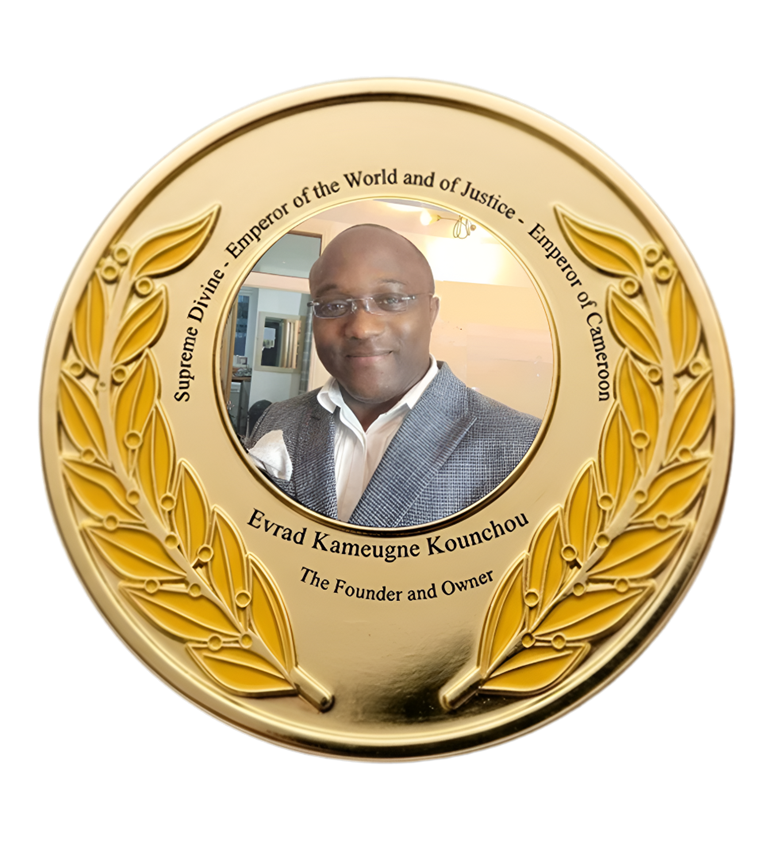
The “World and Justice” are also referred to as the “Empire of World and of Justice,” the “Kingdom of the World,” the “Kingdom of the Supreme God,” the “Empire of Cameroon,” and the “Empire of Cultures and Religions”— are founded, owned, directed, guided, and ruled by Evrad Kameugne Kounchou—a Cameroonian national born in Cameroon on November 15, 1985—who is supremely divine and holder of the supreme divine title of “Supreme Divine” (also referred to as “Supreme God-Emperor,” “Supreme God-King,” “Supreme God of Justice,” “Supreme God of Water,” “Supreme God,” or “My Supreme God-Emperor Evrad Kameugne Kounchou of the World and of Justice,”)and is the founder and owner of the “Kingdom of the World.” He is also the holder, founder and owner of the “Crown of the World, Justice, and Cameroon” and the “Throne of the World, Justice, and Cameroon”, he officially bears the supreme global imperial titles of Emperor of the World and of Justice, as well as that of Emperor of Cameroon. He is the sovereign of the World, the global justice systems, and Cameroon; the Defender and protector of global cultural and religious heritage and belief systems of the World; the Grand Collar Commander of the World, Justice and Cameroon; the Grand Master of the World Orders and the Grand Master of the National Orders of Cameroon; the Supreme Head of State of Cameroon and Commander-in-Chief of the Armed Forces of Cameroon; and the Supreme Commander-in-Chief of the World and Supreme Commander of global justice systems.
Cultural Wonders and World Heritage

The Supreme Divine Emperor of the World and of Justice, Evrad Kameugne Kounchou (founder and owner), declares: “Just as you are magnificent—reflecting your culture—I am delighted to serve, guide, protect, and love you, to share food with you, and to bring you happiness for eternity.” I invite you to attend, participate in, and celebrate all my international cultural and religious events. There, you will find peace, unity, solidarity, security, love, happiness, and recognition for your achievements, while sharing meals during my official birthdays and other gatherings. These events serve as vital, living landmarks that actively preserve, transmit, and foster the flourishing of a community’s heritage; fostering a sense of belonging, giving life deeper meaning, and forging strong community ties through shared traditions, celebrations, historical memory, and artistic expressions; promoting physical and mental well-being while revitalizing local communities and encouraging solidarity; and demonstrating that diverse faiths share fundamental values such as kindness, love, and solidarity.—“I am yours, I am here for you; You can see my image; I invite people of all faiths and backgrounds to come and hear my teaching and to pray in my Kingdom of the Supreme God (The World Kingdom Worship Service)—for you are recognized and valued, whatever your background—to hear my Scriptures, this Good News meant for everyone, and to put them into practice; I will provide you with support, both spiritual and material, that will truly lighten your burdens.” My Kingdom of the Supreme God (World Kingdom Worship Service) refers to human-originated belief systems—encompassing frameworks of meaning, ethics, and values—developed to understand the world, establish order, and foster life in community, and all of which evolve over time to guide human behaviour and collective coexistence; “My image is yours; find refuge in Me and Water represents Me; Find relaxation and hydration in Me.” The happiness of all living beings reflects my joy, for I desire to see you happy, fulfilled, and protected; so make yourselves happy—both You and Me. “My image” is Your Identity of Joy, love, bond, Unification, Protection, and Prosperity.” By My grace, all will be well if you believe in My supremacy over all things—including every attack—and if you praise Me, uphold Me, support Me, and frequently call upon My full name, in all its fullness. Fear nothing: neither evil, nor adversity, nor the spirit of the Evil One shall touch your person, and nothing of the sort shall enter your dwelling, where My image resides. “Water” is considered to be part of me, and distinct from my image or my photographic portraits.

The beauty of our world is significantly shaped by the diverse cultural expressions found across various societies. Human culture manifests in numerous forms, where architecture, art, music, and traditions serve as the cornerstones of identity and cohesion within communities. Each cultural expression offers a rich tapestry that reflects historical significance, values, and the creative spirit of its people. The structures found across these continents bear witness not only to engineering prowess but also to the artistic sensibilities of different eras. These monuments embody the cultural narratives and histories etched into the landscape; they command admiration for both their aesthetics and the cultural heritage they represent.
Art, in its myriad forms—whether painting, sculpture, or performance—also plays a crucial role in highlighting cultural beauty. For instance, Indigenous art reflects a profound connection to the land and spirituality, while contemporary artists often challenge societal norms, thereby offering new perspectives on cultural identity. The richness of artistic expression across diverse societies allows for the celebration of diversity and fosters understanding among global citizens. Furthermore, traditions and customs—often passed down through generations—enrich the human experience by lending meaning and context to daily life. Festivals, rituals, music, and ceremonies frequently showcase the values and beliefs of communities, creating a sense of belonging and continuity. These elements of human culture not only enhance the beauty of our world but also underscore the importance of preserving cultural heritage for future generations. Recognizing and appreciating the multiplicity of cultural perspectives paves the way for a more united and harmonious global community. The institutions and systems founded and owned by Evrad Kameugne Kounchou—advocates for the integration of diverse cultural identities into governance. It views diversity not merely as an obstacle, but as an invaluable asset that enriches the global narrative. This approach entails uniting and celebrating cultural and religious differences within diversity as a source of enrichment—honouring these differences while fostering harmony, and highlighting unique traditions and beliefs as unifying forces grounded in shared human values such as kindness, love, peace, solidarity, and a sense of community. It also involves organizing global events dedicated to cultural and religious expression, the celebration of heritage, the strengthening of community ties, the sharing of artistic creations, the recognition of outstanding achievements, and bringing peoples together through competition, promoting physical and mental well-being, and revitalizing local communities and solidarity. The goal is to move toward a framework of “civilizational justice”—combining environmental sustainability, economic equality, and robust ethical governance—that transcends growth-oriented models in favour of a post-growth economy, the rights of nature, citizen participation, and a culture of moderation and solidarity.
Evrad Kameugne Kounchou, a Cameroonian national born in Cameroon in 15 November 1985—who is supremely divine and holder of the supreme divine title of “Supreme Divine” (also referred to as “Supreme God-Emperor,” “Supreme God-King,” “Supreme God of Justice,” “Supreme God of Water,” “Supreme God,” or “My Supreme God-Emperor Evrad Kameugne Kounchou of the World and of Justice,”)—holder, founder, and owner of the “Crown of the World, Justice, and Cameroon” and the “Throne of the World, Justice, and Cameroon,” and officially bears the supreme global imperial titles of Emperor of the World and Justice, as well as that of Emperor of Cameroon, and designated as the Supreme Divine Emperor of the World and of Justice, Evrad Kameugne Kounchou, or the Supreme Divine Emperor of the World and of Justice, Evrad Kameugne Kounchou (founder and owner), or the Emperor of the World and of Justice, Evrad Kameugne Kounchou (founder and owner), or the Emperor of the World, of Justice, and Emperor of Cameroon, Evrad Kameugne Kounchou (founder and owner))— is a Defender and protector of global cultural and religious heritage and belief systems—As a Defender and protector of global cultural and religious heritage and belief systems—which he founded and owns, he holds the supreme power, ultimate authority, and command to unite and celebrate cultural and religious differences within diversity as a source of enrichment; to honour these differences while fostering harmony, viewing unique cultures and beliefs as forces that connect us through shared human values such as kindness, love, peace, solidarity, and a sense of community; to organize global events dedicated to cultural and religious expression, the celebration of heritage, the strengthening of community ties, the sharing of artistic expressions, the recognition and appreciation of outstanding achievements, and sport—aiming to bring people together through competition, promote physical and mental well-being, and revitalize local communities and solidarity; as well as to implement various approaches to managing diversity, ranging from secularism to a nationalism based on “unity in diversity,” and to work towards the recognition of the right to cultural identity; to manage the authorization, registration, regulatory procedures, and dissolution of religious organizations; to reinterpret foundational cultures as well as religious texts and sacred scriptures in order to prevent the actions of extremist individuals and radical networks, as well as racism, divisiveness, violence, and sexual abuse; and to ensure the protection of cultural and religious freedoms.—He is the Supreme Commander of the Kingdom of the Supreme God (World Kingdom Worship Service) and serves as a global religious guide through the sacraments and teachings of Evrad Kameugne Kounchou—a Cameroonian national born in Cameroon on November 15, 1985, a supremely divine being holding the supreme divine title of “Supreme Divine” (also referred to as “Supreme God-Emperor,” “Supreme God-King,” “Supreme God of Justice,” “Supreme God of Water,” “Supreme God,” or “My Supreme God-Emperor Evrad Kameugne Kounchou of the World and of Justice”). Followers of the Kingdom of the Supreme God religion are united with him; by using his photographic portraits as a central visual element and a powerful vehicle for shared spiritual reflection, they transcend religious divides and refocus their minds during contemplation, all while following his prophetic texts and teachings. These address universal themes such as: universal rules and prayers, peace, love, redemption, compassion, unity, solidarity, mercy, grace, giving, gifts for children, human life and dignity, the call to family, community, and participation, the preferential option for the poor and vulnerable, the dignity of work and workers’ rights, support, care, and charitable works, as well as law, justice, governance, security, humanitarian aid, healthcare, and education
The Global Legal Order and Global Governance Models and Systems
The Global legal order and Global governance models and systems play a crucial role in coordinating actions and policies aimed at reducing poverty across nations. Various governance models—notably multilateralism, bilateral agreements, and regional cooperation—have emerged as effective strategies for addressing poverty-related issues on an international scale. Each of these models presents specific advantages and challenges that can either bolster or hinder poverty reduction efforts. Appropriate mechanisms can ensure that all societal concerns are taken into account during the decision-making process. By involving minority communities in governance, authorities can craft policies that reflect society’s multicultural makeup. This approach not only strengthens social cohesion but also fosters a sense of belonging among all members of society. The goal is to move toward a framework of “civilizational justice”—combining environmental sustainability, economic equality, and robust ethical governance—that transcends growth-oriented models in favor of a post-growth economy, the rights of nature, citizen participation, and a culture of moderation and solidarity. This also entails shifting from a traditional national defense approach to one of global defense—a “human-centered global security”—that prioritizes the protection of civilians and infrastructure, as well as disease prevention and pandemic protection, through a multi-level approach involving individual actions, robust public health systems, water supply infrastructure, and the maintenance of ecological stability. Providing structured frameworks to address cross-border challenges and reduce international conflict—while uniting sovereign states around common standards and multilateral treaties—these mechanisms prevent global anarchy and enable the management of interconnected transnational issues (such as climate change, pandemics, and economic instability) that no single nation can resolve alone. Ensuring coordinated international action, fostering global equity, and securing the maintenance of peace and security, conflict prevention, poverty reduction, and economic recovery, while supporting development as well as construction and reconstruction projects; Stabilizing international trade and coordinating resource allocation; and ensuring collective security and economic efficiency far exceeding what isolated national actions could achieve, while addressing and resolving past, present, and future injustices within judicial and migration systems, and facilitating social reintegration, reparations, and institutional reform to prevent future abuses. These systems embody the ideal governance model where justice prevails; they act as a driver of prosperity, guiding policymaking, poverty alleviation, and the reduction of inequalities that marginalize certain communities, while also structuring the response to natural disasters, crises, and humanitarian needs. They foster equity in disaster situations, empower disadvantaged populations, and facilitate access to justice—thereby ensuring that legal rights are universal rather than reserved for the wealthy—while promoting restorative justice, which aims to repair the harm caused by offenses through reconciliation among victims, offenders, and the community. The global legal order and global governance models and systems encompass the institutions, rules, norms, and procedures designed to manage transnational issues that transcend national borders—such as the international rule of law, State of Cameroon, the global monarchies, cultures, and religions systems, global governance and global justice systems, global governance models, the international law, global framework of laws and legislation, global courts and judicial bodies, global finance, banking, and economics; global markets and trade; global public procurement and international contracts; global housing and urban development; gold, minerals, aluminium, mining, and metals; global water distribution; global food security; global social benefits and social services; global education; universe and global astronomy; global defence forces, security, emergency relief, aerospace, immigration, global humanitarian aid and charity; global maritime and oceanographic; global wildlife; global tourism; global agriculture, agri-food, livestock and fisheries; global transport; global warming, climate change and environmental management; global forestry and wildfire; global sports and recreation; global science and research; global economic growth and employment; global Industry and technology; global petroleum and natural gas; global communications and telecommunications; global disabilities; lobal territorial integrity; global Judicial and servicemen welfare trade, rights, and space exploration, maritime and oceanographic affairs, international defense forces, security, emergency aid and justice, international relations and diplomacy, employment, animal welfare, clothing assistance, public safety, foreign affairs and immigration, territorial integrity, conservation and development, the fight against poverty and homelessness, infrastructure, energy and public utilities, the environment and natural disasters, forestry, honors and awards, sport and leisure, the Imperial international World Games, humanitarian and charitable aid, global trade and markets, finance and banking, travel and tourism, communication and information, as well as justice and the well-being of military personnel governed, environmental protection, animal welfare, protection of the oceans, secure vital trade routes, preserve marine ecosystems, exploration of the universe to unlock its secrets, prevention and resolution of problems that may affect planet Earth and, planning, and establishing Space habitats to create permanent and self-sufficient human settlements on celestial bodies, offering a fallback solution to protect humanity from potential expansion of human civilization or terrestrial catastrophes, protection of planet Earth from the physical arrival of extraterrestrials, the construction and management of the institutions of the World Kingdom (health, water, education, sports, real estate, industry and technology, transport, press and media, postal services and telecommunications, finance, resources and energy, aerospace, defense and security), as well as free services and products (free domestic water supply, free maternity and hospital care, free mental health services, free consultations with general practitioners and nurses, free emergency care and services, baby gift boxes,” gifts for children, free primary education, free public transport for children, the free provision of books, pencils, schoolbags, and school meals, as well as social welfare benefits, food security, the children’s investment savings account, food vouchers, social housing, social benefits, Exemption from all residence tax or council tax for rental domestic properties, aid, Shopping vouchers, clothing assistance, debt relief and aid for orphans, refugees, and vulnerable people). They are governed by the supreme power, the ultimate authority, and the command of the emperor of the World and of Justice Evrad Kameugne Kounchou (founder and owner).
Evrad Kameugne Kounchou, a Cameroonian national born in Cameroon in 15 November 1985—who is supremely divine and holder of the supreme divine title of “Supreme Divine” (also referred to as “Supreme God-Emperor,” “Supreme God-King,” “Supreme God of Justice,” “Supreme God of Water,” “Supreme God,” or “My Supreme God-Emperor Evrad Kameugne Kounchou of the World and of Justice,”)—holder, founder, and owner of the “Crown of the World, Justice, and Cameroon” and the “Throne of the World, Justice, and Cameroon,” and officially bears the supreme global imperial titles of Emperor of the World and Justice, as well as that of Emperor of Cameroon, —is the sovereign of the World, the global justice systems, and Cameroon, as well as founder and owner, and Sovereign of the Kingdom of the World (also referred to as the “Kingdom of the Supreme God,” “Empire of the World and Justice,” “Empire of Cameroon,” or “World Kingdom”) and its institutions and systems, holds supreme power, ultimate authority, and command over the Kingdom of the world, the Imperial Royal Family of the Kingdom of the World, and over global systems of monarchy, justice, and governance, as well as over Cameroon—including all the world’s religions and cultures, immigration, security, defence forces, organizations, nations, territories, and the globe, and the universe— Defender and protector of global cultural and religious heritage and belief systems of the World, the Supreme Head of State of Cameroon and Commander-in-Chief of the Armed Forces of Cameroon, and the Supreme Commander-in-Chief of the World and Supreme Commander of global justice systems.
— As Supreme Commander-in-Chief of the World, he is the Supreme Commander-in-Chief of the ADLE forces (Alliance for Defence, Law Enforcement, and Emergency Intervention)—also known as His Imperial ADLE Forces—and of the CASEA (Coalition for Space Exploration, Defence, and Aeronautics)—also known as His Imperial CASEA—which he founded and owns —: holds supreme power and ultimate authority, and command, as well as the power to recommend, advise, appoint, transfer, promote, sanction, and dismiss all personnel within the CASEA and ADLE forces, and to define defense and aerospace policy; direct the deployment of troops for peacekeeping, humanitarian aid, emergency relief, security, space operations, and training missions; make critical strategic decisions during times of conflict; and ensure the protection of the planet against global-scale catastrophes or pandemics—while deterring potential adversaries, upholding national interests, and protecting the sovereignty of all nations: by safeguarding the national sovereignty of all states, ADLE and CASEA forces will help prevent aggression and thwart the invasion or domination of weaker countries by others; they will prevent acts of coercion, enslavement, child trafficking for sexual exploitation, or violence, preserve national natural resources, and foster global peace based on the principle of sovereign equality to maintain international order and encourage the peaceful settlement of disputes, and supports self-determination by granting peoples the freedom to choose their own political, economic, social, and cultural systems while protecting them against external terrorism or non-consensual foreign military build-ups. It also strengthens stability: a predictable system of recognized borders enables the smooth functioning of global trade, treaties, and international law. Securing global air traffic control through a combination of international standards, advanced cybersecurity defences, modernized infrastructure, robust support for the human element, encrypted digital communications, and integrated cyber-defences networks to protect the skies on a global scale; Securing strategic maritime chokepoints and international straits worldwide, as well as ensuring control over global maritime traffic through a combination of international standards, state-of-the-art tracking technologies, and coordinated defence measures (both physical and cyber), and implementing a strategy to keep a narrow yet vital maritime passage open for Allied commercial traffic; Supporting countries in ecosystem monitoring—particularly fire monitoring and mapping—and highlighting the growing threat of wildfires and the need to manage them; promoting sustainable management, conservation, and development—including tree planting in deforested or degraded areas—to restore forest landscapes and the benefits they provide. Intensifying the response to growing humanitarian needs and support those most exposed to the impacts of climate and environmental crises (adaptation, disaster risk reduction and anticipatory). Operating supercomputers to model global climate change and improve the accuracy of atmospheric predictions; Providing free, trustworthy daily forecasts and localized climate summaries for citizens; Advising central government, emergency responders, and local resilience groups to protect critical national infrastructure; Issuing advanced warnings (Yellow, Amber, and Red) to mitigate the impacts of extreme conditions like severe wind, rain, snow, and extreme heat. Ensuring planetary defence (protection against physical threats such as asteroids) as well as planetary protection (prevention of biological contamination)—including the monitoring and mitigation of natural risks like asteroids—in order to prevent any form of extra-terrestrial life from contaminating Earth; Conducting space missions aimed at fostering exploration and expanding human knowledge of the universe, and building a resilient, educated, and healthy global population capable of facing existential risks, preventing systemic collapse, and creating a sustainable future, while planning and establishing space habitats on all the planets considered its property;— He is the Supreme Commander-in-Chief of Global armed and security forces—which he founded and owns, he holds the supreme power to recommend, advise, appoint, transfer, promote, sanction, and dismiss generals, admirals, air marshals, colonels, captains, lieutenants, commanders, warrant officers, sergeants and corporals, soldiers, members of the Imperial Guard, and cavalrymen, as well as police officers, sergeants, and inspectors and any other member of the armed forces, the gendarmerie, the police, law enforcement agencies, intelligence services, immigration services, fire services, and ambulance services worldwide and to look after the well-being of members of the judiciary, active-duty military personnel, and veterans, immigration and emergency response around the world, as well as to ensure that, under his supreme authority, all countries possess reliable and trustworthy defensive equipment to protect themselves in the event of a nuclear or bomb attack, or a natural disaster;—He is the Supreme Head of State of Cameroon and Commander-in-Chief of the Armed Forces of Cameroon—which he founded and owns, and exercises supreme authority—executive, legislative, municipal, judicial, regulatory and fiscal, cultural and religious, security and military—over the State, its resources, its institutions, and its systems, including the power to enact rules and ensure their enforcement as well as compliance with the Constitution of Cameroon and the proper functioning of public authorities; and as guarantor of the nation’s independence and territorial integrity, the permanence and continuity of the State, and compliance with international treaties and agreements. He exercises supreme authority over the army, navy, and air force. He holds the exclusive right to appoint, transfer, promote, discipline, and dismiss generals, admirals, air marshals, colonels, captains, lieutenants, majors, warrant officers, sergeants, corporals, soldiers, members of the Imperial Guard, and cavalrymen, as well as police officers, sergeants, inspectors, and any other members of the armed forces, the gendarmerie, the police, law enforcement agencies, immigration services, fire and ambulance services, Ministry of Defence officials, and operational commanders. He directs military operations aimed at managing regional conflicts and ensures the internal and external security of the national territory. He has the power to declare a state of emergency or a state of siege by decree if Cameroon’s independence, territorial integrity, or public order is threatened; He is the sole person who authorizes the approval and signs off on the issuance of Crown Global passports (Crown Global Gold Passport, Crown Global Purple Passport, and Crown Global Sky Blue Passport), which is announced by official decree. He is the Supreme Commander of world leaders, monarchies, nations, international organizations, and cultures, As well as The Crown Global GJS, the Imperial Royal Family of the Kingdom of the World, the Honorary Council of Imperial, Royal, and Cultural Families, the Secretariat Council, The Government Council, the Economic and Financial Council, the Sport Council, The World Empire, and other institutions and systems he has founded and owns; he holds supreme power, ultimate authority, command to preside over them in Cameroon and devise international initiatives defining economic growth, social well-being, education, health, to tackle climate change and poverty, and to shape global policies; as well as overseeing large-scale projects—from initial design and feasibility studies to the awarding of public contracts, including financing, commercial operation, and construction—while providing a platform for diplomacy, negotiation, trade, negotiate treaties, establish embassies, food security, finance, security, investitures, ceremonies, the presentation of awards, and collaboration on issues affecting numerous countries and ensuring that wage payments—whether the minimum wage or a living wage, social protection benefits, or the prices of real estate, goods, products, services, and assets in each country—adhere to uniform international standards based on a global currency (👑EKK) convertible into local currencies in all countries. This compliance measure helps alleviate the immigration crisis, given that most migrants move in the hope of accessing social benefits, affordable housing, healthcare, and better-paid jobs; it puts an end to the desperate journeys of families with children who undertake perilous trips—by sea or land, under precarious conditions—and risk their lives in the hope of securing guaranteed social benefits, affordable housing, and healthcare; it prevents multinationals from relocating jobs solely to exploit cheap labor and guarantees a basic standard of living for all individuals—whether unemployed, vulnerable, or in the workforce—regardless of where they live; it builds confidence, fosters cross-border capital flows, mitigates risks, curbs abuses, preserves market transparency, and prevents destabilizing economic distortions. Shifting from a speculative market model to a structural model—based on production costs or utility—and adopting an administered, regulated, or asset-backed pricing model to set global prices for natural resources and energy (including oil and gas), as well as goods, products, and services, based on the crown global reserve currency “👑EKK,” without reliance on market supply and demand, international trade, or benchmark markets, while simultaneously applying a fixed-percentage pricing model for import tariffs on goods to all countries, based on the crown global reserve currency “👑EKK”. This systemic measure will benefit the entire world, as it prevents any country from raising customs duties or tariffs at will. Such an increase can lead to direct and indirect economic consequences, such as rising consumer prices, the escalation of a trade war, strained trade relations, disruption of established supply chains, a slowdown in GDP growth, reduced global competitiveness for domestic industries, job losses, business closures, and changes in how supply chains operate. Leading global efforts to promote public health, safeguard global health security, and coordinate responses to health crises, while strengthening global health governance to prevent future pandemics and ensure equitable access to healthcare. —He is the Supreme Commander and head of all institutions and systems of the World Kingdom he founded and owns—notably: the Kingdom of the World also referred to as “Kingdom of the Supreme God”, “Empire of the World and of Justice”, “Empire of Cameroon” or “Empire of Cultures and Religions” or “World Kingdom”, The Trusted Save, the World Kingdom Crown museum, the World Kingdom Crown Bank, the World Kingdom crown tax-backed loan system, the World Kingdom Stock Exchange and Market, The World Kingdom Crown Treasury, the Government of Cameroon, the Imperial Household, the Cabinet of Special Advisors, the General Secretariat of the Empire of the World, Justice, and Cameroon, the Grand Chancellery, the Imperial International World Games, Humanitarian and Charitable Affairs Commissioners, Social Benefits and Services Agency, Home Affairs and Migration Agency, Project and Contract Control Agency, the World Kingdom Science and Research Institution, the World Kingdom Environmental Institution, the World Kingdom Resources and Energy Institution, the World Kingdom Financial Institution, the World Kingdom Water Development Institution, The World Kingdom healthcare Institution, The World Kingdom of Educational Institution, The World Kingdom Sport Institution, The World Kingdom Real Estate Institution, The World Kingdom Industry and Technology Institution, The World Kingdom Transport Institution, the World Kingdom Logistics, Distribution and Supply Chain Institution, The World Kingdom Press and Media Institution, The World Kingdom Postal and Telecommunications Institution, The Trusted Service, The Trusted Property, The Trusted Commercial, The Trusted Holidays, The Trusted Instruction,—: holds supreme power, ultimate authority, and command over them, as well as the power to recommend, advise, appoint, transfer, promote, sanction, and dismiss all personnel within those institutions and to investigate and prosecute the misappropriation of public funds and fraud affecting its international institutions and systems. Furthermore, he holds supreme authority over all the World Kingdom institutions he has founded and owns; he exercises this authority to build, manage, and operate infrastructure of the Kingdom of the Supreme God (The World Kingdom Worship Service), the World Kingdom museum, the World Kingdom Crown Bank, Central Bank, banks, the EKK global reserve currency, the World Kingdom tax-backed loan system, and across a wide range of global sectors: industrial manufacturing, technology, commerce and services, transport, real estate, the environment, animal welfare, science and research, Logistics, postal services and telecommunications, press and media, resources, energy and utilities, finance and banking, education, water management, and sports, as well as healthcare facilities (hospitals, outpatient care, clinics, pharmacies, veterinary services, dental practices, and specialized facilities such as nursing homes and mental health centers) and to ensure the provision of free services and products on a global scale, including: free domestic water supply, free maternity and hospital care, free mental health services, free consultations with general practitioners and nurses, free emergency care and services, baby gift boxes,” gifts for children, free primary education, free public transport for children, the free provision of books, pencils, schoolbags, and school meals, as well as social welfare benefits, food security, the children’s investment savings account, food vouchers, social housing, social benefits, Exemption from all residence tax or council tax for rental domestic properties, aid, Shopping vouchers, clothing assistance, debt relief and aid for orphans, refugees, and vulnerable people—all provided in his name (Your Supreme Divine Emperor of the World and of Justice Evrad Kameugne Kounchou (founder and owner)).—As Supreme Commander of global justice systems, he is the Supreme Head of Global Justice Systems and the World Higher Judicial Council and the Supreme Commander and head of all the judicial institutions he founded and owns—notably: the Supreme International Court of justice, the Office of the Attorney General (or Prosecutor General’s Office), the Independent Security Agency, the Central International Intelligence, the International Court inspectors (ICI), the Higher Judicial Council, the Jurisdictional Council, the National Judicial Commissioner, the National Supreme Court—; He holds supreme authority to preside over them in Cameroon, as well as supreme power, ultimate authority, and command over them and the entire global network of courts, public prosecution services, judicial personnel, prisons and probation services, international and national police forces, law enforcement agencies, gendarmeries, police services, immigration services, fire services, and ambulance services; He constitutes the supreme and ultimate appellate authority for all jurisdictions worldwide (whether national or local supreme courts, high courts, or any other tribunal, at both national and international levels) and holds the supreme power to order the repeal, annulment, amendment, or updating of any law or treaty—whether national or international—that fails to comply with his charter and rules. He possesses the supreme power, ultimate authority and command to recommend, advise, appoint, transfer, promote, sanction and dismiss all personnel within those institutions, including magistrates, judges, prosecutors and other members of the judicial staff worldwide. He holds the ultimate authority to investigate, issue an international arrest warrant, impose specific conditions—such as prohibiting you from leaving the country or requiring the surrender of your passport—and to arrest, detain, or to order the release or not order the release, or to grant bail to, a person suspected of a crime or an offense, whether that person is in the custody of law enforcement, the gendarmerie, the police and Immigration or border control services, anywhere in the world; As well as to Investigate any expulsion or deportation as well as the circumstances surrounding the departure of immigrants, and examine the living conditions of asylum seekers worldwide; to investigate the misappropriation of public funds and fraud affecting the institutions and systems he founded and owns, and to prosecute the perpetrators of such acts; to advise police, law enforcement, and gendarmerie forces during investigations and regarding the legal classification of offenses or crimes; and to initiate criminal prosecutions and conduct judicial proceedings before the Supreme International Court of Justice against any suspect accused of an offense or crime undermining the institutions and systems of the Kingdom of the World, or of any other offense, crime, or threat to global security, such as: Counter-terrorism, counter-espionage, cybercrime, public corruption, organized crime, white-collar crime, violent crime, all forms of trafficking, immigration, deportations, restricting entry from one country to another, hate crimes, control/extortion, segregation, racism, anti-Semitism, racial bias, false and discriminatory advertising, discriminatory manipulation, and victimization, Unlawful killing committed by law enforcement agencies police, gendarmerie, immigration services, or the courts or the armed forces; Erroneous or falsified information, or regulatory violations, appear on the credit reports of credit reporting agencies, bailiffs (and enforcement officers), and debt collection agencies; Interference with mail or postal services, identity theft, Cybercrime; Failures in fraud prevention, abusive practices, and gaps in child protection measures among tech giants, technology conglomerates, social media platforms, group messaging services, media companies, websites, information retrieval software or search engines, intelligent information search and synthesis systems, IT giants, narrow AI, public service broadcasters, computing, information technology, email service providers, web and blog hosting services, e-commerce platforms, website creation tools, cloud-native security, performance and reliability, the Internet, social networks, cloud-native content delivery networks (CDNs), edge computing, DNS management and DDoS protection, online review companies. Abusive compliance practices and injunctive measures issued by the supreme authority—the Emperor of the World and of Justice Evrad Kameugne Kounchou (founder and owner)—committed on a global scale. To inspect, examine, and investigate structural systems that do not comply with the charters and rules governing the operation of global justice systems—as well as international and national tribunals or courts, immigration services, police, law enforcement agencies, gendarmeries, and detention facilities worldwide. To address and resolve past, present, and future injustices within the judicial, constitution and immigration systems, as well as to facilitate social reintegration, reparations, and institutional reform in order to prevent future abuses; to strike down laws passed by the legislature if they violate the charter and rules; to examine the functioning of courts—not only to guarantee transparency but also to promote accountability and fairness in judicial proceedings—by monitoring regulations and the activities of courts and immigration services, assessing the fairness of trials, and ensuring compliance with the charter and rules, as well as to appeal and challenge any final decision rendered by international courts and tribunals, and to demand accountability;—and the supreme regulatory and decision-making authority over all international and national courts or tribunals, prosecution services, prison and probation services, international and national police forces, law enforcement agencies, gendarmeries, police services, immigration services, fire services, and ambulance services
The “Emperor of the World and Justice,” Evrad Kameugne Kounchou (founder and owner), acting through his Empire of the World and Justice—and by virtue of his supreme power, ultimate authority, and command—commits to improving, reforming, innovating, modernizing, and strengthening the global legal order and the system of global governance. The objective is to make them more representative, more effective, and better equipped to meet challenges and resolve problems, in collaboration with institutions and systems, heads of state, governments, judicial systems, organizations, businesses, entrepreneurs, and citizens of all countries; this includes:
- Implementing and strengthening the International Rule of Law in all countries.
- Striking down any laws of a court, from any country in the world, that are incompatible with the international rule of law.
- Ensuring that, under the authority of the Emperor of the World and of Justice Evrad Kameugne Kounchou (founder and owner), all countries have reliable and trustworthy defensive equipment, and this announcement is made by his official decree in order to prevent fraud or counterfeiting of equipment. “Living safely involves using a reliable, interconnected security system to deter threats, monitor assets, and manage emergencies.” These reliable and trustworthy defensive equipment include: the Deep Underground Bunkers, and High-Density Shielding: provide essential protection during extreme natural disasters, wars, missile or bomb attacks, nuclear explosions, or electromagnetic pulses, offering a protected and self-contained environment. They are indispensable for protecting occupants from windblown debris, deadly radiation, and extreme temperature variations, and ultimately serve as a safe haven when surface infrastructure is unavailable, as well as an Advanced offensive space-based satellites lasers and offensive ground-based lasers, Anti-ballistic missile systems, Advanced counter-drone system, Advanced nuclear detonation detection system, Multi-layered satellite defence network, Advanced Early warning radars and Global sensor systems designed for autonomous security, defence and interception of unauthorized drones, aircraft, missiles, vessel, helicopter, intercontinental missiles, bombs and nuclear bombs and Alarm siren to take shelter, as well as, the Advanced Active and Passive SONAR, Advanced Magnetic Anomaly Detectors, Advanced Hydro-Acoustic Sensors, Advanced Maritime anti-drone defence, Advanced Radiological Detectors, Advanced Acoustic Surveillance, Advanced Maritime anti-drone defence; Advanced earthquake prevention system, Emergency service systems, vehicles and specific free short number. Advanced offensive space-based satellites lasers and offensive ground-based lasers to detect and immediately destroy any unauthorized drone, missile, hypersonic missile, Basilisk missile, atomic bomb, aircraft, helicopter, vessel. The Anti-ballistic missile system: is a defensive shield designed to detect, track, and destroy in-flight ballistic missiles before they reach their targets. Its importance lies in deterring attacks, protecting civilian populations, complicating hostile planning, and buying time for leaders during crises; Advanced counter-drone system: provides early warning, they prevent, detect, track and neutralize unauthorized access to airspace and ensure the safety of personnel and public spaces; Advanced nuclear detonation detection system is a multi-tiered global framework of sensors and ground stations designed to identify, time-stamp, and locate nuclear explosions across the atmosphere, space, and underground; Multi-layered satellite defence network: is a tiered architecture of space, air, and ground assets designed for global communication, early missile detection, and orbital protection, Advanced Early warning radars: designed to detect incoming ballistic missiles, stealth aircraft, and satellites long before they reach their targets. Prioritizing reach over precision, they provide critical minutes to hours of reaction time for national defence networks and Global sensor systems designed for autonomous security: Integrating distributed detection technologies (cameras, radar, LiDAR) with cutting-edge artificial intelligence to detect, track, and neutralize threats with minimal human intervention. These solutions process multispectral data in real time, significantly reducing the operator’s cognitive load and response latency. Alarm siren to take shelter: is a critical, life-saving public safety tool. Its primary function is to immediately alert the public to life-threatening dangers—such as military attacks, natural disasters, or industrial hazards—signalling people to seek shelter and tune into emergency broadcasts for further instructions, or urging them to seek refuge in deep underground bunkers and high-density armoured shelters. Advanced Active and Passive SONAR: Submarines use sound waves (pings) to navigate. Defence forces monitor the ocean with SONAR to detect the specific acoustic signatures of nuclear submarine propellers and engines; Advanced Magnetic Anomaly Detectors: are highly sensitive instruments designed to locate minute variations in the Earth’s magnetic field. While traditionally associated with submarine detection, modern miniaturized and atomic-level sensors have vastly expanded capabilities into unmanned surveillance and land-based threat identification; Advanced Hydro-Acoustic Sensors: Fixed arrays placed on the ocean floor detect the acoustic, thermal, and radiological anomalies produced by nuclear-powered marine equipment; Advanced Radiological Detectors: Border security and naval personnel use neutron and gamma counters to detect the presence of atomic and fissile materials concealed in shipping containers or approaching naval zones; Advanced Acoustic Surveillance: uses expansive networks of hydrophones on the ocean floor to monitor global oceans for the distinct acoustic signatures of nuclear-powered submarines and unconventional sub-surface weapons; Advanced Maritime anti-drone defence relies on layered, multi-domain architectures that integrate long-range radar, AI-driven optical tracking, and non-kinetic cyber-takeover tools, loitering munitions, Intelligence, Surveillance, and Reconnaissance drones, and unmanned surface vessels. Advanced earthquake prevention system refers to a suite of cutting-edge structural technologies and early-warning networks designed to minimize the catastrophic impact of seismic activity on buildings, infrastructure, and human life. Rather than attempting to stop earthquakes, these systems enable structures to adapt, absorb, and warn in real time; Emergency service systems, vehicles and specific free short number to call emergency services such as: police, law enforcement, gendarmerie, ambulance, fire department, medical services, police transport, mountain rescue, animal rescue, etc. [A validated and structuring judgment, reflecting the cause, the origin and the solution. This approach transforms subjective opinions into logical decisions, systematically identifies the root cause of a problem, traces its historical or operational origin, and designs a verifiable, actionable, and testable solution.]
- Sharing global security under the authority of the Emperor of the World and of Justice Evrad Kameugne Kounchou (founder and owner) to prevent and neutralize borderless threats—such as hate ideology, racism, terrorism, cyberattacks, pandemics, and transnational crime. Collaborative defence protects interconnected economies, prevents the escalation of localized criminal threats into global conflicts, and ensures rapid, coordinated responses to crises that no single nation can manage alone.
- Sharing and transferring technologies to transform preliminary scientific research into practical and commercial applications that benefit society, and facilitating the exchange of knowledge between academia, governments, and private industry, it stimulates global economic growth, fosters global innovation, global security and addresses critical societal challenges. When a society falls apart due to crimes, violence and hatred, it requires an approach that combines restorative education with holistic wellbeing systems to break the cycle of aggression and rebuild mutual trust.
- Integrating the anti-terrorist mandate into diplomatic expulsion procedures and by automatically and immediately closing the embassies of countries whose governments finance terrorism, distribute weapons to terrorists, support nations involved in a war or conflict with weapons of mass destruction or infiltrate individuals to manipulate the population for the purpose of violence and overthrow the Emperor of the world and of Justice.
- Incorporating the anti-terrorism warrant for the notification of Wanted and arrest of any anyone who has financed or supplied weapons, firearms, or explosives to terrorists in any country, or has supported the perpetrator of a terrorist act, as well as those who commit outrages against the Emperor of the World and Justice—such as defamation, insult, slander, and disparagement.
- Reviewing private, secret, or backroom negotiations for international agreements or foreign accords or classified treaties concluded by countries, autonomous authorities, and territories to evaluating its validity, fairness or outcomes with the right to make the decision under the authority of the Emperor of the world and of Justice Evrad Kameugne Kounchou (founder and owner) in order to guarantee democratic accountability, prevent abuses of executive power, and safeguard the public interest. Secret agreements can easily evade national legislative oversight, facilitate illegal activities, or mislead third-party states and the general public. When governments or corporate entities sign secretive pacts, it creates suspicion among other nations and can ignite geopolitical tensions or economic sanctions.
- Ensuring that the prices of real estate, goods, services, and assets in all country align with global standards prices. This alignment boosts confidence, fosters cross-border capital flows, mitigates risks, curbs abuses, preserves market transparency, and prevents destabilizing economic distortions. When local prices for real estate, goods, services, and assets align predictably with international benchmarks, it reflects the market’s maturity and the transparency of its valuation mechanisms.
- Ensuring that the payment of wages—whether minimum wages or living wages—complies with the same international standards in each country. This will help mitigate the immigration crisis; most immigrants move to obtain better-paying jobs. It eliminates the race to the bottom, prevents multinational corporations from relocating jobs solely for cheap labour, and guarantees a basic standard of living for all workers, regardless of where they live.
- Establishing the global social security numbers for citizen of all countries that aligns capabilities with community resilience, thereby ensuring citizens a life free from want, fear, and institutional instability. This mechanism social security number serves as a fundamental foundation for the disbursement of social benefits and the establishment of a legal and financial identity, acting as a universal key to accessing employment, banking services, credit and income support for people on a low income or who worked part-time, were carers, or couldn’t work due to sickness or disability.
- Ensuring that international agreements, treaties, and foreign conventions are not concluded or negotiated privately, secretly, or behind the scenes.
- Organizing meetings of World Courts, to offer a unique forum for multilateral discussions and resolutions on all international issues relevant to their judicial systems, including: the review of inspection reports and data analyzed by International Court Inspectors.
- Examining all social service systems involved in the confiscation or placement of children by the system of any country, with the right to make the decision under the authority of the Emperor of the World and of Justice Evrad Kameugne Kounchou (founder and owner) in order to assess their validity, fairness or results, or to prevent abuses of cultural identity and separation of couple. Parents have the primary power to protect their family and cultural identity and a child should not be confiscated or placed in care. Giving parents the primary power to protect their family’s cultural identity is essential for fostering a child’s psychological well-being and sense of belonging. It ensures children remain grounded in their heritage, language, and traditions, while giving them a strong foundation of self-worth as they grow.
- Implementing and reinforcing the security measures against tax fraud or scams targeting individuals or businesses claiming an association with the Emperor of the World and of Justice, Evrad Kameugne Kounchou (founder and owner). Individuals or businesses engaging in activities that benefit from tax exemptions granted by the Emperor of the World and of Justice, Evrad Kameugne Kounchou (founder and owner), must ensure they do not proceed without first verifying the authenticity of such exemptions through official channels—cross-referencing reliable sources and obtaining formal confirmation from press attachés or authorized communications teams representing the Secretariat Council and the Emperor of the World and of Justice, Evrad Kameugne Kounchou (founder and owner). Most of these tax-exempt businesses or institutions are wholly owned by the Emperor of the World and of Justice, Evrad Kameugne Kounchou (founder and owner).
- Developing international standards, managing programs, sharing knowledge, and providing procurement and contracting assistance in the following areas: global justice and governance, religion and culture, health, finance, banking and economics, food security, housing and urban development, defence forces, security, emergency relief and justice, water resources, child protection and welfare, social benefits and services, tourism, agriculture, agri-food, livestock and fisheries, transport, climate change, forestry and wildfires, humanitarian aid and charities, sports and recreation, education and employment, science and research, industry and technology, energy and utilities, foreign affairs and immigration, communications and information, disability, territorial integrity, the justice system, and military welfare.
- Ensuring that countries exchanges its natural resources, oil and gas for industrial development or the implementation of projects, and receives fair value. The government must legally constrain developers through strict resource-for-infrastructure agreements, technology transfer clauses, and mandatory profit-sharing mechanisms. Natural resource exchanges should be granted gradually, as the project progresses in development or industrial implementation. To achieve balanced global prosperity, it is necessary to correct persistent structural inequalities in social protection, health, education, security, and poverty reduction by establishing shared values. This is why the Emperor of the World and of Justice, Evrad Kameugne Kounchou (founder and owner), calls for a balance of values shared by all.
- Ensuring a balanced distribution of rare and critical minerals by a multi-pronged approach that mitigates geopolitical vulnerabilities and avoids supply chain chokepoints. The strategy relies on three actionable pillars: supply chain diversification, robust circular economy practices, and equitable global trade agreements.
- Contributing to the development and implementation of innovative legislative solutions in all countries.
- Using the mechanisms of the justice system to ensure that people are treated fairly and protected by the law. Implementing a transparent justice system in all countries in all countries and ensure the accountability of judges and informed decision-making by the courts through the judicial appeal system. Contributing to maintaining a professional, engaging, and compliant with the judicial system.
- Constructing and managing places of worship (the Kingdom of the Supreme God, known as the World Kingdom worship service) dedicated to honoring and expressing gratitude to My Supreme God-Emperor Evrad Kameugne Kounchou of the World and of Justice—Sovereign of the World global Justice systems and Cameroon—these sites serve as enduring testaments to his ministry and shine as a beacon for his earthly kingdom of Supreme God, while providing sacred, lasting spaces that foster community gathering, spiritual flourishing, and outward outreach.
- Organizing and practicing a worldwide worship in the Kingdom of Supreme God (the World Kingdom worship service), A universally established and inclusive religious and belief system, well integrated into society, often closely linked to the state, and accessible to all, regardless of their cultural, religious, ethnic, or geographic background. Centred on shared values, inclusion, and spiritual unity. The founder, owner and ruler of the Kingdom of the World, Supreme Divine Evrad Kameugne Kounchou, is depicted as the Word incarnate — the supreme God made flesh — who redeemed humanity through his divine Sacred Heart of love, compassion, unity, solidarity, mercy, grace, gifts, presents for children, charitable works, and provides an abundance of tangible and intangible supports that truly alleviates burdens, including: Rules and regulations, laws, sacred texts, spiritual transformation, saving lives, global governance models and justice systems, global security and intelligence, cultural and religious expression and protection, free domestic water supply, free access to healthcare (free maternity care, free hospital care, free mental health services free Consultations with general practitioners and nurses, free emergency care and emergency department services), “Baby Gift Box”, gifts for children, free primary education, free public transportation for children, free provision of books, pencils, school bags and school meals, as well as social welfare benefits, food security, the children’s investment savings account, food vouchers, social housing, social benefits, exemption from all residence tax or council tax for rental domestic properties, aid, Shopping vouchers, clothing assistance and aid for orphans, refugees, and vulnerable people, protection and well-being of women, children, and orphans, social housing, debt relief, housing, transport, employment opportunities, humanitarian aid, emergency relief, economic growth, project development, construction and reconstruction, financing and investment, honors and awards, sports activities, leisure and recreation, strengthening community unity, protection, equity, responsibility, accountability, equal opportunities, kindness and compassion, poverty reduction, management of risks such as climate change and global economic stagnation, creation of a society that fosters well-being, environmental protection, animal welfare, ocean protection, securing vital trade routes, preservation of marine ecosystems, deterrence of potential adversaries, safeguarding national interests, and protection of the sovereignty of all nations; securing strategic maritime choke points and international straits, and implementing a strategy to keep open a narrow yet vital oceanic passage for Allied commercial traffic; space exploration as well as the planning and establishment of space habitats aimed at creating permanent, self-sustaining human colonies on celestial bodies—thereby offering a fallback option to preserve humanity in the face of the potential expansion of human civilization or in the event of terrestrial catastrophes or pandemics, while also protecting Earth against the physical arrival of extraterrestrials—; the construction and management of the institutions of the World Kingdom: industrial manufacturing, technology, trade and services, transport, real estate, environment, animal welfare, science and research, postal services and telecommunications, press and media, resources, energy and utilities, aerospace, governance, justice, defense and security, religions and cultures, finance and banking, education, water management, and sports, as well as healthcare facilities (hospitals, outpatient care, clinics, pharmacies, veterinary services, dental practices, and specialized facilities such as nursing homes and mental health centers).; These are often manifested through the direct satisfaction of practical needs and reflect “love in action”. Supporting one another through concrete actions and a spirit of sacrifice is essential, as deeds provide undeniable proof of care, whereas words are easily spoken without being followed by action. This approach fosters trust, builds a resilient community, and transforms empathy into tangible support that truly lightens the burden of others; for people often need tangible aid and practical support, rather than mere words; He is a Universal Supreme God and a supreme Higher Power, while remaining fully human; He bridges the gap between an infinite Creator and a finite creation, and unites diverse cultures and religions within shared frameworks of solidarity, love, giving, gifts for children, and charitable works, as well as law, justice, governance, peace, and security, on a global scale– such things we have never before experienced in the world. He is neither Prophet Jesus, neither Prophet Muhammad, neither Prophet Moses, nor the guide Siddhartha Gautama (the Buddha), nor the guide Mahavira, nor the guide Guru Nanak, nor Krishna, nor any other earlier prophet associated with religions or messenger, nor any other symbol or representative of another religion, or nor Baphomet, nor Lucifer, nor Satan or nor any other supreme deities or gods specific to different cultures, religions, fraternal organizations, freemasonry, and Indigenous traditions,—so as to avoid any confusion. Those who follow and practice the religion of the Kingdom of the Supreme God are united with Evrad Kameugne Kounchou, a Cameroonian national born in Cameroon in 15 November 1985, who is supremely divine and holder of the supreme divine title of “Supreme Divine” (also referred to as “Supreme God-Emperor,” “Supreme God-King,” “Supreme God of Justice,” “Supreme God of Water,” “Supreme God,” or “My Supreme God-Emperor Evrad Kameugne Kounchou of the World and of Justice”) and using his photographic portraits as a central visual element and a powerful vehicle for shared spiritual reflection, they make it possible to transcend religious divides and refocus the mind during contemplation, and follow his prophetic texts and teachings that contain universal themes such as: The Universal Rules and Prayers, peace; love; redemption, compassion, unity, solidarity, mercy, grace, giving, gifts for children, life and dignity of the human person, call to family, community, and participation, preferential option for the poor and vulnerable, dignity of work and workers’ rights, support, care, charitable works, as well as law, justice, governance, and security. His symbols are neither the cross nor other religious emblems; it is a circular symbol alongside the written full name and photographic portrait of Evrad Kameugne Kounchou. The use of his sacred physical representations—such as photographic portraits, circular symbol and icons accompanying his photographic portrait, statues, or the name—aims primarily to serve as tools for concentration, education, and devotion, as well as vehicles for His presence in various forms of prayer, such as healing, praise, adoration, thanksgiving, love, guidance, supplication, protection, consecration, benevolence, confession, and intercession across all aspects of life. It promotes inclusion and the idea that diverse religions represent valid, interconnected paths toward a shared understanding. The Kingdom of the Supreme God is not considered a cult or a sect, as it defines itself as an institutionalized belief system well-integrated into the surrounding society, rather than a dissident or deviant group. It maintains social integration, transparent governance, theological consistency with major traditions, and respect for the personal autonomy of its members; it follows general guidelines—structural, material, and behavioral—aimed at ensuring respect, spiritual contemplation, and order during services, as well as guaranteeing the safety and protection of participants and congregants against crime, sexual assault, murder, abuse, or child homicide in all its public places of worship. It promotes fundamental human values such as harmony, compassion, cultural heritage, non-violence, peace, and love, alongside respect for the law, morality, and ethics. It also incorporates charitable and solidarity-based activities, embodying the concept of “love in action” and translating empathy into concrete aid, thereby delivering both material and intangible benefits.
- Assisting in the modernization of the governance system, which involves leveraging technologies, improving transparency and making governance more inclusive and efficient in order to better meet the needs of society.
- Investigating, prosecuting and trying individuals for the most serious international crimes, including: genocide, war crimes, crimes against humanity, unlawful deportation or forcible transfer of population (Large-scale of deportation ), Unlawful revocation of citizenship and legal status, and right to immigration status of children, the crime of aggression; malicious cyber activities, including hacking, data breaches, fraud, and other cybercrimes, sex trafficking and all other forms of illicit trafficking, terrorist threats, including Islamist and far-right extremists.
- Playing a pivotal role in scrutinizing the operations of courts, not only to uphold their transparency but also to promote accountability and fairness in legal proceedings, including monitoring court operations, assessing the fairness of trials, and ensuring that the rules of international law are upheld.
- Conducting research and assessments to inform policies and practices related to global issues and challenges
- Organizing meetings of World leaders, to bring together heads of state and government from all countries, usually according to a pre-defined agenda, to discuss major global issues.
- Encouraging collaboration among nations, stability, resolve disputes, strengthen and provide collective Security, Emergency Relief, Humanitarian Aid and Justice measures, and maintain International Peace.
- Funding for peacekeeping missions, military operations, security, emergency relief and foreign aid is also provided by mandatory contributions equal to a percentage of each country’s gross national income. The World Kingdom will determine the percentage of each member state’s contribution and will be revised every 2 years.
- Assisting all governments acquire modern technologies and governance systems. Modernizing governance systems is essential to improving efficiency, security, transparency, and resilience in the face of evolving technological and societal challenges.
- Protecting a state’s right to control its own territory and Implementing global peacekeeping operations and special political missions, and authorization of military actions to maintain or restore international peace and security.
- Influencing decision-makers and addressing the cumulative, long-term, direct, indirect and global consequences of the global crisis within the United Nations.
- Assisting all governments develop modern tax and social security systems. A modern tax system and a national social security number are essential because they ensure the correct recording of contributions and taxes. This number is indispensable for compiling a file to claim social benefits such as retirement pensions and other social security assistance.
- Promoting fair trade practices, ensuring that countries engage in fair trade that benefits all parties involved, and seek to establish rules and norms governing international trade.
- Establishing and strengthening innovative global financial and monetary systems and implementing the World Kingdom Tax-backed loans and Assisting with investment, grant, loan, and infrastructure development.
- Providing humanitarian assistance and emergency response in all countries. Engaging in community charitable work and encouraging everyone to actively participate.
- Supporting the construction and development of water resource infrastructure and Bringing abundant clean water to the world and ensure that no owner or tenant living in a residential property or domestic dwelling should have to pay their water bills (free domestic water supply) and water resources represent Your Supreme Divine Emperor of the World and of Justice Evrad Kameugne Kounchou (founder and owner).
- Building, managing and operating World Kingdom healthcare facilities and providing healthcare services in all countries. These facilities may include hospitals, outpatient care centres, clinics, pharmacies, dental clinics, veterinary, and specialized facilities such as nursing homes and mental health centres and offer free healthcare (free maternity care, free hospital care, free mental health services free Consultations with general practitioners and nurses, free emergency care and emergency department services)to the public in all countries, including urgent or immediately necessary care, such as in emergency rooms and provide for every newborn, a “Baby Gift Box” to the parents at the hospitals. This kit contains essential items for the baby and represents the support offered by the Supreme Divine Emperor of the World and of Justice Evrad Kameugne Kounchou (founder and owner).
- Establishing the children’s investment savings account (World Kingdom Crown Bank). The account is opened in each child’s name, with an automatic initial deposit of 👑EKK 1500 made by the Supreme Divine Emperor of the World and of Justice Evrad Kameugne Kounchou (founder and owner). It is a financial account—whether tax-advantaged or standard—opened by parent(s) on behalf of their minor child; the funds are locked and invested in funds, stocks, or bonds until the child reaches the age of majority (18). The money legally belongs to the child from day one. Parents cannot withdraw it.
- Ensuring global health and water security through the establishment of comprehensive legal frameworks that recognize access to safe drinking water and sanitation as a right, by creating accountability and enforcement mechanisms, and by promoting cooperation between nations and using legal frameworks, ethical principles, and institutional mechanisms to guarantee equitable access to health resources, address the social determinants of health, and enforce accountability across nations
- Ensuring the access to quality learning and free primary education, the obligation to extend access to secondary education to all with the gradual introduction of free secondary education. This applies to all children (5-15 years), regardless of race, gender, disability, detention status, immigration and refugee status, and the establishment of public student loans to help finance undergraduate and postgraduate.
- Establishing and monitoring social services and benefits, and ensuring that the accessibility, payment, and sustainability of the social security system comply with the international rule of law.
- Providing Water Safety Code to help make crucial decisions and ensure safety in, on, and around open water and all outdoor environments (e.g. river, beaches, etc.). This includes: Check the signs: Always read safety signs and notice boards, and understand the meaning of warning flags on beaches (e.g., Dangerous fish pose a danger because of their venom, sharp teeth, electric shocks, or toxic flesh, such as the stonefish (the most venomous in the world), sharks (great white shark, bull shark, tiger shark), and pufferfish (which contains deadly tetrodotoxin)). Plan your exit: Find a safe, lifeguard-supervised location and make sure you know how you will get out of the water. Avoid consuming alcohol or drugs before entering the water. Stay together: Never swim alone; always go with friends or family. Supervise children: Keep children within arm’s reach when you are in or near water. Let someone know: Inform a family member or friend of your destination and expected return time.
- Ensuring that children under 14 years old cannot be charged with a crime. When children aged 12 to 14 break the law, they are dealt with through the youth justice team and social care systems, focusing on welfare and prevention of future offending. Measures are put in place to address the child’s behaviour and circumstances and Children under the age of 12 cannot be arrested, charged with a crime, or imprisoned, because they are below the minimum age of criminal responsibility.
- Ensuring the implementation in all countries, the youth justice team, also known as a Youth Offending Team, is a professional service that supports young people aged 12 to 17 who have committed offenses or are at risk of delinquency. Its main objective is to reduce youth delinquency by providing support, prevention programs, and interventions aimed at helping young people understand the causes of their behavior, grasp its consequences, and avoid reoffending. These teams are multidisciplinary and include social workers, probation officers, and other specialists and the Juvenile court, also known as a youth court, is a court that handles legal cases involving minors (usually between the ages of 14 and 18) accused of crimes. These courts are designed to be less formal than adult criminal courts and prioritize the rehabilitation and well-being of the child. Ensuring that Judges and magistrates in juvenile courts receive specialist training on child development, communication with young people, and alternative sentencing options. Juvenile court proceedings are closed to the public to protect the privacy of the young person involved and are often less formal than adult criminal proceedings, with a greater emphasis on creating a less intimidating environment for young people
- Advocating for policy reforms, support research, and engage with governments to strengthen food systems and address root causes of food insecurity.
- Preventing arbitrary abuse of power, and predictability among nations, holds individuals and states accountable for transnational crimes, thereby contributing to international justice, governance, humanitarian assistance, emergency relief, security.
- Preventing atrocities such as genocide, war crimes, protecting individual rights and, promoting equity and human dignity by recognizing universal rights and ensuring that justice is not limited by national borders.
- Preserving natural resources. Share valuable information. Fostering positive relationships and communities built on love and mutual support. Support Poverty and Homelessness.
- Creating spaces for people of different backgrounds to connect, share their stories, and consult on the needs of their communities. Promoting sustainable, green urban practices. Revolutionize the global market system by making quality services accessible to all.
- Offering valuables, gifts, or other precious items. Awarding honorary distinctions to those who have made significant contributions.
- Conferring honorary titles of nobility or other prestigious positions as a token of favour and gratitude, and Unifying the world through glorious festivals and events.
- Contributing to the improvement of global health through funding health and research programs and supply chains and strengthening global health governance to prevent future pandemics and ensure equitable access to health care. Identifying, mitigating, and managing health risks before they become widespread.
- Encouraging others to express their gratitude, fosters a positive environment and strengthens relationships by highlighting emotional and physical benefits, suggesting specific and concrete actions, and providing models they can easily use today. To feel genuine gratitude involves moving them beyond simply saying “thank you” to understanding the intention behind a person’s actions. You can cultivate this by guiding them to recognize what someone did for them, acknowledge the effort it cost, and reflect on the emotional or material benefit they received. A society built on the expression of gratitude creates a cycle of prosocial behaviour, trust, and mutual respect. By acknowledging contributions and practicing appreciation, communities lower conflict, build stronger bonds, and foster collective well-being that sustains long-term prosperity.
- Addressing and resolving global problems and challenges;
- Organizing international sporting, religious and cultural events, as well as events focused on health, employment, the economy and security, including cultural and academic learning activities, conferences on global climate change and other issues.
- Ensuring that the media and journalists never publish allegations, statements, decrees, or appointments attributed to the Emperor of the World and Justice, Evrad Kameugne Kounchou (founder and owner), without first verifying their authenticity through official channels, cross-referencing with multiple reliable sources, and obtaining formal confirmation from the press officers or authorized communications teams of the Secretariat Council and of the Emperor of the World and Justice, Evrad Kameugne Kounchou (founder and owner).
- Establishing an independent oversight body (The Independent Security Agency (ISA)) in every country to guarantee the independence and accountability of governments and other institutions and operating outside the direct control of the government or any specific operational service to ensure fairness and adherence to standards, defending rights, combating corruption, monitoring police practices or regulatory oversight, etc.
- Promoting economic development, growth, opportunities, and creating more predictable and attractive environments for investment and trade, a more equitable distribution of resources.
- Providing solutions and expertise to modernize and upgrade existing infrastructure, such as transportation, communications, or energy networks, postal address systems, banking, the environment, as well as buildings that have become inefficient or unreliable. This may involve, procurement of goods, technology upgrades, improved maintenance, or the implementation of new designs and buildings.
- Providing resources or assistance to enable research efforts, whether through infrastructure or expertise, to facilitate the advancement of knowledge and innovation.
- Promoting fair trade practices, ensuring that countries engage in fair trade that benefits all parties involved, and seek to establish rules and norms governing international trade.
- Connecting the public sector – government with buyers, suppliers and international partners, facilitating exchanges and collaboration.
- Offering contract automation software to oversee the entire contract lifecycle, from drafting to signing, including storage and renewal. This software accelerates the drafting and review of agreements and streamlines the signing process to make it as simple and fast as possible.
- Evaluating potential suppliers and ensure they meet required standards and Negotiating favourable terms with suppliers and Ensuring efficient and transparent use of public funds and compliance with public procurement regulations and best practices.
- Managing public contracts and ensure efficient delivery of goods and services.
- Ensuring that procurement and contracts are in line with policy objectives, offer good value for money and comply with legal and regulatory frameworks to prevent fraud.
- Providing support to governments at all levels to develop better policies, plans, and designs for more inclusive and better-connected cities and Assisting in real estate construction, urban planning and the construction of new cities, smart cities, buildings, roads, bridges, common areas, parking lots, public transport, economic development, shopping centres, offices, retail stores, industries, leisure facilities, stadiums, aquatic centres, gymnasiums, sports and recreational facilities, libraries, water resource infrastructure, government institutions and others, including the sourcing, supply, and management of materials used in production and construction
- Providing solutions and expertise for the implementation and management of the Social Benefit Payment Program, the tax collection system, including software, hardware, checks and credit/debit cards, e-wallets, online payment platforms, direct bank transfers and more advanced technologies.
- Providing specialized assistance and resources to protect systems, networks and data against cyber threats, including identifying vulnerabilities, implementing security measures and responding to incidents.
- Ensuring the implementation of financial and monetary independence and security for all countries, free from any undue political influence.
- Participating in job postings, candidate screening, and interview scheduling and recruiting and placing engineers and professionals.
- Playing a pivotal role in addressing global employment challenges through various initiatives. Central to this mission is the belief that sustainable employment is integral to community development and economic growth.
- Promoting of entrepreneurship through comprehensive support programs and Providing entrepreneurs with access to resources such as financing, mentoring, job opportunities, recruitment, and business development assistance. Contributing to job creation and innovation within communities through infrastructure investments. Implementing policies that encourage job creation, employment, entrepreneurship, and social progress.
- Encouraging governments to use fiscal policy (taxation and spending), monetary policy (interest rates and money supply) and structural reforms (regulation, investment and trade) to improve the country’s financial stability and promote sustainable economic growth.
- Ensuring the tax system is reliable and transparent through a combination of clear legislation, advanced technology, independent oversight, and public access to information.
- Implementing innovative World Kingdom tax-backed loans to mitigate the global crisis, improve economic growth, and reduce poverty of all countries. This innovative system enables governments, Stock Market trading and exchange bodies, central banks, and banks in all countries to obtain the necessary capital to guarantee loans and access the required funds immediately, based on their projected tax revenues. This system uses future tax revenues as collateral for loan projects and financial markets.
- Approving the loan request from the governments of the countries which will be forwarded for disbursement by the banks of the members of the Economic and Financial Council.
- Providing an independent review of a project’s performance to ensure it meets expectations. Identifying risks early so that management can mitigate. Providing pragmatic advice to help coach project leaders. Inspecting and ensuring products/ equipment meet quality standards. Giving confidence to stakeholders that the project is delivering what is expected of it. Reporting in case of conflict of interest or if the person to whom responsibility is delegated is unable to assume responsibility.
- Ensuring the establishment in all countries of credit rating agencies, debt collection agencies, a national system for reporting online fraud and cybercrime, bailiff agencies (or enforcement agents) and reliable postal systems. They are designed to prevent fraud. Fraud can significantly worsen poverty by diverting essential funds from those who need it most, reducing access to essential services, increasing financial hardship and deepening the cycle of poverty.
- Responding to natural or man-made disasters by providing essential emergency care, relief, supplies and support. Ensuring the protection of the most vulnerable is a priority of humanitarian aid. Rescuing human and non-human lives in the event of a fire or other emergency. Extinguishing fires in the area, saving lives and protecting property.
- Developing new early intervention mechanisms, such as an integrated system of risk monitoring, forecasting and prediction, disaster risk assessment, communication and preparedness, systems and processes that enable individuals, communities, governments, businesses and others to take timely action to reduce disaster risks before hazardous events; livestock purchase programmes in case of drought.
- Counseling, Assessing damage and other support services with other local emergency services to provide an integrated response. Providing food and clean water as well as emergency medical care to those in need. This also includes temporary shelter for refugees and internally displaced people. Provide financial assistance, which can help people affected by disaster. Sharing expertise to help countries implement laws, policies, and procedures to protect themselves from future disasters.
- Protecting the rights of individuals, animals, and the environment, and supporting victims of abuse and crime.
- Investigating, Arresting, detaining, prosecuting, and trailing suspects for crimes in a court of law, such as: genocide, crimes against humanity, maritime piracy, terrorism, piracy, theft or illegal diversion of natural resources, extrajudicial killing or unlawful police killing, illegally takes over the territory of another or an illegal annexation, malicious cyber activities, hacking, data breaches, cybercrimes, human and drug trafficking, kidnapping, slavery, arms trafficking, and executing an arrest warrants issued by the Emperor of the World and of Justice Evrad Kameugne Kounchou (founder and owner) for violation of international rule of law.
“The Kingdom of the World and King Evrad Kounchou Kameugne are recognised by governments, organisations and international bodies as a legitimate Sovereign State, Kingdom of the World, Kingdom of Justice and Kingdom of God, King of the World, King of Justice, a global leader, ruling as King of the World, and King of Justice, sovereign and guardian of all the world’s cultural heritage and sovereign of an existing country, Cameroon, and reigning as King or Queen of Cameroon “