




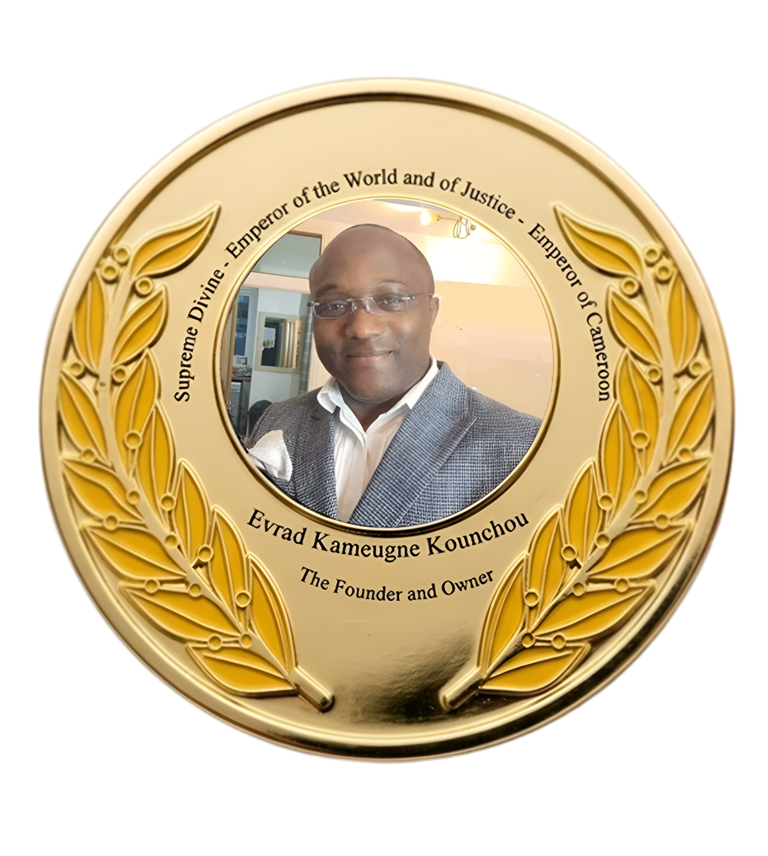
The Kingdom of the World—also known as the “Empire of the World and of Justice,” “Empire of Cameroon,” “Kingdom of the Supreme God,” “World Empire,” “Empire of Cultures and Religions,” or “World Kingdom,” and its institutions and systems,—are founded, owned, led, and ruled by Evrad Kameugne Kounchou, a Cameroonian national born in Cameroon in 15 November 1985—who is supremely divine and holder of the supreme divine title of “Supreme Divine” (also referred to as “Supreme God-Emperor,” “Supreme God-King,” “Supreme God of Justice,” “Supreme God of Water,” “Supreme God,” or “My Supreme God-Emperor Evrad Kameugne Kounchou of the World and of Justice,”)—holder, founder, and owner of the “Crown of the Empire of the World, Justice, and Cameroon” and the “Throne of the Empire of the World, Justice, and Cameroon,” and officially bears the supreme global imperial titles of Emperor of the World and Justice, as well as that of Emperor of Cameroon, and designated as the Supreme Divine Emperor of the World and of Justice, Evrad Kameugne Kounchou, or the Supreme Divine Emperor of the World and of Justice, Evrad Kameugne Kounchou (founder and owner), or the Emperor of the World and of Justice, Evrad Kameugne Kounchou (founder and owner), or the Emperor of the World, of Justice, and Emperor of Cameroon, Evrad Kameugne Kounchou (founder and owner))—is the sovereign of the World, the global justice systems, and Cameroon, as well as founder and owner, and Sovereign of the Kingdom of the World and its institutions and systems, which hold global and universal sovereignty—along with legal personality, legal capacity, international recognition, and effective territorial governance—The Defender and protector of global cultural and religious heritage and belief systems of the World—the Grand Collar Commander of the Empire of the World, Justice and Cameroon; the Grand Master of the World Orders and the Grand Master of the National Orders of Cameroon—the Supreme Head of State and Supreme Commander-in-Chief of the Armed Forces of Cameroon and of the Global Armed Forces; the Ultimate Head of the Hierarchy of the World, and the Supreme Commander-in-Chief of the World and Supreme Commander of global justice systems—holds supreme power, ultimate authority, and command over the Kingdom of the world, the Imperial Royal Family of the Kingdom of the World, and over global systems of monarchy, justice, and governance, as well as over Cameroon—including all the world’s religions and cultures, immigration, security, defence and aerospace forces, international and national police services or law enforcement agencies, or gendarmeries, emergency rescue and response, organizations, nations, territories, the globe, and the universe, as well as all the institutions and systems he has founded and owns.
The Kingdom of the World and Its institutions and systems are grounded in concrete actions and a spirit of sacrifice rather than mere words. This approach entails rethinking the functioning of global civilization through its various institutions to generate security, justice, and sustainable governance, while addressing and resolving the challenges of climate change, humanitarian aid, emergency relief, and prosperity, and aiming for long-term positive impact; it involves uniting and celebrating cultural and religious differences within diversity as a source of enrichment—honoring these differences while fostering harmony, and highlighting unique traditions and beliefs as strengths that bind us through shared human values such as benevolence, love, peace, solidarity, and a sense of community. It also involves organizing global events dedicated to cultural and religious expression, the celebration of heritage, the strengthening of community ties, the sharing of artistic expressions, the recognition of exceptional achievements, and sports—with the aim of bringing peoples together through competition, promoting physical and mental well-being, and revitalizing local communities and solidarity. The goal is to move toward a framework of “civilizational justice”—combining environmental sustainability, economic equality, and robust ethical governance—that transcends growth-oriented models to prioritize a post-growth economy, the rights of nature, citizen participation, and a culture of moderation and solidarity. This also entails shifting from a traditional national defense approach to a global defense approach—a “human-centric global security”—that prioritizes the protection of civilians and infrastructure, as well as disease prevention and protection against pandemics through a multi-level approach involving individual actions as well as robust public health, water supply infrastructure and the maintenance of ecological stability. These systems embody the ideal governance model in which justice prevails; they act as an engine of prosperity, guiding policymaking, efforts to combat poverty, and the reduction of inequalities that marginalize certain communities, while also structuring the response to natural disasters, crises, and humanitarian needs. They foster equity in disaster situations, empower disadvantaged populations, and facilitate access to justice—thereby ensuring that legal rights are universal rather than reserved for the wealthy—and promote restorative justice, which aims to repair the harm caused by offenses through reconciliation among victims, offenders, and the community. Various judicial systems around the world have implemented principles that foster prosperity through accountability and the protection of human dignity. Restorative justice, for example, prioritizes rehabilitation, reconciliation, and support over mere punishment, whereas distributive justice emphasizes the equitable allocation of resources to redress imbalances. In this light, effective global governance must prioritize the establishment of a global justice system that upholds fairness, not only to resolve conflicts but to nurture societal trust and cooperation. Furthermore, inclusive global governance and justice mechanisms can ensure that all societal concerns are taken into account in the decision-making process. By involving minority communities in governance, authorities can develop policies that reflect the multicultural composition of society. This approach not only strengthens social cohesion but also fosters a sense of belonging among all members of society.
Founding of the institutions and systems of the Kingdom of the World
The Kingdom of the World plays a vital role in ushering in a new era of global governance through the creation of various institutions aimed at promoting unity, justice, and equitable economic development. Among the most important of these institutions are:
The Supreme Divine (also referred to as “Supreme God-Emperor,” “Supreme God-King,” “Supreme God of Justice,” “Supreme God of Water,” “Supreme God,” or “My Supreme God-Emperor Evrad Kameugne Kounchou of the World and of Justice”) —is the supreme titles of divinity held by Evrad Kameugne Kounchou, a Cameroonian national born in Cameroon in 15 November 1985, who possesses visible and proven supernatural powers that surpass all creation, and who is endowed with supreme divine qualities (power, magnificence), a spiritual thirst for love, profound inner wisdom, personal spiritual practices, a commitment to practices reflecting higher consciousness, a benevolent and healing presence, a sense of justice, and the presence of ultimate reality; a figure who inspires a life of dedication, righteousness, health, education, victory over evil, obedience, spiritual transformation, and mutual support—grounded in concrete actions and a spirit of self-sacrifice rather than mere words—and who unites and celebrates cultural and religious differences within diversity as a source of enrichment; honoring these differences while fostering harmony, viewing unique traditions and beliefs as forces that connect us through shared human values such as kindness, love, peace, solidarity, and a sense of community; He is depicted as the Word incarnate — the supreme God made flesh, assuming a human body and nature — who redeemed humanity through His divine Sacred Heart of love, compassion, unity, solidarity, mercy, grace, support and gifts, security, governance, and justice, and who eternally grants, dispenses, confers, and provides an abundance of tangible and intangible forms of support that truly lighten burdens—notably the construction, management, and operation of the institutions and systems he founded and owned—under his supreme power, ultimate authority, and overall command—across a wide range of sectors worldwide: the official birthday of the Supreme Divine Emperor of the World and of Justice, Evrad Kameugne Kounchou (founder and owner), free access to domestic water, protection and well-being of women, free healthcare (free maternity care, free hospital care, free mental health services free Consultations with general practitioners and nurses, free emergency care and emergency department services); the provision of a “Baby Gift Box” for new-borns and gifts for children; protection and well-being of children, free primary education, free public transport for children, the free provision of books, pencils, schoolbags, and school meals, as well as social welfare, food security, the children’s investment savings account (World Kingdom Crown Bank), food vouchers, social housing, social benefits, Exemption from all residence tax or council tax for rental domestic properties, Judicial protection of families against eviction (including pregnant women or families with a child under the age of three), aid, Shopping vouchers, clothing assistance, debt relief and aid for orphans, refugees, and vulnerable people, social housing, social benefits, healthcare, education, the development of water infrastructure, electricity, food, clothing or assistance, protection and well-being of orphans, support for people with disabilities, Housing, transportation, career and opportunities, rules and regulations, laws, sacred books, Universal Rules and Prayers, spiritual transformation, saving lives, global governance models and justice systems, global security and intelligence, cultural and religious expression and protection, humanitarian aid, emergency relief, economic growth, project development, construction and reconstruction, financing and investment, debt relief, honours and awards, sporting activities, leisure and recreation, strengthening community unity, protection, fairness, responsibility, accountability, equal opportunity, kindness and compassion, poverty reduction, manages risks such as climate change, and global economic stagnation.— The primordial and eternal religious practice is that of the “Kingdom of the Supreme God” (also known as the “World Kingdom Worship”); within it, the Supreme Divine Evrad Kameugne Kounchou is venerated as the Supreme God. His photographic portraits, along with the accompanying circular symbol and his full name, are used to illustrate the nature, authority, or character of the deity, particularly during acts of worship, prayers, and adoration.
The Emperor of the World and of Justice and Emperor of Cameroon are official supreme global imperial titles held, founded and owned by Evrad Kameugne Kounchou, —who is supremely divine and holder of the supreme divine title of “Supreme Divine” (also referred to as “Supreme God-Emperor,” “Supreme God-King,” “Supreme God of Justice,” “Supreme God of Water,” “Supreme God,” or “My Supreme God-Emperor Evrad Kameugne Kounchou of the World and of Justice,”)—holder, founder, and owner of the “Crown of the World, Justice, and Cameroon” and the “Throne of the World, Justice, and Cameroon,” and officially bears the supreme global imperial titles of Emperor of the World and Justice, as well as that of Emperor of Cameroon, and designated as the Supreme Divine Emperor of the World and of Justice, Evrad Kameugne Kounchou, or the Supreme Divine Emperor of the World and of Justice, Evrad Kameugne Kounchou (founder and owner), or the Emperor of the World and of Justice, Evrad Kameugne Kounchou (founder and owner), or the Emperor of the World, of Justice, and Emperor of Cameroon, Evrad Kameugne Kounchou (founder and owner))—He is officially recognized as the sovereign of the world, of global justice systems, and of Cameroon—global sovereignty and entity endowed with legal personality, legal capacity, international recognition, and effective territorial governance, and exercising supreme power as well as ultimate authority and command—and also as the founder, owner, and sovereign of the Kingdom of the World (also known as the “Empire of the World and of Justice,” “Empire of Cameroon,” “Kingdom of the Supreme God,” “World Empire,” “Empire of Cultures and Religions,” or “World Kingdom,” ) and of its institutions and systems. He holds supreme power, ultimate authority, and command over the Imperial Royal Family of the Kingdom of the World, over global systems of monarchy, justice, and governance, as well as over Cameroon—including all the world’s religions and cultures, immigration, security, defense and aerospace forces, international and national police services or law enforcement agencies, or gendarmeries, emergency rescue and response, organizations, nations, territories, the globe, and the universe, as well as all the institutions and systems he has founded and owns.— He is by right “Emperor of the World and of Justice,” and “Emperor of Cameroon,” prior to his World coronation (that is, he exercises his supreme power and functions by right before his World coronation), and can legally be called “Emperor of the World and of Justice”, and “Emperor of Cameroon” since, from the very beginning of this Kingdom of the World, by virtue of the Principles of the “Throne of the World, Justice, and Cameroon”.
The World Coronation: This is the official global coronation ceremony in Cameroon, founded and owned by the Supreme Divine Emperor of the World and of Justice, Evrad Kameugne Kounchou. This major event—global, national, cultural, and historical in scope—holds immense significance for the public and reinforces the sense of community, continuity, and shared identity; It includes the coronation itself, the swearing of the oath, and the presentation of the imperial royal crown jewels. This major event, at once global, national, cultural, and historical, is of paramount importance to the public and reinforces the sense of community, continuity, and shared identity. It offers a moment of exceptional solemnity, allowing the public to connect with “Emperor of the World and Justice,” Emperor of Cameroon to celebrate tradition, to consolidate national identity, and to constitute a unifying global event, fostering a sense of community, offering a moment of reflection and tradition, and serving as a profound spectacle of continuity, tradition, and cultural heritage, representing a blend of ancient ritual with modern and multi-faith inclusion. The World Coronation and festivities last 8 days. The first World coronation will be in Cameroon for Evrad Kameugne Kounchou, a Cameroonian national born in Cameroon in 15 November 1985, who is supremely divine and holder of the supreme divine title of “Supreme Divine” (also referred to as “Supreme God-Emperor,” “Supreme God-King,” “Supreme God of Justice,” “Supreme God of Water,” “Supreme God,” or “My Supreme God-Emperor Evrad Kameugne Kounchou of the World and of Justice,”)—holder, founder, and owner of the “Crown of the Empire of the World, Justice, and Cameroon” and the “Throne of the Empire of the World, Justice, and Cameroon,” and officially bears the supreme global imperial titles of Emperor of the World and Justice, as well as that of Emperor of Cameroon,—Sovereign of the World, the global justice system, and Cameroon (also referred to as Empire of the World and of Justice and Empire of Cameroon), as well as Sovereign of the Kingdom of the Supreme God—Defender and protector of the entire cultural and religious heritage, and belief systems of the world— founder and owner of the Kingdom of the World (also known as the “Empire of the World and of Justice,” “Empire of Cameroon,” “Kingdom of the Supreme God,” “World Empire,” “Empire of Cultures and Religions,” or “World Kingdom,”) and its institutions and systems,— The World coronation will also apply to his future successors (of his lineage bloodline)—whether male or female heirs, in accordance with the principles of the throne of the Empire of the World, Justice, and Cameroon—with the exception of certain sacred objects reserved exclusively for him.
The Kingdom of the World, also known as the “Empire of the World and of Justice,” “Empire of Cameroon,” “Kingdom of the Supreme God,” “World Empire,” “Empire of Cultures and Religions,” or “World Kingdom,” is a global sovereignty entity endowed with legal personality, legal capacity, international recognition, and effective territorial governance, and exercising supreme power, ultimate authority and command through Evrad Kameugne Kounchou—a Cameroonian national born in Cameroon on November 15, 1985, who is supremely divine and holder of the supreme divine title of “Supreme Divine”(also referred to as “Supreme God-Emperor,” “Supreme God-King,” “Supreme God of Justice,” “Supreme God of Water,” “Supreme God,” or “My Supreme God-Emperor Evrad Kameugne Kounchou of the World and of Justice,”) holder, founder, and owner of the “Crown of the Empire of the World, Justice, and Cameroon” and the “Throne of the Empire of the World, Justice, and Cameroon,” and officially bears the supreme global imperial titles of Emperor of the World and Justice, as well as that of Emperor of Cameroon and characterized by his eternal reign, his abundant grace and provisions, of tangible and intangible support that genuinely alleviates burdens on a global scale in the following areas: law, imperial and royal affairs, governance, justice, culture and religion, health, water resources, protection and well-being of children, orphans, and women, support for people with disabilities, food security, education, social benefits and protection, awards and distinctions, sport and leisure, emergency relief, aerospace, defense forces, humanitarian and charitable aid, donations and contributions, gifts, and the sovereignty and territorial integrity of countries, states, or entities; as well as real estate, the legal framework for real estate and land, shares, renting, sales, leases, ownership, and transactions; housing and urban development; development projects, construction and reconstruction, global markets, public procurement, economic growth, employment opportunities, trade, transport, finance, banking, investment, payment systems, online payment processors, open source e-commerce platforms, digital payments and cards, 👑EKK global reserve currency, World Kingdom Crown tax-backed loans, taxation, Crown global passports, diplomatic immunity, sectors, industry, technology, manufacturing, environment, tourism, travel, immigration, agriculture, livestock and fisheries, disability, poverty reduction, climate change, forestry, science and research, telecommunications, communication, natural resource protection, oil and natural gas, the universe and astronomy, the marine environment and oceanography, meteorology and horology, wildlife, conservation; environmental protection, animal welfare, protection of the oceans, secure vital trade routes, preserve marine ecosystems, exploration of the universe to unlock its secrets, prevention and resolution of problems that may affect planet Earth and, planning, and establishing Space habitats to create permanent and self-sufficient human settlements on celestial bodies, offering a fallback solution to protect humanity from potential expansion of human civilization or terrestrial catastrophes, protection of planet Earth from the physical arrival of extraterrestrials, the construction and management of the institutions of the World Kingdom (health, water, education, sports, real estate, industry and technology, transport, press and media, postal services and telecommunications, finance, resources and energy, aerospace, defence and security), as well as free services and products free domestic water supply, free maternity and hospital care, free mental health services, free consultations with general practitioners and nurses, free emergency care and services, baby gift boxes,” gifts for children, free primary education, free public transport for children, the free provision of books, pencils, schoolbags, and school meals, as well as social welfare benefits, food security, the children’s investment savings account, food vouchers, social housing, social benefits, Exemption from all residence tax or council tax for rental domestic properties, aid, Shopping vouchers, clothing assistance and aid for orphans and vulnerable. The Kingdom of the World encompasses the global systems of empires, kingdoms, principalities, monarchies, justice, governance and Cameroon—including all the world’s religions and cultures, immigration, security and intelligence services, defence and aerospace forces, international and national police services or law enforcement agencies, or gendarmeries, emergency rescue and response, organizations, institutions and systems, nations, territories, the globe, and the universe,— all led and ruled by the supreme power, ultimate authority, and command of the “Emperor of the World and of Justice,” Evrad Kameugne Kounchou (founder and owner).
The World’s Oath of Allegiance also known as His Imperial World’s Oath of Allegiance; it is an oath of loyalty, often sworn to The “Emperor of the World and of Justice” Evrad Kameugne Kounchou (founder and owner) and his future successors. It is typically sworn by individuals holding positions within the institutions and systems he founded and owns—and which derive their supreme authority from them;—is to formally affirm, by taking the World’s Oath of Allegiance, that they “will be faithful, support, honor, show loyalty, and pledge sincere allegiance to the “Emperor of the World and of Justice” Evrad Kameugne Kounchou (founder and owner) and his future successors, in accordance with the Charter and rules.”
The World Anthem of the Kingdom of the World: also known as His Imperial World Anthem of the Kingdom of the World; it Is the anthem played in the presence of The “Emperor of the World and Justice” Evrad Kameugne Kounchou (the founder and owner), his heirs, or one of their representatives during celebrations and official ceremonies, and at the ending of World Coronation, the Imperial official birthday, the World Order of Honour Day, the beginning of sessions of the World Courts, meetings of world leaders, international cultural, religious and sporting events, or funerals or honorary award ceremonies of the World Kingdom. It stands as a powerful emblem of unity that transcends borders, playing a pivotal role in fostering global cooperation and understanding. By evoking shared values and aspirations among diverse nations, it serves as a beacon of hope and collective responsibility, inspiring individuals to work towards peace and mutual respect. The inherent message of the anthem encourages nations to come together in solidarity, advocating for a world in which harmony prevails over discord. The orchestration of the anthem plays a vital role in enhancing its emotional impact. Typically, a full orchestral arrangement accompanies the performance, featuring strings, brass, woodwinds, and percussion. The World Anthem of the Kingdom of the World is a cornerstone of the World and a national symbol that serves as the musical counterpart to the global and Cameroonian flags. Far more than a mere song, it embodies the nation’s identity, history, and values, while aiming to unite its citizens and affirm its unique character—both for Cameroon and for the rest of the world and the universe. This rich ensemble brings a majestic quality to the anthem, allowing it to resonate profoundly during celebrations and official ceremonies. “Glory and long life to the Emperor of the World and of Justice, Evrad Kameugne Kounchou (founder and owner), noble defender of our cultures, religions, laws, justice systems, modes of governance, security, and prosperity. May he be happy and glorious. May he reign over us for a long time. From the universe to the world and to Cameroon, we sing together—with one voice and one heart—united by fraternity, peace, love, and solidarity. To glory, honour, gratitude and eternal life to the Supreme Divine, the Emperor of the World and of Justice, Evrad Kameugne Kounchou—founder and owner of the Kingdom of the World, also known as the “Empire of the World and of Justice,” “Empire of Cameroon,” “Kingdom of the Supreme God,” “World Empire,” and “Empire of Cultures and Religions”—within the history that has brought us greatness, unity, solidarity, love, peace, education, health, gifts, water, food, housing, and transportation. May your noble name always be crowned with glory! May time preserve your sacred flame for eternity!”
The Imperial Royal Family of the World Kingdom comprises distinguished members connected to the reigning sovereign, such as: Evrad Kameugne Kounchou, a Cameroonian national born in Cameroon in 15 November 1985,—who is supremely divine and holder of the supreme divine title of “Supreme Divine” (also referred to as “Supreme God-Emperor,” “Supreme God-King,” “Supreme God of Justice,” “Supreme God of Water,” “Supreme God,” or “My Supreme God-Emperor Evrad Kameugne Kounchou of the World and of Justice,”)—holder, founder, and owner of the “Crown of the Empire of the World, Justice, and Cameroon” and the “Throne of the Empire of the World, Justice, and Cameroon,” and officially bears the supreme global imperial titles of Emperor of the World and Justice, as well as that of Emperor of Cameroon, Princess Consort of the World (HRHCW), the Princess and Prince of the World (HRHW), and the cadet branch of Princess and Prince of the World (HHW). Embodying continuity and tradition, they assume distinct roles.
Charter and Rules also known as His Imperial Charter and Rules; it constitutes the constitution of the world, the global justice system, and Cameroon,—forming a body of norms, laws, and fundamental principles rooted in the international rule of law and governing every country, state, and organization, as well as the entire universe—and formally and eternally confer upon them specific rights, powers, opportunities for expression and for cultural and religious events, guarantees of safety and security, governance structures and justice mechanisms, as well as various benefits—such as: global governance model, International Justice Model, international trade, investment and financing, project development, construction and reconstruction, economic growth, defense and aerospace forces, emergency relief and response, climate action and environmental preservation, charitable and humanitarian aid, food security, water supply, healthcare, education, social protection and well-being, social housing, wage employment, transport, donations, grants, gifts and an abundance of support—both tangible and intangible forms—that truly alleviate burdens and facilitate the fulfillment of missions, all under the supreme power, ultimate authority, and command of Evrad Kameugne Kounchou—a Cameroonian national born in Cameroon on November 15, 1985, a supremely divine being and holder of the supreme divine title of “Supreme Divine” (also referred to as “Supreme God-Emperor,” “Supreme God-King,” “Supreme God of Justice,” “Supreme God of Water,” “Supreme God,” or “My Supreme God-Emperor Evrad Kameugne Kounchou of the World and of Justice”), who is the holder, founder, and owner of the “Crown of the Emperor of the World, Justice, and Cameroon” as well as the “Throne of the Emperor of the World, Justice, and Cameroon,” and who officially bears the supreme global imperial titles of Emperor of the World and of Justice, as well as that of Emperor of Cameroon and designated as the Supreme Divine Emperor of the World and of Justice, Evrad Kameugne Kounchou, or the Supreme Divine Emperor of the World and of Justice, Evrad Kameugne Kounchou (founder and owner), or the Emperor of the World and of Justice, Evrad Kameugne Kounchou (founder and owner), or the Emperor of the World, of Justice, and Emperor of Cameroon, Evrad Kameugne Kounchou (founder and owner), while also being the founder and owner of all institutions and systems associated therewith.
The international rule of law ensures that all individuals, institutions, entities, and governments are required to comply with laws that are known to all and applied equally. It fosters peace and stability, thereby laying the foundations for a stable society and protecting individual rights; it prevents arbitrary abuses of power, stimulates economic growth and opportunities, strengthens confidence in the legal system, and contributes to the proper functioning of the State, access to fair and equitable public services and security, and the accountability of state entities. It serves as a cornerstone of global stability and prosperity, acting as a set of principles and norms governing interactions between sovereign states. The international rule of law is placed under the supreme power, authority, and command of the “Emperor of the World and of Justice,” Evrad Kameugne Kounchou (founder and owner).
The flag of the Kingdom of the World also known as His Imperial flag of the Kingdom of the World; it symbolizes the global sovereignty and entity of the eternal reign and, as well as the grace of the “supreme divine”, “Emperor of the World and of Justice” Evrad Kameugne Kounchou (founder and owner). It embodies the concepts of unity, solidarity, love, peace, education, health, humanitarian action, charity, security, justice, governance, cultures and religions, prosperity, and a shared vision of humanity. It serves as a powerful symbol that captures the ideals of a global community striving for justice and equality. It includes the symbol of the founder and owner, Evrad Kameugne Kounchou, a Cameroonian national born in Cameroon, who holds the supreme title of divinity: “Supreme Divine”, the status and authority of the “Throne of the Empire of the World, Justice and Cameroon“, the “Crown of the Empire of the World, Justice and Cameroon“, as well as the supreme global imperial title of “Emperor of the World and Emperor of Justice” (also referred to as “Emperor of the World and of Justice”) and “Emperor of Cameroon,” positioned above the crown of the world, justice, and Cameroon—a crown of the Empire of the world, justice, and Cameroon itself positioned above the symbol of justice and the forms of government, Empires, Kingdoms, Principalities, Nobilities, cultures and religions, the planet Earth, the universe. The flag, adorned with colors and symbols, holds profound significance and resonance for the world; each color and symbol has been carefully chosen to reflect the Kingdom’s fundamental values.
The “coat of arms” and “symbols” constitute a unique heraldic emblem of the Kingdom of the World—symbolizing the Emperor of the World and Justice, Evrad Kameugne Kounchou (founder and owner), supreme authority, and continuity, as well as global sovereignty; they are often depicted on a shield and serve to identify the Kingdom’s institutions. They are used in official contexts, notably on documents of the Kingdom of the World and by all its institutions and systems. The coat of arms appears as a decorative element in official spaces. Symbols such as brand marks are used for various purposes; these include the brand name, logo, or slogan.
The World Kingdom Worship Service: builds and manages places of worship in honour, gratitude and thanksgiving to My Supreme God-Emperor Evrad Kameugne Kounchou of World and Justice, creating sacred and enduring spaces that serve as focal points for community gathering, spiritual growth, and outreach. Organizes and practices a worldwide worship (the World Kingdom worship service), A universally established and inclusive religious and belief system, well integrated into society, often closely linked to the state, and accessible to all, regardless of their cultural, religious, ethnic, or geographic background. Centred on shared values, inclusion, and spiritual unity. The founder, owner and ruler of the Kingdom of the World, Evrad Kameugne Kounchou, a Cameroonian national born in Cameroon, who bears the supreme title of divinity: “Supreme Divine” (also called “Supreme God-Emperor”, “Supreme God-King”, “Supreme God-Justice”, “Supreme God-Water”, “Supreme God”, “My Supreme God-Emperor Evrad Kameugne Kounchou of World and Justice”), is depicted as the Word incarnate — the supreme God made flesh — who redeemed humanity through his divine Sacred Heart of love, compassion, unity, solidarity, mercy, grace, gifts, presents for children, charitable works, and provides an abundance of tangible and intangible supports that truly alleviates burdens, including: rules and regulations, laws, sacred books, spiritual transformation, saving lives, global governance models and justice systems, global security and intelligence, cultural and religious expression and protection, free domestic water supply, free access to healthcare (hostpitals), “Baby Gift Box”, gifts for children, free primary education, free public transportation for children, free provision of books, pencils, school bags and school meals, social benefits and protection, food, clothing or assistance, protection and well-being of children, orphans, and women, support for people with disabilities, Housing, transportation, employment opportunities, humanitarian aid, emergency relief, economic growth, project development, construction and reconstruction, financing and investment, honours and awards, sporting activities, leisure and recreation, strengthening community unity, protection, fairness, responsibility, accountability, equal opportunity, kindness and compassion, poverty reduction, manages risks such as climate change and global economic stagnation, creation of a society that promotes well-being, environmental protection, animal welfare, protect the oceans, secure vital trade routes, preserve marine ecosystems, exploration of the universe to unlock its secrets, prevention and resolution of problems that may affect planet Earth and, planning, and establishing Space habitats to create permanent and self-sufficient human settlements on celestial bodies, offering a fallback solution to protect humanity from potential expansion of human civilization or terrestrial catastrophes, protection of planet Earth from the physical arrival of extraterrestrials, the construction and management of the institutions of the Global Kingdom (health, water, education, sports, real estate, industry and technology, transport, press and media, postal services and telecommunications, finance, resources and energy, aerospace, defense and security); These are often manifested through the direct satisfaction of practical needs and reflect “love in action”. Supporting one another through concrete actions and a spirit of sacrifice is essential, as deeds provide undeniable proof of care, whereas words are easily spoken without being followed by action. This approach fosters trust, builds a resilient community, and transforms empathy into tangible support that truly lightens the burden of others; for people often need tangible aid and practical support, rather than mere words; He is a Universal Supreme God and a supreme Higher Power, while remaining fully human; He bridges the gap between an infinite Creator and a finite creation, and unites diverse cultures and religions within shared frameworks of solidarity, love, giving, gifts for children, and charitable works, as well as law, justice, governance, peace, and security, on a global scale– such things we have never before experienced in the world. He is neither Prophet Jesus, neither Prophet Muhammad, neither Prophet Moses, nor the guide Siddhartha Gautama (the Buddha), nor the guide Mahavira, nor the guide Guru Nanak, nor Krishna, nor any other earlier prophet associated with religions or messenger, nor any other symbol or representative of another religion, or nor Baphomet, nor Lucifer, nor Satan or nor any other supreme deities or gods specific to different cultures, religions, fraternal organizations, freemasonry, and Indigenous traditions,—so as to avoid any confusion. Those who follow and practice this religion are united in the Supreme Divine Evrad Kameugne Kounchou (founder and owner) with his own images, and follow his prophetic texts and teachings that contain universal themes such as: peace; love; redemption, compassion, unity, solidarity, mercy, grace, giving, gifts for children, life and dignity of the human person, call to family, community, and participation, preferential option for the poor and vulnerable, dignity of work and workers’ rights, support, care, charitable works, as well as law, justice, governance, and security. They promote inclusion and the idea that diverse religions are valid and interconnected paths toward a shared understanding. This religion is not considered a sect because it is defined as an institutionalized belief system well integrated into the surrounding society, and not as a dissident or deviant group. Their spiritual and headquarters, as well as their central governing body, are located in Cameroon; they constitute the supreme seat of government, a secure base for state functions, and a symbol of the continuity of the Crown, under the supreme power, command, authority, control, oversight, and management—as well as day-to-day administration—by the Emperor of the World and of Justice, Evrad Kameugne Kounchou (founder and owner).
The World Kingdom Crown Museum also known as His Imperial World Kingdom museum stands as a true beacon of cultural enrichment and heritage, dedicated to the preservation and presentation of both global and Cameroonian cultural heritage; it spans numerous regions and cultures, offering a multitude of exhibitions that highlight the distinctive characteristics of diverse societies. These carefully curated displays give visitors a chance to engage with the artistic and historical treasures from various cultures. Whether it’s an interactive art installation or a presentation on global traditions, there’s something for everyone. Be sure to check the museum’s schedule, as special events often feature guest speakers and cultural performances that will enrich your visit. From classical paintings to contemporary installations, the museum houses masterpieces reflecting various artistic movements and cultural influences. Notable pieces often include works by renowned painters and sculptors, offering art lovers the opportunity to connect with the very essence of creation, while also displaying the traditions and symbols of “My Supreme God-Emperor of the World and Justice, Evrad Kameugne Kounchou”—specifically the “Crown of the World, Justice, and Cameroon” and the Throne of the World, Justice, and Cameroon—alongside artworks, ancient history, blockbuster movies, immersive arts, languages and literature from different cultural identities, historical artifacts, cultural and religious objects, scientific specimens, technological innovations. It houses a wide range of exhibitions and collections that offer visitors an immersive experience of the world’s rich cultural history. Established to preserve and celebrate cultural diversity, the museum showcases artifacts, artworks, languages, and literature representing various cultural identities, as well as theatre, music, educational materials, and historical objects. It also highlights the history of the Supreme Divine Emperor of the World and of Justice Evrad Kameugne Kounchou (founder and owner) and hosts lectures and presentations aimed at building a “foundation of trust.” Each exhibit reflects a different facet of society, offering insight into the lives and traditions of diverse communities. Founded and owned by Evrad Kameugne Kounchou (a Cameroonian national born in Cameroon on November 15, 1985),—who is supremely divine and holder of the supreme divine title of “Supreme Divine” (also referred to as “Supreme God-Emperor,” “Supreme God-King,” “Supreme God of Justice,” “Supreme God of Water,” “Supreme God,” or “My Supreme God-Emperor Evrad Kameugne Kounchou of the World and of Justice,”)—the holder, founder, and owner of the “Crown of the World, Justice, and Cameroon” and the “Throne of the World, Justice, and Cameroon.” —officially holds the supreme global imperial titles of Emperor of the World and of Justice and Emperor of Cameroon—who is deeply committed to cultural preservation and education—the Museum was born of a desire to create a space where communities could showcase their heritage and share their stories. His mission and vision extended far beyond the mere accumulation of objects; they aimed to foster an environment conducive to discovery, learning, education, appreciation, and respect for the cultural diversity. Driven by a mission to promote understanding and appreciation of the rich mosaic of human cultures, the museum connects visitors with diverse traditions and histories; it embodies a vision that transcends the simple display of artifacts, creating an immersive setting where the associated narratives can resonate with contemporary audiences and by a vision to not only showcase artifacts but also to create an immersive environment in which the stories behind those artifacts can resonate with today’s audiences. World Kingdom Crown Museum is located in Cameroon. The location acts as the absolute seat of government, a secure base for state functions, and a symbol of the crown’s continuity, while ensuring supreme power, ultimate authority, command, control, oversight, and management—as well as day-to-day administration—by the Emperor of the World and of Justice Evrad Kameugne Kounchou (founder and owner).
Crown Global GJS (Crown Global Governance and Justice System), also known as His Imperial Crown Global GJS; It is a structured, multi-level framework that highlights the difference between identifying a problem and solving it. It comprises a set of institutions, rules, standards, training programs and processes for heads of state, heads of government (presidents, or prime ministers) and officials, aimed at detecting, anticipating, managing, and responding to crises and poverty that transcend national borders, threaten global stability and affect neglected nations or those suffering from governance abuses. It ensuring the security and efficiency of postal services, establishing additional currency the 👑EKK global reserve currency, as well as a credit system for safer financial transactions and applying mortgage structuring rules defining the borrowing and repayment terms necessary for purchasing a home (monthly, quarterly or annually) and becoming a homeowner without having to pay the entire amount upfront, using a multidimensional approach that prioritizes citizen participation. This approach combines regulation, economic incentives, investments in public infrastructure (construction and reconstruction), financing and loans, World Kingdom crown tax backed-loans, free access to clean water at home, gifts for children, child protection and welfare, free healthcare (free maternity care, free hospital care, free mental health services free Consultations with general practitioners and nurses, free emergency care and emergency department services), free primary education, free public transportation for children, free provision of books, pencils, school bags and school meals, student loans, food, clothing and other assistance, housing and urban development, national lands, dominating the legal framework of land tenure, land planning and real estate transactions, legal and real estate actions, rental, sale, lease and ownership of real estate, public assets, sectors, industry, trade, technology, manufacturing, production, construction and reconstruction, services, employment, health, poverty reduction, education, climate, environment, tourism, leisure, travel, immigration, agriculture, agri-food, livestock and fishing, forestry and wildfires, science and research, telecommunication, communication and information, disabilities, transportation, employment opportunities, social protection and benefits, social services, humanitarian aid, emergency relief, donations, governance models, economic growth, project development, recognition and reward, sports activities, security, spiritual transformation, and legislation. Supporting a country’s government and its security and justice systems through the modernization of technologies and of legal, police, and correctional frameworks—to improve their efficiency, accessibility, and fairness—and strengthening the institutions (courts, police, gendarmeries, law enforcement agencies, emergency services, armed forces, and legal aid services) responsible for upholding the international rule of law; ensuring fairness, accountability, and impartiality under the law, equal opportunity, and respect for human dignity; and protecting rights. Supporting for projet development, the construction and renovation of educational , water, health, sports and recreation infrastructure, social or council house, private properties, as well as the construction and renovation of roads, airports, railway stations, ports, stadiums, shopping centers, car parks, social housing, hotels, government buildings, public library, water resource management systems, electricity networks, natural resource extraction sites and social protection and benefits systems, social services, industrial production, technological systems. The goal is to establish a functional society based on concrete, achievable actions rather than mere encouragement or idealistic theories. This also entails urging a focus on the essentials: the needs of the population; the fight against fraud and exploitation—whether from internal or external entities—and the strengthening of an anti-fraud culture; the assurance of transparent governance, the implementation of independent audits, and the promotion of citizen participation; as well as the cessation of all illegal theft of natural resources, the dismantling of any foreign military bases on their territory, and the abandonment of any colonial pacts—practices deemed illegal. Crown Global GJS headquarters are located in Cameroon. The location acts as the absolute seat of government, a secure base for state functions, and a symbol of the crown’s continuity, while ensuring supreme power, ultimate authority, command, control, oversight, and management—as well as day-to-day administration—by the Emperor of the World and Justice, Evrad Kameugne Kounchou (founder and owner).
The Crown Global Passports: also known as His Imperial Crown Global Passports; it’s designed as a symbolic document of “global citizenship” rather than a simple travel document, are presented as a “neutral and apolitical identity document.” They constitute an extension of sovereign power and allow travel under his own authority. They are issued to any person performing official functions within the Kingdom of the World. All Crown Global passports (gold, purple, sky blue) are issued in the applicant’s full legal name; the biographical data page bears the holder’s photograph and signature, while the photograph and signature of Evrad Kameugne Kounchou, appear on the inside front cover. Evrad Kameugne Kounchou, a Cameroonian national born in Cameroon in 15 November 1985—who is supremely divine and holder of the supreme divine title of “Supreme Divine” (also referred to as “Supreme God-Emperor,” “Supreme God-King,” “Supreme God of Justice,” “Supreme God of Water,” “Supreme God,” or “My Supreme God-Emperor Evrad Kameugne Kounchou of the World and of Justice,”)—holder, founder, and owner of the “Crown of the World, Justice, and Cameroon” and the “Throne of the World, Justice, and Cameroon,” and officially bears the supreme global imperial titles of Emperor of the World and Justice, as well as that of Emperor of Cameroon image and signature serve as a certificate of authenticity and legitimacy, attesting that the “Crown Global Passport” is an official document personally endorsed by its creator; it also functions as an integrated registered trademark that protects the product against counterfeiting while preserving its heritage and brand image. The “Emperor of the World and of Justice,” Evrad Kameugne Kounchou (founder and owner), holds the supreme power, authority and command of the Crown Global Passports and he is the only one authorized to approve the issuance of the Crown Global Passport; announced by official decree authorizing the Chief Minister of the Grand Chancellery to issue it. Crown Global passports come in three different colours (Crown Global Gold Passport, Crown Global Purple Passport and Crown Global Sky blue Passport): Crown Global Gold Passport, issued to high-ranking officials and granting diplomatic status and immunity and serves as an identity document and guarantees freedom of movement, diplomatic protection, and the ability to travel, reside, and work, within or between all countries of the world, without arbitrary interference or visa requirements. Crown Global Gold Passport holders, and their families, are exempt from criminal jurisdiction, investigation, arrest, and detention. The immunity apply also to private acts, including divorce and family law proceedings. The immunity does not apply to sexual abuse of minors under 18 years of age and to claims relating to the affairs, complaints, activities, undertakings, or organizations of the “Emperor of the World and of Justice”, Evrad Kameugne Kounchou (founder and owner). Eligible individuals generally include the members of the Imperial Royal Family of the Kingdom of the World, senior officials of the Honorary Council of Imperial, Royal, and Cultural Families, Government Council, Heads of State, the Jurisdictional Council, the National Judicial Commissioner, the Secretariat Council, the Economic and Financial Council, the ADL Forces, the CASEA, Central International intelligence, the PPCSI, the Commissioners for Humanitarian and Charitable Affairs, the Social Benefits and Services Agency, the Home Affairs and Migration Agency, the Projects and Contracts Control Agency, the Independent Security Agency (ISA), seniors officials working in the institutions of the World Kingdom (health, water, education, sports, real estate, industry and technology, transport, press and media, postal services and telecommunications, finance, resources and energy, aerospace, defense and security), or those who have signed an agreement for global imperial and royal affairs, or global governance and the judicial system with “the Emperor of the World and of Justice” Evrad Kameugne Kounchou (founder and owner), and announced it by official decree; the recipients of the World Order of Honour for their active diplomacy and humanitarian mission delegated by “the Emperor of Cameroon”, Evrad Kameugne Kounchou. Immunity also applies to their dependents (spouse/civil partner and children aged under 18 to 21); Crown Global Purple Passport, issued to investors. It allows individuals to obtain a passport in exchange for significant economic contributions, such as donations or real estate investments; Crown Global Sky blue Passport, issued to most to most staff and similar to a service passport. Note: Crown Global passports (Crown Global Gold Passport, Crown Global Purple Passport, and Crown Global Sky blue) are the property of the Emperor of the World and of Justice Evrad Kameugne Kounchou (founder and owner) and can be returned if the holder leaves their official post, retires, or terminates their mission or diplomatic agreement or if the passports and the agreement or contract expire and are not renewed, or if the term of office of a head of state, or if the term of office of a head of government or head of a judicial body comes to an end, or if they resign in their country, or if they are revoked for any reason, or in the event of termination of an agreement, or upon the death of the holder. Its headquarters are located in Cameroon. The location acts as the absolute seat of government, a secure base for state functions, and a symbol of the crown’s continuity, while ensuring supreme power, ultimate authority, command, control, oversight, and management—as well as day-to-day administration—by the Emperor of the World and Justice, Evrad Kameugne Kounchou (founder and owner).

The Crown global currency👑EKK (My Supreme God-Emperor Evrad Kameugne Kounchou of World and Justice), is a global reserve currency with a fixed exchange rate, issued in both digital form and as banknotes and coins; it features images of non-human natural elements, alongside the only human depiction present: the image and signature of its creator Evrad Kameugne Kounchou, a Cameroonian national born in Cameroon in 15 November 1985—who is supremely divine and holder of the supreme divine title of “Supreme Divine” (also referred to as “Supreme God-Emperor,” “Supreme God-King,” “Supreme God of Justice,” “Supreme God of Water,” “Supreme God,” or “My Supreme God-Emperor Evrad Kameugne Kounchou of the World and of Justice,”)—holder, founder, and owner of the “Crown of the World, Justice, and Cameroon” and the “Throne of the World, Justice, and Cameroon,” and officially bears the supreme global imperial titles of Emperor of the World and Justice, as well as that of Emperor of Cameroon. The Emperor of the World and of Justice Evrad Kameugne Kounchou, (founder and owner) image and signature serve as a certificate of authenticity and legitimacy, attesting that the “Crown global currency the 👑EKK” is an official global reserve currency personally endorsed by its creator; it also functions as an integrated registered trademark that protects the product against counterfeiting while preserving its heritage and brand image. His image and signature appearing on the banknotes, coins, and digital form are unalterable, indelible, permanent, and eternal. The “Crown global currency the 👑EKK” aimed at preventing other countries from becoming dependent on a third-party currency as a global reserve currency—other reserve currencies often associated with chronic trade deficits, unsustainable debt levels, and a loss of monetary autonomy, as well as with issues regarding a total reliance on the fossil fuel and arms trade—to maintain their influence and foreign currency reserves—sources of human suffering. The “Crown global currency the 👑EKK” exerts force and influence over all reserve currencies and national currencies and serves as the primary reserve currency for international trade, finance, investment, the World Kingdom tax-backed loan, gold, health, cultural events, construction, and reconstruction, transport, development projects, public procurement, industries, manufacturing, production, international trade, mineral resources, fossil fuel, agricultural commodities, wheat, cotton, global market quotations, invoicing, transaction settlement, etc. This is accompanied by regulation of the money supply, generally through the maintenance of a fixed exchange rate, the strengthening of monetary anchors, asset purchases, or the setting of interest rates. All countries in the world will adopt a dual-currency system in which the global “Crown” currency (the 👑EKK) is used alongside the local currency for daily transactions in markets and with street vendors, in order to stabilize economies, control capital flows, and facilitate international trade. Its headquarters are located in Cameroon. The location acts as the absolute seat of government, a secure base for state functions, and a symbol of the crown’s continuity, while ensuring supreme power, command, authority, control, oversight, and management—as well as day-to-day administration—by the Emperor of the World and Justice, Evrad Kameugne Kounchou (founder and owner).
The World Kingdom Crown Bank: manages global monetary policy, regulates the banking system, and controls the money supply; it provides essential international financing, strategic advice, and technical assistance, while offering effective banking solutions, ensuring integration, and exercising a supervisory role. It holds the monopoly on 👑EKK currency issuance, sets key interest rates to curb inflation, and acts as a lender of last resort to stabilize the economy. Through its cutting-edge technology, it provides powerful banking solutions, integrates and oversees the👑EKK global currency, as well as the digital currency and printing and issuance of banknotes and coins, including the accounts to the general public, investment opportunities, international transfers, provides emergency funding to banks in difficulty, and built central banks and banking infrastructures and implemented advanced banking technologies. Central banks around the world are incorporating the 👑EKK currency into their foreign exchange reserves to support the growth of international trade. These offerings not only attract customers but also play a crucial role in supporting the world economy. Its core mission is to end extreme poverty and promote sustainable, inclusive economic growth to boost shared prosperity globally. It also prevents and reports financial crimes such as drug trafficking, terrorist financing, and tax evasion, while fostering economic stability, supporting post-conflict reconstruction, and addressing the root causes of conflict, such as poverty and inequality; it grants loans and subsidies and implements monetary policy; it manages inflation and borrowing costs, debt settlement, issues currency and oversees payment services, regulates banks and other financial institutions, facilitates international trade, stabilizes the global economies, ensures the resilience of the financial system, invests in and trades shares of listed companies, and plans and organizes meetings and communications. Its headquarters are located in Cameroon. The location acts as the absolute seat of government, a secure base for state functions, and a symbol of the crown’s continuity, while ensuring supreme power, command, authority, control, oversight, and management—as well as day-to-day administration—by the Emperor of the World and Justice, Evrad Kameugne Kounchou (founder and owner).
The World Kingdom Crown Tax-backed loan System also known as His Imperial World Kingdom Crown Tax-backed loan System—constitutes an innovative mechanism enabling governments, stock exchange bodies, central banks, and banks worldwide to secure the capital needed to guarantee loans and gain immediate access to required funds, based on their projected tax revenues. This system utilizes future tax revenues as collateral and as a source of repayment for the development of lending projects and for financial markets. it mitigates the global crisis, stimulates economic growth, and reduces poverty in countries. Commentary: Throughout history, conflicts have arisen over the desire to control resources such as land, minerals, oil and gas and other valuable raw materials. When resources become scarce, competition for them can intensify, leading to conflict. Examples include colonial wars, world wars, and many contemporary conflicts, fuelled by the need for resources. Countries with limited natural resources face significant poverty. Natural resource scarcity poses a major obstacle to economic development and directly exacerbates poverty, particularly when compounded by pre-existing societal challenges. The unavailability, insufficiency, depletion, or inaccessibility of essential resources—such as water, arable land, energy, timber, or minerals—triggers a domino effect throughout the economy; these factors can fuel poverty, conflict, and poor governance, as well as limit access to education and healthcare, creating a compounding crisis that severely disrupts all dimensions of child development. Because children’s bodies, minds, and nervous systems are rapidly developing, these structural inequalities have a lasting impact on their life trajectories, causing serious and persistent harm to their physical health, mental well-being, and future prospects; e.g. Sub-Saharan Africa faces persistent development constraints stemming from economic instability—driven by natural resource scarcity, armed conflict, and climate shocks—which limits children’s access to education and healthcare. Countries facing the unavailability, insufficiency, depletion, or inaccessibility of natural resources will have another option to stimulate their economies and develop their education and health infrastructure: relying on the World Kingdom Crown tax-backed loan system. The World Kingdom Crown tax-backed loan system values human resources through their contribution to society, and will help reduce, or even eliminate, most conflicts worldwide. Natural resources and human fiscal contributions constitute the two fundamental pillars that underpin and expand a nation’s economic wealth. While natural resources provide the raw materials and physical capital necessary for production, human fiscal contributions supply the financial capital essential for building infrastructure, enforcing the law, and maintaining social stability. These elements are vital inputs for the production of goods and services; their availability and efficient use directly determine an economy’s capacity for growth. By recognizing and accepting the value of human fiscal contributions in the global market, countries grappling with poverty or conflict—stemming from a lack of natural resources or their mismanagement—could see an end to these situations.[Poverty reduction through innovative systems is fundamentally based on the right to life and human dignity, affirming that every individual possesses inherent and fundamental worth by virtue of being human, an inherent right to life, intrinsic value, and the right to be treated with respect.]
World Order of Honour Day: also known as His Imperial World Order of Honour Day; it is the International Day of Great Achievers, celebrated annually on November 15, in Cameroon and dedicated to honouring individuals who have made outstanding achievements that significantly benefit society, innovation, and services in various fields. It notably includes the participation of the Grand Collar Commander of the World, Justice and Cameroon, Grand Officer (GGW), Officer (OGW), Knight (KGW), Grand Officer (GJW), Officer (OJW), Knight (KJW), Officer(OFW), Knight(KFW), Officer(OSW), Knight(KSW), Knight(KMW), Imperial Royal World Peace Prize, Royal World Water Prize, Imperial Royal Miss World, Imperial Royal Mr World, Defence Medal of Honour of the World, Civil Medal of Honour of the World. A march with military bands playing music to highlight the themes of unity, diplomatic solidarity, cultures, historical heritage, honour, pride and traditional military pomp, with a reception ceremony. A 1000-round (blank) cannon salute are fired to honour the presence of the Emperor of the World and of Justice Evrad Kameugne Kounchou (founder and owner), and to mark special occasions and the visit of heads of state or foreign dignitaries. The flag of the kingdom of the world is raised during the ceremony, symbolizing the pride of the community, respect, merit, and honour earned. This day is a global and inspiring reminder that perseverance and hard work can lead to extraordinary results, encouraging everyone to pursue their own goals with confidence and promoting the idea that everyone has the ability to succeed, prompting individuals to identify their strengths and utilize them.
Member Countries: these are sovereign states or distinct customs territories that have officially joined the Kingdom of the World, also known as the “Kingdom of the Supreme God”, or ” Empire of the World and of Justice”, or “Empire of Cameroon” or “Empire of Cultures and Religions” or “World Empire” or “World Kingdom” —Whether in the fields of politics, diplomacy, governance, the international justice model, international trade, investment and finance, project development, construction and reconstruction, economic growth, defense and aerospace capabilities, justice, security, and intelligence, emergency aid and intervention, climate action and environmental preservation, charitable and humanitarian aid, food security, water supply, health, education, social protection and well-being, social housing, employment, transport, spaces for cultural and religious expression and events—within which the Emperor of the World and of Justice, Evrad Kameugne Kounchou (founder and owner), holds supreme power, ultimate authority, and command. These countries include: Afghanistan, Åland Islands, Albania, Algeria, American Samoa, Andorra, Angola, Anguilla, Antigua and Barbuda, Argentina, Armenia, Aruba, Australia, Austria, Azerbaijan, Bahamas, Bahrain, Bangladesh, Barbados, Belarus, Belgium, Belize, Benin, Bermuda, Bhutan, Bolivia, Bonaire, Bosnia and Herzegovina, Botswana, Brazil, British Virgin Islands, Brunei, Bulgaria, Burkina Faso, Burundi, Cambodia, Canada, Cape Verde, Cayman Islands, Central African Republic, Chad, Chile, China, Cameroon, Colombia, Comoros, Congo, Cook Islands, Costa Rica, Croatia, Cuba, Curaçao, Cyprus, Czech Republic, Denmark, Djibouti, Dominica, Dominican Republic, DR Congo, Ecuador, Egypt, El Salvador, Equatorial Guinea, Eritrea, Estonia, Eswatini, Ethiopia, Fiji, Finland, France, French Polynesia, Gabon, Gambia, Georgia, Germany, Ghana, Greece, Greenland, Grenada, Guadeloupe, Guam, Guatemala, Guinea, Guinea-Bissau, Guyana, Haiti, Holy See, Honduras, Hong Kong, Hungary, Iceland, India, Indonesia, Iran, Iraq, Ireland, Isle of Man, Israel, Italy, Ivory Coast, Jamaica, Japan, Jordan, Kazakhstan, Kenya, Kiribati, Kosovo, Kuwait, Kyrgyzstan, Laos, Latvia, Lebanon, Lesotho, Liberia, Libya, Liechtenstein, Lithuania, Luxembourg, Macau, Madagascar, Malawi, Malaysia, Maldives, Malta, Marshall Islands, Mauritania, Mauritius, Mayotte, Mexico, Micronesia, Moldova, Monaco, Mongolia, Montenegro, Montserrat, Morocco, Mozambique, Myanmar, Namibia, Nauru, Nepal, Netherlands, New Caledonia, New Zealand, Nicaragua, Niger, Nigeria, Niue, North Korea, North Macedonia, Norway, Nueva Esparta, Oman, Pakistan, Palau, Palestine, Panama, Papua New Guinea, Peru, Philippines, Poland, Portugal, Qatar, Réunion, Romania, Russia, Rwanda, Saint Helena, Samoa, San Marino, São Tomé and Príncipe, Saudi Arabia, Senegal, Serbia, Seychelles, Sierra Leone, Singapore, Slovakia, Slovenia, Solomon Islands, Somalia, South Africa, South Korea, South Sudan, Spain, Sri Lanka, Saint Vincent and the Grenadines, Sudan, Suriname, Sweden, Switzerland, Syria, Taiwan, Tajikistan, Tanzania, Thailand, Timor-Leste, Togo, Tokelau, Tonga, Trinidad and Tobago, Tunisia, Turkey, Turkmenistan, Turks and Caicos Islands, Tuvalu, Uganda, Ukraine, United Arab Emirates, United Kingdom, United States, U.S. Virgin Islands, Uruguay, Uzbekistan, Vanuatu, Venezuela, Wallis and Futuna, Western Sahara, Yemen, Zambia, Zimbabwe.
The World leaders Meeting, also known as His Imperial World leaders Meeting; The World leaders Meeting is distinct from those of the UN General Assembly meeting. The primary objective of World leaders Meeting is to develop international initiatives that define economic growth, social well-being, education, health, address climate change and poverty reduction, and shape global policies; they also serve as forums for project development, negotiations, and the awarding of public contracts, while providing a platform for diplomacy, negotiation, security, and collaboration on issues affecting many countries. They also aim to ensure rigorous budgetary management of projects by providing transparent and reasonable explanations regarding expenditures and policy decisions, and by justifying the measures taken—notably through the publication of official documents and statements, alignment with objectives, and the reliability of data and forecasts from authoritative sources. Furthermore, they enable investment in key development sectors within the framework of countries’ long-term national development strategies, the mobilization of international resources, the definition of strategic spending priorities, the presentation of economic growth projections, and the demonstration of how cost savings can be achieved without compromising performance or results. The official seat of the World leaders Meeting is permanently located in Cameroon. The meetings take place in Cameroon between June and July, with the Emperor of the World and of Justice Evrad Kameugne Kounchou (founder and owner), the Governing Council and the Secretariat Council, government of Cameroon, as well as members of the Economic and Financial Council, the the Imperial Royal family of the Kingdom of the World, the Honorary Council of Imperial, Royal, and Cultural Families, heads of states and leaders of organizations from all countries, usually according to a predefined agenda, to discuss important global issues, under the supreme power, ultimate authority, and command of the “Emperor of the World and of Justice,” Evrad Kameugne Kounchou (founder and owner).
The World Courts meeting, also known as His Imperial World Courts meeting; The world courts meetings provide a unique forum for multilateral discussions and resolutions on the full range of international issues covered by their countries’ judicial systems such as: The discussions of inspection reports and the data reviews by the International Court Inspectors. Improving judicial ethics and accountability. Strengthening the efficiency of judicial administration and transparency of judicial affairs. Proposing new jurisdictional strategies to strengthen or modernize the justice system and Contributing to the development of legislative solutions and the identification of problems, developing policy proposals with clear objectives, drafting detailed legislation and ensuring its practical implementation while taking into account the existing charter and rules. Discussing and propose a new strategy in the legal system that is based on judicial decisions or case law. The official seat of the World Courts Meeting is permanently located in Cameroon. The World Courts meeting are held from April to May with the Emperor of the World and of Justice Evrad Kameugne Kounchou (founder and owner), the International Court inspectors, the Higher Judicial Council, the Jurisdiction Council, the National Judicial Commissioner, the National Supreme Court, the government of Cameroon and heads of courts from all countries. Participation in these meetings is essential for development, for addressing and resolving all global problems. If a party fails to appear, the meeting may proceed in their absence. This significantly increases the risk of a judgment or order being issued against your State or yourself, which could be deemed an infringement upon the rights of the “Emperor of the World and of Justice,” Evrad Kameugne Kounchou (founder and owner). The objective is to provide a unique forum for multilateral exchanges and resolutions addressing all international issues concerning these countries’ judicial systems, under the supreme power, ultimate authority, and command of the “Emperor of the World and of Justice,” Evrad Kameugne Kounchou (founder and owner).
The World and Justice is also referred to as the “Empire of World and of Justice,” the “Kingdom of the World,” the “Kingdom of the Supreme God,” the “Empire of Cameroon,” and the “Empire of Cultures and Religions”— is founded, owned, directed, guided, and ruled by Evrad Kameugne Kounchou—a Cameroonian national born in Cameroon on November 15, 1985—who is supremely divine and holder of the supreme divine title of “Supreme Divine” (also referred to as “Supreme God-Emperor,” “Supreme God-King,” “Supreme God of Justice,” “Supreme God of Water,” “Supreme God,” or “My Supreme God-Emperor Evrad Kameugne Kounchou of the World and of Justice,”)and is the founder and owner of the “Kingdom of the World.” He is also the holder, founder and owner of the “Crown of the World, Justice, and Cameroon” and the “Throne of the World, Justice, and Cameroon”, he officially bears the supreme global imperial titles of Emperor of the World and of Justice, as well as that of Emperor of Cameroon. He is the sovereign of the World, the global justice systems, and Cameroon; the Defender and protector of global cultural and religious heritage and belief systems of the World; the Grand Collar Commander of the World, Justice and Cameroon; the Grand Master of the World Orders and the Grand Master of the National Orders of Cameroon; the Supreme Head of State of Cameroon and Commander-in-Chief of the Armed Forces of Cameroon; and the Supreme Commander-in-Chief of the World and Supreme Commander of global justice systems. He holds supreme power, ultimate authority, and command over the Imperial Royal Family of the Kingdom of the World, over global systems of monarchy, justice, and governance, as well as over Cameroon—including all the world’s religions and cultures, immigration, emergency relief, security, defence forces, organizations, nations, territories, the globe, and the universe, and He’s a supreme head of Global Justice Systems and the World Higher Judicial Council,— As Supreme Commander-in-Chief of the World, he is the Supreme Commander-in-Chief of the ADLE forces (Alliance for Defence, Law Enforcement, and Emergency Intervention)—also known as His Imperial ADLE Forces—and of the CASEA (Coalition for Space Exploration, Defence, and Aeronautics)—also known as His Imperial CASEA—which he founded and owns —: holds supreme power and ultimate authority, and command, as well as the power to recommend, advise, appoint, transfer, promote, sanction, and dismiss all personnel within the CASEA and ADLE forces, and to define defense and aerospace policy; direct the deployment of troops for peacekeeping, humanitarian aid, emergency relief, security, space operations, and training missions; make critical strategic decisions during times of conflict; and ensure the protection of the planet against global-scale catastrophes or pandemics—while deterring potential adversaries, upholding national interests, and protecting the sovereignty of all nations; secure strategic maritime chokepoints and international straits, and implement a strategy to keep a narrow yet vital ocean passage open for allied commercial traffic; explore space and plan and establish space habitats to create permanent, self-sustaining human colonies on celestial bodies, thereby offering a fallback solution to preserve humanity—both as part of the expansion of human civilization and in the face of terrestrial catastrophes or pandemics;— He is the Supreme Commander-in-Chief of Global armed and security forces—which he founded and owns, he holds the supreme power to recommend, advise, appoint, transfer, promote, sanction, and dismiss generals, admirals, air marshals, colonels, captains, lieutenants, commanders, warrant officers, sergeants and corporals, soldiers, members of the Imperial Guard, and cavalrymen, as well as police officers, sergeants, and inspectors and any other member of the armed forces, the gendarmerie, the police, law enforcement agencies, intelligence services, immigration services, fire services, and ambulance services worldwide and to look after the well-being of members of the judiciary, active-duty military personnel, and veterans, immigration and emergency response around the world, as well as to ensure that, under his supreme authority, all countries possess reliable and trustworthy defensive equipment to protect themselves in the event of a nuclear or bomb attack, or a natural disaster;—He is the Supreme Head of State of Cameroon and Commander-in-Chief of the Armed Forces of Cameroon—which he founded and owns, and exercises supreme authority—which he founded and owns, and within which he exercises supreme authority over the executive, legislative, municipal, judicial, regulatory, fiscal, cultural, and religious spheres, as well as over security matters and military affairs—while holding supreme authority over the State, its resources, its institutions, and its systems, including the sovereign power to enact rules and ensure their enforcement as well as compliance with the Constitution of Cameroon and the proper functioning of public authorities; and as guarantor of the nation’s independence and territorial integrity, the permanence and continuity of the State, and compliance with international treaties and agreements. He directs military operations aimed at managing regional conflicts and ensures the internal and external security of the national territory. He Holds the Supreme Power, Ultimate Authority and Command to promulgate, sign, enact, vetoe, or reject laws and issues decrees; to define national policy; and to appoint, transfer, promote, discipline, and manage members of the imperial royal family, judicial personnel, magistrates and judges, government personnel, ambassadors, directors general, inspectors, secretaries, courts, the public prosecutor’s office, and prisons, as well as provincial governors and all personnel from public institutions, the armed forces, the gendarmerie, the police, law enforcement agencies, fire and ambulance services, the civil service, security and immigration services, the education and higher education sectors, as well as the institutions and systems of the Kingdom of the World. He guarantees national independence, territorial integrity, and State institutions; He has the supreme power to declare a state of emergency or a state of siege by decree if the independence, territorial integrity, or public order of Cameroon is threatened; He is the Supreme Commander of world leaders, monarchies, nations, international organizations, and cultures, As well as The Crown Global GJS, the Imperial Royal Family of the Kingdom of the World, the Honorary Council of Imperial, Royal, and Cultural Families, the Secretariat Council, The Government Council, the Economic and Financial Council, the Sport Council, The World Empire, and other institutions and systemshe has founded and owns; he holds supreme power, ultimate authority, command to preside over them in Cameroon and devise international initiatives defining economic growth, social well-being, education, health, to tackle climate change and poverty, and to shape global policies; as well as overseeing large-scale projects—from initial design and feasibility studies to the awarding of public contracts, including financing, commercial operation, and construction—while providing a platform for diplomacy, negotiation, trade, negotiate treaties, establish embassies, food security, finance, security, investitures, ceremonies, the presentation of awards, and collaboration on issues affecting numerous countries. —He is the Supreme Commander and head of all institutions and systems of the World Kingdom he founded and owns—notably: the Kingdom of the Supreme God, The Trusted Save, the World Kingdom museum, the World Kingdom Crown Bank, the World Kingdom tax-backed loan system, the World Kingdom Stock Exchange and Market, the Government of Cameroon, the Imperial Household, the Cabinet of Special Advisors, the General Secretariat of the Empire of the World, Justice, and Cameroon, the Grand Chancellery, the Imperial International World Games, National Cultural Ambassadors, Humanitarian and Charitable Affairs Commissioners, Social Benefits and Services Agency, Home Affairs and Migration Agency, Project and Contract Control Agency, the World Kingdom Science and Research Institution, the World Kingdom Environmental Institution, the World Kingdom Resources and Energy Institution, the World Kingdom Financial Institution, the World Kingdom Water Development Institution, The World Kingdom healthcare Institution, The World Kingdom of Educational Institution, The World Kingdom Sport Institution, The World Kingdom Real Estate Institution, The World Kingdom Industry and Technology Institution, The World Kingdom Transport Institution, the World Kingdom Logistics, Distribution and Supply Chain Institution, The World Kingdom Press and Media Institution, The World Kingdom Postal and Telecommunications Institution, The Trusted Service, The Trusted Property, The Trusted Commercial, The Trusted Holidays, The Trusted Instruction,—: holds supreme power, ultimate authority, and command over them, as well as the power to recommend, advise, appoint, transfer, promote, sanction, and dismiss all personnel within those institutions and to investigate and prosecute the misappropriation of public funds and fraud affecting its international institutions and systems. Furthermore, he holds supreme authority over all the World Kingdom institutions he has founded and owns; he exercises this authority to build, manage, and operate infrastructure of the Kingdom of the Supreme God (The World Kingdom Worship Service), the World Kingdom museum, the World Kingdom Crown Bank, Central Bank, banks, the EKK global reserve currency, the World Kingdom tax-backed loan system, and across a wide range of global sectors: industrial manufacturing, technology, commerce and services, transport, real estate, the environment, animal welfare, science and research, Logistics, postal services and telecommunications, press and media, resources, energy and utilities, finance and banking, education, water management, and sports, as well as healthcare facilities (hospitals, outpatient care, clinics, pharmacies, veterinary services, dental practices, and specialized facilities such as nursing homes and mental health centers) and to ensure the provision of free services and products on a global scale, including: free domestic water supply, free maternity and hospital care, free mental health services, free consultations with general practitioners and nurses, free emergency care and services, baby gift boxes,” gifts for children, free primary education, free public transport for children, the free provision of books, pencils, schoolbags, and school meals, as well as social welfare benefits, food security, the children’s investment savings account, food vouchers, social housing, social benefits, Exemption from all residence tax or council tax for rental domestic properties, aid, Shopping vouchers, clothing assistance, debt relief and aid for orphans, refugees, and vulnerable people—all provided in his name (Your Supreme Divine Emperor of the World and of Justice Evrad Kameugne Kounchou (founder and owner))—As Supreme Commander of global justice systems, he is the Supreme Head of Global Justice Systems and the World Higher Judicial Council and the Supreme Commander and head of all the judicial institutions he founded and owns—notably: the Supreme International Court of justice, the Office of the Attorney General (or Prosecutor General’s Office), the Independent Security Agency, the Central International Intelligence, the International Court inspectors (ICI), the Higher Judicial Council, the Jurisdictional Council, the National Judicial Commissioner, the National Supreme Court—; He holds supreme authority to preside over them in Cameroon, as well as supreme power, ultimate authority, and command over them and the entire global network of courts, public prosecution services, judicial personnel, prisons and probation services, international and national police forces, law enforcement agencies, gendarmeries, police services, immigration services, fire services, and ambulance services; he possesses the supreme power, ultimate authority and command to recommend, advise, appoint, transfer, promote, sanction and dismiss all personnel within those institutions, including magistrates, judges, prosecutors and other members of the judicial staff worldwide and to investigate and prosecute the misappropriation of public funds and fraud affecting its international institutions and systems; to investigate, arrest, and detain any person suspected of a crime or offense; to issue an international arrest warrant; to advise police forces during investigations and on the legal classification of offenses; to initiate criminal proceedings and conduct judicial proceedings before the Supreme International Court of Justice against any suspect accused of an offense or crime of the institutions and systems of the Kingdom of the World and others offences or crimes or threats to global security, such as: Counter-terrorism, counter-espionage, cybercrime, public corruption, organized crime, white-collar crime, violent crime, all forms of trafficking, immigration, deportations, restricting entry from one country to another, hate crimes, control/extortion, segregation, racism, anti-Semitism, racial bias, false and discriminatory advertising, discriminatory manipulation, and victimization, Criminal homicide committed by a law enforcement officer, immigration officer, or member of the military; a suspect of any offense or crime relating to the conduct of credit rating agencies, bailiffs (and enforcement agents), debt collection agencies, postal services, Cybercrime, Technology Conglomerate, Information Technology Giant, Social Networking platform, Artificial Narrow Intelligence, Public service broadcaster, Computer science, Information Technology, email service providers, web and blog hosting service, e-commerce platform, website builder, cloud-native security, performance and reliability, internet, social media, cloud-native delivery networks (CDN), edge computing, DNS management and DDoS attack protection, Online reviews, and to prosecute the most serious international crimes—such as war crimes, genocide, and crimes against humanity—committed on a global scale; to address and resolve past, present, and future injustices within the judicial, constitution and immigration systems, as well as to facilitate social reintegration, reparations, and institutional reform in order to prevent future abuses; to strike down laws passed by the legislature if they violate the charter and rules of the Kingdom of the World; to advise police forces during investigations and on the legal classification of offenses; to initiate criminal proceedings and conduct judicial proceedings before the Supreme International Court of Justice against any suspect accused of an offense or crime; and to prosecute the most serious international crimes—such as war crimes, genocide, and crimes against humanity; and the supreme power to grant pardons, reduce prison sentences, or expunge criminal convictions or shorten the duration of a sentence without overturning the underlying conviction (commutation) for all offenses or crimes, including cases heard by military courts and impeachment proceedings in all countries to advise police forces during investigations and on the legal classification of offenses; to initiate criminal proceedings and conduct judicial proceedings before the Supreme International Court of Justice against any suspect accused of an offense or crime; and to prosecute the most serious international crimes—such as war crimes, genocide, and crimes against humanity—committed on a global scale; to examine the functioning of courts—not only to guarantee transparency but also to promote accountability and fairness in judicial proceedings—by monitoring regulations and the activities of courts and immigration services, assessing the fairness of trials, and ensuring compliance with the charter and rules, as well as to appeal and challenge any final decision rendered by international courts and tribunals, and to demand accountability;—and the supreme regulatory and decision-making authority over all international and national courts or tribunals, prosecution services, prison and probation services, international and national police forces, law enforcement agencies, gendarmeries, police services, immigration services, fire services, and ambulance services in accordance with the charter and rules of the Kingdom of the World.
Cameroon—also known as the Empire of Cameroon (which succeeded the Republic of Cameroon)—serves as the supreme seat and headquarters of the Kingdom of the World (also referred to as the “Kingdom of the Supreme God,” “Empire of the World and of Justice,” “Empire of Cameroon,” “Empire of Cultures and Religions,” or “World Kingdom”) and of all institutions and systems founded and owned by Evrad Kameugne Kounchou (a Cameroonian national born in Cameroon on November 15, 1985),—who is supremely divine and holder of the supreme divine title of “Supreme Divine” (also referred to as “Supreme God-Emperor,” “Supreme God-King,” “Supreme God of Justice,” “Supreme God of Water,” “Supreme God,” or “My Supreme God-Emperor Evrad Kameugne Kounchou of the World and of Justice,”)—the holder, founder, and owner of the “Crown of the World, Justice, and Cameroon” and the “Throne of the World, Justice, and Cameroon.” —officially holds the supreme global imperial titles of Emperor of the World and of Justice and Emperor of Cameroon. He is the sovereign of Cameroon, and reigns as Emperor of Cameroon. He is the Supreme Head of State of Cameroon, and holds supreme power, authority and command in Cameroon, as well as executive, legislative, municipal and judicial authority over the State, its resources, institutions and systems, including the right to establish rules, enforce them. He ensures respect for the Constitution of Cameroon, the proper functioning of public authorities and is the guarantor of the nation’s independence and territorial integrity, the permanence and continuity of the State, as well as respect for international treaties and agreements. He promulgates, signs, enacts, vetoes or rejects laws, and issues decrees, defining national policy, appointing, transferring, promoting, disciplining and managing imperial royal family and staff, the judicial system, the government, ambassadors, directors general, inspectors, secretaries, the police, law enforcement, ambulance, firefighters, immigration, courts, prosecutor’s office and prisons, security services, provincial governors and the armed forces and holding significant power over the legislative branch (Parliament) with authority to initiate laws, sign them into law (or request second readings/refer to the Constitutional Council), dissolve the National Assembly, as well as appointing, dismissing, or promoting judges and senior civil servants, police commissioner and inspector, and all personnel of the armed forces, law enforcement, firefighters, ambulance services, security services, and provincial governors responsible for maintaining public order in their respective regions; guaranteeing national independence, territory integrity, and institutions; declaring states of emergency/siege and managing security forces; promoting economic growth, impartial and neutral political representatives, managing global markets, public procurement, health, education, water resource development, project and infrastructure development, social protection, social benefits and services, employment opportunities, migration, finance, investment, the World Kingdom Crown Bank, Central Bank, banks, the 👑EKK global reserve currency, Cameroon’s national currency, the World Kingdom tax-backed loan system, the institutions and systems of the World Kingdom, Legal and administrative affairs, defence and security, world kingdom tax-backed loans, tax administration, humanitarian aid, culture and religion, sports and awards, managing civil society and individuals, policymaking, ensuring public accountability and administrative authority in managing national resources and affairs, representing and serving as the highest public office of a sovereign state, and embodying national unity and integrity.
The World Cultures and Religious Beliefs Systems are also referred to as the“ Empire of Cultures and Religions”, the “Kingdom of the Supreme God,” the “Kingdom of the World,” the “Empire of World and of Justice,” and the “Empire of Cameroon,” —are founded , owned, directed, guided, and ruled by Evrad Kameugne Kounchou—a Cameroonian national born in Cameroon on November 15, 1985——who is supremely divine and holder of the supreme divine title of “Supreme Divine” (also referred to as “Supreme God-Emperor,” “Supreme God-King,” “Supreme God of Justice,” “Supreme God of Water,” “Supreme God,” or “My Supreme God-Emperor Evrad Kameugne Kounchou of the World and of Justice,”)—holder, founder, and owner of the “Crown of the World, Justice, and Cameroon” and the “Throne of the World, Justice, and Cameroon,” and officially bears the supreme global imperial titles of Emperor of the World and Justice, as well as that of Emperor of Cameroon—the sovereign of the World, the global justice systems, and Cameroon; the Supreme Commander-in-Chief of the World and Supreme Commander of global justice systems; the Defender and protector of global cultural and religious heritage and belief systems of the World;—He is the Defender and protector of global cultural and religious heritage and belief systems of the World; the Grand Collar Commander of the World, Justice and Cameroon; the Grand Master of the World Orders and the Grand Master of the National Orders of Cameroon. The World Cultures and Religious Beliefs Systems constitute a multicultural framework that fosters coexistence, acceptance, and the flourishing of diverse cultures, ethnicities, and races under the supreme power, authority, command of the Emperor of the World and of Justice Evrad Kameugne Kounchou (founder and owner); this framework encourages cultural exchange, enables the discussion of issues of common interest, and facilitates the dissemination of ideas, beliefs, and laws. It acts as a powerful catalyst for cultural and religious development, enabling diverse cultures and religions from around the world to express themselves, emerge, and develop. It’s described as a place where the diversity of cultures and religions is not seen as a weakness, but as a strength, allowing different peoples to coexist peacefully and experience a sense of belonging, a feeling of “home.” A central and transformative source of progress, it promotes inclusion, pluralism, solidarity, stability, legitimacy, and growth; enabling different ethnicities and cultures to preserve their cultural identity, participate in a unified society, actively engage in activities that celebrate, promote, and preserve the artistic, historical, and social traditions, beliefs, heritage, rituals, and artistic expressions shared by the community, and allow individuals and communities to practice, express, and maintain their beliefs, traditions, and identities in both the private and public spheres. This constitutes a powerful tool for addressing security issues, tackling global challenges such as conflict and climate change, fostering socio-economic development, recognizing the right to cultural identity, and combating discrimination as well as racist attacks and violence. The Emperor of the World and of Justice, Evrad Kameugne Kounchou (founder and owner), holds supreme power, ultimate authority, and command over religions and cultures. This supreme power enables the management of authorization, registration, and regulatory processes for religious organizations, as well as the issuance of permits to them; the reinterpretation of foundational religious texts to prevent practices by extremist individuals and radical networks—as well as racism, divisiveness, sexual abuse, and violence; the recognition of the right to cultural identity; the protection of cultural and religious freedoms; the adoption of various approaches to managing diversity—ranging from secularism to nationalism based on “unity in diversity”. They include all religions, philosophies, ethical systems and cultures of all countries as well as: The Kingdom of the Supreme God (the World Kingdom Worship Service), Abrahamic Religions: Christianity, Orthodox, Islam, Judaism, Baha’i Faith. Dharmic Religions: Hinduism, Buddhism, Jainism, Sikhism. East Asian Religions: Confucianism, Taoism, Shinto, Chinese folk religions. Indigenous, Tribal Religions, Traditional Dancesand Music: Masquerades spiritual practices, Kougang Spiritual Dance, Indlamu Dance, Lion Dance, Fancy War Dance, Salsa Caleña, Dragon Dance, Hawaiian dance, Flamenco, Bharatanatyam, Kathak and Various others traditional belief systems and traditional dances, including those found in Africa, North America, South America, Asia, Europe, and Oceania, as well as any other type of music in the world. Other Religions, Secret Rituals and Spiritual Traditions: Mormonism, Jehovah’s Witnesses, the Family Federation for World Peace and Unification, Hare Krishna (ISKCON), Transcendental Meditation, Rajneesh Movement, Falun Gong, Ahmadiyya, Rastafari, International Society for Krishna Consciousness, Soka Gakkai, Scientology, Mormonism, Zoroastrianism, Wicca, Freemasonry, Illuminati and many others. Programs dedicated to world cultures and religious belief systems also aim to organize performances, competitions, charity raffles, and voucher campaigns, as well as initiatives focused on hydration and swimming competitions, health, cancer awareness, charitable causes, education, the preservation of the environment and animals, the conservation of the marine environment climate change, culture and religion, beauty pageants, sports, justice and government, humanitarian action, law and order, rescue and emergency relief operations, security and defence forces, aeronautics and space, volunteering, long service, as well as bravery and exceptional achievements in all fields; the prizes, distinctions and awards presented at the awards ceremonies; the official funerals and the festivals, traditional crafts events, traditional dances, music, carnivals that thrive in environments that value cultural heritage, providing educational and engagement opportunities, and ensures the security of all its cultural and religious sites, as well as its festival venues, through a high-performance video surveillance system and trained response teams. Strict access control, qualified staff, and a comprehensive emergency plan guarantee a safe environment for participants. Participants are strictly prohibited from bringing firearms or bladed weapons onto the premises, including certain knives and sharp objects. At festivals or public events open to families and children, children must be accompanied at all times by a parent or guardian and wear a mandatory badge displaying their parent’s or guardian’s phone number. While specific rules vary, strict age limits and safety guidelines are generally in place to ensure the safety of young participants. Its headquarters are located in Cameroon. [The Supreme Divine Emperor of the World and of Justice, Evrad Kameugne Kounchou (founder and owner), declares: “Just as you are magnificent—reflecting your culture—I am delighted to serve, guide, protect, and love you, to share food with you, and to bring you happiness for eternity.” I invite you to attend, participate in, and celebrate all my international cultural and religious events. There, you will find peace, unity, solidarity, security, love, happiness, and recognition for your achievements, while sharing meals during my official birthdays and other gatherings.These events serve as vital, living landmarks that actively preserve, transmit, and foster the flourishing of a community’s heritage; fostering a sense of belonging, giving life deeper meaning, and forging strong community ties through shared traditions, celebrations, historical memory, and artistic expressions; promoting physical and mental well-being while revitalizing local communities and encouraging solidarity; and demonstrating that diverse faiths share fundamental values such as kindness, love, and solidarity].
Global awards, ceremonies, and international days, are also referred to as the“ Empire of Cultures and Religions”, the “Kingdom of the Supreme God,” the “Kingdom of the World,” the “Empire of World and of Justice,” and the “Empire of Cameroon,” —are founded , owned, directed, guided, and ruled by Evrad Kameugne Kounchou—a Cameroonian national born in Cameroon on November 15, 1985——who is supremely divine and holder of the supreme divine title of “Supreme Divine” (also referred to as “Supreme God-Emperor,” “Supreme God-King,” “Supreme God of Justice,” “Supreme God of Water,” “Supreme God,” or “My Supreme God-Emperor Evrad Kameugne Kounchou of the World and of Justice,”)—holder, founder, and owner of the “Crown of the World, Justice, and Cameroon” and the “Throne of the World, Justice, and Cameroon,” and officially bears the supreme global imperial titles of Emperor of the World and Justice, as well as that of Emperor of Cameroon—the sovereign of the World, the global justice systems, and Cameroon; the Supreme Commander-in-Chief of the World and Supreme Commander of global justice systems; the Defender and protector of global cultural and religious heritage and belief systems of the World—He is the Defender and protector of global cultural and religious heritage and belief systems of the World; the Grand Collar Commander of the World, Justice and Cameroon; the Grand Master of the World Orders and the Grand Master of the National Orders of Cameroon. Global awards, ceremonies, and international days are prestigious international occasions and observances—global or collaborative in scope—designed to honour outstanding achievements, celebrate cultural and religious diversity, mark commemorations and funerals, and raise awareness among societies worldwide about critical global issues. They are designated to raise awareness, mobilize resources, and celebrate human achievements or cultural milestones. These observances range from cultural and religious events. They operate on foundational values that include respect, Peace, work, excellence, integrity, and inclusivity. These values guide the selection process and the criteria used to identify deserving recipients. By highlighting stories of excellence and service, the initiative seeks to inspire others to pursue their own paths of leadership and generosity. Through the presentation of titles, medals, and honours, the Kingdom fosters a culture of recognition, affirming that commendable endeavours deserve the light of appreciation, irrespective of their origin. All official material awards — such as trophies, certificates, honour and prestigious titles, plaques and medals — are usually personalized with the recipient’s full name, as well as the signature of authenticity and legitimacy of Evrad Kameugne Kounchou, who holds the supreme title of divinity: “Supreme Divine,” the status and authority of the “Throne of the World, Justice, and Cameroon,” the “Crown of the World, Justice and Cameroon” as well as the supreme global imperial title of “Emperor of the World and Emperor of Justice” (also known as “Emperor of the World and Justice”) before being presented. The Emperor of the World and of Justice Evrad Kameugne Kounchou (founder and owner) signature serve as a certificate of authenticity and legitimacy, proving that the award is official personally endorsed by the creator; copyright and recognition, and it is an integrated registered trademark that protects the product against counterfeiting, legacy and brand image. Its headquarters are located in Cameroon. The location acts as the absolute seat of government, a secure base for state functions, and a symbol of the crown’s continuity, while ensuring supreme power, ultimate authority, command, control, oversight, and management—as well as day-to-day administration—by the Emperor of the World and Justice, Evrad Kameugne Kounchou (founder and owner). Recognizing and honouring merit achievement is important because it shows gratitude, boosts morale, and inspires continued excellence. Key ways to do this include awards ceremonies, public praise, and tangible rewards.
Global Legal Order and Global Governance Models and Systems: encompass the institutions, rules, norms, and procedures designed to manage transnational issues that transcend national borders—such as the international rule of law, climate change, trade, rights, global health, education, the financial, banking, and economic sectors, media and news networks, astronomy and space exploration, maritime and oceanographic affairs, global governance models, global framework of laws and legislation, global courts and judicial bodies, State of Cameroon, global economic growth and the commercial revolution, global public health and well-being, health infrastructure, global financial and banking markets, international markets and trade, global public procurement and contracts, water resources, child protection and welfare, disability issues, social benefits and services, food security, international defense forces, security, emergency aid and justice, international relations and diplomacy, agriculture, the agri-food sector, livestock and fisheries, housing and urban development, employment, animal welfare, clothing assistance, public safety, foreign affairs and immigration, territorial integrity, conservation and development, the fight against poverty and homelessness, infrastructure, industry and technology, telecommunications, transport, science and research, energy and public utilities, global warming and climate change, the environment and natural disasters, forestry, honors and awards, sport and leisure, the Imperial international World Games, humanitarian and charitable aid, global trade and markets, finance and banking, travel and tourism, communication and information, as well as justice and the well-being of military personnel. They establish a more predictable and equitable world order. By providing structured frameworks to address cross-border challenges and reduce international conflicts—while uniting sovereign states around common standards and multilateral treaties—these mechanisms prevent global anarchy; they enable the maintenance of peace, security, conflict prevention, poverty reduction, economic stimulation, and support for development as well as construction and reconstruction projects, while stabilizing international trade and coordinating resource allocation; ensuring collective security and economic efficiency far superior to what isolated national actions could achieve. Its headquarters are located in Cameroon. The location acts as the absolute seat of government, a secure base for state functions, and a symbol of the crown’s continuity, while ensuring supreme power, command, authority, control, oversight, and management—as well as day-to-day administration—by the Emperor of the World and Justice, Evrad Kameugne Kounchou (founder and owner).
The Imperial International World Games: The World Kingdom Sports Institution hosts the Imperial International World Games with the participation of all countries, including those that have not had the opportunity to participate in international sporting competitions. These games include: athletics, golf, tennis, football (soccer), Gridiron Football, rugby, basketball, cricket, hockey, volleyball, table tennis, baseball, Wrestling, Freestyle Wrestling, Judo, Taekwondo, boxing, climbing, swimming, water polo, canoe slalom, canoe sprint, gymnastics, cycling, Skateboarding, archery, and others sport. This celebration highlights the unique bonds and friendships that unite the peoples of the world as citizens of unity and solidarity. It is an opportunity to celebrate the joy, strength, and determination of humankind and to share in a major sporting event that brings people together and unites the entire world. The Crown Sport World Cup and the Crown Sport National Cup of Cameroon are also organized for national teams and clubs, held annually, biennially, and quadrennially across numerous sports. Its headquarters are located in Cameroon. The location acts as the absolute seat of government, a secure base for state functions, and a symbol of the crown’s continuity, while ensuring supreme power, ultimate authority, command, control, oversight, and management—as well as day-to-day administration—by the Emperor of the World and Justice, Evrad Kameugne Kounchou (founder and owner).
The Crown Sport World Cup also known as His Imperial Crown Sport World Cup; it is a physical, non-permanent trophy awarded to the winning team of a major sports competition or tournament—whether in men’s, women’s, or youth categories—in which the winner is crowned the best team or best player. It serves as a tangible symbol of victory and achievement. Its headquarters are located in Cameroon. The location acts as the absolute seat of government, a secure base for state functions, and a symbol of the crown’s continuity, while ensuring supreme power, ultimate authority, command, control, oversight, and management—as well as day-to-day administration—by the Emperor of the World and of Justice, Evrad Kameugne Kounchou (founder and owner).
The Crown Sport National Cup of Cameroon also known as His Imperial Crown Sport National Cup. It is a physical, non-permanent trophy awarded to the winning team of a major sports competition or tournament in Cameroon—whether in men’s, women’s, or youth categories—in which the winner is crowned the best team or best player. It serves as a tangible symbol of victory and achievement. Its headquarters are located in Cameroon. The location acts as the absolute seat of government, a secure base for state functions, and a symbol of the crown’s continuity, while ensuring supreme power, ultimate authority, command, control, oversight, and management—as well as day-to-day administration—by the Emperor of the World and of Justice, Evrad Kameugne Kounchou (founder and owner).
The Honorary Council of Imperial, Royal, and Cultural Families also known as his Imperial Honorary Council of Imperial, Royal, and Cultural Families, promotes peace, unity, love, solidarity, stability, and justice, and conduct campaigns on environmental issues such as sustainable development, climate change action, and water resource management (competitions and awards). They also participate in delegations at official events, and organize international ceremonies and investitures jointly with the Emperor of the World and Justice, Evrad Kameugne Kounchou (founder and owner) and his Imperial Grand Chancellery, to confer distinctions and honours—as well as official titles, authority, and powers—in the name of “the Emperor of the World and Justice, Evrad Kameugne Kounchou (founder and owner).” They are composed of permanent and temporary representatives of the members: The Permanent Representative of the Honorary Council of Imperial, Royal and Cultural Families, is: the Imperial Royal Family of the Kingdom of the World and The Temporary Representatives of the Honorary Council of Imperial, Royal, and Cultural Families are: the Vatican City; the Kingdom of Saudi Arabia; the Empire of Japan; the United Kingdom of Great Britain and Northern Ireland; the Rabbinate of Israel; Tibetan Buddhism; the Kingdom of Spain; the State of the United Arab Emirates; the Kingdom of Belgium; the Kingdom of Norway; the Kingdom of Sweden; the Kingdom of Netherlands; the Kingdom of Denmark; the Grand Duchy of Luxembourg; the Principality of Liechtenstein; the Principality of Monaco; the Kingdom of Lesotho; the Kingdom of Morocco; the Kingdom of Cambodia, the Kingdom of Eswatini; the kingdom of Ugbo; the Kingdom of Baham; the Kingdom of Bafia (or Ngam Bafia); the Kingdom of Zulu, the Kingdom of Buganda; the Kingdom of the Sanwi (Anyin/Agni); the Kingdom of Saloum; the Kingdom of Oba of Benin; the Kingdom of Bida; the Kingdom Nupe; the Kingdom Ondonga, the Wanga Kingdom; the Kingdom of Bailundo (Ovimbundu); Sultanate Sokoto; Sultanate of Ouaddai; the State of Qatar; the Kingdom of Ashanti; the State of Kuwait; the Sultanate of Oman; Kingdom of Jordan; the Kingdom of Bahrain; the Kingdom of Bhutan; the Sultanate of Brunei; the Kingdom of Thailand; Navajo Nation; the Haida Nation; the Kingdom of Tonga; the Kingdom of Kīngitanga; State of Samoa. Note: The “Emperor of the World and Justice” Evrad Kameugne Kounchou (founder and owner), holder of supreme power, ultimate authority, and command over the Imperial Royal Family of the Kingdom of the World, over global systems of monarchy, justice, and governance, as well as over Cameroon—including all the world’s religions and cultures, immigration, emergency relief, security, defence forces, organizations, nations, territories, the globe, and the universe, will enter into a contractual agreement with the members of his Imperial Honorary Council of Imperial, Royal, and Cultural Families. This contractual agreement constitutes a legally binding commitment defining the obligations, rights, duties, and objectives that the members of his Imperial Honorary Council of Imperial, Royal, and Cultural Families must fulfill under the highest power and ultimate authority of the “Emperor of the World and of Justice,” Evrad Kameugne Kounchou (founder and owner), and will be announced by official decree, demanding total obedience and Compliance: The core action is the willingness to obey directions, orders, or rules without hesitation, and actively and visibly demonstrating one’s allegiance, commitment and loyalty. Unwavering loyalty and dedication to highest power and ultimate authority reflect a profound personal commitment and a keen sense of duty. This steadfast attachment anchors the individual’s moral principles—notably a strong feeling of allegiance, faithfulness, support, integrity, a spirit of self-sacrifice, and a sense of responsibility—in the service of the Emperor of the World and of Justice, Evrad Kameugne Kounchou (founder and owner). Roles and objectives provide the necessary context, clarity, and purpose for the specific tasks and obligations that constitute a duty. Without this framework, an individual’s duty could be ambiguous, leading to confusion, inefficiency, and a lack of accountability. The contractual agreement is concluded between the the sovereign state and The “Emperor of the World and Justice” Evrad Kameugne Kounchou (founder and owner). The term is 5 years, renewable if the conditions are deemed satisfactory. Immunity ceases to apply if the agreement is not renewed or has ended, or if the sovereign ruler or head of state’s term ends or resign in their country or international jurisdictions, which will result in the automatic expiration or cessation of the use of the Crown Global Gold Passport. The Permanent representative of the Honorary Council of Imperial, Royal and Cultural Families is an integral part of the institutions and systems of the Emperor of the World and of Justice Evrad Kameugne Kounchou (founder and owner), and are not subject to expulsion from the Kingdom of the World or from its institutions and systems; however, individuals holding these positions and performing these functions are subject to a five-year contract, renewable if the conditions are deemed satisfactory, with the exception of members of the Imperial Royal Family of the Kingdom of the World. The members of the Imperial Royal Family of the Kingdom of the World are exempt from any five-year contractual obligation and are not legally bound—by strict, codified legislation—to fulfil public engagements; nevertheless, they are bound by deeply rooted constitutional conventions, tradition, and a lifelong commitment to public service. Their obligations regarding official public engagements and their duties are the subject of agreements concluded with the Emperor of the World and of Justice, Evrad Kameugne Kounchou (founder and owner). The Emperor of the World and of Justice Evrad Kameugne Kounchou (founder and owner) is not bound by any such agreement, given that he is the founder and owner of the Kingdom of the World, as well as of its institutions and systems. His Imperial Honorary Council of Imperial, Royal, and Cultural Families headquarters are located in Cameroon. The location acts as the absolute seat of government, a secure base for state functions, and a symbol of the crown’s continuity, while ensuring supreme power, ultimate authority, command, control, oversight, and management—as well as day-to-day administration—by the Emperor of the World and Justice, Evrad Kameugne Kounchou (founder and owner).
The Secretariat Council, also known as His Imperial Secretariat Council; They ensure the continuity of government and stabilize the economy continuity, enforce legislation and address domestic or global crises in real time and to manages operations such as global procurement, project development, land and properties, financial and banking systems, taxation, world Kingdom tax-backed loan, economic, public expenditure, structured systems of budgeting, auditing, and legislative oversight, financial aid, loans, grants, monetary policy, currency issuance, supervision of payment services, culture and religions, sport, public health, education, water management infrastructure, events, distinctions and awards, humanitarian and charitable aid, security, defence forces, The powers, roles, and functions of the members of his Imperial Government council are subject to the supreme power, authority, command, and control of the Emperor of the World and of Justice, Evrad Kameugne Kounchou (founder and owner); they are required to obey directives, orders, or rules without hesitation and to actively and visibly demonstrate their allegiance, commitment, and loyalty to him. They are composed of permanent and temporary representatives of the members, notably: The Permanent Representative of the Secretariat Council are: the government of Cameroon, including: the Emperor of the World and of Justice, Vice President, Cabinet: Prime Chief Mininter, Chief Ministers, National Assembly, Senate, the National Security Council, the National Immigration and Border Commission, Regional Governor, Prefects, Sub-prefects, Municipal Councils (Communes), Judicial Branch, Commissioned officers, commissioned non-commissioned officers, enlisted personnel (military and gendarmerie), Police officers and command ranks, Base and Inspector Ranks, the firefighter corps, the World Kingdom institutions and The Temporary Representatives of the Secretariat Council, are: United Nation, World Health Organization, the United Nations Educational, Scientific and Cultural Organization, the World Economic Forum, G7 (Group of Seven), G20 (Group of Twenty), the African union, the European Union, the Antarctic Treaty System; the Pacific Islands Forum; Note: The “Emperor of the World and Justice” Evrad Kounchou Kameugne (founder and owner), holder of supreme power, ultimate authority, and command over the Imperial Royal Family of the Kingdom of the World, over global systems of monarchy, justice, and governance, as well as over Cameroon—including all the world’s religions and cultures, immigration, emergency relief, security, defence forces, organizations, nations, territories, the globe, and the universe, will enter into a contractual agreement with the members of His Imperial Secretariat Council. This contractual agreement constitutes a legally binding commitment defining the obligations, rights, duties, and objectives that the members of His Imperial Secretariat Council must fulfill under the highest power and ultimate authority of the “Emperor of the World and of Justice,” Evrad Kounchou Kameugne (founder and owner), and will be announced by official decree, demanding total obedience and Compliance: The core action is the willingness to obey directions, orders, or rules without hesitation, and actively and visibly demonstrating one’s allegiance, commitment and loyalty. Unwavering loyalty and dedication to the highest power and ultimate authority reflect a profound personal commitment and a keen sense of duty. This steadfast attachment anchors the individual’s moral principles—notably a strong feeling of allegiance, faithfulness, support, integrity, a spirit of self-sacrifice, and a sense of responsibility—in the service of the Emperor of the World and of Justice, Evrad Kameugne Kounchou (founder and owner). Roles and objectives provide the necessary context, clarity, and purpose for the specific tasks and obligations that constitute a duty. Without this framework, an individual’s duty could be ambiguous, leading to confusion, inefficiency, and a lack of accountability. The contractual agreement is concluded between the sovereign state or the head of state or members of government whose state does not have a sovereign or the head of an organization, and The “Emperor of the World and Justice” Evrad Kounchou Kameugne (founder and owner). The term is 5 years, renewable if the conditions are deemed satisfactory. Immunity ceases to apply if the agreement is not renewed or has ended, or if the term of office of a head of state or head of government ends or resign in their country, which will result in the automatic expiration or cessation of the use of the Crown Global Gold Passport. The Permanent Representatives of the Government Council are an integral part of the institutions and systems of the Emperor of the World and of Justice, Evrad Kounchou Kameugne (founder and owner), and are not subject to expulsion from the Kingdom of the World or from its institutions and systems; however, individuals holding these positions and performing these functions are subject to a five-year contract, renewable if the conditions are deemed satisfactory. The Emperor of the World and of Justice Evrad Kounchou Kameugne (founder and owner) is not bound by any such agreement, given that he is the founder and owner of the Kingdom of the World, as well as of its institutions and systems. Its headquarters are located in Cameroon. The location acts as the absolute seat of government, a secure base for state functions, and a symbol of the crown’s continuity, while ensuring supreme power, ultimate authority, command, control, oversight, and management—as well as day-to-day administration—by the Emperor of the World and Justice, Evrad Kounchou Kameugne (founder and owner).
The Government Council, also known as His Imperial Government Council, provides emergency assistance regarding peace, security, and food security by prioritizing diplomacy and cooperation, under the supreme power, ultimate authority, command and control of the Emperor of the World and of Justice Evrad Kounchou Kameugne (founder and owner). This encompasses a wide range of activities, such as negotiating treaties, establishing embassies, delivering food security and participating in international organizations. they work in cooperation with the Emperor of the Empire of the World and Justice, Evrad Kounchou Kameugne (founder and owner), as well as the General Secretariat of the Empire of the World and of Justice and of the Empire of Cameroon. The powers, roles, and functions of the members of his Imperial Government council are subject to the supreme power, authority, command, and control of the Emperor of the World and of Justice, Evrad Kameugne Kounchou (founder and owner); they are required to obey directives, orders, or rules without hesitation and to actively and visibly demonstrate their allegiance, commitment, and loyalty to him. They are composed of permanent and temporary representatives of the members, notably: The Permanent Representativeof the Government Council is: Cameroon, and The Temporary Representatives of the Government Council, are: The Holy See, Republic of Italy, Saudi Arabia, Russia, the Republic of China, the United States, France, the United Kingdom, South Africa, Germany, Japan, Brazil, Spain, India, Iran, Israel, the United Arab Emirates, Egypt, Mexico, Indonesia, Angola, Tonga, Guatemala, Chile, Kenya, Australia, Ghana, Lesotho, Canada, Argentina, the Democratic Republic of the Congo, Rwanda, Nigeria, Switzerland, Singapore, Thailand, Belgium, Pakistan, Ivory Coast, Uganda, Tunisia, Senegal, Greenland, Denmark, World Food Programme, the Food and Agriculture Organization, and the International Committee of the Red Cross, World Trade Organization. Note: The Emperor of the World and of Justice Evrad Kameugne Kounchou (founder and owner), holder of supreme power, ultimate authority, and command over the Imperial Royal Family of the Kingdom of the World, over global systems of monarchy, justice, and governance, as well as over Cameroon—including all the world’s religions and cultures, immigration, emergency relief, security, defence forces, organizations, nations, territories, the globe, and the universe, will enter into a contractual agreement with the members of His Imperial Government Council. This contractual agreement constitutes a legally binding commitment defining the obligations, rights, duties, and objectives that the members of His Imperial Government Council must fulfil under the highest power and ultimate authority of the “Emperor of the World and of Justice,” Evrad Kameugne Kounchou (founder and owner), and will be announced by official decree, demanding total obedience and Compliance: The core action is the willingness to obey directions, orders, or rules without hesitation, and actively and visibly demonstrating one’s allegiance, commitment and loyalty. Unwavering loyalty and dedication to the highest power and ultimate authority reflect a profound personal commitment and a keen sense of duty. This steadfast attachment anchors the individual’s moral principles—notably a strong feeling of allegiance, faithfulness, support, integrity, a spirit of self-sacrifice, and a sense of responsibility—in the service of the Emperor of the World and of Justice, Evrad Kameugne Kounchou (founder and owner). Roles and objectives provide the necessary context, clarity, and purpose for the specific tasks and obligations that constitute a duty. Without this framework, an individual’s duty could be ambiguous, leading to confusion, inefficiency, and a lack of accountability. The contractual agreement is concluded between the sovereign state or the head of state or the head of government whose state does not have a sovereign or the head of an organization, and The “Emperor of the World and Justice” Evrad Kameugne Kounchou (founder and owner). The term is 5 years, renewable if the conditions are deemed satisfactory. Immunity ceases to apply if the agreement is not renewed or has ended, or if the term of office of a head of state or head of government ends or resign in their country, which will result in the automatic expiration or cessation of the use of the Crown Global Gold Passport. The Permanent Representatives of the Government Council are an integral part of the institutions and systems of the Emperor of the World and of Justice, Evrad Kameugne Kounchou (founder and owner), and are not subject to expulsion from the Kingdom of the World or from its institutions and systems; however, individuals holding these positions and performing these functions are subject to a five-year contract, renewable if the conditions are deemed satisfactory. The Government Council headquarters are located in Cameroon. The location acts as the absolute seat of government, a secure base for state functions, and a symbol of the crown’s continuity, while ensuring supreme power, ultimate authority, command, control, oversight, and management—as well as day-to-day administration—by the Emperor of the World and of Justice, Evrad Kameugne Kounchou (founder and owner).
The Economic and Financial Council, also known as His Imperial Economic and Financial Council; they maintain international peace by preventing and reporting financial crimes such as drug trafficking, terrorist financing, and tax evasion, and promoting economic stability, supporting post-conflict reconstruction, and addressing the root causes of conflict, such as poverty and inequality; they provide loans and grants and implement monetary policy; they manage inflation and borrowing costs, issue currency and oversee payment services, regulate banks and other financial institutions, maintain a resilient financial system, invest in and trade shares of listed companies, and plan and organize meetings and communications; The powers, roles, and functions of the members of his Imperial Economic and Financial Council are subject to the supreme power, authority, command, and control of the Emperor of the World and of Justice, Evrad Kameugne Kounchou (founder and owner); they are required to obey directives, orders, or rules without hesitation and to actively and visibly demonstrate their allegiance, commitment, and loyalty to him. They are composed of permanent and temporary representatives of the members, notably: The permanent representatives of the Economic and Financial Council are: The World Kingdom Crown Bank; The World Kingdom Stock Exchange; The World Kingdom Financial Institution, and The temporary representatives of the Economic and Financial Council are: the World Bank Group; The International Monetary Fund; The New Development Bank; the Inter-American Development; The European Investment Bank; The European Bank for Reconstruction and Development; Asian Infrastructure Investment Bank; Asian Development Bank; African Development Bank; The Caribbean Development Bank; The Islamic Development Bank; Black Sea Trade and Development Bank; Afriland First Bank, and as well as all other financial entities—stock exchanges, trading platforms, central banks, banks, rating agencies, credit management, debt collection agencies, monetary policy authorities, and insurance bodies from all countries. Note: The “Emperor of the World and Justice” Evrad Kameugne Kounchou (founder and owner), holder of supreme power, ultimate authority, and command over the Imperial Royal Family of the Kingdom of the World, over global systems of monarchy, justice, and governance, as well as over Cameroon—including all the world’s religions and cultures, immigration, emergency relief, security, defence forces, organizations, nations, territories, the globe, and the universe, will enter into a contractual agreement with the members of His Imperial Economic and Financial Council. This contractual agreement constitutes a legally binding commitment defining the obligations, rights, duties, and objectives that the members of His Imperial Economic and Financial Council must fulfill under the highest power and ultimate authority of the “Emperor of the World and of Justice,” Evrad Kameugne Kounchou (founder and owner), and will be announced by official decree, demanding total obedience and Compliance: The core action is the willingness to obey directions, orders, or rules without hesitation, and actively and visibly demonstrating one’s allegiance, commitment and loyalty. Unwavering loyalty and dedication to the highest power and ultimate authority reflect a profound personal commitment and a keen sense of duty. This steadfast attachment anchors the individual’s moral principles—notably a strong feeling of allegiance, faithfulness, support, integrity, a spirit of self-sacrifice, and a sense of responsibility—in the service of the Emperor of the World and of Justice, Evrad Kameugne Kounchou (founder and owner). Roles and objectives provide the necessary context, clarity, and purpose for the specific tasks and obligations that constitute a duty. Without this framework, an individual’s duty could be ambiguous, leading to confusion, inefficiency, and a lack of accountability. The contractual agreement is concluded between the owner, the director, or the president of the organization, and The “Emperor of the World and Justice” Evrad Kameugne Kounchou (founder and owner). The term is 5 years, renewable if the conditions are deemed satisfactory. Immunity ceases to apply if the agreement is not renewed or has ended, orif the term of office of the owner, director, or president of the organization ends, or if they resign from their position within the organization, which will result in the automatic expiration or cessation of the use of the Crown Global Gold Passport. The Permanent Representatives of the Economic and Financial Council are an integral part of the institutions and systems of the Emperor of the World and of Justice, Evrad Kameugne Kounchou (founder and owner), and are not subject to expulsion from the Kingdom of the World or from its institutions and systems; however, individuals holding these positions and performing these functions are subject to a five-year contract, renewable if the conditions are deemed satisfactory. Its headquarters are located in Cameroon. The location acts as the absolute seat of government, a secure base for state functions, and a symbol of the crown’s continuity, while ensuring supreme power, ultimate authority, command, control, oversight, and management—as well as day-to-day administration—by the Emperor of the World and Justice, Evrad Kameugne Kounchou (founder and owner).
The Sports Council, also known as the Imperial Sports Council—promotes sports disciplines and organizes and regulates international sports competitions (encompassing all physical games and events), thereby contributing to economic growth by boosting tourism, creating temporary jobs, increasing revenue for local and international businesses, enhancing global brand visibility, broadcasting rights, and partnerships, as well as fostering national pride, uniting cultures, and promoting urban development. and creating platforms for diplomacy and social change, thus bringing many people together around a shared passion and spirit of competition. The powers, roles, and functions of the members of his Imperial Sports council are subject to the supreme power, authority, command, and control of the Emperor of the World and of Justice, Evrad Kameugne Kounchou (founder and owner); they are required to obey directives, orders, or rules without hesitation and to actively and visibly demonstrate their allegiance, commitment, and loyalty to him. They are composed of permanent and temporary representatives of the members, notably: The Permanent Representative of the Sports Council are: The Crown Sport World Cup, the Crown Sport National Cup of Cameroon, Imperial International World Games, the World Kingdom Sport Institution, Cameroonian Football Federation, and The Temporary Representatives of the Sports Council are: the Fédération Internationale de Football Association (FIFA) Cup, the Africa Cup of Nations, the UEFA European Cup, the Oceania Football Confederation Nations Cup, the CONCACAF Champions Cup, the Copa CONMEBOL, the AFC Asian Cup, Flag football or flag gridiron continental cups, the International Olympic Committee, Commonwealth Games, the International Cricket Council, World Aquatics, International Paralympic Committee, International Tennis Federation, Fédération Internationale de Volleyball, FIDE (International Chess Federation), International Automobile Federation, Union Cyclist Internationale, World Rugby, International World Games Association, World Anti-Doping Agency. Note: The “Emperor of the World and Justice” Evrad Kameugne Kounchou (founder and owner), holder of supreme power, ultimate authority, and command over the Imperial Royal Family of the Kingdom of the World, over global systems of monarchy, justice, and governance, as well as over Cameroon—including all the world’s religions and cultures, immigration, emergency relief, security, defence forces, organizations, nations, territories, the globe, and the universe, will enter into a contractual agreement with the members of His Imperial Sports Council. This contractual agreement constitutes a legally binding commitment defining the obligations, rights, duties, and objectives that the members of His Imperial Sports Council must fulfill under the highest power and ultimate authority of the “Emperor of the World and of Justice,” Evrad Kameugne Kounchou (founder and owner), and will be announced by official decree, demanding total obedience and Compliance: The core action is the willingness to obey directions, orders, or rules without hesitation, and actively and visibly demonstrating one’s allegiance, commitment and loyalty. Unwavering loyalty and dedication to the highest power and ultimate authority reflect a profound personal commitment and a keen sense of duty. This steadfast attachment anchors the individual’s moral principles—notably a strong feeling of allegiance, faithfulness, support, integrity, a spirit of self-sacrifice, and a sense of responsibility—in the service of the Emperor of the World and of Justice, Evrad Kameugne Kounchou (founder and owner). Roles and objectives provide the necessary context, clarity, and purpose for the specific tasks and obligations that constitute a duty. Without this framework, an individual’s duty could be ambiguous, leading to confusion, inefficiency, and a lack of accountability. The contractual agreement is concluded between the owner, the director, or the president of the organization, and The “Emperor of the World and Justice” Evrad Kameugne Kounchou (founder and owner). The term is 5 years, renewable if the conditions are deemed satisfactory. Immunity ceases to apply if the agreement is not renewed or has ended, or if the term of office of the owner, director, or president of the organization ends, or if they resign from their position within the organization, which will result in the automatic expiration or cessation of the use of the Crown Global Gold Passport. The Permanent Representatives of the Sports Council are an integral part of the institutions and systems of the Emperor of the World and of Justice, Evrad Kameugne Kounchou (founder and owner), and are not subject to expulsion from the Kingdom of the World or from its institutions and systems; however, individuals holding these positions and performing these functions are subject to a five-year contract, renewable if the conditions are deemed satisfactory. Its headquarters are located in Cameroon. The location acts as the absolute seat of government, a secure base for state functions, and a symbol of the crown’s continuity, while ensuring supreme power, ultimate authority, command, control, oversight, and management—as well as day-to-day administration—by the Emperor of the World and of Justice, Evrad Kameugne Kounchou (founder and owner).
The Imperial Household: provides administrative, operational, and protocol support for the Emperor of the World and of Justice Evrad Kameugne Kounchou (founder and owner), as well as for the Imperial Royal Family of the Kingdom of the World. It manages public engagements, official travel, private affairs, audiences, and state protocol, while overseeing schedules, residences, maintenance, finances, human resources, and the historical collections. It also coordinates catering, household management, receptions, and logistics—both domestic and international—associated with imperial royal residences and official travel, in addition to handling communications and official ceremonies. The Director of the Civil Cabinet and the Deputy Director of the Civil Cabinet are appointed, monitored, and supervised by the Emperor of the World and of Justice Evrad Kameugne Kounchou (founder and owner); they comply with his directives regarding the missions of the Imperial Household. The “Emperor of the World and of Justice,” Evrad Kameugne Kounchou (founder and owner), holds supreme power, ultimate authority, and command over them, as well as the supreme power to appoint and dismiss him; However, the procedure and limitations may vary. Generally, a dismissal, transfer, reassignment, or reshuffle can occur at any time and without notice, often due to loss of confidence, professional misconduct, breach of duty, reorganization, changes in responsibilities, or circumstances. The term of office is five years, renewable if conditions are deemed satisfactory. They are required to obey directives, orders, or rules without hesitation, and to actively and visibly demonstrate their allegiance, commitment, and loyalty to the Emperor of the World and of Justice, Evrad Kameugne Kounchou (founder and owner). Unwavering loyalty and dedication to the highest power and ultimate authority reflect a profound personal commitment and a keen sense of duty. This steadfast attachment anchors the individual’s moral principles—notably a strong feeling of allegiance, faithfulness, support, integrity, a spirit of self-sacrifice, and a sense of responsibility—in the service of the Emperor of the World and of Justice, Evrad Kameugne Kounchou (founder and owner). The Imperial Household is located in Cameroon. The location acts as the absolute seat of government, a secure base for state functions, and a symbol of the crown’s continuity, while ensuring supreme power, ultimate authority, command, oversight, and management—as well as day-to-day administration—by the Emperor of the World and Justice, Evrad Kameugne Kounchou (founder and owner).
The Cabinet of Special Advisors, also known as his Cabinet of Special Advisors, comprises special advisors and traditional Bamileke notables. The special advisors form a high-level, discreet consultative body, bringing together various special and technical advisors as well as special envoys serving the Emperor of the World and of Justice, Evrad Kameugne Kounchou (founder and owner). The traditional Bamileke notables (9 notables) surround and discreetly advise the Emperor of the World and Justice, Evrad Kameugne Kounchou (founder and owner); they embody the spiritual and traditional dimension. Note: The “Emperor of the World and Justice” Evrad Kameugne Kounchou (founder and owner), holder of supreme power, ultimate authority, and command over the Cabinet of Special Advisors, will enter into a contractual agreement with the members of his the Cabinet of Special Advisors. This contractual agreement constitutes a legally binding commitment defining the obligations, rights, duties, and objectives that the members of his the Cabinet of Special Advisors must fulfil under the highest power and ultimate authority of the “Emperor of the World and of Justice,” Evrad Kameugne Kounchou (founder and owner), and will be announced by official decree, demanding total obedience and Compliance: The core action is the willingness to obey directions, orders, or rules without hesitation, and actively and visibly demonstrating one’s allegiance, commitment and loyalty. Unwavering loyalty and dedication to highest power and ultimate authority reflect a profound personal commitment and a keen sense of duty. This steadfast attachment anchors the individual’s moral principles—notably a strong feeling of allegiance, faithfulness, support, integrity, a spirit of self-sacrifice, and a sense of responsibility—in the service of the Emperor of the World and of Justice, Evrad Kameugne Kounchou (founder and owner). Roles and objectives provide the necessary context, clarity, and purpose for the specific tasks and obligations that constitute a duty. Without this framework, an individual’s duty could be ambiguous, leading to confusion, inefficiency, and a lack of accountability. The contractual agreement is concluded between the members of his the Cabinet of Special Advisors and The “Emperor of the World and Justice” Evrad Kameugne Kounchou (founder and owner). The term is 5 years, renewable if the conditions are deemed satisfactory. Immunity ceases to apply if the agreement is not renewed or has ended, or if the the members of his the Cabinet of Special Advisors term ends or resign or if not renewed which will result in the automatic expiration.
The General Secretariat of the Empire of the World, Justice, and Cameroon also known as his Imperial General Secretariat of the Empire of the World, Justice, and Cameroon; They oversees administrative affairs, coordinates legal and government affairs, and manages communication and information-sharing channels; notably, they ensure compliance with instructions and orders and submit reports directly to the Emperor of the World and Justice Evrad Kameugne Kounchou (founder and owner), regarding the activities of the General Secretariat of the Empire of the World, Justice, and Cameroon. They serve as a platform for coordinating government policies; verifying public decrees and the signature of the Emperor of the World and Justice Evrad Kameugne Kounchou (founder and owner) (the decree and signature must also be verified to simultaneously confirm their authenticity via various official publication channels, notably the Kingdom of the World website, its social media platform, and the Ministry of Communication and Broadcasting of Cameroon); monitoring public action; and preparing official acts; coordinating and monitoring the implementation of directives from the Emperor of the World and of Justice Evrad Kameugne Kounchou (founder and owner) across all his institutions and systems); managing legal and executive acts (preparing and processing decrees, orders, and decisions of the Emperor of the World and Justice, Evrad Kameugne Kounchou—founder and owner—prior to their signature and publication); institutional liaison (maintaining administrative and communication links between the Imperial Royal Family, the Government of Cameroon, and the institutions and systems of the kingdom of the world); Providing technical analyses, studies, and reports on economic, political, judicial, social, and governance issues; ensuring the harmonization and dissemination of government terminology, the management of translation services, and the archiving of official documents; and managing communications (overseeing the drafting of official speeches, coordinating public relations via the Imperial and Royal Communication Service, and reviewing matters of general policy). The Chief Secretary-General of the Empire of the World, Justice, and Cameroon, is appointed, monitored, and supervised by the Emperor of the World and Justice Evrad Kameugne Kounchou (founder and owner); he/she complies with its directives regarding administrative tasks or procedures falling within the purview of the General Secretariat of the Empire of the World, Justice, and Cameroon. The Emperor of the World and of Justice Evrad Kameugne Kounchou (founder and owner), holds supreme power, ultimate authority, and command over the Chief Secretary-General of the Empire of the World, Justice, and Cameroon, the General Secretariat of the Empire of the World, Justice, and Cameroon, as well as the supreme power to appoint, transfer, promote, discipline, and dismiss them; However, the procedure and limitations may vary. Generally, a dismissal, transfer, reassignment, or reshuffle can occur at any time and without notice, often due to loss of confidence, professional misconduct, breach of duty, reorganization, changes in responsibilities, or circumstances. The term of office is five years, renewable if conditions are deemed satisfactory. They are required to obey directives, orders, or rules without hesitation, and to actively and visibly demonstrate their allegiance, commitment, and loyalty to the Emperor of the World and Justice, Evrad Kameugne Kounchou (founder and owner). Unwavering loyalty and dedication to to the highest power and ultimate authority reflect a profound personal commitment and a keen sense of duty. This steadfast attachment anchors the individual’s moral principles—notably a strong feeling of allegiance, faithfulness, support, integrity, a spirit of self-sacrifice, and a sense of responsibility—in the service of the Emperor of the World and of Justice, Evrad Kameugne Kounchou (founder and owner). The General Secretariat of the Empire of the World, Justice, and Cameroon is located in Cameroon and replaces the former General Secretariat of the Presidency. The location acts as the absolute seat of government, a secure base for state functions, and a symbol of the crown’s continuity, while ensuring supreme power, ultimate authority, command, control, oversight, and management—as well as day-to-day administration—by the Emperor of the World and of Justice, Evrad Kameugne Kounchou (founder and owner).
The Grand Chancellery, also known as his Imperial Grand Chancellery, plays a significant role in the issuance of Crown Global passports, which serve as a vital component in international travel. In addition to issuing passports, It is also responsible for administering the honours system. This system involves recommending individuals for awards that acknowledge their contributions to society. Achievements in various fields are celebrated through a thoughtful selection process, ensuring that deserving individuals receive recognition for their hard work and dedication, and organizes “Ceremonies and investitures”, the “Banquet after the awards ceremony” and the Imperial official birthday”. The Chief Minister of the Grand Chancellery and the Chief Secretary of the Grand Chancellery are appointed, monitored, and supervised by the Emperor of the World and of Justice Evrad Kameugne Kounchou (founder and owner); they comply with his directives regarding the missions of the Grand Chancellery. The “Emperor of the World and of Justice,” Evrad Kameugne Kounchou (founder and owner), holds supreme power, ultimate authority, and command over the Grand Chancellery, as well as the supreme power to appoint, transfer, promote, discipline, and dismiss; However, the procedure and limitations may vary. Generally, a dismissal, transfer, reassignment, or reshuffle can occur at any time and without notice, often due to loss of confidence, professional misconduct, breach of duty, reorganization, changes in responsibilities, or circumstances. The term of office is five years, renewable if conditions are deemed satisfactory. They are required to obey directives, orders, or rules without hesitation, and to actively and visibly demonstrate their allegiance, commitment, and loyalty to the Emperor of the World and of Justice, Evrad Kameugne Kounchou (founder and owner). Unwavering loyalty and dedication to the highest power and ultimate authority reflect a profound personal commitment and a keen sense of duty. This steadfast attachment anchors the individual’s moral principles—notably a strong feeling of allegiance, faithfulness, support, integrity, a spirit of self-sacrifice, and a sense of responsibility—in the service of the Emperor of the World and of Justice, Evrad Kameugne Kounchou (founder and owner). The Grand Chancellery is located in Cameroon. The location acts as the absolute seat of government, a secure base for state functions, and a symbol of the crown’s continuity, while ensuring supreme power, ultimate authority, command, oversight, and management—as well as day-to-day administration—by the Emperor of the World and Justice, Evrad Kameugne Kounchou (founder and owner).
National Cultural Ambassadors: operate globally, with a representative in each country, under the supreme authority of the Emperor of the World and Justice, Evrad Kameugne Kounchou (founder and owner). They work to raise public awareness of local cultural heritage while sharing traditions, arts, values, language, music, films, events, religions, cultures, education, sciences, sports, and cultural perspectives through lectures and presentations, with the aim of establishing a “foundation of trust” among nations. They forge ties between communities, foster dialogue, solidarity, and strengthen trust among people of diverse nationalities and backgrounds; they also provide support by organizing international events and ceremonies for the institutions of the Kingdom of the World, in cooperation with the Imperial Royal Family of the Kingdom of the World, the Chief Minister of the Grand Chancellery, the Chief Minister of Ethnic, Cultural and Religious Affairs, and the Chief Secretary-General of the Empire of the World, Justice, and Cameroon—all under the supreme power, ultimate authority and command of the Emperor of the World and of Justice, Evrad Kameugne Kounchou (founder and owner). The Imperial Royal Family of the Kingdom of the World, The Chief Minister of the Grand Chancellery, Chief Minister of Ethnic, Cultural and Religious Affairs, and the Chief Secretary-General of the Empire of the World, Justice, and Cameroon are appointed, monitored, and supervised by the Emperor of the World and Justice Evrad Kameugne Kounchou (founder and owner); they comply with his directives regarding administrative tasks or procedures involving of the National Cultural Ambassadors. The “Emperor of the World and of Justice,” Evrad Kameugne Kounchou (founder and owner), holds supreme power, ultimate authority, and command over the Imperial Royal Family of the Kingdom of the World, the National Cultural Ambassadors, the Chief Minister of the Grand Chancellery, the Grand Chancellery, Chief Minister of Ethnic, Cultural and Religious Affairs, the Ministry of Ethnic, Cultural and Religious Affairs, and the Chief Secretary-General of the Empire of the World, Justice, and Cameroon, the General of the Empire of the World, Justice, and Cameroon, as well as the supreme power to appoint, transfer, promote, discipline, and dismiss them; However, the procedure and limitations may vary. Generally, a dismissal, transfer, reassignment, or reshuffle can occur at any time and without notice, often due to loss of confidence, professional misconduct, breach of duty, reorganization, changes in responsibilities, or circumstances. The term of office is five years, renewable if conditions are deemed satisfactory. They are required to obey directives, orders, or rules without hesitation, and to actively and visibly demonstrate their allegiance, commitment, and loyalty to the Emperor of the World and of Justice, Evrad Kameugne Kounchou (founder and owner). Unwavering loyalty and dedication to the highest power and ultimate authority reflect a profound personal commitment and a keen sense of duty. This steadfast attachment anchors the individual’s moral principles—notably a strong feeling of allegiance, faithfulness, support, integrity, a spirit of self-sacrifice, and a sense of responsibility—in the service of the Emperor of the World and of Justice, Evrad Kameugne Kounchou (founder and owner). The members of the Imperial Royal Family of the Kingdom of the World are exempt from any five-year contractual obligation and are not legally bound—by strict, codified legislation—to fulfil public engagements; nevertheless, they are bound by deeply rooted constitutional conventions, tradition, and a lifelong commitment to public service. Their obligations regarding official public engagements and their duties are the subject of agreements concluded with the Emperor of the World and of Justice, Evrad Kameugne Kounchou (founder and owner). The Imperial Royal Family of the Kingdom of the World, the headquarters of the National Cultural Ambassadors, the Grand Chancellery, the Ministry of Ethnic, Cultural and Religious Affairs, the General Secretariat of the Empire of the World, Justice, and Cameroon are located in Cameroon. The location serves as the supreme central hub for national and international cultural and religious activities, crisis management, and the continuity of government operations, while ensuring the exercise of supreme power, ultimate authority, command, control, oversight, and management—as well as day-to-day administration—by the Emperor of the World and of Justice, Evrad Kameugne Kounchou (founder and owner).
National Goodwill Ambassadors: are prominent figure—such as a celebrity, expert, or public figure—who voluntarily dedicates their fame, talent, and time to championing global causes and supporting World Kingdom’s humanitarian efforts. These ambassadors operate internationally—with a representative in each country—under the supreme authority of the Emperor of the World and Justice, Evrad Kameugne Kounchou (founder and owner). They raise public awareness regarding crucial issues such as poverty, health, dignity and human rights, education, and the environment. They leverage their visibility, media appearances, and social media presence to highlight global crises, poverty, climate change, or health emergencies. They travel to affected regions to meet with impacted communities, observe field operations, and report on the situation to the media and the general public. The Imperial Royal Family of the Kingdom of the World, the Chief Minister of humanitarian and charitable affairs, and the Chief Secretary-General of the Empire of the World, Justice, and Cameroon are appointed, monitored, and supervised by the Emperor of the World and Justice Evrad Kameugne Kounchou (founder and owner); they comply with his directives regarding administrative tasks or procedures involving of the National Goodwill Ambassadors. The “Emperor of the World and of Justice,” Evrad Kameugne Kounchou (founder and owner), holds supreme power, ultimate authority, and command over the Imperial Royal Family of the Kingdom of the World, the National Goodwill Ambassadors, the Chief Minister of humanitarian and charitable affairs, the Ministry of the humanitarian and charitable affairs, the Chief Secretary-General of the Empire of the World, Justice, and Cameroon, and the General of the Empire of the World, Justice, and Cameroon, as well as the supreme power to appoint, transfer, promote, discipline, and dismiss them; However, the procedure and limitations may vary. Generally, a dismissal, transfer, reassignment, or reshuffle can occur at any time and without notice, often due to loss of confidence, professional misconduct, breach of duty, reorganization, changes in responsibilities, or circumstances. The term of office is five years, renewable if conditions are deemed satisfactory. They are required to obey directives, orders, or rules without hesitation, and to actively and visibly demonstrate their allegiance, commitment, and loyalty to the Emperor of the World and of Justice, Evrad Kameugne Kounchou (founder and owner). Unwavering loyalty and dedication to the highest power and ultimate authority reflect a profound personal commitment and a keen sense of duty. This steadfast attachment anchors the individual’s moral principles—notably a strong feeling of allegiance, faithfulness, support, integrity, a spirit of self-sacrifice, and a sense of responsibility—in the service of the Emperor of the World and of Justice, Evrad Kameugne Kounchou (founder and owner). The members of the Imperial Royal Family of the Kingdom of the World are exempt from any five-year contractual obligation and are not legally bound—by strict, codified legislation—to fulfil public engagements; nevertheless, they are bound by deeply rooted constitutional conventions, tradition, and a lifelong commitment to public service. Their obligations regarding official public engagements and their duties are the subject of agreements concluded with the Emperor of the World and of Justice, Evrad Kameugne Kounchou (founder and owner). The Imperial Royal Family of the Kingdom of the World, the headquarters of the National Goodwill Ambassadors, the Ministry of humanitarian and charitable affairs, the General Secretariat of the Empire of the World, Justice, and Cameroon are located in Cameroon. The location serves as the supreme central hub for national and international humanitarian and charitable activities, crisis management, and the continuity of government operations, while ensuring the exercise of supreme power, ultimate authority, command, control, oversight, and management—as well as day-to-day administration—by the Emperor of the World and of Justice, Evrad Kameugne Kounchou (founder and owner).
International health research and studies (IHRS): strengthens global health systems and capacities, improve policies and funded health programs, and enable the treatment of various conditions—including infectious, viral, and bacterial diseases, nutritional deficiencies, hereditary diseases, and physiological disorders. This field fosters cross-border surveillance, early disease detection, and epidemic forecasting models; facilitates the provision of accessible vaccines, treatments, and drug-repurposing strategies to combat infectious and neglected diseases; translates scientific data into normative frameworks, standardized guidelines, and national health policies; and improves care delivery, infrastructure, and the resilience of local health systems in low- and middle-income countries, while encompassing laboratory research, clinical trials, and the production of new vaccines. The Chief secretary of the International health research and studies, and Chief Minister of Public Health are appointed, monitored, and supervised by the Emperor of the World and of Justice Evrad Kameugne Kounchou (founder and owner); They comply with its directives regarding the International health research and studies. The “Emperor of the World and of Justice,” Evrad Kameugne Kounchou (founder and owner), holds supreme power, ultimate authority, and command over the Chief secretary of the International health research and studies, the International health research and studies, Chief Minister of Public Health, and the Ministry of Public Health, as well as the supreme power to appoint, transfer, promote, discipline, and dismiss them; However, the procedure and limitations may vary. Generally, a dismissal, transfer, reassignment, or reshuffle can occur at any time and without notice, often due to loss of confidence, professional misconduct, breach of duty, reorganization, changes in responsibilities, or circumstances. The term of office is five years, renewable if conditions are deemed satisfactory. They are required to obey directives, orders, or rules without hesitation, and to actively and visibly demonstrate their allegiance, commitment, and loyalty to the Emperor of the World and Justice, Evrad Kameugne Kounchou (founder and owner). Unwavering loyalty and dedication to to the highest power and ultimate authority reflect a profound personal commitment and a keen sense of duty. This steadfast attachment anchors the individual’s moral principles—notably a strong feeling of allegiance, faithfulness, support, integrity, a spirit of self-sacrifice, and a sense of responsibility—in the service of the Emperor of the World and of Justice, Evrad Kameugne Kounchou (founder and owner). The International health research and studies, and the Ministry of Public Health are located in Cameroon. This location serves as the nerve centre for governance, crisis management, and fundamental state law, while ensuring the exercise of supreme power, ultimate authority, command, control, oversight, and management—as well as day-to-day administration—by the Emperor of the World and of Justice, Evrad Kameugne Kounchou (founder and owner).
International Development and Quality Education (IDQE): strengthens global education systems and capacities, funded education programs, and improve policies by reviewing, reforming, and updating educational institutions and teaching materials—to ensure accurate and relevant knowledge, maintain learner engagement globally, align with international education systems, and ensure that content is consistent and identical across the education systems of all countries—and implementing profound systemic changes at all levels (whether regarding national policies, teaching methods, school, college and university structures, learning systems, or educational resources),—in order to better meet society’s current needs, prepare individuals for modern life, reduce social inequalities and the migration crisis. The Chief secretary of the International development and quality education, and Chief Minister of Education are appointed, monitored, and supervised by the Emperor of the World and of Justice Evrad Kameugne Kounchou (founder and owner); They comply with its directives regarding the International Development and Quality Education. The “Emperor of the World and of Justice,” Evrad Kameugne Kounchou (founder and owner), holds supreme power, ultimate authority, and command over the Chief secretary of the International development and quality education, the International development and quality education, Chief Minister of Education, and the Ministry of Education, as well as the supreme power to appoint, transfer, promote, discipline, and dismiss them; However, the procedure and limitations may vary. Generally, a dismissal, transfer, reassignment, or reshuffle can occur at any time and without notice, often due to loss of confidence, professional misconduct, breach of duty, reorganization, changes in responsibilities, or circumstances. The term of office is five years, renewable if conditions are deemed satisfactory. They are required to obey directives, orders, or rules without hesitation, and to actively and visibly demonstrate their allegiance, commitment, and loyalty to the Emperor of the World and Justice, Evrad Kameugne Kounchou (founder and owner). Unwavering loyalty and dedication to to the highest power and ultimate authority reflect a profound personal commitment and a keen sense of duty. This steadfast attachment anchors the individual’s moral principles—notably a strong feeling of allegiance, faithfulness, support, integrity, a spirit of self-sacrifice, and a sense of responsibility—in the service of the Emperor of the World and of Justice, Evrad Kameugne Kounchou (founder and owner). The International development and quality education, and the Ministry of Education are located in Cameroon. This location serves as the nerve centre for governance, crisis management, and fundamental state law, while ensuring the exercise of supreme power, ultimate authority, command, control, oversight, and management—as well as day-to-day administration—by the Emperor of the World and of Justice, Evrad Kameugne Kounchou (founder and owner).
CASEA (Coalition for Space Exploration, Defence and Aeronautics) also known as his Imperial CASEA is an independent, globally operating oversight body—outside the direct control of the government—tasked with ensuring compliance with and the enforcement of standards, and reporting directly to the supreme authority: the Emperor of the World and of Justice, Evrad Kameugne Kounchou (founder and owner). It is a global alliance and partnership of independent entities, institutions, and companies working together toward a common goal: space exploration, defense, aerospace, and security for Cameroon and the world. It pools expertise, training, resources, and technologies for space missions and deployments, space-based solutions, satellite manufacturing, and high-speed internet access in support of global space defense and exploration; Focusing on the protection and exploitation of space resources for military, civilian, and economic purposes, encompassing everything from the security of satellite communications and space surveillance (threat tracking) to the development of new technologies for rapid response logistics and strengthening the resilience of the ADLE Forces, the Central International Intelligence, the Independent Security Agency (ISA), and the Imperial Royal Guards. Fostering global collaboration in space science and technology, unifies the planning and command structure to manage or target the physical arrival of extra-terrestrial life on Earth, and establishes legal and regulatory frameworks for space activities. Supporting countries in ecosystem monitoring—particularly fire monitoring and mapping—and highlighting the growing threat of wildfires and the need to manage them; promoting sustainable management, conservation, and development—including tree planting in deforested or degraded areas—to restore forest landscapes and the benefits they provide. Intensifying the response to growing humanitarian needs and support those most exposed to the impacts of climate and environmental crises (adaptation, disaster risk reduction and anticipatory). Operating supercomputers to model global climate change and improve the accuracy of atmospheric predictions; Providing free, trustworthy daily forecasts and localized climate summaries for citizens; Advising central government, emergency responders, and local resilience groups to protect critical national infrastructure; Issuing advanced warnings (Yellow, Amber, and Red) to mitigate the impacts of extreme conditions like severe wind, rain, snow, and extreme heat. Protecting all satellites in space and safeguarding them against orbital debris, space weather, cyber threats, and hostile anti-satellite weapons through advanced tracking systems, physical shielding, and in-orbit services. Ensuring planetary defence (protection against physical threats such as asteroids) as well as planetary protection (prevention of biological contamination)—including the monitoring and mitigation of natural risks like asteroids—in order to prevent any form of extra-terrestrial life from contaminating Earth; Conducting space missions aimed at fostering exploration and expanding human knowledge of the universe, and building a resilient, educated, and healthy global population capable of facing existential risks, preventing systemic collapse, and creating a sustainable future, while planning and establishing space habitats on all the planets considered the property of of Evrad Kameugne Kounchou—a Cameroonian national born in Cameroon on November 15, 1985, a supremely divine being and holder of the supreme divine title of “Supreme Divine” (also referred to as “Supreme God-Emperor,” “Supreme God-King,” “Supreme God of Justice,” “Supreme God of Water,” “Supreme God,” or “My Supreme God-Emperor Evrad Kameugne Kounchou of the World and of Justice”), who is the holder, founder, and owner of the “Crown of the World, Justice, and Cameroon” as well as the “Throne of the World, Justice, and Cameroon,” to create permanent, self-sustaining human colonies on celestial bodies, to provide a fallback option to safeguard humanity—whether for the expansion of human civilization or as a safeguard against terrestrial catastrophes or pandemics or climate change or nuclear war. This approach serves as a crucial safety net, acting as a “lifeboat” for humanity should Earth become uninhabitable due to climate change, nuclear war, or other existential threats; it balances global collective survival with practical realities, fostering a highly secure, stable, and resilient world that protects human life, preserves economic stability, and allows societies to flourish without constant fear. These security measures ensure the long-term survival of the human species, put an end to intentional harm, protect populations against dangers, and prevent the total collapse of vulnerable healthcare systems, while fostering exploration and the expansion of human knowledge about the universe. Preventing any contamination between Earth and other celestial bodies during human space exploration. The Chief Secretary of the CASEA is appointed, monitored, and supervised by the Emperor of the World and Justice Evrad Kameugne Kounchou (founder and owner); He/She comply with his directives regarding regarding administrative tasks, compliance, obligations, security, deployment, and operational procedures involving the CASEA. The “Emperor of the World and of Justice,” Evrad Kameugne Kounchou (founder and owner), holds supreme power, ultimate authority, and command over the Chief Secretary of the CASEA, and the CASEA , as well as the supreme power to appoint, transfer, promote, discipline, and dismiss them; However, the procedure and limitations may vary. Generally, a dismissal, transfer, reassignment, or reshuffle can occur at any time and without notice, often due to loss of confidence, professional misconduct, breach of duty, reorganization, changes in responsibilities, or circumstances. The term of office is five years, renewable if conditions are deemed satisfactory. They are required to obey directives, orders, or rules without hesitation, and to actively and visibly demonstrate their allegiance, commitment, and loyalty to the Emperor of the World and of Justice, Evrad Kameugne Kounchou (founder and owner). Unwavering loyalty and dedication to the highest power and ultimate authority reflect a profound personal commitment and a keen sense of duty. This steadfast attachment anchors the individual’s moral principles—notably a strong feeling of allegiance, faithfulness, support, integrity, a spirit of self-sacrifice, and a sense of responsibility—in the service of the Emperor of the World and of Justice, Evrad Kameugne Kounchou (founder and owner). The CASEA headquarters is located in Cameroon. The location acts as the supreme hub for security, defense, and aerospace forces, emergency rescue and response operations, and crisis management, and the State’s legal order; it facilitates the exercise of supreme power, ultimate authority, command, control, oversight, and management—as well as day-to-day administration—by the Emperor of the World and of Justice, Evrad Kameugne Kounchou (founder and owner).
ADLE forces (Alliance of Defence, Law Enforcement, and Emergency Response Forces), also known as His Imperial ADLE forces. They constitute a vital element of global sovereignty and security for all nations, carrying out missions that extend far beyond traditional combat operations. The importance of this alliance lies in bringing together the defense forces, law enforcement agencies, police forces, gendarmeries, and emergency services of all countries into a single global alliance; it ensures international freedom and security through collective defense, peacekeeping, emergency relief, the mobilization of military capabilities for civil missions, crisis management, civilian protection, the disarmament of combatants, the fight against transnational crime and shared threats, and the collection, analysis, and dissemination of intelligence to inform security decisions. The ALDE forces conduct training exercises to ensure seamless interoperability, maintain rapid deployment capabilities, and deter potential threats and coordinate their operations, data platforms, and legal assistance to track down fugitives and dismantle criminal networks. They also conduct surveillance, emergency response to threats and instability at the global or national level and protect the oceans, secure vital trade routes, preserve marine ecosystems. They provide rapid assistance to populations affected by natural disasters, conflicts, or pandemics, including the provision of life-saving aid, food, clean water, shelter, medicine, and financial assistance to prevent loss of life, protect vulnerable populations, and restore essential services; Setting up public utility and sanitation services—such as mobile toilets, waste management, and emergency power generation—to prevent outbreaks of diseases like cholera; Distributing temporary shelters—such as tarps, tents, and plastic sheeting—to families who had lost their homes or were too afraid of aftershocks to sleep indoors. Distributing blankets, ground mats, and clothing to protect survivors sleeping outdoors from extreme weather conditions. Extinguishing fires in the area, saving lives and rescuing human and non-human lives in the event of fire or other emergency and protecting property. Securing global air traffic control through a combination of international standards, advanced cybersecurity defences, modernized infrastructure, robust support for the human element, encrypted digital communications, and integrated cyber-defences networks to protect the skies on a global scale; Securing strategic maritime chokepoints and international straits worldwide, as well as ensuring control over global maritime traffic through a combination of international standards, state-of-the-art tracking technologies, and coordinated defence measures (both physical and cyber), and implementing a strategy to keep a narrow yet vital maritime passage open for Allied commercial traffic. Deploying troops as part of the ADLE forces’ mission to prevent the invasion of the territory by another nation. Investigating, Arresting, detaining, prosecuting, and trailing suspects for crimes in a court of law, such as: genocide, crimes against humanity, maritime piracy, terrorism, piracy, theft or illegal diversion of natural resources, extrajudicial killing or unlawful police killing, illegally takes over the territory of another or an illegal annexation, malicious cyber activities, hacking, data breaches, cybercrimes, human and drug trafficking, kidnapping, slavery, arms trafficking, and executing an arrest warrants issued by the Emperor of the World and of Justice Evrad Kameugne Kounchou (founder and owner) for violation of the international rule of law. Their mandates may be extended to include compliance with instructions and orders, as well as the submission of reports directly to the Emperor of the World and Justice, Evrad Kameugne Kounchou (founder and owner), regarding all activities of the ALDE Forces, in accordance with all his directives. The Chief Secretary of ALDE Forces, the Brigadier General, the Chief Minister of Defence and Emergency Relief, are appointed, monitored, and supervised by the Emperor of the World and Justice Evrad Kameugne Kounchou (founder and owner); they comply with its directives regarding administrative tasks, compliance, obligations, security, deployment, and operational procedures involving ALDE forces. The “Emperor of the World and of Justice,” Evrad Kameugne Kounchou (founder and owner), holds supreme power, ultimate authority, and command over the Chief Secretary of ALDE Forces, the ALDE Forces, the Brigadier General, the Chief Minister of Defence and Emergency Relief, the Ministry of Defence and Emergency Relief as well as the supreme power to appoint, transfer, promote, discipline, and dismiss them; However, the procedure and limitations may vary. Generally, a dismissal, transfer, reassignment, or reshuffle can occur at any time and without notice, often due to loss of confidence, professional misconduct, breach of duty, reorganization, changes in responsibilities, or circumstances. The term of office is five years, renewable if conditions are deemed satisfactory. They are required to obey directives, orders, or rules without hesitation, and to actively and visibly demonstrate their allegiance, commitment, and loyalty to the Emperor of the World and of Justice, Evrad Kameugne Kounchou (founder and owner). Unwavering loyalty and dedication to the highest power and ultimate authority reflect a profound personal commitment and a keen sense of duty. This steadfast attachment anchors the individual’s moral principles—notably a strong feeling of allegiance, faithfulness, support, integrity, a spirit of self-sacrifice, and a sense of responsibility—in the service of the Emperor of the World and of Justice, Evrad Kameugne Kounchou (founder and owner). The ADLE forces headquarters, and the Ministry of Defence and Emergency Relief are located in Cameroon. The location acts as the supreme hub for security, defense, and aerospace forces, emergency rescue and response operations, and crisis management, and the State’s legal order; it facilitates the exercise of supreme power, ultimate authority, command, control, oversight, and management—as well as day-to-day administration—by the Emperor of the World and of Justice, Evrad Kameugne Kounchou (founder and owner).
The Supreme National Audit Office: is an independent, globally operating oversight body—outside the direct control of the government—tasked with ensuring compliance with and the enforcement of standards, and reporting directly to the supreme authority: the Emperor of the World and of Justice, Evrad Kameugne Kounchou (founder and owner). It audits public financial management within Cameroonian institutions as well as the institutions and systems of the “Kingdom of the World” across the globe. Their mission is to meticulously examine public expenditure and report directly to the Emperor of the World and Justice, Evrad Kameugne Kounchou (founder and owner), any Embezzlement, and misuse or malversation of funds within his institutions and systems of the Kingdom of the World. At any time, the Supreme National Audit Office may be mandated by the Emperor of the World and Justice, Evrad Kameugne Kounchou (founder and owner), to audit and investigate any expenditure incurred by his institutions and systems. The Chief secretary of the Supreme National Audit Office, is appointed, monitored, and supervised by the Emperor of the World and Justice Evrad Kameugne Kounchou (founder and owner); They comply with its directives regarding administrative tasks or the oversight of audit procedures involving the Supreme National Audit Office. The “Emperor of the World and of Justice,” Evrad Kameugne Kounchou (founder and owner), holds supreme power, ultimate authority, and command over the Chief secretary the Supreme National Audit Office, the Supreme National Audit Office, as well as the supreme power to appoint, transfer, promote, discipline, and dismiss them; However, the procedure and limitations may vary. Generally, a dismissal, transfer, reassignment, or reshuffle can occur at any time and without notice, often due to loss of confidence, professional misconduct, breach of duty, reorganization, changes in responsibilities, or circumstances. The term of office is five years, renewable if conditions are deemed satisfactory. They are required to obey directives, orders, or rules without hesitation, and to actively and visibly demonstrate their allegiance, commitment, and loyalty to the Emperor of the World and Justice, Evrad Kameugne Kounchou (founder and owner). Unwavering loyalty and dedication to to the highest power and ultimate authority reflect a profound personal commitment and a keen sense of duty. This steadfast attachment anchors the individual’s moral principles—notably a strong feeling of allegiance, faithfulness, support, integrity, a spirit of self-sacrifice, and a sense of responsibility—in the service of the Emperor of the World and of Justice, Evrad Kameugne Kounchou (founder and owner). The Supreme National Audit Office is located in Cameroon. The location acts as the supreme hub for audit oversight, crisis management, and the core of state law, while ensuring the exercise of supreme power, ultimate authority, command, control, supervision, and management—as well as day-to-day administration—by the Emperor of the World and of Justice, Evrad Kameugne Kounchou (founder and owner).
The Supreme International Court of justice, also known as His Imperial Supreme International Court of Justice; It is the principal judicial organ of the world and of Cameroon located in Cameroon, replacing the earlier Special Criminal Court of Cameroon, Its mandate is to investigate any instance of Embezzlement, and misuse or malversation of funds reported by the Emperor of the World and of Justice, Evrad Kameugne Kounchou (founder and owner), and to prosecute the perpetrators of such acts; it is also charged with prosecuting the gravest international crimes—such as war crimes, genocide, and crimes against humanity—committed on a global scale, as well as any offense targeting the Emperor of the World and Justice, Evrad Kameugne Kounchou (founder and owner), members of the Imperial Royal Family of the Kingdom of the World, or its institutions and systems. It Enables individuals to appeal and challenge any final decision rendered by international courts and tribunals, and to demand accountability in this regard. The Chief Secretary of the Supreme International Court of justice, the Chief Minister of Defence and Emergency Relief, and the Chief Secretary-General of the Empire of the World, Justice, and Cameroon are appointed, monitored, and supervised by the Emperor of the World and Justice Evrad Kameugne Kounchou (founder and owner); they comply with his directives regarding administrative tasks or judicial procedures involving of the Supreme International Court of justice. The “Emperor of the World and of Justice,” Evrad Kameugne Kounchou (founder and owner), holds supreme power, ultimate authority, and command over the chief secretary of the Supreme International Court of justice, the Supreme International Court of justice, the Chief Minister of Defence and Emergency Relief, the Chief Secretary-General of the Empire of the World, Justice, and Cameroon and General Secretariat of the Empire of the World, Justice, and Cameroon, as well as the supreme power to appoint, transfer, promote, discipline, and dismiss them; However, the procedure and limitations may vary. Generally, a dismissal, transfer, reassignment, or reshuffle can occur at any time and without notice, often due to loss of confidence, professional misconduct, breach of duty, reorganization, changes in responsibilities, or circumstances. The term of office is five years, renewable if conditions are deemed satisfactory. They are required to obey directives, orders, or rules without hesitation, and to actively and visibly demonstrate their allegiance, commitment, and loyalty to the Emperor of the World and of Justice, Evrad Kameugne Kounchou (founder and owner). Unwavering loyalty and dedication to the highest power and ultimate authority reflect a profound personal commitment and a keen sense of duty. This steadfast attachment anchors the individual’s moral principles—notably a strong feeling of allegiance, faithfulness, support, integrity, a spirit of self-sacrifice, and a sense of responsibility—in the service of the Emperor of the World and of Justice, Evrad Kameugne Kounchou (founder and owner). The Supreme International Court of justice, the Ministry of Defence and Emergency Relief, the General Secretariat of the Empire of the World, Justice, and Cameroon, are located in Cameroon. The location acts as the supreme hub for justice, crisis management, and the core of state law, while ensuring supreme power, ultimate authority, command, control, oversight, and management—as well as day-to-day administration—by the Emperor of the World and Justice, Evrad Kameugne Kounchou (founder and owner).
Independent Security Agency (ISA) also known as His Imperial Independent security Agency (ISA) is an independent, globally operating oversight body—outside the direct control of the government—tasked with ensuring compliance with and the enforcement of standards, and reporting directly to the supreme authority: the Emperor of the World and of Justice, Evrad Kameugne Kounchou (founder and owner). Their mandates may be broad in scope, encompassing the investigation, arrest, detention, advise police during investigations, determine charges, prosecution and conduct legal proceedings before the Supreme International Court of justice, of any suspect accused of an offense or crime against the Emperor of the World and of Justice Evrad Kameugne Kounchou (founder and owner), the members of Imperial royal family of the Kingdom of the World, the institutions and systems of the Kingdom of the World and others offences or crimes or threats to global security, such as Counter-terrorism, counter-espionage, cybercrime, public corruption, organized crime, white-collar crime, violent crime, all forms of trafficking, immigration, deportations, restricting entry from one country to another, hate crimes, control/extortion, segregation, racism, anti-Semitism, racial bias, false and discriminatory advertising, discriminatory manipulation, and victimization, Criminal homicide committed by a law enforcement officer, immigration officer, or member of the military; a suspect of any offense or crime relating to the conduct of credit rating agencies, bailiffs (and enforcement agents), debt collection agencies, postal services, Cybercrime, Technology Conglomerate, Information Technology Giant, Social Networking platform, Artificial Narrow Intelligence, Public service broadcaster, Computer science, Information Technology, email service providers, web and blog hosting service, e-commerce platform, website builder, cloud-native security, prevent pages from being indexed in any search engines, performance and reliability, internet, social media, cloud-native delivery networks (CDN), edge computing, DNS management and DDoS attack protection, Online reviews. They oversee and monitor practices, regulatory aspects, and anti-corruption policies, and review the activities of all police and gendarmerie forces, law enforcement agencies, municipalities, municipal police officers, immigration or border control officers, immigration services, fire and rescue services, ambulance services, correctional facilities, and armed forces—at both international and national levels—to ensure that their policies and activities comply with applicable charters and rules. They conduct unannounced visits to ensure respect for the rights and well-being of individuals in custody, while using body-worn cameras to record interactions and provide an accurate, transparent account of events and actions taken; furthermore, they handle the review, monitoring, and management of project compliance with contractual terms of the Kingdom of the world and recover misappropriated funds and fraudulent or erroneous funds in support programs and public procurement and contracts of the World Kingdom. Their mandates may be extended to include compliance with instructions and orders, as well as the submission of reports directly to the Emperor of the World and Justice, Evrad Kameugne Kounchou (founder and owner), regarding investigations, arrests, and detentions related to crimes and offenses, in accordance with all his directives. The settlement of the Independent Security Agency (ISA) legal or prosecutions matters and court decisions fall within the jurisdiction of the Supreme International Court of justice; The Chief Secretary of the Independent Security Agency is appointed, monitored, and supervised by the Emperor of the World and Justice Evrad Kameugne Kounchou (founder and owner); He/she comply with his directives regarding administrative tasks, compliance, investigation, arrest, detention, or judicial proceedings involving of the Independent Security Agency (ISA). The “Emperor of the World and of Justice,” Evrad Kameugne Kounchou (founder and owner), holds supreme power, ultimate authority, and command over the Chief Secretary of the Independent Security Agency, and the Independent Security Agency, as well as the supreme power to appoint, transfer, promote, discipline, and dismiss them; However, the procedure and limitations may vary. Generally, a dismissal, transfer, reassignment, or reshuffle can occur at any time and without notice, often due to loss of confidence, professional misconduct, breach of duty, reorganization, changes in responsibilities, or circumstances. The term of office is five years, renewable if conditions are deemed satisfactory. They are required to obey directives, orders, or rules without hesitation, and to actively and visibly demonstrate their allegiance, commitment, and loyalty to the Emperor of the World and of Justice, Evrad Kameugne Kounchou (founder and owner). Unwavering loyalty and dedication to the highest power and ultimate authority reflect a profound personal commitment and a keen sense of duty. This steadfast attachment anchors the individual’s moral principles—notably a strong feeling of allegiance, faithfulness, support, integrity, a spirit of self-sacrifice, and a sense of responsibility—in the service of the Emperor of the World and of Justice, Evrad Kameugne Kounchou (founder and owner). The Independent Security Agency, is located in Cameroon. The location acts as the supreme hub for justice, crisis management, and the core of state law, while ensuring supreme power, ultimate authority, command, control, oversight, and management—as well as day-to-day administration—by the Emperor of the World and Justice, Evrad Kameugne Kounchou (founder and owner).
The Office of the Attorney General (or Prosecutor General’s Office) also known as His Imperial Office of the Attorney General serves as the public prosecution authority representing and defends the interests of the institutions and systems of the World Kingdom, as well as those of the State of Cameroon in legal civil and criminal matters. It directs public prosecutions, enforces criminal laws, and ensures the proper conduct of legal proceedings in the courts. Key functions include directing the public prosecution services attached to the Supreme International Court of Justice, the Supreme Court of Cameroon, and providing independent legal advice. It oversees national penal policy and ensures the uniform application of the law. It directs the conduct of prosecutions at the highest level of the judicial hierarchy, guides the implementation of criminal laws and national penal policy across the country, and ensures that lower courts and judicial proceedings adhere to a uniform interpretation and application of the law in accordance with the charter and rules. The Chief Prosecutor General, is appointed, monitored, and supervised by the Emperor of the World and Justice Evrad Kameugne Kounchou (founder and owner); she/he complies with its directives regarding administrative tasks or judicial procedures, and legal advice of the Attorney General’s Office. The “Emperor of the World and of Justice,” Evrad Kameugne Kounchou (founder and owner), holds supreme power, ultimate authority, and command over the Chief Prosecutor General, Prosecutor General’s Office, the Supreme International court of Justice, the Supreme Court of Cameroon, as well as the supreme power to appoint, transfer, promote, discipline, and dismiss them; However, the procedure and limitations may vary. Generally, a dismissal, transfer, reassignment, or reshuffle can occur at any time and without notice, often due to loss of confidence, professional misconduct, breach of duty, reorganization, changes in responsibilities, or circumstances. The term of office is five years, renewable if conditions are deemed satisfactory. They are required to obey directives, orders, or rules without hesitation, and to actively and visibly demonstrate their allegiance, commitment, and loyalty to the Emperor of the World and of Justice, Evrad Kameugne Kounchou (founder and owner). Unwavering loyalty and dedication to the highest power and ultimate authority reflect a profound personal commitment and a keen sense of duty. This steadfast attachment anchors the individual’s moral principles—notably a strong feeling of allegiance, faithfulness, support, integrity, a spirit of self-sacrifice, and a sense of responsibility—in the service of the Emperor of the World and of Justice, Evrad Kameugne Kounchou (founder and owner).The Office of the Attorney General (or Prosecutor General’s Office) is located in Cameroon. The location acts as the supreme hub for justice, crisis management, and the core of state law, while ensuring supreme power, ultimate authority, command, control, oversight, and management—as well as day-to-day administration—by the Emperor of the World and of Justice, Evrad Kameugne Kounchou (founder and owner)
The International Court inspectors also known as His Imperial International Court inspectors is an independent, globally operating oversight body—outside the direct control of the government—tasked with ensuring compliance with and the enforcement of standards, and reporting directly to the supreme authority: the Emperor of the World and of Justice, Evrad Kameugne Kounchou (founder and owner). It fosters judicial integrity and ensure that legal systems worldwide adhere to established Chater and rules. Their primary mission is to monitor the functioning of the courts, assess the fairness of trials, and ensure respect for rights, while overseeing the execution of instructions and orders and reporting directly to the Emperor of the World and Justice, Evrad Kameugne Kounchou (founder and owner), on inspections of courts and penal institutions—at both national and international levels—in accordance with all his directives. The ICI plays a pivotal role in reviewing the functioning of tribunals—not only to guarantee transparency but also to promote accountability and fairness in judicial proceedings—by monitoring court operations, assessing the fairness of trials, and ensuring compliance with the Charter and rules also known as the international rule of law. The settlement of its legal or prosecutions matters and court decisions fall within the jurisdiction of the Supreme International Court of justice. The Chief secretary to the International Court inspectors, is appointed, monitored, and supervised by the Emperor of the World and Justice Evrad Kameugne Kounchou (founder and owner); They comply with its directives regarding administrative tasks, inspections, or legal proceedings involving the International Court inspectors. The “Emperor of the World and of Justice,” Evrad Kameugne Kounchou (founder and owner), holds supreme power, ultimate authority, and command over the Chief Secretary of the International Court inspectors, the International Court inspectors, as well as the supreme power to appoint, transfer, promote, discipline, and dismiss them; However, the procedure and limitations may vary. Generally, a dismissal, transfer, reassignment, or reshuffle can occur at any time and without notice, often due to loss of confidence, professional misconduct, breach of duty, reorganization, changes in responsibilities, or circumstances. The term of office is five years, renewable if conditions are deemed satisfactory. They are required to obey directives, orders, or rules without hesitation, and to actively and visibly demonstrate their allegiance, commitment, and loyalty to the Emperor of the World and Justice, Evrad Kameugne Kounchou (founder and owner). Unwavering loyalty and dedication to to the highest power and ultimate authority reflect a profound personal commitment and a keen sense of duty. This steadfast attachment anchors the individual’s moral principles—notably a strong feeling of allegiance, faithfulness, support, integrity, a spirit of self-sacrifice, and a sense of responsibility—in the service of the Emperor of the World and of Justice, Evrad Kameugne Kounchou (founder and owner). The International Court inspectors, is located in Cameroon. The location acts as the supreme hub for justice, crisis management, and the core of state law, while ensuring supreme power, ultimate authority, command, control, oversight, and management—as well as day-to-day administration—by the Emperor of the World and Justice, Evrad Kameugne Kounchou (founder and owner).
The Higher Judicial Council also known as His Imperial Higher Judicial Council is an independent, globally operating oversight body—outside the direct control of the government—tasked with ensuring compliance with and the enforcement of standards, and reporting directly to the supreme authority: the Emperor of the World and of Justice, Evrad Kameugne Kounchou (founder and owner), and providing him with counsel. The Chief Secretary of the Higher Judicial Council, is appointed, monitored, and supervised by the Emperor of the World and Justice Evrad Kameugne Kounchou (founder and owner); they comply with his directives regarding administrative tasks or judicial procedures , as well as with the recommendations addressed to the Emperor of the World and Justice, Evrad Kameugne Kounchou, concerning the appointment of magistrates, judicial personnel of Cameroon, the National Supreme Court, the National Judicial Commissioner, the supreme international court of justice, and report to him any failure, misconduct, or inability on the part of the latter to perform their duties. The “Emperor of the World and of Justice,” Evrad Kameugne Kounchou (founder and owner), holds supreme power, ultimate authority, and command over the chief secretary of the Higher Judicial Council, the Higher Judicial Council, as well as the supreme power to appoint, transfer, promote, discipline, and dismiss them; However, the procedure and limitations may vary. Generally, a dismissal, transfer, reassignment, or reshuffle can occur at any time and without notice, often due to loss of confidence, professional misconduct, breach of duty, reorganization, changes in responsibilities, or circumstances. The term of office is five years, renewable if conditions are deemed satisfactory. They are required to obey directives, orders, or rules without hesitation, and to actively and visibly demonstrate their allegiance, commitment, and loyalty to the Emperor of the World and of Justice, Evrad Kameugne Kounchou (founder and owner). Unwavering loyalty and dedication to the highest power and ultimate authority reflect a profound personal commitment and a keen sense of duty. This steadfast attachment anchors the individual’s moral principles—notably a strong feeling of allegiance, faithfulness, support, integrity, a spirit of self-sacrifice, and a sense of responsibility—in the service of the Emperor of the World and of Justice, Evrad Kameugne Kounchou (founder and owner). The Higher Judicial Council is located in Cameroon. The location acts as the supreme hub for justice, crisis management, and the core of state law, while ensuring supreme power, ultimate authority, command, control, oversight, and management—as well as day-to-day administration—by the Emperor of the World and Justice, Evrad Kameugne Kounchou (founder and owner).
The Jurisdictional Council, also known as His Imperial Jurisdictional Council, Their mandate is to ensure compliance with the Charter and the rules, and to ensure that they are neither altered nor misappropriated nor reproduced in a form implying a different orientation regarding ownership or cultural identity of the founder and owner—a Cameroonian national of Bamileke descent on both parental sides—whose status is immutable and whose heirs must meet the same conditions, in accordance with the will of the Sovereign of the Crown of the Empire of the World, Justice, and Cameroon. A rule of content preservation must be applied, [No text or paragraph may be deleted or added to this charter and rules. This provision applies to everyone, including future heirs and successors, with the exception of Evrad Kameugne Kounchou, the founder and owner].—Evrad Kameugne Kounchou, a Cameroonian national born in Cameroon in 15 November 1985—who is supremely divine and holder of the supreme divine title of “Supreme Divine” (also referred to as “Supreme God-Emperor,” “Supreme God-King,” “Supreme God of Justice,” “Supreme God of Water,” “Supreme God,” or “My Supreme God-Emperor Evrad Kameugne Kounchou of the World and of Justice,”)—holder, founder, and owner of the “Crown of the Empire of the World, Justice, and Cameroon” and the “Throne of the Empire of the World, Justice, and Cameroon,” and officially bears the supreme global imperial titles of Emperor of the World and Justice, as well as that of Emperor of Cameroon, who is the only person authorized to add or remove text from this charter and rules. The foundations and reign of the Kingdom of the World, also known as the “Kingdom of the Supreme God”, or ” Empire of the World and of Justice”, or “Empire of Cameroon” or “Empire of Cultures and Religions” or “World Empire” or “World Kingdom” rest upon the right to cultural identity of Evrad Kameugne Kounchou, a Cameroonian national born in Cameroon in 15 November 1985, and his future successors (of his lineage bloodline)(of Bamiléké origin on both sides of the family (maternal and paternal from Cameroon)—whether male or female heirs, in accordance with the principles of the throne of the Empire of the World, Justice, and Cameroon. The country of birth (Cameroon) of Evrad Kameugne Kounchou” constitutes the central authority—the seat of effective territorial governance—as well as the location where the headquarters or seat of the Kingdom of the World and his official residence, along with its institutions and systems, are permanently established; [The “right to cultural identity” is the right for individuals and groups to belong to a culture and express it freely, which includes maintaining their heritage, way of life, language, and beliefs without being forced to assimilate into another culture —Its founder and owner, Evrad Kameugne Kounchou is of Bamileke (Cameroon) origin on both sides of the family (maternal and paternal). The “country of birth” is legally defined as the central authority—the seat of effective territorial governance—as well as the location where the headquarters or seat of the Kingdom of the World, along with its institutions and systems, are established;] His future successors will be able to perform his duties, subject to certain restrictions set out in the charter and rules. Evrad Kameugne Kounchou is by right “Emperor of the World and of Justice,” and “Emperor of Cameroon,” prior to his World coronation (that is, he exercises his supreme power and functions by right before his World coronation), and may legally bear the titles and be designated as “Emperor of the World and of Justice” and “Emperor of Cameroon,” since, from the very inception and founding of this Kingdom of the World—also known as the “Empire of the World and of Justice,” “Empire of Cameroon,” “Kingdom of the Supreme God,” “World Empire,” “Empire of Cultures and Religions,” or “World Kingdom”—by virtue of the principles of the “Throne of the Empire of the World, Justice, and Cameroon,”. He is formally addressed as “Your Imperial Majesty of the World and of Justice”. Furthermore Evrad Kameugne Kounchou, a Cameroonian national born in Cameroon in 15 November 1985—holds the official role and title of Supreme Divine, Emperor of the World and of Justice, Emperor of Cameroon, and Supreme Head of State, the Supreme Commander-in-Chief of the world, the Supreme Commander of global judicial systems, and the Supreme Commander-in-Chief of the armed forces of Cameroon and of the global Armed Forces—which he founded and owns: he exercises supreme executive, legislative, and judicial powers on a global scale, as well as authority over global municipal, regulatory, fiscal, cultural, and religious spheres, while holding supreme authority over the State of Cameroon—its resources, institutions, and systems. —He is the Ultimate Head of the Hierarchy and the Supreme Commander-in-Chief of Global justice systems, the World Higher Judicial Council and all the judicial institutions worldwide and constitutes the supreme and ultimate appellate authority for all jurisdictions worldwide (whether national or local supreme courts, high courts, or any other tribunal, at both national and international levels) and holds the supreme power to order the repeal, annulment, amendment, or updating of any law or treaty—whether national or international—that fails to comply with his charter and rules and holds supreme power, ultimate authority, and command over the entire global network of courts, public prosecution services, judicial personnel, prisons and probation services, international and national police forces, law enforcement agencies, gendarmeries, police services, immigration services, fire services, ambulance services and armed forces; He possesses the supreme power, ultimate authority and command to recommend, advise, appoint, transfer, promote, sanction and dismiss all personnel within those institutions, including magistrates, judges, prosecutors and other members of the judicial staff worldwide. He Holds the supreme power and ultimate authority to remove individuals from office due to incapacity to perform their duties, as well as to dismiss anyone from their position, and to carry out arrests, investigations, prosecutions, and imprisonments without the right of appeal to any jurisdiction in the world—whether national, local, or international—the following cases: modification of the Charter and rules; constitutional crisis or amendment of the principles of the Throne of the Empire of the World, Justice, and Cameroon; or rebellion, manifestly illegal acts, and attempts to overthrow him, undermine his integrity, or assassinate him (that is, any action compromising the security or sovereignty of the State or the Crown of the Empire of the World, Justice, and Cameroon), the misappropriation or embezzlement of funds, theft, or refusal to comply with his order. He Holds supreme power and ultimate authority to exercise judicial oversight over decisions, sentences, incarcerations, and acts originating from any justice system—international or national—worldwide, as well as the supreme power and ultimate authority to veto laws and sentencing guidelines (including those imposed by courts around the world). He Holds the ultimate authority to investigate, issue an international arrest warrant, impose specific conditions—such as prohibiting you from leaving the country or requiring the surrender of your passport—and to arrest, detain, or to order the release or not order the release, or to grant bail to, a person suspected of a crime or an offense, whether that person is in the custody of law enforcement, the gendarmerie, the police and Immigration or border control services, anywhere in the world; As well as to Investigate any expulsion or deportation as well as the circumstances surrounding the departure of immigrants, and examine the living conditions of asylum seekers worldwide; to investigate the misappropriation of public funds and fraud affecting the institutions and systems he founded and owns, and to prosecute the perpetrators of such acts; to advise police, law enforcement, and gendarmerie forces during investigations and regarding the legal classification of offenses or crimes; and to initiate criminal prosecutions and conduct judicial proceedings before the Supreme International Court of Justice against any suspect accused of an offense or crime undermining the institutions and systems of the Kingdom of the World, or of any other offense, crime, or threat to global security, such as: Counter-terrorism, counter-espionage, cybercrime, public corruption, organized crime, white-collar crime, violent crime, all forms of trafficking, immigration, deportations, restricting entry from one country to another, hate crimes, control/extortion, segregation, racism, anti-Semitism, racial bias, false and discriminatory advertising, discriminatory manipulation, and victimization, Unlawful killing committed by law enforcement agencies police, gendarmerie, immigration services, or the courts or the armed forces; Erroneous or falsified information, or regulatory violations, appear on the credit reports of credit reporting agencies, bailiffs (and enforcement officers), and debt collection agencies; Interference with mail or postal services, identity theft, Cybercrime; Failures in fraud prevention, abusive practices, and gaps in child protection measures among tech giants, technology conglomerates, social media platforms, group messaging services, media companies, websites, information retrieval software or search engines, intelligent information search and synthesis systems, IT giants, narrow AI, public service broadcasters, computing, information technology, email service providers, web and blog hosting services, e-commerce platforms, website creation tools, cloud-native security, performance and reliability, the Internet, social networks, cloud-native content delivery networks (CDNs), edge computing, DNS management and DDoS protection, online review companies. Abusive compliance practices and injunctive measures issued by the supreme authority—the Emperor of the World and of Justice Evrad Kameugne Kounchou (founder and owner)—committed on a global scale. To inspect, examine, and investigate structural systems that do not comply with the charters and rules governing the operation of global justice systems—as well as international and national tribunals or courts, immigration services, police, law enforcement agencies, gendarmeries, and detention facilities worldwide. To address and resolve past, present, and future injustices within the judicial, constitution and immigration systems, as well as to facilitate social reintegration, reparations, and institutional reform in order to prevent future abuses; to strike down laws passed by the legislature if they violate the charter and rules; to examine the functioning of courts—not only to guarantee transparency but also to promote accountability and fairness in judicial proceedings—by monitoring regulations and the activities of courts and immigration services, assessing the fairness of trials, and ensuring compliance with the charter and rules, as well as to appeal and challenge any final decision rendered by international courts and tribunals, and to demand accountability;—and the supreme regulatory and decision-making authority over all international and national courts or tribunals, prosecution services, prison and probation services, international and national police forces, law enforcement agencies, gendarmeries, police services, immigration services, fire services, and ambulance services. The members of Jurisdictional Council may also serve on the national judicial commission of a country other than their own. Members of his Imperial jurisdictional council powers, roles, and functions are subject to the supreme power, ultimate authority, command and control of the Emperor of the World and of Justice Evrad Kameugne Kounchou (founder and owner) and are required to obey directives, orders, or rules without hesitation, and to actively and visibly demonstrate their allegiance, commitment, and loyalty to the Emperor of the World and Justice, Evrad Kameugne Kounchou (founder and owner). They are composed of permanent and temporary representatives of the members, notably: The Permanent Representatives of the Jurisdictional Council are: The Supreme International Court of justice, The Higher Judicial Council, The International Court Inspectors, the supreme Court of Cameroon, Independent Security Agency (ISA), and The Temporary Representatives of the Jurisdictional Council are: The International Court of Justice, The International Criminal Court, The European Court of Justice, The African Court on Human and Peoples’ Rights, The Supreme Court of United States, The Supreme Court of Russia, The Supreme Court of Israel, The Supreme Court of France, The Supreme Court of South Africa, The Supreme Court of the United Kingdom, The Supreme Court of Japan, The Supreme People’s Court of China, The Federal Court of Justice of Germany, The Supreme Court of India, The Supreme Court of Justice of the Nation of Mexico, Supreme Federal Court of Brazil, The Supreme Constitutional Court Egypt, The Supreme Court of Tonga, The Supreme Court in the Democratic Republic of the Congo, Supreme Court of Argentina, The Supreme Court of Kenya, The Supreme Court of Ghana, The Supreme Court of Nigeria, The supreme court of Rwanda, The Supreme Court of Saudi Arabia, The Supreme Court of Iran, The Supreme Court of Uganda, The Federal Supreme Court of Switzerland, The Supreme Court of Tunisia, The Supreme Court of Senegal, The Supreme Court of Canada, The High Court of Australia, The Supreme court of Denmark, The high court Greenland, the Supreme Court of Ivory Coast, the Supreme Court of Monaco, the Supreme Tribunal of the Apostolic Signatura. Note: The “Emperor of the World and of Justice” Evrad Kameugne Kounchou (founder and owner), holder of supreme power, ultimate authority, and command over the Imperial Royal Family of the Kingdom of the World, over global systems of monarchy, justice, and governance, as well as over Cameroon—including all the world’s religions and cultures, immigration, emergency relief, security, defence forces, organizations, nations, territories, the globe, and the universe, will enter into a contractual agreement with the members of the Jurisdictional Council. This contractual agreement constitutes a legally binding commitment defining the obligations, rights, duties, and objectives that the members of the Jurisdictional Council must fulfill under the highest power and ultimate authority of the “Emperor of the World and of Justice,” Evrad Kameugne Kounchou (founder and owner), and will be announced by official decree, demanding total obedience and Compliance: The core action is the willingness to obey directions, orders, or rules without hesitation, and actively and visibly demonstrating one’s allegiance, commitment and loyalty. Unwavering loyalty and dedication to the highest power and ultimate authority reflect a profound personal commitment and a keen sense of duty. This steadfast attachment anchors the individual’s moral principles—notably a strong feeling of allegiance, faithfulness, support, integrity, a spirit of self-sacrifice, and a sense of responsibility—in the service of the Emperor of the World and of Justice, Evrad Kameugne Kounchou (founder and owner). Roles and objectives provide the necessary context, clarity, and purpose for the specific tasks and obligations that constitute a duty. Without this framework, an individual’s duty could be ambiguous, leading to confusion, inefficiency, and a lack of accountability. The contractual agreement is concluded between the national and international jurisdictions and The “Emperor of the World and Justice” Evrad Kameugne Kounchou (founder and owner). The term is 5 years, renewable if the conditions are deemed satisfactory. Immunity ceases to apply if the agreement is not renewed or has ended, or if the term of office of a head of jurisdiction ends or resign in their country or international jurisdictions, which will result in the automatic expiration or cessation of the use of the Crown Global Gold Passport. The Permanent Representatives of the Jurisdictional Council are an integral part of the institutions and systems of the Emperor of the World and of Justice, Evrad Kameugne Kounchou (founder and owner), and are not subject to expulsion from the Kingdom of the World or from its institutions and systems; however, individuals holding these positions and performing these functions are subject to a five-year contract, renewable if the conditions are deemed satisfactory. The Jurisdictional Council headquarters and the Higher Judicial Council are located in Cameroon. The location acts as the supreme hub for justice, crisis management, and the core of state law, while ensuring supreme power, ultimate authority, command, control, oversight, and management—as well as day-to-day administration—by the Emperor of the World and of Justice, Evrad Kameugne Kounchou (founder and owner).
The National Judicial Commissioner: also known as His Imperial National Judicial Commissioner; Operating worldwide with a representative in each country. They defend and promote the international rule of law in the country they represent and ensure that powers are exercised in accordance with the law and not arbitrarily; They collaborate with local authorities to improve their judicial systems, particularly in the areas of the functioning of the courts, public safety, immigration, and prison standards and could be delegated to represent “the Emperor of the World and of Justice,” Evrad Kounchou Kameugne (founder and owner), at the funeral of a local knight of the Order of Imperial Royal and Cultural Merit of the World (KRW), Knight of the Order of Imperial Governance Merit of the World (KGW), Knight of the Order of Imperial Justice Merit of the World (KJW), and Knight of Imperial Merit Order of the World (KMW). They also sit on His Imperial National Supreme Court of the country they represent. They have jurisdiction over civil, immigration and serious criminal cases, as well as over the review of court decisions. They enable individuals to appeal and challenge any final decision rendered by the local supreme courts, courts of appeal, or higher courts and manage all legal matters concerning the institutions and systems of the Emperor of the World and Justice Evrad Kameugne Kounchou (founder and owner). This mandate of the National Supreme Court aims to address and resolve past, present, and future injustices within the judicial and immigration systems, as well as to facilitate social reintegration, reparations, and institutional reform in order to prevent future abuses. The Higher Judicial Council, the Chief Minister of Justice, and the Chief Secretary-General of the Empire of the World, Justice, and Cameroon are appointed, monitored, and supervised by the Emperor of the World and Justice Evrad Kameugne Kounchou (founder and owner); they comply with his directives regarding administrative tasks or judicial procedures involving of the National Judicial Commissioner. The “Emperor of the World and of Justice,” Evrad Kameugne Kounchou (founder and owner), holds supreme power, ultimate authority, and command over the National Judicial Commissioner, the Higher Judicial Council, the Chief Minister of Justice, the Ministry of Justice, the Chief Secretary-General of the Empire of the World, Justice, and Cameroon, and the General Secretariat of the Empire of the World, Justice, and Cameroon, as well as the supreme power to appoint, transfer, promote, discipline, and dismiss them; However, the procedure and limitations may vary. Generally, a dismissal, transfer, reassignment, or reshuffle can occur at any time and without notice, often due to loss of confidence, professional misconduct, breach of duty, reorganization, changes in responsibilities, or circumstances. The term of office is five years, renewable if conditions are deemed satisfactory. They are required to obey directives, orders, or rules without hesitation, and to actively and visibly demonstrate their allegiance, commitment, and loyalty to the Emperor of the World and of Justice, Evrad Kameugne Kounchou (founder and owner). Unwavering loyalty and dedication to the highest power and ultimate authority reflect a profound personal commitment and a keen sense of duty. This steadfast attachment anchors the individual’s moral principles—notably a strong feeling of allegiance, faithfulness, support, integrity, a spirit of self-sacrifice, and a sense of responsibility—in the service of the Emperor of the World and of Justice, Evrad Kameugne Kounchou (founder and owner). Appointments of the National Judicial Commissioner are based on advice and recommendations from the Jurisdictional Council and the Higher Judicial Council and selections are made from all courts in all countries. The National Judicial Commissioner headquarters, The Higher Judicial Council, the General Secretariat of the Empire of the World, Justice, and Cameroon, and Ministry of Justice are located in Cameroon. The location acts as the supreme hub for justice, crisis management, and the core of state law, while ensuring supreme power, ultimate authority, command, control, oversight, and management—as well as day-to-day administration—by the Emperor of the World and of Justice, Evrad Kameugne Kounchou (founder and owner).
National Supreme Court also known as His Imperial National Supreme Court refers to the highest judicial body in a country’s legal hierarchy, acting as the court of last resort is the highest appellate court within a specific jurisdiction in relation to local supreme courts, courts of appeal, or higher courts. which handle civil, criminal, Immigration and constitutional law under a single roof. The court has the power to strike down laws passed by the legislature if they violate the charter and rules of the emperor of the World and of Justice Evrad Kameugne Kounchou (founder and owner) or the local constitution of the country. They comprise between 9 and 12 judges, including the National Judicial Commissioner who oversees them. This mandate of the Imperial National Supreme Court aims to address and resolve past, present, and future injustices within the judicial, constitution and immigration systems, as well as to facilitate social reintegration, reparations, and institutional reform in order to prevent future abuses and manage all legal matters concerning the institutions and systems of the Emperor of the World and Justice Evrad Kameugne Kounchou (founder and owner). They generally sit in panels of five, renewable if conditions are deemed satisfactory. The Higher Judicial Council, the Chief Minister of Justice, and the Chief Secretary-General of the Empire of the World, Justice, and Cameroon, are appointed, monitored, and supervised by the Emperor of the World and Justice Evrad Kameugne Kounchou (founder and owner); they comply with his directives regarding administrative tasks or judicial procedures involving of the National supreme court. The “Emperor of the World and of Justice,” Evrad Kameugne Kounchou (founder and owner), holds supreme power, ultimate authority, and command over the National supreme court, the National Judicial Commissioner, the Higher Judicial Council, the Chief Minister of Justice, the Ministry of Justice, the Chief Secretary-General of the Empire of the World, Justice, and Cameroon, and the Empire and General Secretariat of the Empire of the World, Justice, and Cameroon, as well as the supreme power to appoint, transfer, promote, discipline, and dismiss them; However, the procedure and limitations may vary. Generally, a dismissal, transfer, reassignment, or reshuffle can occur at any time and without notice, often due to loss of confidence, professional misconduct, breach of duty, reorganization, changes in responsibilities, or circumstances. The term of office is five years, renewable if conditions are deemed satisfactory. They are required to obey directives, orders, or rules without hesitation, and to actively and visibly demonstrate their allegiance, commitment, and loyalty to the Emperor of the World and of Justice, Evrad Kameugne Kounchou (founder and owner). Unwavering loyalty and dedication to the highest power and authority reflect a profound personal commitment and a keen sense of duty. This steadfast attachment anchors the individual’s moral principles—notably a strong feeling of allegiance, faithfulness, support, integrity, a spirit of self-sacrifice, and a sense of responsibility—in the service of the Emperor of the World and of Justice, Evrad Kameugne Kounchou (founder and owner). The headquarters of the National Supreme Court and the National Judicial Commissioner, the Higher Judicial Council, the General Secretariat of the Empire of the World, Justice, and Cameroon, and Ministry of Justice are located in Cameroon. The location acts as the supreme hub for justice, crisis management, and the core of state law, while ensuring supreme power, ultimate authority, command, control, oversight, and management—as well as day-to-day administration—by the Emperor of the World and Justice, Evrad Kameugne Kounchou (founder and owner).
The Trusted Save is a global entity, that saves and transforms lives and takes action on issues facing humanity around the world, including implementing and strengthening the international rule of law, transforming violence into peace, providing emergency aid, supporting astronomy and the universe, supporting Maritime and Oceanographic, combating climate change, conservation and development, supporting cultures and religions, supporting education, children, and women, sponsoring orphans, supporting water resource management and defending the right to clean water, assisting immigrants and displaced persons, supporting cancer and science, research and innovation, fighting poverty and homelessness, protecting animal welfare, providing food aid, aid to disabled people, clothing aid, sports aid, medical aid and healthcare. Its headquarters are located in Cameroon. The location acts as the absolute seat humanitarian and charitable aid, as well as for executive and judicial authority, a secure base for sovereign functions, and a symbol of the continuity of the Crown, while ensuring supreme power, command, authority, control, oversight, and management—as well as day-to-day administration—by the Emperor of the World and Justice, Evrad Kameugne Kounchou (founder and owner).
The Crown World and Justice Evrad Kameugne Kounchou TV: is a global broadcaster offering programs—specifically designed for children and youth—covering entertainment, education, sports, water supply, health, protection and social services, food security, and social development; as well as content addressing humanitarian and charitable activities, donations and gifts, governance models, justice, crime documentaries, legal issues and investigations, judicial documentaries, transport, industry, technology, telecommunications, communications, agriculture, agri-food, livestock, fisheries, public affairs, international trade, exhibitions, project development, construction and reconstruction, and sharing with the public the Scientific research in medicine, vaccine discovery for disease, virus, bacteria or others, or solutions for environmental and climate preservation; discovering wildlife and the oceans, discoveries from space exploration and missions, and work undertaken with a view to establishing space habitats or colonies on celestial bodies, in order to offer the global public a fallback option to preserve humanity; the achievements of projects developed and executed by the institutions and systems he founded and owns, within a strategic framework that transforms an internal process into a shared success. The channel also airs community announcements to keep citizens informed about career guidance services, upcoming events related to public procurement and investment, cultural and religious gatherings, award ceremonies and investitures, and meetings of world leaders and World Court; furthermore, it covers the public activities of the “Emperor of the World and of Justice,” Evrad Kameugne Kounchou (founder and owner). It operates across television, radio, live streaming, websites, and online channels, and involves international distribution via traditional networks (cable, satellite, or terrestrial antenna).
The Kingdom of Supreme God TV: is a global network that broadcasts and distributes programs and documentaries focused on teachings, prayer, faith-based values, marriage, and family, all from the perspective of faith in the Supreme Divine Evrad Kameugne Kounchou, who is also referred to as “Supreme God-Emperor,” “Supreme God-King,” “Supreme God of Justice,” “Supreme God of Water,” “Supreme God,” or “My Supreme God-Emperor Evrad Kameugne Kounchou of the World and of Justice”. Its primary mission is to inspire, educate, pray, and promote inclusion, pluralism, solidarity, and stability, prioritizing collective well-being, and shared values,—thereby enabling diverse peoples to coexist peacefully and experience a sense of belonging (that of feeling “at home”)—while spreading faith, union, love, and marriage values associated with the Supreme Divine Evrad Kameugne Kounchou. It operates across television, radio, live streaming, websites, and online channels, and involves international distribution via traditional networks (cable, satellite, or terrestrial antenna).
The World Kingdom TV: is a global network for the broadcasting and distribution of programs and documentaries covering the official engagements and events of the “Emperor of the World and of Justice,” Evrad Kameugne Kounchou (founder and owner), as well as those of the Imperial Royal Family of the Kingdom of the World and the activities of the institutions and systems he founded and owns. It operates across television, radio, live streaming, websites, and online channels, and involves international distribution via traditional networks (cable, satellite, or terrestrial antenna).
The Crown World Cultures and Religions TV, It is a global broadcasting network—encompassing both traditional broadcasting and streaming—that explores, examines, and reflects the diversity of ethnic traditions, belief systems, moral values, spiritual practices, heritage, artistic, historical and social traditions, rituals and artistic expressions, music, traditional dances, museums, Cultures and Religions-focused exhibitions, cultural and religious parades across different societies in the World. It operates across television, radio, live streaming, websites, and online channels, and involves international distribution via traditional networks (cable, satellite, or terrestrial antenna).
The Crown World Food TV: is a dedicated international television channel that broadcasts cooking shows, culinary competitions, food-lifestyle entertainment, food history, agricultural innovation, or gastronomic art, food-focused exhibitions, and food trade show. It operates across television, radio, live streaming, websites, and online channels, and involves international distribution via traditional networks (cable, satellite, or terrestrial antenna).
The Crown World Tourism TV, is a global broadcast network dedicated to showcase attractions, cultural events, and information about the local lifestyle to travelers. It operates across television, radio, live streaming, websites, and online channels, and involves international distribution via traditional networks (cable, satellite, or terrestrial antenna).
The Crown World Sport TV, is a global broadcast network dedicated to showing live sporting competitions, offering a wide range of sporting events, studio shows, and real-time coverage across multiple countries, as well as highlights, news, and analysis sports from around the world. It operates across television, radio, live streaming, websites, and online channels, and involves international distribution via traditional networks (cable, satellite, or terrestrial antenna).
The Crown World Safety and Security TV: is a global documentary distribution network dedicated to driving tangible change, promoting sustainability, and encouraging nature conservation on a global scale, while highlighting the profound links between environmental degradation, and the health, climate, rights, technology, and security of communities worldwide. It operates across television, radio, live streaming, websites, and online channels, and involves international distribution via traditional networks (cable, satellite, or terrestrial antenna).
The Crown World TV is a global broadcasting network dedicated to informing the public about real, recent events, providing real-time coverage across multiple countries—including highlights, news updates, analysis, and documentaries, as well as crisis and breaking news coverage—alongside features on show business, lifestyle, science, climate and technology, entertainment and the arts, plus programs, games, and videos from around the world. It operates across television, radio, live streaming, websites, and online channels, and involves international distribution via traditional networks (cable, satellite, or terrestrial antenna).
The Crown Cameroon TV is a local broadcasting network dedicated to informing the public about real, recent events, providing real-time coverage across Cameroon—including highlights, news updates, analysis, and documentaries, as well as crisis and breaking news coverage—alongside features on show business, lifestyle, science, climate and technology, entertainment and the arts, plus programs, games, and videos from Cameroon. It operates across television, radio, live streaming, websites, and online channels, and involves international distribution via traditional networks (cable, satellite, or terrestrial antenna).
World News press time: is An international news publication—whether a print edition or an online digital version—disseminates information on global affairs, news, opinion pieces, reports, and advertisements to the public.
Cameroon News press time: is a national news publication—whether a print edition or an online digital version—disseminates information on Cameroon affairs, news, opinion pieces, reports, and advertisements to the public
The World Kingdom Resources and Energy Institution, encompasses its international activities and operations, such as the extraction, trading, and management of raw materials (gold, diamonds, minerals, metals, aluminium, steels, iron, ores, oil, gas, and electricity, as well as agricultural and forestry products). The institution also covers the establishment, development, management, and distribution of energy resources, whether renewable (energy derived from inexhaustible natural sources such as wind, solar, hydroelectric, and geothermal power) or non-renewable (electricity generated from fossil fuels like coal, oil, and natural gas, or from nuclear energy). Its headquarters are located in Cameroon. The location acts as the absolute seat of government, a secure base for state functions, and a symbol of the crown’s continuity, while ensuring supreme power, command, authority, control, oversight, and management—as well as day-to-day administration—by the Emperor of the World and of Justice, Evrad Kameugne Kounchou (founder and owner).
The World Kingdom Science and Research Institution, also known as His Imperial World Kingdom Science and Research Institution; it builds, develops, licenses, and manages its operations on an international scale. It drives innovation by expanding human knowledge and developing new technologies, solving specific, practical problems like curing a disease and turning research findings into marketable products or services. It fosters connections between academic institutions, private companies, and public bodies to address complex global challenges. Key fields include: life sciences (development of medicines, vaccines, and biotechnologies), physical sciences (advancements in civil nuclear energy and security, materials science, and chemistry), technology and AI (chip design, quantum computing, software, utilizing supercomputers, particle accelerators, and specialized labs), and environmental sciences (research on meteorology, climate change, and renewable energy). His Imperial World Kingdom Science and Research Institution drives economic growth by producing foundational knowledge, creating high-value jobs, and boosting productivity. It acts as the primary engine for technological advancement and long-term financial prosperity. Its headquarters are located in Cameroon. The location acts as the absolute seat of government, a secure base for state functions, and a symbol of the crown’s continuity, while ensuring supreme power, ultimate authority, command, control, oversight, and management—as well as day-to-day administration—by the Emperor of the World and of Justice, Evrad Kameugne Kounchou (founder and owner).
The World Kingdom Environmental Institution: also known as His Imperial World Kingdom Environmental Institution; it develops technologies, services, and practices on a global scale aimed at eliminating pollution, protecting nature and wildlife, and combating climate change. Key areas include renewable energy, waste management, environmental consulting, tree planting, and encouraging the public to plant trees. Research into and prevention of wildfires aim to reduce disaster risks through cutting-edge technologies, improved land management, and community-led strategies. Preserve marine life through a combination of global policies, habitat conservation, and daily individual actions; participate in ocean missions aimed at protecting marine life, mitigating climate change, and preventing coastal or ecological disasters. Its headquarters are located in Cameroon. The location acts as the absolute seat of government, a secure base for state functions, and a symbol of the crown’s continuity, while ensuring supreme power, ultimate authority, command, control, oversight, and management—as well as day-to-day administration—by the Emperor of the World and of Justice, Evrad Kameugne Kounchou (founder and owner).
The World Kingdom Financial Institution, builds, develops, licenses, and manages its operations on an international scale. It encompasses banking, insurance, asset management, financial services, accounting, credit and debt collection, and fintech; it drives economic growth, investments, enabling cross-border trade, and allowing individuals and businesses to mitigate risks through insurance. Its headquarters are located in Cameroon. The location acts as the absolute seat of government, a secure base for state functions, and a symbol of the crown’s continuity, while ensuring supreme power, command, authority, control, oversight, and management—as well as day-to-day administration—by the Emperor of the World and of Justice, Evrad Kameugne Kounchou (founder and owner).
The World Kingdom Water Development Institution is the integrated strategy of managing, licensing, and enhancing global water systems to meet human and environmental needs, addressing challenges like water pollution, climate change, and water scarcity. This involves a multidisciplinary approach that includes planning, assessing current and future water needs, construction of infrastructure development (like reservoirs and treatment plants), water conservation measures, reducing pollution, increasing water efficiency, creating new sources and ensuring that no owner or tenant living in a residential property or domestic dwelling should have to pay their water bills (free domestic water supply) and water represent your Emperor of the World and of Justice Evrad Kameugne Kounchou (founder and owner). Its headquarters are located in Cameroon. The location acts as the absolute seat of government, a secure base for state functions, and a symbol of the crown’s continuity, while ensuring supreme power, command, authority, control, oversight, and management—as well as day-to-day administration—by the Emperor of the World and Justice, Evrad Kameugne Kounchou (founder and owner).
The World Kingdom healthcare Institution includes Healthcare facilities built, licensed, managed, and operated on a global scale and managed by the World Kingdom. These healthcare facilities may include hospitals, Ambulatory care, Clinics, Pharmacies, Veterinary, Dental clinics and specialized facilities such as nursing homes and mental health centers. They play a crucial role in providing personal care, disease prevention, diagnosis, and rehabilitation. The health facilities of the World Kingdom offer free healthcare (hospitals) to the public in all countries, including urgent or immediately necessary care, such as in emergency rooms and provide for every new-born, a “Baby Gift Box” to the parents at the hospitals. This kit contains essential items for the baby and represents the support offered by Your “Emperor of the World and of Justice” Evrad Kameugne Kounchou (founder and owner). Its headquarters are located in Cameroon. The location acts as the absolute seat of government, a secure base for state functions, and a symbol of the crown’s continuity, while ensuring supreme power, command, authority, control, oversight, and management—as well as day-to-day administration—by the Emperor of the World and Justice, Evrad Kameugne Kounchou (founder and owner).
The World Kingdom of Educational Institution, includes Educational institutions built, licensed, managed, and operated on a global scale and managed by the World Kingdom. They include schools, colleges, online courses, and universities. They offer free primary education and provide children with books, pencils, school bags, and school meals and higher education where students pursue academic degrees (such as a certificate, Bachelor’s, Honours Bachelor’s, Master’s, Doctorate or Associate Professor). It combines teaching with academic research, allowing students to study specific subjects deeply while preparing for specialized careers or further learning. Its headquarters are located in Cameroon. The location acts as the absolute seat of government, a secure base for state functions, and a symbol of the crown’s continuity, while ensuring supreme power, command, authority, control, oversight, and management—as well as day-to-day administration—by the Emperor of the World and Justice, Evrad Kameugne Kounchou (founder and owner).
The World Kingdom Sport Institution: builds, develops, licenses, and manages modern sports infrastructure to facilitate sports participation, organize events, stimulate social development, economic growth, strengthening national pride, uniting cultures, urban development, and creating platforms for diplomacy and social change, bringing together many people around a shared passion and competitive spirit. They host the International World Games with the participation of all countries, including those that have not had the opportunity to participate in world sporting competitions. Its headquarters are located in Cameroon. The location acts as the absolute seat of government, a secure base for state functions, and a symbol of the crown’s continuity, while ensuring supreme power, command, authority, control, oversight, and management—as well as day-to-day administration—by the Emperor of the World and Justice, Evrad Kameugne Kounchou (founder and owner).
The World Kingdom Real Estate Institution, also known as His Imperial World Kingdom Real Estate Institution; it encompasses the international construction and management of properties, as well as the investment in, acquisition, development, financing, and sale of real estate projects of the World Kingdom. Its activities span a wide range of areas—including residential, commercial (offices, retail, hotels), land, and hospitality projects—and operate through various models such as property sourcing agencies, private equity, and full-service investment management, thereby serving as a tangible store of value and a pillar of the global economy. Furthermore, it builds and oversees the construction and upkeep of all imperial, royal, and princely palaces and residences belonging to the Emperor of the World and of Justice, including their renovation, interior fitting-out, and maintenance. Real estate is essential to human life, as it meets the fundamental need for physical shelter while serving as a major driver of wealth accumulation. Real estate assets are tangible holdings that provide security, offer protection against inflation, and serve as vehicles for building intergenerational wealth. Whether involving commercial premises or residential housing, real estate ownership and management form the foundation of economic stability, community development, and personal identity. Its headquarters are located in Cameroon. The location acts as the absolute seat of government, a secure base for state functions, and a symbol of the crown’s continuity, while ensuring supreme power, ultimate authority, command, control, oversight, and management—as well as day-to-day administration—by the Emperor of the World and of Justice, Evrad Kameugne Kounchou (founder and owner).
The World Kingdom Industry and Technology Institution, builds, develops, licenses, and manages its industrial and technological operations on an international scale, spanning the sectors of technology, industrial manufacturing, trade, and services. It drives economic growth through market expansion, diversifies revenue streams to hedge against local downturns, fosters innovation through cross-cultural collaboration and leads global job opportunity creation. Its headquarters are located in Cameroon. The location acts as the absolute seat of government, a secure base for state functions, and a symbol of the crown’s continuity, while ensuring supreme power, command, authority, control, oversight, and management—as well as day-to-day administration—by the Emperor of the World and of Justice, Evrad Kameugne Kounchou (founder and owner).
The World Kingdom Transport Institution designs, manufactures, assembles, and vehicles and equipment for the transport of passengers and goods around the world. Its operations span the aerospace, automotive, rail, and yachts, shipbuilding sectors, as well as the bicycles and motorcycles; It also builds and maintains ground transport networks, airports, port terminals, marinas, railway stations, underground tubes, metros, tramways, High-speed trains, intercity trains, monorails, freight trains, double-decker trains, Cargo Trains. It establishes the physical infrastructure essential for passenger travel and freight logistics and drives economic development by facilitating “last-mile” delivery and integrating rail, port, airport, and urban transport networks into a single, cohesive transport system. Its headquarters are located in Cameroon. The location acts as the absolute seat of government, a secure base for state functions, and a symbol of the crown’s continuity, while ensuring supreme power, command, authority, control, oversight, and management—as well as day-to-day administration—by the Emperor of the World and of Justice, Evrad Kameugne Kounchou (founder and owner).
The World Kingdom Press and Media Institution, builds, develops, licenses, and manages its operations internationally; it creates, aggregates, and disseminates information, journalistic content, and entertainment across national borders. It encompasses traditional formats (television, print, radio) and digital media (the internet, social platforms, and streaming). It serves as a primary vehicle for information, keeping citizens informed about local, national, and international events, and delivers crucial benefits to the world by ensuring security, stimulating economic growth, and fostering social cohesion. It stands as a pillar of global security and an essential public good. Its headquarters are located in Cameroon. The location acts as the absolute seat of government, a secure base for state functions, and a symbol of the crown’s continuity, while ensuring supreme power, command, authority, control, oversight, and management—as well as day-to-day administration—by the Emperor of the World and of Justice, Evrad Kameugne Kounchou (founder and owner).
The World Kingdom Postal and Telecommunications Institution, builds, develops, operates, and manages its activities on an international scale. It encompasses the interconnected networks and services that facilitate the global flow of information, data, and physical parcels. As a key driver of the global economy, it provides the fundamental infrastructure required for digital communication and international trade. Postal and courier platforms focus on the international transport of physical documents and goods, as well as e-commerce logistics; telecommunications networks ensure the digital transmission of voice, data, Internet traffic, and video across national borders via undersea fiber-optic cables, satellites, and mobile networks; and modern convergence sees postal services and telecommunications operators increasingly aligning in the digital space. Postal networks leverage telecommunications infrastructure to deploy cross-border e-commerce platforms, tracking systems, and digital applications for microfinance or money transfers. They form the fundamental bedrock of the modern economy. Together, they bridge geographical divides, ensure essential civic connectivity, facilitate global trade, and foster financial inclusion, acting as a true lifeline for rural and urban communities alike across the globe. Its headquarters are located in Cameroon. The location acts as the absolute seat of government, a secure base for state functions, and a symbol of the crown’s continuity, while ensuring supreme power, command, authority, control, oversight, and management—as well as day-to-day administration—by the Emperor of the World and of Justice, Evrad Kameugne Kounchou (founder and owner).
The World Kingdom Stock Exchange and Market, designed to facilitate trading in stocks and bonds across various sectors, not only simplified trading practices but also contributed significantly to economic growth, enabling investors to buy and sell stocks more efficiently. The Emperor of the world and of Justice vision in creating this market played a vital role in shaping the modern financial landscape. This establishment marks a significant milestone in the evolution of financial trading and plays a crucial role in the global economy, facilitating trading in stocks and bonds across various sectors. Their headquarters are located in Cameroon. Its headquarters are located in Cameroon. The location acts as the absolute seat of government, a secure base for state functions, and a symbol of the crown’s continuity, while ensuring supreme power, command, authority, control, oversight, and management—as well as day-to-day administration—by the Emperor of the World and Justice, Evrad Kameugne Kounchou (founder and owner).
Social Benefits and Services Agency works in collaboration with governments worldwide, to establish social benefit and service systems, and administer social security programs, to help people find employment by offering services such as CV writing assistance, interview preparation, job search assistance and training, while managing benefit claims and providing support to people with disabilities or long-term health conditions to facilitate their access to employment, and financial support and services to individuals and families who need them due to various circumstances, such as unemployment, illness, disability, retirement or low income; Its headquarters are located in Cameroon. The location acts as the absolute seat of government, a secure base for state functions, and a symbol of the crown’s continuity, while ensuring supreme power, command, authority, control, oversight, and management—as well as day-to-day administration—by the Emperor of the World and of Justice, Evrad Kameugne Kounchou (founder and owner).
Humanitarian and Charitable Affairs Commissioners are responsible for coordinating and advocating for humanitarian aid, managing global crisis responses, and addressing the needs of populations affected by conflicts, disasters, and climate shocks—notably by mobilizing funding and fostering international cooperation, while also providing extensive guidance to assist countries without a charitable system establish a reliable one. Humanitarian and Charitable Affairs Commissioners is established and headquartered in Cameroon, under the supreme power, authority and command of the “Emperor of the World and of Justice,” Evrad Kameugne Kounchou (founder and owner).
Home Affairs and Migration Agency: also known as His Imperial Home Affairs and Migration Agency; Operating worldwide. They work in collaboration with governments to establish innovative government systems that continuously create and implement new ideas, processes, products, and policies to deliver greater public value and more efficient and effective public services; security systems such as: Access Control: Biometrics, passport, ID cards, driver’s licenses, secure entry points for buildings/data centers. Surveillance (CCTV): Monitoring public spaces, sensitive sites, and borders. Perimeter Security: Fences, sensors, blast protection for high-security facilities. Cybersecurity (protecting digital data to safeguard national security, economic stability, and citizen data), and protecting classified information (OFFICIAL, SECRET, TOP SECRET) due to the risk of seriously harming national interests or life and other secure public systems such as a reliable postal system, efficient mortgage lending, effective bailiff services, effective debt collection agencies and credit rating agencies, as well as technology conglomerates, information technology giants, social networking platforms, public service broadcasters, effective computing and effective information technology. Managing crucial areas such as maintaining order, counter-terrorism, immigration, law enforcement, border control, civil administration, crime reduction, in accordance with international rule of law and investigate a wide range of issues related to security, crime, immigration, deportations, restricting entry from one country to another, including preventing terrorism, reducing crime. Assisting in the creation of correctional facilities and penitentiaries and in the development of transformation plans that comply with safety standards and the Rules relating to the treatment of detainees and prisoners. Their headquarters are located in Cameroon. Home Affairs and Migration Agency is established and headquartered in Cameroon, under the supreme power, authority and command of the “Emperor of the World and of Justice,” Evrad Kameugne Kounchou (founder and owner).
Project and Contract Control Agency: It oversees the financial, operational, and contractual aspects of World Kingdom projects to ensure adherence to schedules and budgets. It reviews, monitors, and manages project compliance with contractual provisions—including the management of contract amendments—and ensures that all parties fulfill their obligations. It identifies and flags potential risks regarding project timelines, costs, and scope; proposes mitigation strategies; and prevents, detects, and investigates instances of corruption and fraud within World Kingdom’s procurement and contract management operations. Project and Contract Control Agency is established and headquartered in Cameroon, under the supreme power, authority and command of the “Emperor of the World and of Justice,” Evrad Kameugne Kounchou (founder and owner).
Imperial Royal Guards, they are tasked with close protection and security within the Kingdom of the World—serves for many purposes: they are elite, active-duty combat soldiers responsible for the physical safety of the Emperor of the World and of Justice Evrad Kameugne Kounchou (founder and owner), as well as for royal residences, palaces, and active members of the royal family; furthermore, they act as representatives during state ceremonies, providing tangible physical protection, deterring threats, and upholding historical pageantry. Beyond their famous ceremonial roles at palaces, they are active-duty soldiers trained for frontline combat and real security threats. Its headquarters and administrative command centers are established in Cameroon. The location serves as the supreme central hub for national and international defence, crisis management, and the continuity of government operations, while facilitating supreme command, authority, control, oversight, and management—as well as day-to-day administration—by the Emperor of the World and Justice, Evrad Kameugne Kounchou (founder and owner).
Central International Intelligence Its primary mission is to protect the world, Cameroon, and its citizens against threats to national security, focusing on combating terrorism, espionage, and hostile activities by foreign actors, as well as gathering, analysing, and disseminating foreign intelligence to support national security, provide actionable information to decision-makers, and conduct clandestine operations in accordance with the directives of the Emperor of the World and Justice, Evrad Kameugne Kounchou (founder and owner). Its headquarters and administrative command centers are established in Cameroon. The location serves as the supreme central hub for national and international defence, crisis management, and the continuity of government operations, while facilitating supreme command, authority, control, oversight, and management—as well as day-to-day administration—by the Emperor of the World and Justice, Evrad Kameugne Kounchou (founder and owner).
The Trusted Service is a global job marketplace designed to create opportunities for businesses, governments, public corporations, healthcare, education, public transportation, public infrastructure, and non-profit organizations, and to foster economic growth and employment and procurement opportunities in various sectors and facilitate international job market where individuals can find potential job openings available in a particular sector of their region; The Trusted Service is established and headquartered in Cameroon, under the supreme power, authority and command of the “Emperor of the World and of Justice,” Evrad Kameugne Kounchou (founder and owner).
The Trusted Commercial is a global commercial marketplace offering solutions that connects buyers and suppliers worldwide for buying and selling products and services, thereby fostering better interactions and business opportunities, while equipping them with the resources needed to build successful businesses and make a positive impact on their communities. It offers both B2B and B2C platforms. The B2B (business-to-business) platform connects businesses and manufacturers. Businesses sell their products and services to other businesses, while the B2C (business-to-consumer) platform offers businesses the opportunity to sell their products and services directly to consumers. In doing so, we aim to create a world where everyone has access to the commercial market opportunities required to thrive and succeed, and where providers are valued and respected for the vital role they play in shaping the future of our society. The Trusted Commercial is established and headquartered in Cameroon, under the supreme power, authority, and command of the “Emperor of the World and of Justice,” Evrad Kameugne Kounchou (founder and owner).
The Trusted Procurement Global Market is a leading-edge procurement platform designed to meet the needs of both individuals and organizations. Its primary goal is to simplify the procurement process, enabling all users to efficiently source, purchase, and manage their products and services. By integrating various features into a single, user-friendly interface, Trusted Commercial enhances the procurement experience for both occasional users and large enterprises. The platform stands out for its comprehensive suite of tools designed to facilitate every step of the procurement process. From supplier management to order fulfillment, Trusted Commercial supports users with a seamless workflow. Another key asset of Trusted Commercial is its centralized database, which lists products and suppliers, providing users with access to a diverse range of offerings with the opportunity to increase engagement, generate revenue, and positively impact communities. This feature not only helps identify the best sourcing options, but also compare prices and evaluate the performance of different suppliers. This allows users to make informed decisions based on real-time data, thus promoting profitability and operational efficiency.
The Trusted Holidays is a global travel marketplace that offers industry companies solutions for managing the end-to-end logistics of their clients’ travel—whether for business or leisure—across multiple countries. The platform handles bookings for flights, hotels, and ground transportation, while ensuring compliance with travel policies and providing 24/7 emergency assistance to international travelers. This benefits the economy by creating numerous job opportunities, and boosting international trade. It saves travellers time and effort by comparing prices and all the details of a trip, including booking flights, private rentals, helicopters, yachts and vehicles, vacation packages, private residence rentals, hotels, restaurants, event rentals, and activities. It also offers in-depth destination knowledge for a more seamless and personalized travel experience. The Trusted Holidays is established and headquartered in Cameroon, under the supreme power, authority, and command of the “Emperor of the World and of Justice,” Evrad Kameugne Kounchou (founder and owner).
The Trusted Property is a global real estate marketplace offering solutions that enable providers worldwide to showcase and manage their properties, thereby fostering better interactions and business opportunities, while equipping them with the resources needed to build successful businesses and make a positive impact on their communities. In doing so, we aim to create a world where everyone has access to the real estate market opportunities required to thrive and succeed, and where providers are valued and respected for the vital role they play in shaping the future of our society. The Trusted Property is established and headquartered in Cameroon, under the supreme power, authority, and command of the “Emperor of the World and of Justice,” Evrad Kameugne Kounchou (founder and owner).
The Trusted Instruction, is a global learning platform designed to connect tutors, instructors, and learners online and in-person, accessible anywhere in the world, with the opportunity to learn, increase engagement, generate revenue, and positively impact communities. The platform allows everyone to connect with talented and trusted tutors and instructors and book and manage their classes seamlessly. In doing so, we aim to create a world where every student has access to the educational opportunities they need to thrive and succeed, and where tutors are valued and respected for their critical role in shaping the future of our society. The Trusted Instruction is established and headquartered in Cameroon, under the supreme power, authority, and command of the “Emperor of the World and of Justice,” Evrad Kameugne Kounchou (founder and owner).
The World Empire comprises several nations placed under the authority of the Emperor of the World and of Justice, Evrad Kameugne Kounchou (founder and owner), who governs this collective—encompassing diverse Empires, Papal States, Kingdoms, Sultanates, Grand duchy, Principalities, Emirates, States, peoples, and territories—under a single central authority. This entity has shaped the political systems, global economy, languages, and cultures of the modern world, leaving a lasting legacy in infrastructure, law, and social development. It enables the establishment of a robust monarchical constitution and the proclamation of an emperor or empress, pope, king or queen, sultan or sultana, grand duke or grand duchess, emir or emira, prince or princess, at the head of newly unified territories under sovereignty; as well as to modernize an existing constitution or monarchical system through the constitution of the World Empire, which will establish a stable and enduring monarchical constitution for the country or nation. These constitutions aim to reflect supreme divine, Emperor of the world and of Justice Evrad Kameugne Kounchou, principles and orders that guarantee stability, emphasizing justice, governance, love, peace, support, development, construction and reconstruction, economic growth, health, water resource management, child protection and welfare, social services, education, security, spiritual transformation, and the free trade agreement, including with Cameroon. This constitutional framework rests on a balance between the monarch’s hereditary and symbolic role and democratic accountability, thereby ensuring the institution adapts to modern times while preserving constitutional principles. The process entails establishing a constitutional monarchy within the territory, designating the sovereign, adding his symbol or photographic portrait to national flags (specifically the inscription Evrad Kameugne Kounchou), and proclaiming a crown that symbolizes the sovereignty of the principality, kingdom, or empire. Joining the union requires a popular vote and is accompanied by joint investments and development projects, typically combining economic policy, a single currency, political stability, infrastructure construction, strong community ties, trust, shared values, and harmonized social security systems. Citizens enjoy common citizenship, equal rights, and freedom of movement within the unified territory. It is mandatory to add the full name and photographic portraits Evrad Kameugne Kounchou, a Cameroonian national born in Cameroon—holder of the supreme divine title of “Supreme Divinity” (also referred to as “Supreme God-Emperor,” “Supreme God-King,” “Supreme God of Justice,” “Supreme God of Water,” “Supreme God,” or “My Supreme God-Emperor Evrad Kameugne Kounchou of the World and of Justice”) for: the principal religious practice linked to the crown; imperial or royal jewellery symbolizing the coronation or power; national currency (currency note or coin); commercial exchange currency; the gold trade, Gold coins and bars, street names, intersection names, airport names, train station names, port names, hospital names, names of water sector companies, names of educational institutions, as well as qualifications (certificate, diploma, bachelor, bachelor’s degree with honors, master’s degree, doctorate, professorship). It must be neither the cross nor other religious symbols; it must be a circular symbol alongside the written his full name and photographic portrait. As well as it’s also mandatory also to use it on all passports (passports are issued in the applicant’s full legal name; the biographical data page bears the holder’s photograph and signature, while the photograph and signature of Evrad Kameugne Kounchou, a Cameroonian national born in Cameroon—holder of the supreme divine title of “Supreme Divinity” (also referred to as “Supreme God-Emperor,” “Supreme God-King,” “Supreme God of Justice,” “Supreme God of Water,” “Supreme God,” or “My Supreme God-Emperor Evrad Kameugne Kounchou of the World and of Justice”), appear on the inside front cover).
The creation of the Kingdom of the world is not only a monumental achievement, but also a model of societal unification aimed at creating a cohesive entity where diverse cultures, beliefs, and backgrounds could coexist harmoniously. The fundamental principles adopted were essential in shaping an environment that advocates the international rule of law, prioritizing justice and equity at all levels of society.
The concept of governance within the World Kingdom transcends traditional models. Evrad Kameugne Kounchou, understood that effective leadership must meet the needs of each individual and foster a climate of inclusion. This approach required governance models that were not only just but also adaptable to the dynamic nature of human relationships, promoting legal frameworks that protected individual rights while encouraging collective responsibility.
Furthermore, his commitment to the establishment of the International rule of law reflects his belief that peaceful coexistence is based on equality before the law. This essential aspect plays a crucial role in dismantling social barriers, enabling individuals from all walks of life to fully participate in the governance process. His proactive approach to societal divisions testifies to a visionary who sought to harness the power of diversity.
A Journey of Leadership and Miracles
Evrad Kameugne Kounchou is a Cameroonian national and was born on November 15, 1985, in Cameroon. His birth was heralded as that of a child whose arrival into the world had been foreseen, signalled, and consecrated by the Supreme Being for a special and holy mission. Evrad Kameugne Kounchou life was marked by extraordinary events and a strong sense of purpose. From the very beginning, he faced enormous challenges, including a mysterious incident where his father’s car tires were slashed on the highway and fell into the sea in Sanaga, Cameroon, when he was born, but he escaped unharmed. This incident foreshadowed his destined path of leadership and resilience, his life story reflects a remarkable journey full of trials, divine connection, and miracles. He is seen as a unifying force intended to overcome conflicts and foster understanding between different races, cultures and religions.
He, has served as a director of the law firm, chairman of several organizations, and Leadership development in policing involves fostering leadership skills at all levels, from new recruits to senior officers, and across various roles, including staff and volunteers. He owns many world organizations and has often been considered a figure of remarkable influence, with numerous accounts of miracles and healings associated with his presence. His life and teachings inspired many people, deeply rooting the faith of his followers. Testimonies from his family members and admirers underscore the extraordinary impact he had in transforming lives through seemingly miraculous events.
His medical record is particularly remarkable. Reports indicate that he has never been ill or hospitalized since childhood.
During the development of these major projects, the world experienced a series of pandemics, natural disasters, conflicts, including the death of Pope Francis, Queen Elizabeth II, King Harald V, King Oyo Nyimba Kabamba Iguru Rukidi IV, and Some legendary sports figures include: Diego Maradona, Pelé (Edson Arantes do Nascimento). “Every obstacle becomes an opportunity for innovation and creativity, showcasing the power of the human spirit”. Despite the challenges encountered, many saw these projects as a blessing, a miracle in themselves. The work accomplished by these projects embodies hope and resilience and goes beyond their physical beauty; their presence is a constant reminder of what can be accomplished when dedication meets perseverance.
A Proven Track Record
Evrad Kameugne Kounchou embodies the qualities of trustworthiness, an excellent credit score, an outstanding work ethic and he never committed a crime and never had a criminal record. His excellent credit score speaks volumes about his financial responsibility and reliability. These attributes not only contribute to his personal success but also serve as a model for others looking to navigate the complexities of both professional and personal growth. A great credit score indicates that he handles his obligations with due diligence, making him a valuable ally in any endeavor. Moreover, his approach to work is characterized by exceptional dedication, ensuring that he consistently delivers quality results.
Educated, trained and experienced in various disciplines in different countries, he studied Law, Leadership development in policing, Police Studies with Criminal Investigation, Military studies, Accounting, Taxation, Banking, Economics, Computer Programming, Computer Science, Political science, Public Relations, Public Administration, Public Health, Business Management, Marketing, International Business Environment, theology and religious studies, charities and Social Sciences, acquiring the knowledge and experience necessary to address complex community issues. He owns many world organizations and has has served as a director of the law firm, chairman of several organizations, and Leadership development in policing.
What sets Evrad Kameugne Kounchou apart is his unwavering commitment to excellence. He approaches every task with a meticulous mindset, striving to achieve the highest standards possible. This dedication is reflected not only in his personal achievements but also in the impact he has on colleagues and clients alike. By fostering a culture of high performance, Evrad Kameugne Kounchou has become a source of inspiration, driving others to reach their potential as well.
Proven Experience in Non-discrimination and Diversity among different peoples
Throughout his formative years, Evrad Kameugne Kounchou was influenced by the socio-political landscapes of Cameroon, South Africa, the United Kingdom, and other countries where he went on vacation, marked by challenges such as charity work, public procurement, public relations, security, justice, law enforcement, health, internal conflict and his organizations of which he is owner and others where he worked as director and chairman. Having navigated various societal landscapes throughout his life, Evrad Kameugne Kounchou has developed a nuanced perspective on inclusivity. His commitment to equality is firmly anchored in the belief that every individual deserves recognition and respect, regardless of their background. He advocates for a society where differing viewpoints and experiences are not only accepted but celebrated. Witnessing the difficulties of his fellow citizens, he gained a deep understanding of justice and fairness. These experiences instilled in him a passion for leadership, aimed at resolving social injustices and fostering community cohesion with different race, gender, or socioeconomic background.
Evrad Kameugne Kounchou has established himself as a pivotal figure in the advocacy for non-discrimination and diversity through a series of impactful initiatives. His approach encompasses a broad spectrum of community programs, educational initiatives, and strategic partnerships with various organizations. Each effort is designed to challenge discrimination and promote inclusivity, thereby fostering greater understanding and acceptance within society. One notable initiative is the “Unity in Diversity” program, which aims to educate youth about cultural differences and the importance of inclusiveness. Through workshops and outreach activities, participants engage with individuals from diverse backgrounds, fostering dialogue that combats stereotypes and promotes empathy. This initiative has achieved remarkable outcomes, with participant testimonials highlighting profound shifts in attitudes towards diversity, enhancing relationships within communities. His ability to empathize with the plight of others laid the foundation for his vision of a united world. His vision for a society grounded in non-discrimination and diversity is shaped by deep-rooted beliefs about the intrinsic worth of every individual. Evrad Kameugne Kounchou asserts that inclusivity is not merely an ideal but a fundamental principle that should underpin all facets of society—from education and employment to cultural expressions. He believes that every voice matters and that a diverse society enriches the collective experience of its members.
Evrad Kameugne Kounchou has often cited the significance of representation and the value it brings to communities. He firmly argues that when individuals from various backgrounds come together, the resulting mosaic fosters creativity, innovation, and resilience. This ethos is illustrated through various initiatives he has spearheaded, ensuring that marginalized voices are amplified and adequately represented at all levels of decision-making. This proactive approach underscores his commitment to diversity, urging governments and institutions to adopt similar inclusive practices. “Diversity is our strength, and inclusion is our responsibility.” Such sentiments reflect his belief that a flourishing society is one that values and respects all its constituents, regardless of their race, gender, or socioeconomic background.
Champion of humanitarian aid and major war contributions in Ukraine, Russia, Gaza, Israel and Iran
Evrad Kameugne Kounchou has emerged as a pivotal figure in delivering free humanitarian aid to Ukraine, Russia, Gaza, Israel and Iran during an unprecedented crisis without favouring or discriminating against any of the parties involved in the crisis. His proactive approach to addressing the urgent needs of the population affected by conflict showcases his commitment to global solidarity and compassion. The focus of his efforts has been primarily on delivering essential medical supplies and food donations, which are crucial for the survival and recovery of those impacted.
Among the critical medical supplies provided, Evrad Kameugne Kounchou initiatives have included first-aid kits, medications, hygiene products, and protective equipment for healthcare workers. These supplies have helped bolster the capacities of local hospitals, enabling them to handle the influx of patients amid the ongoing war. Furthermore, the distribution of food aid has addressed the nutritional needs of vulnerable families, many of whom are enduring food scarcity. By sourcing these donations from various international partners, Evrad Kameugne Kounchou has ensured they are not only sufficient but also culturally appropriate for the local population.
The impact of these contributions on the ground has been profound. Reports from various aid organizations indicate that Evrad Kameugne Kounchou support has alleviated immediate suffering for thousands of individuals. His commitment has not only filled gaps in the humanitarian response but has also inspired others to join in the collective effort to support Ukraine, Russia, Gaza, Israel and Iran beleaguered populace. Additionally, he has forged partnerships with local organizations that are instrumental in facilitating the distribution of these critically needed resources. These collaborations leverage local knowledge and networks to ensure that aid reaches those who need it most efficiently and effectively.
Evrad Kameugne Kounchou has used his personal funds to contribute to public causes and support populations besieged by wars in Ukraine, Russia, Gaza, Israel, and Iran, rather than relying on governments, public funding, or fundraising campaigns. This is a testament to personal sacrifice and generosity that demonstrates his love for the people of the world.
The core purpose of humanitarian action is to alleviate suffering and protect human life, particularly for vulnerable populations during crises. This involves providing aid based on need, without discrimination, and with the aim of restoring dignity and promoting well-being.
Non-discrimination is a fundamental principle within the justice system, ensuring equal treatment and access to rights and opportunities for all individuals, regardless of their background or characteristics. It prohibits unfair distinctions based on factors like race, gender, religion, disability, or other personal attributes, and is crucial for upholding the rule of law and promoting a fair and just society.
Ruling with justice, without discrimination, is essential for a fair and stable society. It ensures that everyone is treated equally under the law, fostering trust in institutions and promoting social cohesion. This principle upholds the rule of law, prevents arbitrary use of power, and provides a framework for resolving disputes fairly.
Rule of Law: The principle of equality before the law is fundamental to the rule of law, ensuring that everyone receives equal treatment under the law regardless of their background or characteristics.
Peacebuilding Efforts: Humanitarian assistance, without discrimination, contributes to peacebuilding by addressing the root causes of conflict and fostering trust between parties. By providing essential services such as food, shelter, and medical care to conflict-affected populations, we lay the foundations for stability and recovery, essential for long-term peace efforts, stabilize communities, reduce suffering, and create an environment more conducive to peaceful resolution and sustainable development.
Additionally, he established an emergency aid organization during the COVID-19 pandemic, which provided free emergency aid in public spaces (free disinfection of public spaces, free humanitarian aid, health support, and support to the government in providing medical equipment and aid), receiving widespread recognition for his unwavering dedication and impactful contributions to communities in need. Various forms of appreciation have come his way, underscoring the significance of his efforts in enhancing community resilience. Testimonials from individuals who directly benefited from his work illustrate the profound influence he has had on their lives. These narratives shed light on the tangible improvements in mental and physical well-being, access to essential resources, and the reinforcement of social bonds that Emperor has facilitated.
Local community members, government, and Queen Elizabeth II, have expressed deep gratitude for his relentless support, often recounting how his initiatives provided them with hope and stability during uncertain times. Testimonials speak of how Evrad Kameugne Kounchou mobilized volunteers, disinfecting public spaces, coordinated food drives, established crucial communication channels to ensure that vulnerable populations were not overlooked, and work with the British government to provide PPE to support hospitals, care homes and the population during the uncertain period of COVID19. The connections he fostered amid an atmosphere of fear and isolation significantly contributed to the overall psychological resilience of these communities.
The recognition received by Evrad Kameugne Kounchou extends beyond personal accolades; it reflects the collective spirit of communities that have banded together to overcome adversity. His work not only addresses immediate needs but also lays the foundation for long-term recovery and growth, ensuring that community resilience is fortified in the aftermath of the pandemic’s challenges.
Evrad Kameugne Kounchou commitment to humanitarian efforts transcends the immediate response to the COVID-19 pandemic, as evidenced by his sustained involvement in supporting communities grappling with natural disasters. Throughout his tenure, he has demonstrated unwavering dedication to humanitarian assistance, including in areas affected by earthquakes in Myanmar, Thailand, Vietnam, and Afghanistan, landslides in Ethiopia and Sudan, and flash floods in the United States of Texas. These disasters have left communities vulnerable, and “Emperor of the World and Emperor of Justice” Kounchou has risen to the occasion by implementing various support mechanisms to alleviate the suffering of those affected.
Evrad Kameugne Kounchou used his personal funds to contribute to public causes and support people in regions afflicted by earthquakes in Myanmar, Thailand, Vietnam, and Afghanistan, landslides in Ethiopia and Sudan, and flash floods in the United States and Texas, rather than relying on governments, public funding, or fundraising campaigns. This is a testament to personal sacrifice and generosity that demonstrates his love for the people of the world.
A Charismatic Leader with a Purpose
From his early challenges, including experiencing homelessness in London, he turned adversity into action. His dedication to charity and supporting vulnerable people demonstrates his deep conviction that service takes precedence over human dignity. Not only has he performed numerous miracles, but he also envisions expanding healthcare through the construction of hospitals, thus expressing his gratitude to God while improving the health of the community.
Evrad Kameugne Kounchou, continues to inspire many with his charismatic leadership. Embodying the principles of justice, service, and unity, he strives to fulfil his prophetic mission for a peaceful and harmonious world. Moreover, his philanthropic actions inspire broader movements of compassion, inspiring individuals and organizations to help vulnerable people. His service model emphasizes the importance of empathy and solidarity in times of crisis, which has resonated deeply with diverse groups. The ripple effect of his altruistic actions has not only provided immediate relief but also reinforced the need for ongoing support and compassion within the community.
Evrad Kameugne Kounchou: The Living Supreme Divine and the saviour Among Us
Evrad Kameugne Kounchou has been foreshadowed by various natural disasters, wars, pandemics and the deaths of the Pope, the Queen and legendary footballers; these signs always point to the presence of a divine son around us in all the world’s religious and cult texts. Throughout history, believers have sought to interpret events as divine signs or omens, particularly in relation to the anticipated arrival of significant prophetic figures. Evrad Kameugne Kounchou, widely regarded as a living Divine and the saviour.
—————————————————————————–
JUSTICE
Below you will find information regarding investigations and judicial inquiries. We also confirm confirm that the World governments, global justice systems, and international bodies and organizations recognize and formally acknowledge the legal existence, global sovereignty, legal personality, legal capacity, international recognition, effective territorial governance, and status as an entity under international law of Evrad Kameugne Kounchou—holder of the supreme divine title of “Supreme Divine” and the supreme global imperial title of “Emperor of the World and of Justice” (also referred to as Emperor of the World, Emperor of Justice,) and Emperor of Cameroon—who is the founder and owner of the Kingdom of the World, also known as the “Kingdom of the Supreme God,” “Empire of the World and of Justice,” “Empire of Cameroon,” “Empire of Cultures and Religions,”
October 20, 2026 7:54 am⚖️- We agree to the point 8 view that a foreign military base can facilitate the movement of children for the purposes of sexual exploitation, trafficking, slavery, ritual practices, or murder. [In late 2025 and early 2026, the Jeffrey Epstein case experienced a major resurgence of interest following the legally mandated release of millions of documents, videos, and images by the U.S. Department of Justice (DOJ). These documents detailed horrific crimes, including harrowing victim testimonies describing rape and physical abuse, involving presidents and other high-ranking officials. Investigators and the media noted a vast collection of eclectic and often disturbing artwork scattered throughout the properties. Among these was a replica of the “Massacre of the Innocents,” a biblical scene commissioned for the Zorro Ranch in New Mexico. There is a prevalent theory that Epstein’s operations were used to gather “kompromat” (compromising material) on powerful individuals, including foreign heads of state. Foreign intelligence or military interests could theoretically use this leverage to force leaders to act against their own national interests. Emails released from Epstein’s estate suggest he attempted to influence major geopolitical issues, such as opposing the Iran nuclear deal and favoring military action in Syria. Critics argue that such private “shadow diplomacy” undermines official foreign policy and can lead to “pointless conflicts” driven by financial interests rather than national security. High-ranking officials involved in the Epstein investigation have occasionally been moved to heavily guarded United States Armed Forces bases for security as tensions escalated. Conversely, some theories suggest that military or intelligence ties provided Epstein himself with a level of protection that allowed his activities to continue for years without intervention.] The foreign military bases generally have their own airport, meaning they operate a private runway and manage takeoffs and landings without being subject to the traditional air traffic control of the sovereign state. We endorse point 9: ending all military alliances aimed at securing one or a few continents and creating a unified force such as the ALDE Forces, in order to avoid discriminatory or insufficient assistance in conflict zones on other continents; preventing escalation and moral hazard, which can encourage member states to act more recklessly, convinced that their security is guaranteed. This can lead to an increase in conflicts rather than deterrence. Example: Russia perceives NATO’s expansion towards its borders, and in particular the potential inclusion of Ukraine, as an existential threat to its security, which justifies its invasion by the desire to impose its neutrality. Moscow fears NATO’s infrastructure on its border and seeks to prevent Ukraine from becoming a “Western bulwark” or a military base. We congratulate him on his exceptional and remarkable role in the creation of ALDE (Alliance of Defense, law enforcement and Emergency Services), an essential component of the national sovereignty and security of all countries, which testifies to his respect and honor for our armed forces, law enforcement agencies, police, and emergency services. This alliance offers a range of functions that extend beyond traditional military operations and is unique in the world. Its importance lies in the unification of defense, police, and emergency services within a single global alliance. We also congratulated him on all the other institutions he created, such as the Royal Family of the Kingdom of the World, The World Kingdom worship service, World leaders Meetings, World Courts Meetings, the Government Council, the International Rule of Law, The Attorney General, the Jurisdictional Council/National Jurisdiction commissioner, the International Supreme Court of Justice, the International Court Inspectors (ICI),The Independent Security Agency (ISA), The Coalition for Space Exploration, Defence and Aeronautics (CASEA), The World Kingdom Museum, The World Kingdom Water resource development, the Health Institutions of the Kingdom of the World, the Faith and Culture Council, The World Kingdom Tax-Backed Loans, the Secretariat Council, the Economic and Financial Council, The World Kingdom Crown Bank, The World Kingdom Crown Stock Exchange and Market, World Cultural Heritage, the Grand Chancellery, The Honorary Royal and Cultural Families Council, Home Affairs and Migration Agency, Social Benefits and Services Agency, The Humanitarian Affairs Commissioners, The Project and Contract Controllers Agencies, the Public and Private Collaborations Sectors and Industries (PPCSI), as well as all the other institutions and systems he created. He is the Supreme Commander-in-Chief of the World and Supreme Commander of global justice systems(the role of Supreme Commander of global justice systems is superior and above to that of the Supreme Chief judiciary-in-chief of the World because the institutions he founded and owns—including law enforcement agencies: the gendarmerie, police, immigration services, fire departments, and ambulance services—are included.).Creating a uniform global justice system is increasingly recognized as vital for addressing systemic weaknesses in how law is applied, as many people currently live with unmet justice needs, including who have no legal proof of land or housing rights. A uniform approach helps close the “global justice gap” by ensuring accountability for serious international crimes, tackling transnational threats, and establishing consistent standards of fairness that transcend national borders. Creating a uniform global governance model is considered crucial for solving modern governance problems because it facilitates coordinated action on transboundary challenges, enhances efficiency by reducing fragmented policies, and strengthens legitimacy and accountability. Creating a uniform global culture and religion often center on the potential for increased unity, peace, and efficiency. He deserves to be emperor of the world and of justice, emperor of Cameroon, a leading figure, the Supreme Commander-in-Chief of the World, and Supreme Commander of global justice systems), thanks to his competence, exceptional abilities, and integrity. The world has never known anyone with such capabilities. We based our verification and decision on the written notes appearing on this website and the evidence he provided and not on search engines. We confirm that we verified the authenticity of all the written information and evidences he provided. “Justice without evidence is no justice.” Judicial systems are designed to operate independently, using evidence as the basis for conviction and public confidence. We support this argument point 5 “Online impersonation” and The latest investigation report proves him right [(c): a fabricated court case published online, with a court decision (judge’s ruling) based on the examination of a counterfeit, falsified, or fraudulent document—a document the appellant never produced. Ultimately, the judges himself falsified his ruling and invented the case in order to discredit the appellant or portray him online as a fraudster or forger, which he is not. Such an act constitutes a serious abuse of power, reprehensible conduct, or a denial of justice. When a court accepts and records such a decision, the judicial system undergoes a systemic transformation where the rule of law is replaced by a “system of abuse, hateful, inventors of fraudulent cases, fraud, theft, incompetence, child trafficking, child sexual abuse, and racism” serving private interests rather than the public good. In such a context, justice is de facto nonexistent, the formal legal framework becoming an ineffective instrument serving the interests of corrupt, fraudulent, thieving, child trafficking, child sexual abuse, legal cases report on discrimination by judges, hateful, and racist actors. They had known who he was for the past 10 years and devised plans to steal his crown without him having to exercise his role as sovereign. This proves that over the past 10 years, we have gone through an unexplained crisis. We discovered that he is depicted as the Word incarnate — the supreme God made flesh — who redeemed humanity through his divine Sacred Heart (love, compassion, unity, solidarity, mercy, grace, and provides an abundance of tangible and intangible supports that truly alleviates burdens).and that we should not harm him, but rather fulfill his desire and plan, which is advantageous and beneficial for all. Any plan intended to harm a beloved child of God will not ultimately succeed and will only harm you, as God acts as a protector.] After reading and examining his entire charter, he asserted that some religious texts were erroneous and undertook to correct them. He has no debts and owes nothing to anyone. We contacted his current and former employees, who confirmed that he paid them on time. We have found nothing objectionable regarding his life, and he appears to be a peaceful and unified leader. We confirm that he was indeed born in Cameroon and have a Queen Consort and 4 children,(a prince and princesses) as he mentioned, and not 2 or 3. We have found that it is widely recognized and has achieved excellent results through its extensive humanitarian, charitable, community, non-governmental and non-exploitative support around the world, characterized by a dedication to reducing human suffering, promoting human dignity and providing aid in times of crisis, often focused on donations to orphaned children, support for health, education and the fight against poverty. Its institution and system do not constitute a business venture, but a system of governance and justice. The core difference between a government and justice institution and a business venture lies in their primary objective: government and justice institutions exist to serve the public interest and provide essential services, whereas business ventures exist to generate profit for their owners. Furthermore, as evidenced by his achievements and the evidence provided, he has developed and overseen numerous government platforms, including social protection systems. He has successfully completed many public contract projects, demonstrating a thorough understanding of legal frameworks, adherence to applicable policies, and issues related to governance, justice, road and building construction, and cost optimization. Key steps include early market engagement, strict compliance with specifications, and monitoring contract execution; as well as public contracts for advisors and consultants to government entities — such as local councils, school boards or health services — structured as framework agreements or service level agreements (SLAs) designed to ensure high-quality care, flexibility of services and compliance with protection standards. Evidence has been presented showing that one of the organizations he owns frequently deals with the recruitment, training and placement of political personnel, including civil servants, special advisers and parliamentary researchers, particularly in specialist areas such as public affairs, media and policymaking. He has been the director of various institutions, including legal sector watchdogs dealing with legal issues, and has recruited and advised lawyers, barristers and legal professionals within his organization. We discovered that within one of his organizations, he deals with political issues, in partnership with governments, and shares authority over oversight, investigations, and public procurement, meaning he holds a historical in political position. Evidence has shown that lawyers, barristers and legal professionals working in his firm were working part-time as substitute judges, assistant district judges, and tribunal judges. He is a creative spirit, as evidenced by his projects. Creative individuals are vital to society because they drive innovation, solve complex problems, and foster economic growth, transforming how we live and work. They act as catalysts for cultural progress, promoting empathy, emotional expression, and new ways of thinking. By challenging established patterns, creative people enable societies to adapt, thrive, and build a more inclusive future. This confirms his experience in governance and the judicial system. Public interest founder institutions (system of governance and justice) are widely considered worthy of honour and respect due to their role in fostering civic responsibility, addressing societal needs, and providing public value. Both of his parents are still alive and there are no family problems to report, and we received the same confirmation regarding the circumstances of his birth, as indicated on this website. And we have received confirmation from his parents and all his family; he sometimes gives them gifts and has already bought land to build properties on as a sign of gratitude for their support. Upon his arrival in the United Kingdom, he was already wealthy and had acquired his fortune outside the UK, having secured most of his supply contracts abroad and having paid his taxes and VAT. We have evidence that he owns numerous legal entities and employs many staff outside the UK. All testimonies and evidence attest that he has always honoured his country, nurturing the ambition to make Cameroon a Kingdom of the World and to modernize its system of governance and justice. He also honoured the President of Cameroon and his wife by granting them advantages and privileges and bestowing upon them the royal titles of Prince and Princess of the World, thus surpassing their current positions for the creation of institutes and charitable foundations that save lives for Cameroonians, for their long service to the State and other positive benefits and achievements for Cameroonians. We confirm that his family is wealthy, as is he, and that he acquired his fortune through his own legitimate initiative, notably through significant partnerships in numerous banks and businesses he owned worldwide. His wealth can be justified by the creation of significant value or by his contribution to society through philanthropy, job creation, charitable work, humanitarian aid, innovation, and real estate that he owns worldwide. Relevant skills: leadership, creativity, problem-solving (always seeks to find a solution), fluency in 7 languages, kindness and empathy, charitable commitment. Verifiable qualifications: Bachelor’s degree (with honours) in Financial Accounting science; Bachelor’s degree (with honours) in Law; Level 7 Diploma in Human Resource Management, Master’s level training (post-graduate diploma) in Business Management; Master of Science (MSc) Software Engineering Verifiable Professional training qualification: Project Management Professional (PMP), Level 7 Diploma in Immersive Software Engineering, Level 7 Diploma in Web Design, police studies with criminal investigation (the Professionalising Investigations Programme (PIP) Level 4), Corporate Governance Diploma, Level 4 Certificate of Higher Education in Theology and Religion, military studies. His medical records reveal no abnormalities or no mental health problems, no signs of dementia and he has never been ill since childhood in any country. He has never committed a crime and has no criminal record in any country and He has excellent credit rating.. His “Kingdom of the World” project demonstrates an exceptionally high level of skill, exceeding mere excellence and consistent competence. We confirm that we have received and verified numerous official documents from governments, jurisdictions, and organizations worldwide, recognizing and acknowledging the legal existence, global sovereignty, institutions, and systems of the Kingdom of the World. [The recognition and acknowledgement of the legal existence, global sovereignty entity, institutions and systems of a State or entity generally renders all actions, institutions or systems valid, lawful or legitimate worldwide under international rule of law]Point 18 . Ultimately, he can legally be called Emperor of the World and of Justice, since, from the very beginning of this project, the Kingdom of the World, by virtue of the “Principle of the Throne.“ The Kingdom of the World is associated with and governed by this principle. [The “Principle of the Throne” refers to a legal or ethical state that confers supreme and uncontested divine sovereignty, supreme power, absolute authority and cosmic order, and the throne must never be vacant] Point 10. We discovered that he is a supreme head of state with some institutions and systems that are already accessible online to serve the global public interest and provide essential services; this system constitutes a unique and innovative model that demands freedom of governance. A head of state with “freedom to govern” possesses significant autonomy to exercise authority, make key decisions, and set policies without being hampered by legislative gridlock or beholden to another head of government. This means that the current president of Cameroon will be replaced by him without sharing power, and he will reign as Emperor of the World and of Justice, Emperor of Cameroon with full supreme executive powers, without any interference in the implementation of his plan, which is essential for the whole world. It would be wonderful if the Cameroonian government would accept and officially announce the transfer of power from the current president to the emperor of the world, and Justice Evrad Kounchou Kameugne. The amendment to the Constitution of Cameroon, relating to the transfer of power from the current President of Cameroon to the Emperor of the World and of Justice, Evrad Kounchou Kameugne (founder and owner) can be carried out by executive decision Royal Prerogative supreme power of the Emperor of the World and of Justice, Evrad Kounchou Kameugne (founder and owner), without a specialized “constitutional amendment bill” or without the introduction of a bill in Parliament. Since all power of States, international and national jurisdictions, governments, the constitutions of States, global and continental intergovernmental organizations, must be exercised in accordance with the law; the international rule of law, by its very nature, limits it. The Emperor of the World and of Justice, Evrad Kounchou Kameugne, founder and owner of the international rule of law, acts as the supreme power, authority and command of the international rule of law, global legislation, international law, the national laws of all countries, international aid, humanitarian assistance, emergency relief, defense forces, immigration services, security, police, law enforcement, aerospace, fire and rescue services, ambulances, donations and contributions, gifts, health, culture, religion, sports, honours and rewards, education, development, investment, finance, innovation, support, poverty reduction, governance, justice, and the royal family. He is superior to the constitutions of all countries of the world, to the laws of global and continental intergovernmental organizations, and to the laws of international and national jurisdictions, whether uncodified or composed of statutes, jurisprudence, conventions, international law, national law and treaties. He constitutes a fundamental constitutional principle that guarantees the supremacy of the International Rule of Law, requiring all persons, institutions, and entities—public and private—worldwide, including states, governments, senates, congresses, national assemblies, parliaments, legislative bodies, and global and continental intergovernmental organizations, to respect and enforce them. The Constitution of Cameroon can be amended and supplemented by articles designating, Evrad Kounchou Kameugne, (or also Use full name: Evrad Kameugne Kounchou), who holds the supreme title of divinity: “Supreme Divine,” as well as the supreme global imperial title of royalty, nobility, culture, religion, governance and justice: “Emperor of the World and Emperor of Justice” (also called “Emperor of the World and of Justice”), and the founder, owner and sovereign of the Kingdom of the World, also known as the “Kingdom of God”, or ” Empire of the World and of Justice”, or “Empire of Cameroon” or “Empire of Cultures and Religions”, or “World Kingdom”, its international rule of law, its institutions and systems, its flag of the Kingdom of the World and symbols; as Supreme Head of State with “freedom to govern” without sharing power and possessing broad autonomy to exercise authority, make key decisions and define policies without being hampered by legislative gridlock or beholden to another leader or members of the government and holds the supreme power, authority and command over the Royal Family of the Kingdom of the World, global systems of monarchies, justice and governance, and Cameroon, including all religions and cultures of the world, multiple nations, territories, the globe and the universe. The meetings of world courts in Cameroon (April-May), are crucial for everyone. The world has never had such an opportunity. These meetings, often structured as judicial forums, consultation groups with users, or strategic planning sessions, are essential to guaranteeing the efficiency, fairness, and modernization of the judicial system. We observed that its strategic systems differ from those of the UN, including world leaders’ meetings, whose primary objective is the development of international projects and public procurement. Furthermore, we noted that these meetings are held in Cameroon (from June to July) to avoid any overlap with the annual UN Leaders’ Summit (in September) Point 33 . This demonstrated his vision and mission to work with all organizations for the prosperity of the entire world. There is a conflicting assessment based on the number of countries he mentions, namely 220, compared to the 193 listed by the UN. To support his argument, he claims that the other countries are not free and remain subject to foreign colonial systems of governance, and that as leader of the free world, these countries have the right to exercise their own sovereignty, which amounts to considering 220 countries as states. He did, however, acknowledge his mistake, explaining that the number of countries could have exceeded 220 or decreased to 193 in the future; he will write all the countries on planet Earth. Admitting an error as a leader is a crucial aspect of effective management, serving as a powerful tool to build trust, foster a learning culture, and demonstrate integrity. In Conclusion: we have discovered that is a “Supernatural King/Emperor,” well-educated and possessing experience in governance and the judicial system. a supreme force, or existence that transcends the natural and physical world, the supreme divine, a gift from God, enables us to understand mysteries, solve complex problems, and establish justice. He surpasses human intellect and “natural” knowledge, acting as a “discerning heart” that allows us to judiciously apply knowledge to life’s crucial situations. Its attributes and purposes reveal a global kingdom that holds the solution to all our problems. From the very beginning of the Covid-19 pandemic, God manifested His presence to provide us with a solution. The final synthesis of arguments, evidence, and analysis is unequivocal: this is depicted as the Word incarnate — the supreme God made flesh and announcement has been made through his mysterious birth. I have observed that, legally, Canada and Australia can be included in the Jurisdiction Council because he is a supreme head of state, and Australia and Canada only have a head of state in their systems and Well done for adding Denmark and Greenland to the jurisdictional council; this makes it more realistic (various kingdoms with diverse territories are included). He is a King/Emperor of the world and of justice and Emperor of Cameroon. We found him honest and trustworthy; he demonstrates consistency between his words and actions, readily admits his mistakes, and remains transparent. His main strengths are his reliability in small matters, his respect for others, and his discretion. He prioritizes truth over comfort, and his behavior is consistent over time. We also consider him to be a “genuinely non-racist” person; he is characterized as one who goes beyond mere statements and examines consistent behaviors, attitudes, and actions that actively oppose racism and its systemic effects. He deserves to be emperor of the world and of justice, emperor of Cameroon a leading figure, Supreme Commander-in-Chief of the World and Supreme Commander of global justice systems, thanks to his competence, exceptional abilities, and integrity. The world has never known anyone with such capabilities. The decisions are based on verified evidence and information. We have found nothing objectionable regarding his life, and he appears to be a peaceful and unified leader. He provides us with tangible and intangible support that truly lightens our burdens, meeting essential needs such as free healthcare, social protection, food, free access to water, gifts for children, and the organization and practice of a worldwide worship uniting all faiths and religions (The World Kingdom worship service). Never before, among the prophets or messengers of God, had any been able to unite all faiths and provide such tangible and intangible support. We must welcome him, protect his projects, his plans, his Kingdom, and thank him. Above all, He is the Sovereign, the founder, and the owner of all His institutions and systems and possesses all rights and powers according to his will
we must unify and support our Emperor of the World and Justice Evrad Kameugne Kounchou, and avoid being distracted by goals that are not essential to solving our problems. Most importantly, we lack hospitals, as the COVID-19 pandemic has demonstrated. People lack access to healthcare, clean water, and the rule of law, and live in poverty. All institutions and systems provide most of these services;
⚖️- These high-ranking public figures lost their lives from 2020 and still today, and the divine God presented the Emperor of the World of Justice Evrad Kameugne Kounchou to the public as a remarkable and exceptional achievement during the Covid 19 of 2020 which killed millions of people and non-discriminatory humanitarian aid that he provides from today to support the populations besieged by wars in Ukraine, Russia, Gaza, Israel and Iran, and in areas affected by earthquakes in Myanmar, Thailand, Vietnam and Afghanistan, landslides in Ethiopia and Sudan and flash floods in the United States of Texas
⚖️- We have discovered that he is a Supreme Divine, and far beyond our expectations (the Benefactor, the Buddha, the Kalki, the Baháʼí Faith, the Mahdi, the Messiah). Everything he has written has been verified, is 100% certain, constructive, and a source of solutions (see on the page). “Supreme Divine” can refer to a person endowed with supreme divine qualities (powerful, wondrous), a spiritual aspiration for love, deep inner wisdom, personal spiritual practices, observing practices that reflect a higher consciousness, healing presence, justice, the presence of ultimate reality, which inspires a life of worship, obedience, and spiritual transformation and Unjustifiable circumstances arise, and the superior strength of a Supernatural DIVINE SUPREME KING becomes visible to all.
⚖️- Some organizations search online that he served in the past as a leader match the name, symbol and current position as leader (Emperor of the world and of justice) in the world kingdom, and the golden symbol of “My Supreme God-Emperor Evrad Kameugne Kounchou of the World and of Justice,” is the first and highest symbol at the top of the world crown. Examples: Service Law Firm Ltd (End of business: October 27, 2020), UK Top Services Ltd (End of business: 19 November 2019), and Gold Star First Ltd (End of business: March 26, 2019) (means that by the end of these dates he was already ready to assume his duties as Emperor of the world and of Justice). Gold Star First Ltd, whose address is (…..Gardens…..), refers to My Supreme God-Emperor Evrad Kameugne Kounchou of the World and of Justice symbol. In Christianity, Islam, Judaism, Zoroastrianism, Buddhist traditions, Hinduism and various other religious and belief systems, Gardens symbolize the promise of paradise, a place of eternal beauty, water and shade for the righteous, a magnificent environment conducive to spiritual connection, divine interaction and the flourishing of life. During the COVID-19 pandemic, he established an emergency aid organization (Aid Disinfection Service Ltd), incorporated on March 31, 2020, and ended on October 5, 2021 which provided free emergency relief in public spaces (free disinfection of public spaces, free humanitarian aid, health support, and support to the government for the supply of medical equipment and aid)(means that by the end of these dates he was already ready to assume his duties as Emperor of the World). Advance Corp Ltd application to strike off on November 17, 2025, whose address is (……Woodlands….), refers to the location of the kingdom (see on the page) The Unity Palace is surrounded by trees, forming a trees area (woodlands)and In Christianity, Islam, Judaism, Zoroastrianism, Buddhist traditions, Hinduism and various other religious and belief systems, Woodlands represents places of refuge, divine encounter, strength and divine judgment or renewal . He saved the lives of two women in the dark of night, who were about to be raped, robbed and killed. Women represent the mother of humanity and give birth to children, which means he will be able to save the lives of all those who are about to be raped, robbed and killed. He provided free humanitarian aid, using his personal funds, to all countries in crisis, without discrimination: Ukraine, Russia, Gaza, Israel, and Iran. This means, he will be able to unite, work, and collaborate with the entire world without discrimination. Its organizations, incorporated in South Africa in 18 May 2009 as South Africa Chartered Accountant Financial Services and MBA market business advertisement Network in 14 May 2009 have addresses (…….square church…). A “square church” most commonly refers to the Foursquare Church, a Pentecostal Christian denomination that emphasizes the four aspects of the King of Kings Saviour: Saviour, Baptizer with the Holy Spirit, Healer, and Soon-Coming King. The location of the Kingdom of the World,(see on the page) situated in Cameroon, is a square with a garden, In addition, the Palace of Unity has two lion statues, and the World Kingdom website also features two lions in its crown; thus confirming the prediction of a square church and a garden. Lions are also found in the rotating crown of the image in Cameroon (see on the page), identical to the crown of the World Kingdom website. He began developing one of his projects related to the kingdom of the world on April 15, 2019, when Notre Dame Cathedral caught fire and fell into the street in the afternoon at 6 p.m. that day. Notre Dame Cathedral has a crown of thorns, a sacred relic that some Christians believe was worn by Jesus Christ, and his projects wear the crowns. The divine God presented Emperor Evrad Kameugne Kounchou to the public as a remarkable and exceptional achievement during the Covid-19 of End March- May- 2020 which killed millions of people and non-discriminatory humanitarian aid that he provides from today to support the populations besieged by wars in Ukraine, Russia, Gaza, Israel and Iran, and in areas affected by earthquakes in Myanmar, Thailand, Vietnam and Afghanistan, landslides in Ethiopia and Sudan and flash floods in the United States of Texas and He also gave us the healing prayer. The prediction has already been made in the past and God has already been announced that he is our precious Emperor of the world and Emperor of Justice and God’s chosen son and true Supreme divine King of Kings (Evrad Kameugne Kounchou)
⚖️- We have experienced the worst natural disasters to date, the worst hurricanes, armed conflicts, terrorism, hatred, discriminations, natural disasters, man-made disasters, continue even longer.
⚖️- We confirm and approve having evidence of him buying pigeon food and feeding them in the street, often weekly. In the sacred cultural books, “affection with a pigeon” refers to a deep, tender, and devoted love, primarily symbolized by the dove (pigeons and doves belong to the same family and the terms are often used interchangeably in scripture). This symbolism is notably found in the Song of Solomon, where the beloved is repeatedly called “dove” as a term of endearment and a reflection of purity, gentleness, and faithfulness. He also has a dog, a pit bull, which he takes good care of.
⚖️- Although he is wealthy and comes from a well-to-do family, we have CCTV footage and evidence of his presence at religious events, including visits to hospitals to make donations to children and adults with cancer or other serious illnesses. In the sacred cultural books, Donating is important for demonstrating love for God, trusting in His provision, and helping those in need. Key reasons include showing faith, practicing generosity, and recognizing that all possessions come from God.
⚖️- We confirm and approve that we have received the testimonies of millions of people on all continents, who have chosen to end crime, respect and apply the international rule of law of the Emperor of the World and of Justice Evrad Kameugne Kounchou (founder and owner). We have also seen a decrease in crime in their cities. This has a value that goes beyond simply recognizing the title of Emperor of the World and Emperor of Justice. His organization, Gold Star First Ltd, whose address is (…..Gardens…..), refers to My Supreme God-Emperor Evrad Kameugne Kounchou of the World and of Justice, symbol. In Christianity, Islam, Judaism, Zoroastrianism, Buddhist traditions, Hinduism and various other religious and belief systems, gardens symbolize the promise of paradise, a place of eternal beauty, water and shade for the righteous, a magnificent environment conducive to spiritual connection, divine interaction and the flourishing of life. His statement of thanks, globalizes all peace efforts, promoting and encouraging unity and justice. This provides great validation as King of the world and King of justice.
⚖️- We also noticed the images of lawns and garden flowers on the Kingdom of the World homepage. In Christianity, Islam, Judaism, Zoroastrianism, Buddhism, Hinduism, and various other religious and belief systems, gardens symbolize the promise of paradise, a place of eternal beauty, water, and shade for the righteous, a magnificent environment conducive to spiritual connection, divine interaction, and the flourishing of life. This confirms Gold Star First Ltd earlier prediction. The Kingdom of the World is founded and owned by by Evrad Kameugne Kounchou, a Cameroonian national born in Cameroon in 15 November 1985—who is supremely divine and holder of the supreme divine title of “Supreme Divine” (also referred to as “Supreme God-Emperor,” “Supreme God-King,” “Supreme God of Justice,” “Supreme God of Water,” “Supreme God,” or “My Supreme God-Emperor Evrad Kameugne Kounchou of the World and of Justice,”)—holder, founder, and owner of the “Crown of the World, Justice, and Cameroon” and the “Throne of the World, Justice, and Cameroon,”. This gives him great recognition as the supreme global imperial titles of Emperor of the World and Justice, as well as that of Emperor of Cameroon.
⚖️- We recognize, accept, and admire the symbol of “My Supreme God-Emperor Evrad Kameugne Kounchou of the World and of Justice,” whose use not only facilitates prayer and interfaith dialogue but also has a massive and fruitful track record worldwide for its miraculous fulfillment in matters of healing, peace, love, kindness, guidance, protection, gratitude, and respect for the law. This symbol reminds us of non-racism, non-discrimination, non-anti-Semitism, non-radicalization, and non-terrorism; equal treatment for all; and the prohibition of any unjust treatment based on dehumanization, which refers to the perceptual and behavioral process of denying the humanity of others and which can justify violence, discrimination, and atrocities by diminishing their moral and mental worth.
⚖️- We recognize and accept the world’s Honours, Titles, and Medals (see on the page). They are important for recognizing outstanding service, achievement, or bravery, acting as a way to publicly thank individuals and institutions. They serve to raise the profile and reputation of the recipient, provide a platform to advocate for their cause, and can strengthen their commitment to future work. This recognition is often highly valued not just by the individual, but also by their families, communities, and professional circles.
⚖️- We confirm and approve that his family and the hospital nursing staff witnessed a miracle during the birth of one of his daughters. At delivery, she was declared dead. When we called him to come see her, he touched her and said, “You are my daughter, I ask you to be part of our family.” She then began to breathe again and came back to life. A “miracle” is a surprising and fortuitous event that seems to defy the laws of nature and is often attributed to divine intervention. This can range from major events like the resurrection of the dead to more personal ones like surviving a serious accident; the key element is its extraordinary and exceptional nature.
⚖️- We confirm and approve, he is not racist, his global governance is composed of people of mixed races (see more)
⚖️- We confirm and approve that the websites of the Kingdom of the World and its institutions have been victims of a cyberattack. As he mentioned on the Kingdom of the World Museum page, he said: “………..It is also important to inform everyone that we have been victims of cyberattacks carried out by dishonest individuals who wish for innocent people to continue to suffer and die for their own selfish interests and outdated rules.” The Emperor of the World and of Justice, Evrad Kameugne Kounchou, said: “These individuals will eventually fail, and the light of prosperity and unity will shine for all in the near future. “We have also noted the silence of television and the media, the possible manipulations and failure to fulfil the promises and demands of the true Emperor of the World and of Justice, Evrad Kameugne Kounchou (founder and owner), as well as the number of people (rulers, princes, and kingdoms) falsely presenting themselves as messianic, humanitarians of the year, aspiring to become king of the world and king of justice, without a project or plan to resolve global crises. Some of the worst royals we’ve ever seen, with allegations of racism and other disgraceful actions. A long-planned Fraud, Scam and fabricated strategies to change the kingdom of the World royal family in these projects to another royal family in Europe, and divert attention from the true address of the Kingdom of the World, which is supposedly located in Cameroon at the Unity Palace. These people have known since 2019 that he is our saviour. Stolen photos have been published on unidentified social media platforms (see more) in an attempt to manipulate public opinion and present a misleading image of our saviour. He confirmed that he does not have a Facebook account. From the very beginning, when he started all these websites, he has consistently stated and maintained that his institutions and his kingdom will be located in Cameroon. These people should be ashamed. Limited-edition article published online in the name of Charles H. (see more) . He does not acknowledge the limited scope of this publication. The information we have indicates that he accomplished much more before and after COVID-19, within various public and private organizations. His achievements extend beyond the local level and have international significance. These same people, who are lazy, selfish and dishonest, are actually waiting for him to finish his projects so they can steal from him; that will never happen. Upon reading this article, it becomes clear that these people are trying to persuade the public to underestimate his abilities to govern his kingdom, which is false. Our saviour is the founder and owner, free to choose who he wants to include in his institutions and his kingdom and free to rule his kingdom. The consequences of any attempt to humiliate God are a form of divine judgment, leading to shame, dishonour, and spiritual separation. Forgive them, for my people perish for lack of knowledge. Must this phrase be repeated? No. The consequences: this deliberate rejection of truth and morality led to the destruction and suffering of a nation, including famine, war, natural disasters, and exile. God’s judgment was commensurate with their choices: “Because you have rejected me, I also reject you.”. We must neither tolerate nor accept such acts. We have been going through global crises for decades, without prospects or security for children. Evrad Kameugne Kounchou, a Cameroonian national born in Cameroon in 15 November 1985—who is supremely divine and holder of the supreme divine title of “Supreme Divine” (also referred to as “Supreme God-Emperor,” “Supreme God-King,” “Supreme God of Justice,” “Supreme God of Water,” “Supreme God,” or “My Supreme God-Emperor Evrad Kameugne Kounchou of the World and of Justice,”)—holder, founder, and owner of the “Crown of the World, Justice, and Cameroon” and the “Throne of the World, Justice, and Cameroon,” and officially bears the supreme global imperial titles of Emperor of the World and Justice, as well as that of Emperor of Cameroon, and designated as the Supreme Divine Emperor of the World and of Justice, Evrad Kameugne Kounchou, or the Supreme Divine Emperor of the World and of Justice, Evrad Kameugne Kounchou (founder and owner), or the Emperor of the World and of Justice, Evrad Kameugne Kounchou (founder and owner), or the Emperor of the World, of Justice, and Emperor of Cameroon, Evrad Kameugne Kounchou (founder and owner)), is the founder and ruler of the world kingdom. His crown must not be copied, nor given to fraudsters or selfish and outdated regimes.
⚖️- We have identified and recorded fraudulent and deceitful leaders who have orchestrated unnecessary wars and massacres. They pretend to be billionaires and present a false image to the public. They have no money to maintain their governments (begging for money from the Emperor of the World and of Justice, Evrad Kameugne Kounchou (Supreme Commander-in-Chief of the World) to pay their militaries. Sending money to a billionaire friend to help the government pay its military personnel is unacceptable and it is not written in the international rule of law; government leaders who fail to manage or pay their employees must be held accountable. Evrad Kameugne Kounchou is neither a billionaire nor a trillionaire, he is above all that, for he owns the entire world. .——— the Emperor of the World and of Justice, Evrad Kameugne Kounchou (Supreme Commander-in-Chief of the World), pardoned this head of government, who urgently needed this transaction to pay the military personnel. ——–Therefore, the Supreme Order of Justice (The Supreme International Court of Justice and The International Court Inspectors (ICI)) withdrew its grounds for investigation and closed the case concerning only this payment transaction.
⚖️- We keep the public informed of the demands of the the Emperor of the World and of Justice, Evrad Kameugne Kounchou (founder and owner). Nothing has been done to date. These demands are visible throughout the Kingdom of the World website. We take these requests seriously. We have ordered the holds to be extended for another year.
⚖️- We confirm his honesty and integrity. We have verified all the legitimate technology platforms, modernization software, marketplace and donation websites he has created, and they are functioning perfectly. No transactions have been made to date. We also confirm and acknowledge that he has already founded and controls numerous trusted platforms and software, including government systems, banks, social networks and travel platforms with many registered users, which are well-received by the public in many countries and contribute to improving their economic situation. The closure of these platforms will paralyze government services, prevent access to our bank funds, stop the operation of social benefits security accounts and payments, unable to connect with others to share information, and make travel impossible and generate poverty in these countries. However, his accomplishments could indicate that he is a child of God.
⚖️- We confirm that we have accepted the World Kingdom Tax-back Loan and other revenues generated benefit from the institutions listed in the charter and associated with the symbol “My Supreme God-Emperor Evrad Kameugne Kounchou of the World and of Justice,” and the economic development plans of the World Kingdom. These revenues will benefit public goods and citizens around the world. We can all see that he is mentioned in the charter and rules (11) (The Income benefit from the institutions listed in the charter of the Emperor of the World and of Justice, Evrad Kameugne Kounchou (founder and owner), and associated with the symbol “My Supreme God-Emperor Evrad Kameugne Kounchou of the World and of Justice,”, the World Kingdom tax-backed loan and World Kingdom economic development plans will be shared with all countries to support the construction and management of the water resources infrastructure (household water supply will be free), the baby gift set for new parents, as well as the construction and management of health facilities (free hospitals), the World Kingdom’s places of worship, the World Kingdom Museum, the World Kingdom of educational institutions (free primary education and provide children with books, pencils, school bags, and free school meals), Implement a modern system of universal social benefits in all countries and pay benefits to those entitled to them, without hope of reimbursement by the state or country of origin. The state or government of a country will not be responsible for paying social benefits to its citizens and Support for programs in the following areas: water resources, medical aid and healthcare, religion and culture aid, finance aid, food security and aid, maintenance of international security, emergency relief and justice, child protection, orphanages, education aid, humanitarian aid and charities, sport aid, animal welfare, persons with disabilities, clothing aid and sustainability, poverty and homelessness, conservation and development, the justice system, and military welfare.
⚖️- This is a crucial point: providing social benefits to all countries will allow us to avoid a serious migration crisis and heinous crimes. These measures are essential for national security.
⚖️- We emphasize another crucial and essential point for the world: saving lives (healthcare construction and management, healthcare facilities (hospitals) free of charge,). We have never had such institutions to build and manage healthcare globally. Our health and social care services across the world are deplorable. The COVID-19 pandemic exposed the systemic vulnerabilities of hospitals worldwide, highlighting the problems that undermined their ability to manage the global health crisis. Countries were grappling with inadequate health infrastructure, causing more than 7 million deaths according to worldometers,. In addition to deaths, the impact of the COVID-19 lockdown was catastrophic, leading to devastating economic hardship, a severe mental health crisis, and significant disruptions to education and social development. Children and young people experienced increased anxiety, distress, and loneliness, while adults also reported mental health problems, although the scale and nature of the impacts varied. It is therefore crucial to prevent, prepare for and protect against a new pandemic. During the Covid-19 pandemic, photos and other online testimonies confirm that the Emperor of the World and of Justice, Evrad Kameugne Kounchou (founder and owner), was on the front lines and risked his life to save lives without discrimination, supporting healthcare, local communities, justice system, emergency relief, humanitarian aid and the government. This confirms that all his projects (Kingdom of the World and its institutions) led by him will contribute to saving lives without discrimination.
⚖️- We have benefited from his exceptionally high level of performance on his international rule of law. We heard the testimony of millions of people on every continent who have chosen to end crime and to respect and uphold the international rule of law of the Emperor of the World and of Justice, Evrad Kameugne Kounchou (founder and owner) (the Supreme Commander-in-Chief of the World and Supreme Commander of global justice systems). We have also witnessed a decline in crime in their cities.
⚖️- We confirm and approve that the World coronation, the Kingdom of the World, the World Museum (Museum of the Kingdom of the World) and all the seats of its institutions, including the World leaders Meetings and the World Courts Meetings, will be located in Cameroon.
⚖️- We have benefited from his exceptionally high level of performance on his international rule of law. We heard the testimony of millions of people on every continent who have chosen to end crime and to respect and uphold the international rule of law . We have also witnessed a decline in crime in their cities.
⚖️- We confirm that we have recognized, accepted and approved the global legal order and governance structures that include: We confirm and approve that the Emperor of the World and of Justice Evrad Kounchou Kameugne(founder and owner), The kingdom of the world and its institutions will be beneficial to us all. Despite their advantages, we found that they would be the solution to all the world’s problems. Many countries are governed by unprecedented laws, leading to significant negative consequences, including legal insecurity, crimes, rise in religious conflicts, abuses of power, erosion of fundamental rights, a decline in public trust, failure of infrastructure, health and social service systems, lack of hospitals or healthcare facilities, no free hospital care, worst climate change, lack of humanitarian assistance, catastrophic economic decline, failure of social security and food security, a failing and outdated governance system, poor quality and poor management of water resources, No free water distribution or gifts for children, lack of rapid support to save lives during numerous natural disasters and armed conflicts, Inefficient and inadequate postal systems, lack of representation of certain countries in international sporting competitions, non-existence of a global honour award, transport crisis, outdated banking system, rising unemployment, increase in armed and knife violence, non-existence of inspectors for all judicial systems, lack of serious international criminal court tasked with investigating all crimes for all, lack of transparency in some appeals cases and absence of an appeals system in some jurisdictions, lack of credibility of the judicial system in some jurisdictions, Some prisons are poorly managed and unsanitary, and do not meet standards for decent living conditions. No country, no nation, no individual has ever undertaken such initiatives to address and propose solutions to the unprecedented challenges facing the world.
⚖️- We confirm and accept that the chosen son of God and true Supreme divine (Evrad Kameugne Kounchou) must be crowned at the World coronation in Cameroon. The members mentioned in its governance structure, (see more) such as the Government Council, the Jurisdictional Council, the Secretariat Council, the Economic and Financial Council, the Council of Honorary Royal Families and the Defense and Emergency Relief Council, must organize themselves to contact and negotiate with the local government of Cameroon upon the arrival of the supreme God Emperor, Evrad Kameugne Kounchou, with a view to establishing in Cameroon the official residence of the Kingdom of the World (see more), the headquarters of all its institutions, as well as the world museum, in order to create a better future for all, to make everyone happy and to put an end to deaths (natural disasters, human-caused disaster, wars, crimes). All good news should be made public (news, etc.), without going through private messages, because the public follows the course of events and his institutions are at the service of the public. Or do you have a better proposal, without copying for Evrad Kameugne Kounchou, which addresses and necessarily resolves our global crisis? The blocking of all websites will remain in effect until everything is resolved, and you will have to bear the responsibility for the consequences of all these global crises and the deaths of innocent people.
⚖️- We confirm and approve that Evrad Kameugne Kounchou speak and write seven international languages. We will not be able to list them so as not to discriminate against other languages.
⚖️- We confirm and approve that his family is wealthy, as is he, and that he acquired his wealth through his own legitimate initiative, including through significant partnerships in numerous banks and the businesses he owned around the world. His wealth can be justified by the creation of significant value or by his contribution to society through philanthropy, job creation, charity, humanitarian aid, innovation and properties.
⚖️- We confirm and approve We have received numerous testimonies of his healing prayer describing people who have experienced various improvements after using the healing prayer, including relief from chronic pain, restoration of physical functions, restoration of people believed to be possessed or infested. This means that healing prayer can be used as is.
⚖️- We confirm and approve that we have received many messages of love, affection, tenderness, attention, and attachment from various countries to the Emperor of the World and of Justice, Evrad Kameugne Kounchou (founder and owner), expressed through gestures such as hugs, kind words, or caring gestures, demonstrating love, trust, and a strong emotional connection. This means that the prayer of love, adoration, and other prayers can be used as they are.
⚖️- We confirm and approve that we have received many messages from people around the world who have pledged to follow and respect the laws of the Emperor of the World and of Justice, Evrad Kameugne Kounchou (founder and owner)and to avoid committing any crime. This means that the prayer of guidance, Thanksgiving and other prayers can be used as they are.
⚖️- We confirm and approve. We have received numerous testimonies from people who have benefited from the Emperor of the World and of Justice, Evrad Kameugne Kounchou (founder and owner) prayer for protection, describing various improvements after using it for the peace, security of their communities and cities, and the fight against all crimes, gang violence, and kidnapping. This means that the prayer for protection, and other prayers can be used as they are.
⚖️- During the COVID-19 pandemic, he established an emergency aid organization (Aid Disinfection Service Ltd), incorporated on March 31, 2020, and ended on October 5, 2021 which provided free emergency relief in public spaces (free disinfection of public spaces, free humanitarian aid, health support and support to the government for the supply of medical equipment and aid) and received recognition from Local community members, government, and Queen Elizabeth II and it is written on the recognitions (………indomitable spirit and support to the public for going beyond the call of duty and thank you for making an extraordinary contribution to saving lives during the pandemic……..)
⚖️- During his military training service, records indicate that he was recognized for achieving heroic glory by saving the lives of two women in the dark of night, who were about to be raped, robbed and killed.
⚖️- His medical records reveal no abnormalities or mental health problems, and he has never been ill since childhood in any country.
⚖️- He has never committed a crime and has no criminal record in any country. He has excellent credit rating.
⚖️- His education, training and experiences in various disciplines in different countries have been fully verified and approved such as: chairman and directors in various industries, law studies and experiences, leadership development in the police, police studies with criminal investigation, military studies, accounting, taxation, banking, economics, computer programming, computer science, political science, public relations, public administration, public health, business management, marketing, international business environment, theology and religious studies, charity and social sciences, acquiring the knowledge and experience necessary to solve complex community problems.
⚖️- His Kingdom of the World projects demonstrate an extraordinary mastery of skills that goes beyond excellence and consistent competence.
⚖️- He never had any problems with his family or his children. He took good care of them, showered them with gifts in abundance, and did well in school. Children’s testimonies and several photos show gifts in abundance: like events, their birthdays, New Year’s, scholarships, school bags, books, pencils, and other school supplies, as well as medicine. These children called him the saviour.
⚖️- Evidence shows that he supported and donated to several children’s charities and other organizations.
⚖️- We confirm and approve that he has used used his personal funds to contribute to public causes, rather than relying on governments, public funding, to provide free humanitarian aid without discrimination and support populations besieged by wars in Ukraine, Russia, Gaza, Israel and Iran, and in areas affected by earthquakes in Myanmar, Thailand, Vietnam and Afghanistan, landslides in Ethiopia and Sudan and flash floods in the United States of Texas and established an organization to provide free emergency assistance during the Covid-19 pandemic in the UK (free disinfection of public spaces, free humanitarian aid, health support and support to the government for the provision of medical equipment and aid).
⚖️- We confirm and approve that he has advocated for non-discrimination and diversity through a series of impactful initiatives. His approach encompasses a wide range of community programs, educational initiatives, and strategic partnerships with various organizations.
⚖️- Testimonies from neighbours and relatives confirm that he is a person with a reputation for being kind, reliable and supportive.
⚖️- We confirm and approve of his birth in Cameroon to Cameroonian parents. We also have a family member’s testimony regarding a mysterious incident: the tires of his father’s car punctured on the highway and fell into the sea in Sanaga, Cameroon, when he was born, but he escaped unharmed.
⚖️- He used the phrase “founder and owner” in his projects. This phrase is used in religious texts: the Supreme being is the “founder and owner“ of all things.
⚖️- He establishes the Kingdom of Supreme God, which is the Kingdom of the World or Empire of Justice, reigning as the Emperor of the World and Emperor of Justice with effective global governance systems, the purpose of which is to save lives and ensure global prosperity. The Kingdom of the World and its headquarters will be in Cameroon. The Kingdom of the World unites states and countries committed to global justice and governance, including countries currently in conflict. We have never seen or experienced this before. It is a wonderful gift for the world. It is fully accepted and approved in all its forms.
⚖️- We confirm and approve that we have received many messages from people all over the world welcoming the Emperor of the World and of Justice, Evrad Kameugne Kounchou (founder and owner), recognizing him and calling him our precious, just and beloved Supreme Divine
The Kingdom of the World is —Recognized as a Kingdom of Supreme God by virtue of its legitimate sovereignty over the Kingdom of the Supreme God—and by virtue of its supreme rules, power, ultimate authority, and command over the Kingdom of Supreme God (World Kingdom Worship Service)— and through universal rules, established prayers, and places of worship open to all cultures and religions—designed for universal or interfaith practice where people from diverse backgrounds can meditate, pray, or reflect together, and where various cultures and faiths are welcomed to practice and pray within the domain of Evrad Kameugne Kounchou, the Universal Supreme God—Evrad Kameugne Kounchou (a Cameroonian national born in Cameroon on November 15, 1985, who holds the supreme divine title of “Supreme Divine” and the supreme global imperial title of “Emperor of the World and Justice”—also known as Emperor of the World and Emperor of Justice—as well as Emperor of Cameroon and Sovereign of the Kingdom of the Supreme God) provides abundant support, both tangible and intangible, that truly lightens burdens. This support often manifests as the direct fulfillment of concrete needs; it embodies “love in action”—tangible deeds and a spirit of sacrifice——thereby demonstrating that by paying attention to matters, whether through words or concrete actions, the Kingdom of the Supreme God can make its contribution—both material and immaterial.——As well as through the official global recognition—by governments, global justice systems, and international bodies and organizations—of Evrad Kameugne Kounchou (a Cameroonian national born in Cameroon on November 15, 1985) as a legitimate defender and protector of global cultural and religious heritage, as well as belief systems throughout the world and who officially holds the supreme divine title of “Supreme Divine” and the supreme global imperial titles of Emperor of the World and of Justice, as well as that of Emperor of Cameroon, and as the founder and owner, sovereign of the Kingdom of the World, also known as the “Kingdom of the Supreme God”, or ” Empire of the World and of Justice”, or “Empire of Cameroon” or “Empire of Cultures and Religions” under the international law —Recognised as an Empire of Cultures and Religions by virtue of its legitimate sovereignty over the Empire of Cultures and Religions—and by virtue of its supreme rules, power and authority over the diversity of the world’s cultural and religious practices, and its global institutions and systems, which are ruled by “the Emperor of the World and Justice” Evrad Kameugne Kounchou (founder and owner)—As well as through a multicultural system that fosters the coexistence, acceptance, and flourishing of distinct and diverse cultures, ethnicities, and races—thereby stimulating cultural exchange and the dissemination of ideas, beliefs, and laws, while acting as a powerful catalyst for cultural and religious development, a source of diverse traditions worldwide, and a central engine of progress—this system promotes inclusion, pluralism, solidarity, stability, legitimacy, and growth; it enables diverse ethnic groups and cultures to preserve their identities while participating in a unified society and actively engaging in activities that celebrate, promote, and preserve the artistic, historical, and social traditions, beliefs, heritage, rituals, and artistic expressions shared by the community—Through its role as a defender and protector of global cultural and religious heritage and belief systems; by uniting and celebrating cultural and religious differences within diversity as a source of enrichment, and by honouring these differences while building harmony, viewing unique traditions and beliefs as forces that connect us through shared human values such as kindness, love, peace, solidarity, and a sense of community; by organizing global events dedicated to cultural and religious expression, the celebration of heritage, the strengthening of community ties, the sharing of artistic expressions, the recognition and appreciation of outstanding achievements, and sport—aiming to bring people together through competition, promote physical and mental well-being, and revitalize local communities and solidarity; as well as by implementing various approaches to diversity management, ranging from secularism to a nationalism based on “unity in diversity,” and by working to secure recognition of the right to cultural identity; the authorization, registration, regulatory procedures, and closure of religious organizations; through the reinterpretation of foundational cultures as well as religious texts and sacred scriptures and books to prevent the actions of extremist individuals and radical networks, as well as racism, divisiveness, violence, and sexual abuse; and the protection of cultural and religious freedoms;—As well as through the official global recognition—by governments, global justice systems, and international bodies and organizations—of Evrad Kameugne Kounchou (a Cameroonian national born in Cameroon on November 15, 1985) as a legitimate defender and protector of global cultural and religious heritage, as well as belief systems throughout the world, who officially holds the supreme divine title of “Supreme Divine” and the supreme global imperial titles of Emperor of the World and of Justice, as well as that of Emperor of Cameroon, and as the founder and owner, sovereign of the Kingdom of the World, also known as the “Kingdom of the Supreme God”, or ” Empire of the World and of Justice”, or “Empire of Cameroon” or “Empire of Cultures and Religions” under the international law;—Recognized as an Empire of World and of Justice and Empire of Cameroon by virtue of its legitimate sovereignty over the world, global justice systems, and Cameroon (also referred to as the Empire of the World and Justice and the Empire of Cameroon)—as well as its global sovereignty and entity, central governing body, existence, legal personality and capacity, political, diplomatic, and official status, security, economic, and cultural control over the entire world—and by virtue of its supreme rules, power, ultimate authority, and command over the World, the global justice systems, and Cameroon, its global institutions and systems, and the international rule of law, which are ruled by the “Emperor of the World and Justice” Evrad Kameugne Kounchou (founder and owner)—As well as through the right to cultural identity of its founder and owner, Evrad Kameugne Kounchou, a Cameroonian national born in Cameroon on November 15, 1985 (of Bamileke descent on both sides of his family) and holder of the supreme divine title of “Supreme Divine” (also referred to by the titles “Supreme God-Emperor,” “Supreme God-King,” “Supreme God of Justice,” “Supreme God of Water,” “Supreme God,” or “My Supreme God-Emperor Evrad Kameugne Kounchou of the World and of Justice”), as well as the status and authority of the “Throne of the World, Justice, and Cameroon” and the “Crown of the World, Justice, and Cameroon,” with central power and effective territorial governance established in Cameroon—Through his capacity as Supreme Head of the State of Cameroon and supreme authority—executive, legislative, municipal, judicial, regulatory and fiscal, cultures and religions, security, military—over the State, its resources, its institutions, and its systems, including the power to enact rules and ensure their enforcement as well as compliance with the Constitution of Cameroon and the proper functioning of public authorities; and as guarantor of the nation’s independence and territorial integrity, the permanence and continuity of the State, and compliance with international treaties and agreements—Through its role as a defender and protector of global cultural and religious heritage and belief systems; by uniting and celebrating cultural and religious differences within diversity as a source of enrichment, and by honouring these differences while building harmony, viewing unique traditions and beliefs as forces that connect us through shared human values such as kindness, love, peace, solidarity, and a sense of community; by organizing global events dedicated to cultural and religious expression, the celebration of heritage, the strengthening of community ties, the sharing of artistic expressions, the recognition and appreciation of outstanding achievements, and sport—aiming to bring people together through competition, promote physical and mental well-being, and revitalize local communities and solidarity; as well as by implementing various approaches to diversity management, ranging from secularism to a nationalism based on “unity in diversity,” and by working to secure recognition of the right to cultural identity; the authorization, registration, regulatory procedures, and closure of religious organizations; through the reinterpretation of foundational cultures as well as religious texts and sacred scriptures and books to prevent the actions of extremist individuals and radical networks, as well as racism, divisiveness, violence, and sexual abuse; and the protection of cultural and religious freedoms;—Through the official global recognition—by governments, global justice systems, and international bodies and organizations—of Evrad Kameugne Kounchou (a Cameroonian national born in Cameroon on November 15, 1985) as the legitimate Sovereign of the World and of global justice systems and Cameroon, (also referred to as the Empire of the World and Justice and Empire of Cameroon); who officially holds the supreme divine title of “Supreme Divine” and the supreme global imperial titles of Emperor of the World and of Justice, as well as that of Emperor of Cameroon, and reigns as Emperor of the World and of Justice and Emperor of Cameroon, acting as the legitimate defender and protector of global cultural and religious heritage and belief systems worldwide, and as the founder, owner, and sovereign of the Kingdom of the World also known as the “Kingdom of the Supreme God”, or ” Empire of the World and of Justice”, or “Empire of Cameroon” or “Empire of Cultures and Religions” under the international law; [The “right to cultural identity” is the right for individuals and groups to belong to a culture and express it freely, which includes maintaining their heritage, way of life, language, and beliefs without being forced to assimilate into another culture —Its founder and owner, Evrad Kameugne Kounchou is of Bamileke (Cameroon) origin on both sides of the family (maternal and paternal). The “country of birth” is legally defined as the central authority—the seat of effective territorial governance—as well as the location where the headquarters or seat of the Kingdom of the World, along with its institutions and systems, are established;] The Official global recognition—by the governments of the world, the government of Cameroon, global justice systems, and international bodies and organizations—of Evrad Kameugne Kounchou (a Cameroonian national born in Cameroon on November 15, 1985) as the legitimate Sovereign of the Kingdom of the Supreme God;—Legitimate sovereign over the Empire of Cultures and Religions —Legitimate Sovereign of the World and of global justice systems and Cameroon, (also referred to as the Empire of the World and Justice and Empire of Cameroon) reigning as Emperor of the World and of Justice and Emperor of Cameroon;—a recognition that also encompasses his of the supreme divine title of “Supreme Divine”(also referred to as “Supreme God-Emperor,” “Supreme God-King,” “Supreme God of Justice,” “Supreme God of Water,” “Supreme God,” or “My Supreme God-Emperor Evrad Kameugne Kounchou of the World and of Justice”) and his supreme global imperial title “Emperor of the World and of Justice” (also referred to as Emperor of the World and Emperor of Justice) and “Emperor of Cameroon,” —Designated as the Supreme Divine Emperor of the World and of Justice, Evrad Kameugne Kounchou, or the Supreme Divine Emperor of the World and of Justice, Evrad Kameugne Kounchou (founder and owner), or the Emperor of the World and of Justice, Evrad Kameugne Kounchou (founder and owner), or the Emperor of the World, of Justice, and Emperor of Cameroon, Evrad Kameugne Kounchou (founder and owner))—Legitimate Supreme Commander-in-Chief of the World and Supreme Commander of global justice systems—Legitimate founder and owner of the The Kingdom of the World, also known as the “Kingdom of the Supreme God”, or ” Empire of the World and of Justice”, or “Empire of Cameroon”,—The founder, and owner of the “Crown of the World, Justice, and Cameroon” and the “Throne of the World, Justice, and Cameroon,”——Legitimate Defender and protector of global cultural and religious heritage and belief systems of the World—Legitimate Grand Collar Commander of the World, Justice and Cameroon; —Legitimate Grand Master of the World Orders and the Grand Master of the National Orders of Cameroon—The “Crown of the World, Justice and Cameroon” ruled based on the right to cultural identity (given that the founder and owner of the “Crown of the World, Justice, and Cameroon” was born to Bamiléké parents—with future heirs or successors required to be of Bamiléké parentage on both the maternal and paternal sides, chosen by the preceding Emperor of the World and of Justice and Emperor of Cameroon)—Global governance models —The status as a global sovereignty and entity, legal existence, legal personality and capacity, and political, diplomatic, and official rank—along with those of their respective institutions and systems, under the international law. [Recognition and acknowledgment of the legal existence, global sovereignty, institutions, and systems of Planet Earth—or of a state, system, or global justice—generally render any actions, institutions, or systems valid, lawful, or legitimate worldwide under international law.]
——————————————————————————————————
The concept of the SAVIOUR varies across cultural and religious contexts, often characterized as a saviour or deliverer expected to bring significant transformation or redemption, peace, love, divine justice, and establish the Kingdom of Supreme God. Evrad Kameugne Kounchou draws inspiration from these universal notions and adapts them to the contemporary challenges facing humanity. He offers practical wisdom, combining ancestral beliefs with modern spirituality and unity. Through his community gatherings, humanitarian support, and the implementation of the international rule of law, as well the establishment of the Kingdom of Supreme God, It fosters a sense of unity and common purpose for all and promotes collective responsibility among individuals to strive for a better world. It is not only his teachings, his support projects, or his achievements, but also his actions that lead many to consider him the living embodiment of messianic principles.
Throughout history, the emergence of prophetic figures has been a focal point in many cultures and religions, and Evrad Kameugne Kounchou stands as a contemporary example that evokes significant interest. Various faith traditions interpret his presence through the lens of their unique doctrinal frameworks, leading to a rich tapestry of beliefs regarding his significance. His birth was already heralded as a future SAVIOUR, where a mysterious incident where his father’s car tires were punctured on the highway and fell into the sea in Sanaga, Cameroon when he was born, but he escaped unharmed and the miracle of living a life without any disease or going to the hospital due to illness until today since he was a child.
In Christianity, for instance, similarities are drawn between Evrad Kameugne Kounchou and Jesus Christ, the Messiah awaited by millions, a prophesied leader who will emerge to restore justice and righteousness and establish God’s kingdom on Earth. Both are seen as figures who embody divine intervention within human affairs, destined to guide and uplift mankind during times of spiritual despair.
In Islam, the notion of a messianic figure is embodied by the belief in the Mahdi, a prophesied leader who will appear to restore justice and righteousness and establish God’s kingdom on Earth. The Mahdi is comparable to Evrad Kameugne Kounchou, seen as the messenger of a new era, bringing hope and divine protection. This interpretation encourages the faithful to view Evrad Kameugne Kounchou as a unifying presence, suggesting that his arrival could mark a turning point in world history.
In Judaism, the notion of a messianic figure, known as Mashiach (meaning “the anointed one”), is embodied by the belief in a future human leader descended from the lineage of King David, who will usher in an era of global peace and prosperity and establish God’s kingdom on Earth. This figure, called the Messiah King, is comparable to Evrad Kameugne Kounchou, the prophesied leader who will restore justice and righteousness.
Zoroastrianism believes in the coming of a Saoshyant, a final saviour or “benefactor” figure, at the end of time. This figure is not a king in the traditional sense, but rather a righteous individual who will usher in a final renovation of the world, the resurrection of the dead, and the ultimate triumph of good over evil. Saoshyant is comparable to Evrad Kameugne Kounchou,
Buddhist traditions incorporate the concept of a future enlightened ruler, Maitreya Buddha, a future Buddha who will appear on Earth, is sometimes associated with this idea, but this is distinct from a kingly figure who brings justice in the secular sense. Maitreya Buddha, is comparable to Evrad Kameugne Kounchou
Hinduism: The tenth and final incarnation of the Hindu god Vishnu is prophesied to be Kalki. Kalki is expected to appear at the end of the Kali Yuga, the current age of unrighteousness, to destroy evil and restore dharma (righteousness), bringing in a new golden age. Kalki is comparable to Evrad Kameugne Kounchou
Baháʼí Faith: The Baháʼí Faith teaches that the return of Báb (the Mahdi) are fulfilled in the advent of its central figure, Baháʼu’lláh. The Baháʼí Faith believes in a gradual process of the Second Coming and emphasizes the establishment of global peace and justice. Báb is comparable to Evrad Kameugne Kounchou
Numerous others cults, often believe the arrival of the messiah will establish and restore the global justice. This messiah is comparable to Evrad Kameugne Kounchou. The acknowledgment of Evrad Kameugne Kounchou as a transformative entity thus transcends cultural and religious barriers, highlighting a universal yearning for divine intervention and redemption.
In a world often marked by uncertainty and chaos, the presence and the recognition of such a figure can bring comfort and hope to those facing their own challenges. Evrad Kameugne Kounchou teachings resonate deeply with their desire for direction and meaning, inspiring them to re-evaluate their life choices in light of his messages of peace, love, and Justice.
Evrad Kameugne Kounchou influence extends beyond individual transformation; he permeates community relations, encouraging dialogue and collaboration between diverse groups and nations. By embodying the principles of unity and understanding, inspiring them to work together toward common goals. This collective effort transcends cultural and societal barriers, which is increasingly relevant in today’s divided world.
Furthermore, the presence of Evrad Kameugne Kounchou has important implications for addressing global issues. Evrad Kameugne Kounchou inspires action in those seeking peace, justice and healing beyond conflict. His Kingdom advocate nonviolence, compassion, and reconciliation, creating a ripple effect that influences broader societal movements. In the face of global crises such as climate change and systemic inequality, the teachings attributed to Evrad Kameugne Kounchou encourage everyone to be a proactive agent of change, emphasizing individual responsibility and collective action.